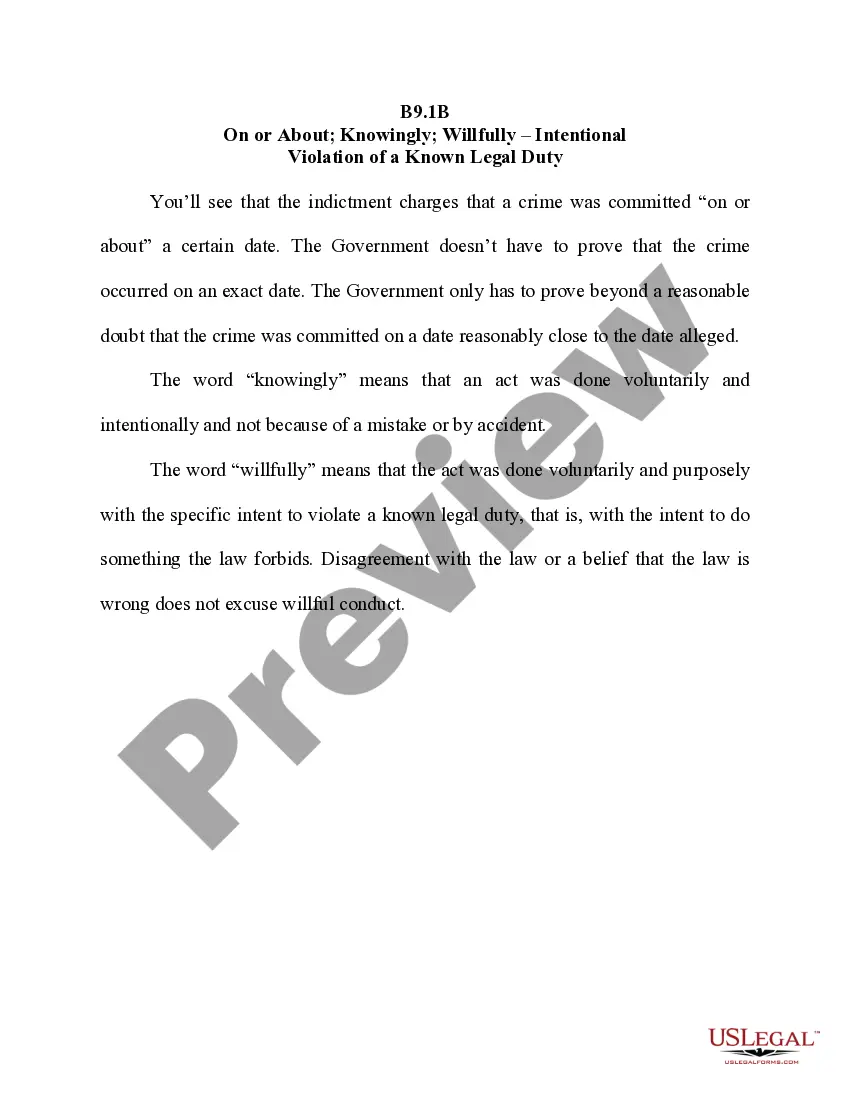
On or About; Knowingly; Willfully - Intentional Violation of a Known Legal Duty
What is this form?
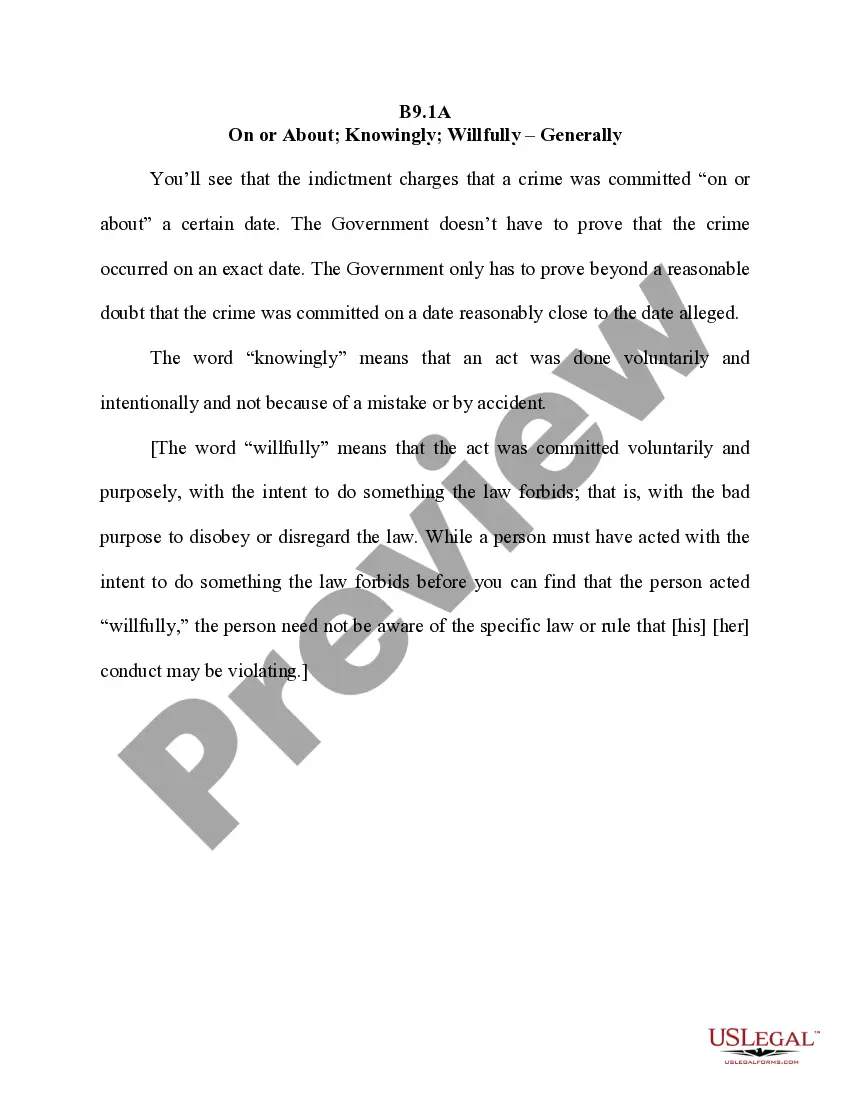
This form outlines the legal framework for determining an intentional violation of a known legal duty. It is used primarily in criminal law to guide juries in assessing whether an act was committed knowingly and willfully. This document assists in establishing the necessary proof for an indictment related to specific offenses.
What’s included in this form
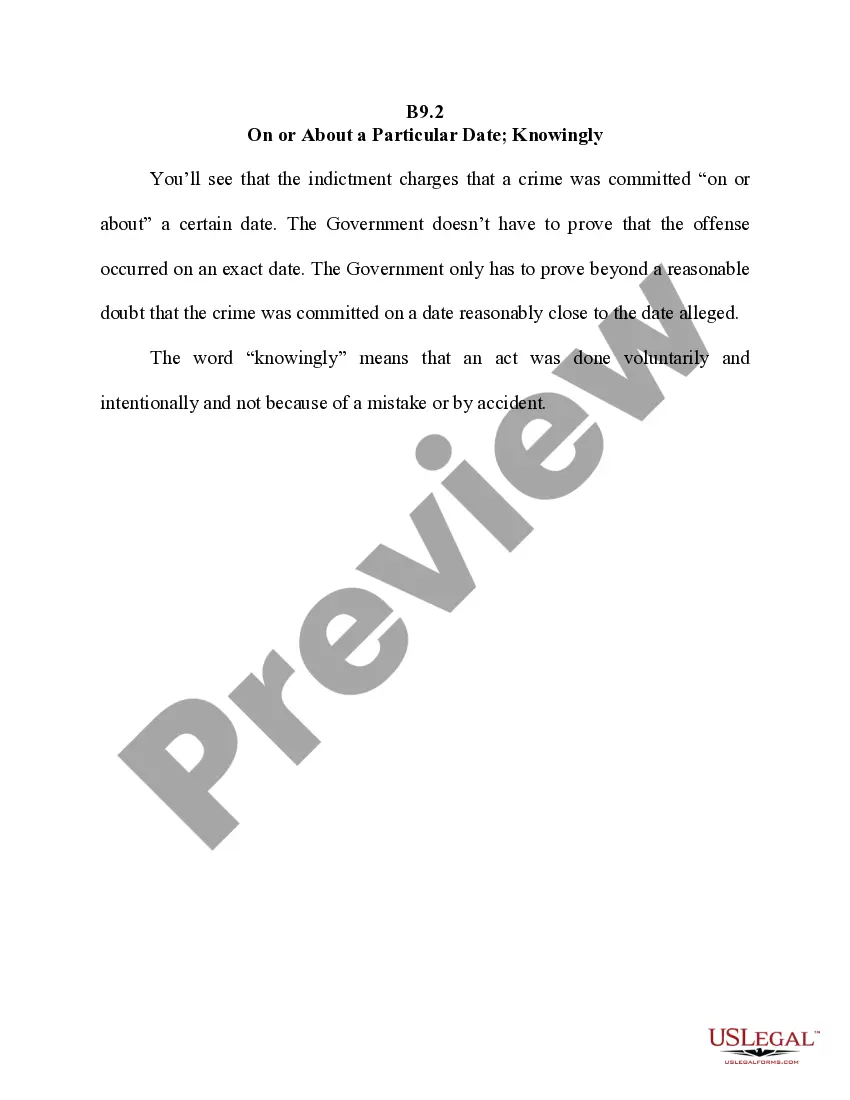
- Definition of "on or about": Clarifies that an exact date is not required, but a close approximation is sufficient.
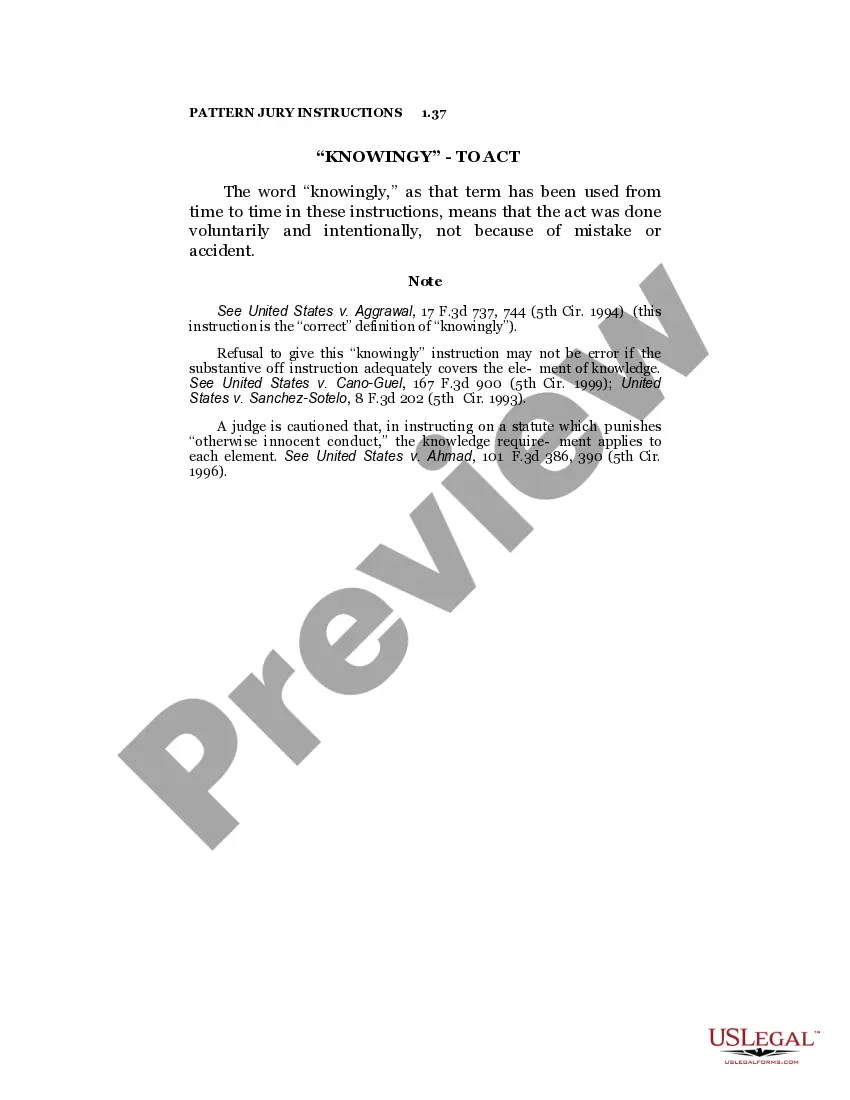
- Meaning of "knowingly": Specifies that the act must be done intentionally, not accidentally.
- Meaning of "willfully": Indicates that the act must have the intent to violate a known legal duty.
- Emphasis on intent: Helps juries understand the emotional and cognitive aspects behind the defendant's actions.
When to use this form
This form is essential when a legal case involves an indictment for committing a crime with a willful disregard of the law. It is particularly relevant in scenarios where the accused's knowledge and intention are critical factors, such as fraud cases or violations of regulatory statutes.
Who should use this form
- Legal professionals preparing for criminal trials.
- Prosecutors requiring a standard instructional model for jury guidance.
- Defense attorneys looking to understand the prosecutorial burden of proof related to intent.
- Students or individuals studying criminal law seeking clarity on jury instructions.
Instructions for completing this form
- Identify the charges: Clearly state the nature of the violation being addressed.
- Establish the timeline: Specify the approximate date of the alleged crime.
- Define "knowingly": Articulate what constitutes intentional action in the context of the case.
- Clarify "willfully": Explain the defendant's intent and recognition of their legal duty.
- Prepare for jury instruction: Ensure that all elements meet the requirements for jury evaluation.
Does this document require notarization?
Notarization is generally not required for this form. However, certain states or situations might demand it. You can complete notarization online through US Legal Forms, powered by Notarize, using a verified video call available anytime.
Get your form ready online
Our built-in tools help you complete, sign, share, and store your documents in one place.
Make edits, fill in missing information, and update formatting in US Legal Forms—just like you would in MS Word.
Download a copy, print it, send it by email, or mail it via USPS—whatever works best for your next step.
Sign and collect signatures with our SignNow integration. Send to multiple recipients, set reminders, and more. Go Premium to unlock E-Sign.
If this form requires notarization, complete it online through a secure video call—no need to meet a notary in person or wait for an appointment.
We protect your documents and personal data by following strict security and privacy standards.

Make edits, fill in missing information, and update formatting in US Legal Forms—just like you would in MS Word.

Download a copy, print it, send it by email, or mail it via USPS—whatever works best for your next step.

Sign and collect signatures with our SignNow integration. Send to multiple recipients, set reminders, and more. Go Premium to unlock E-Sign.

If this form requires notarization, complete it online through a secure video call—no need to meet a notary in person or wait for an appointment.

We protect your documents and personal data by following strict security and privacy standards.
Avoid these common issues
- Failing to provide a precise timeframe, leading to confusion about the charges.
- Neglecting to clarify the distinction between "knowingly" and "willfully."
- Using overly complex language that jurors may find difficult to understand.
Advantages of online completion
- Convenience of downloading forms directly for immediate use.
- Editability allows for customization to meet specific case needs.
- Access to forms drafted by licensed attorneys ensuring legal reliability.
Legal use & context
- Important for cases where the intent behind actions needs thorough evaluation.
- Utilized in criminal proceedings to guide jury decision-making processes.
- Helps establish legal principles that differentiate between various degrees of culpability.
What to keep in mind
- This form clarifies the meaning of "knowingly" and "willfully" in legal terms.
- It is crucial for constructing jury instructions in criminal cases.
- Understanding how to complete this form is essential for legal practitioners involved in serious offenses.
Looking for another form?


Form popularity
FAQ
Purposely is similar to specific intent to cause a particular result. Knowingly is awareness that results are practically certain to occur.
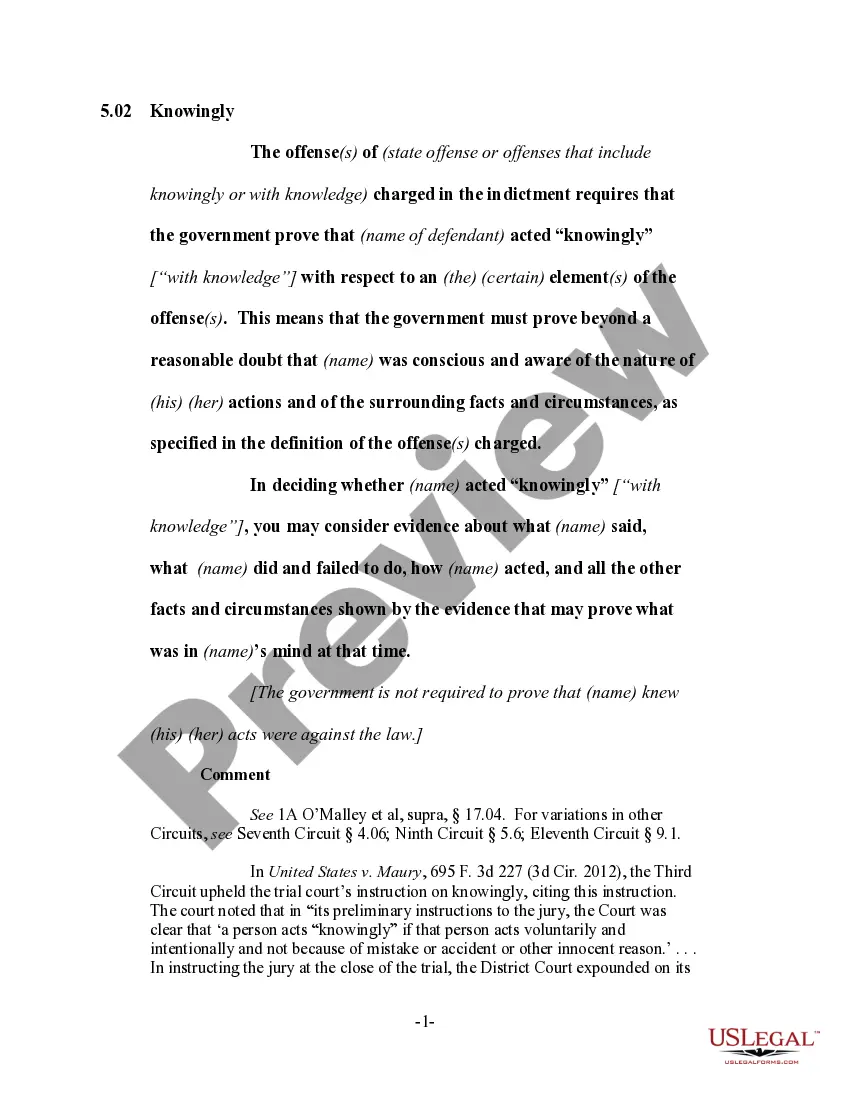
The important difference between willfully as defined in this instruction and the most frequently used definition of knowingly, as stated in Instruction 5.02, is that willfully requires proof beyond a reasonable doubt that the defendant knew his or her conduct was unlawful and intended to do something that 16 Page 17
Black's Law Dictionary defines ?knowingly? as ?with knowledge; consciously; intelligently; willfully; inten- tionally. An individual acts 'knowingly' when he acts with awareness of the nature of his conduct.?
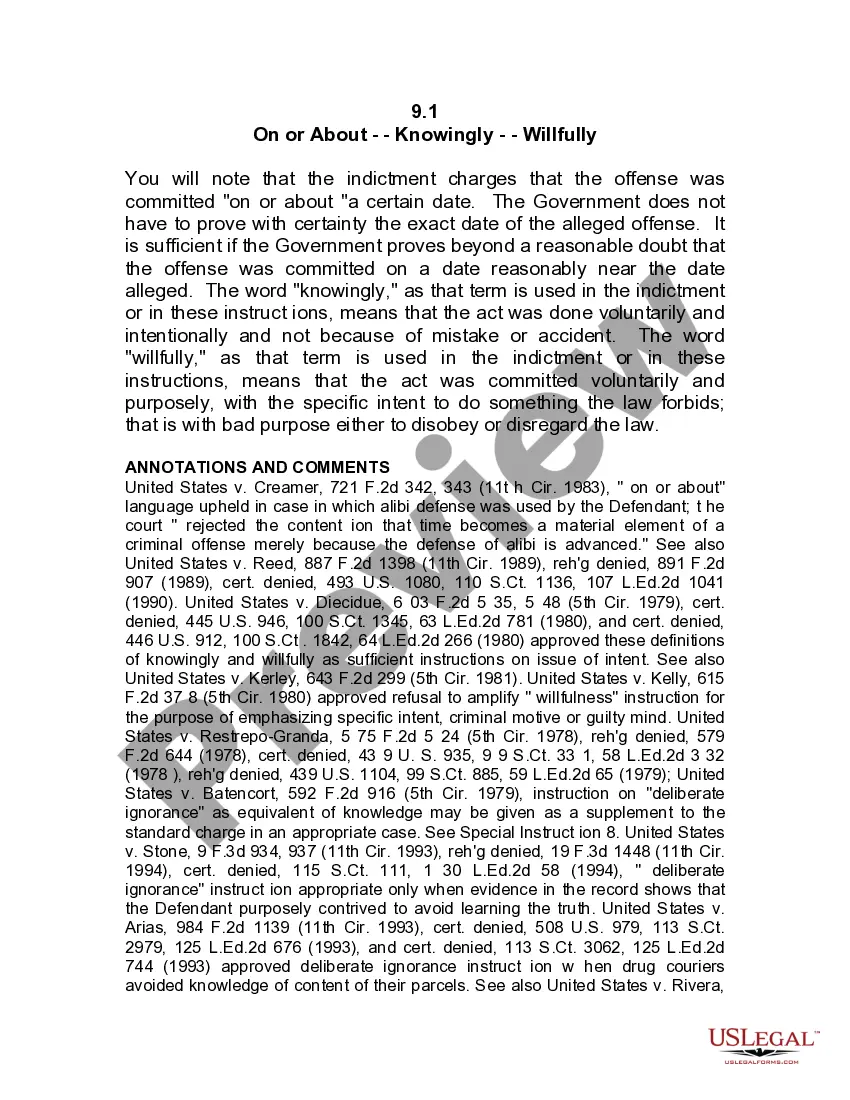
The word "knowingly," as that term has been used from time to time in these instructions, means that the act was done voluntarily and intentionally and not because of mistake or accident.
A person acts ?knowingly? when he is aware that his conduct is of a particular nature or knows that his conduct will cause a particular result. A person acts recklessly when he knows of an unjustifiable risk and consciously disregards it.
Willful. Black's Law Dictionary: 2nd Edition. Definition: Proceeding from a conscious motion of the will; intending the result which actually comes to pass; designed; intentional ; malicious.
The term knowingly, with respect to conduct, a circumstance, or a result, means that a person has actual knowledge, or should have known, of the conduct, the circumstance, or the result.
§ 1001 requires that the false statement, concealment or cover up be "knowingly and willfully" done, which means that "The statement must have been made with an intent to deceive, a design to induce belief in the falsity or to mislead, but § 1001 does not require an intent to defraud -- that is, the intent to deprive