Rhode Island Warranty Deed for Husband and Wife Converting Property from Tenants in Common to Joint Tenancy
Understanding this form
The Warranty Deed for Husband and Wife Converting Property from Tenants in Common to Joint Tenancy is a legal document that allows a married couple, currently holding property as tenants in common, to convert their ownership to joint tenancy. This form ensures that both spouses have equal rights to the property, simplifying transfer of ownership upon the death of one spouse. This is important as it facilitates the seamless transfer of property assets without the need for probate, distinguishing it from other types of deeds that do not address joint tenancy specifically.
Key components of this form
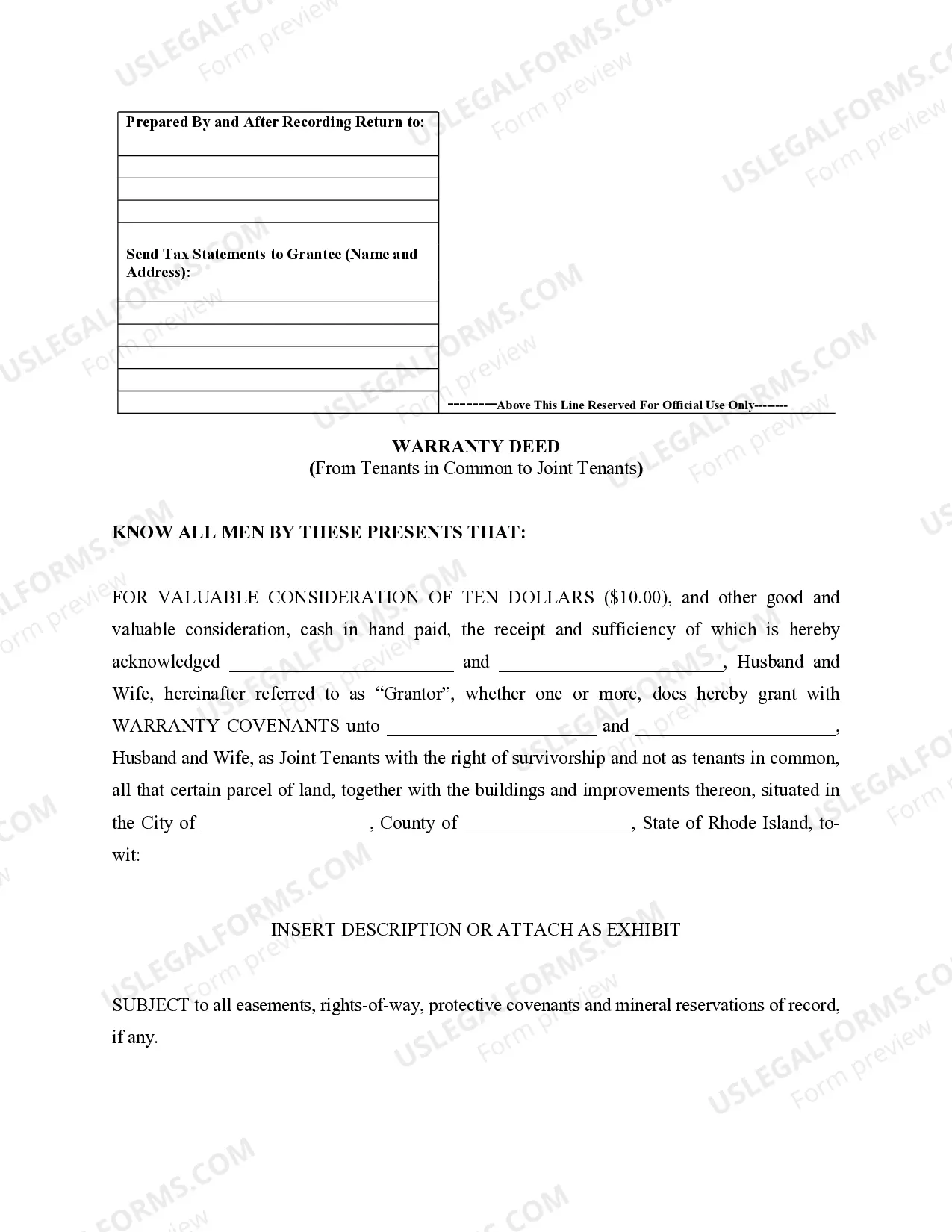
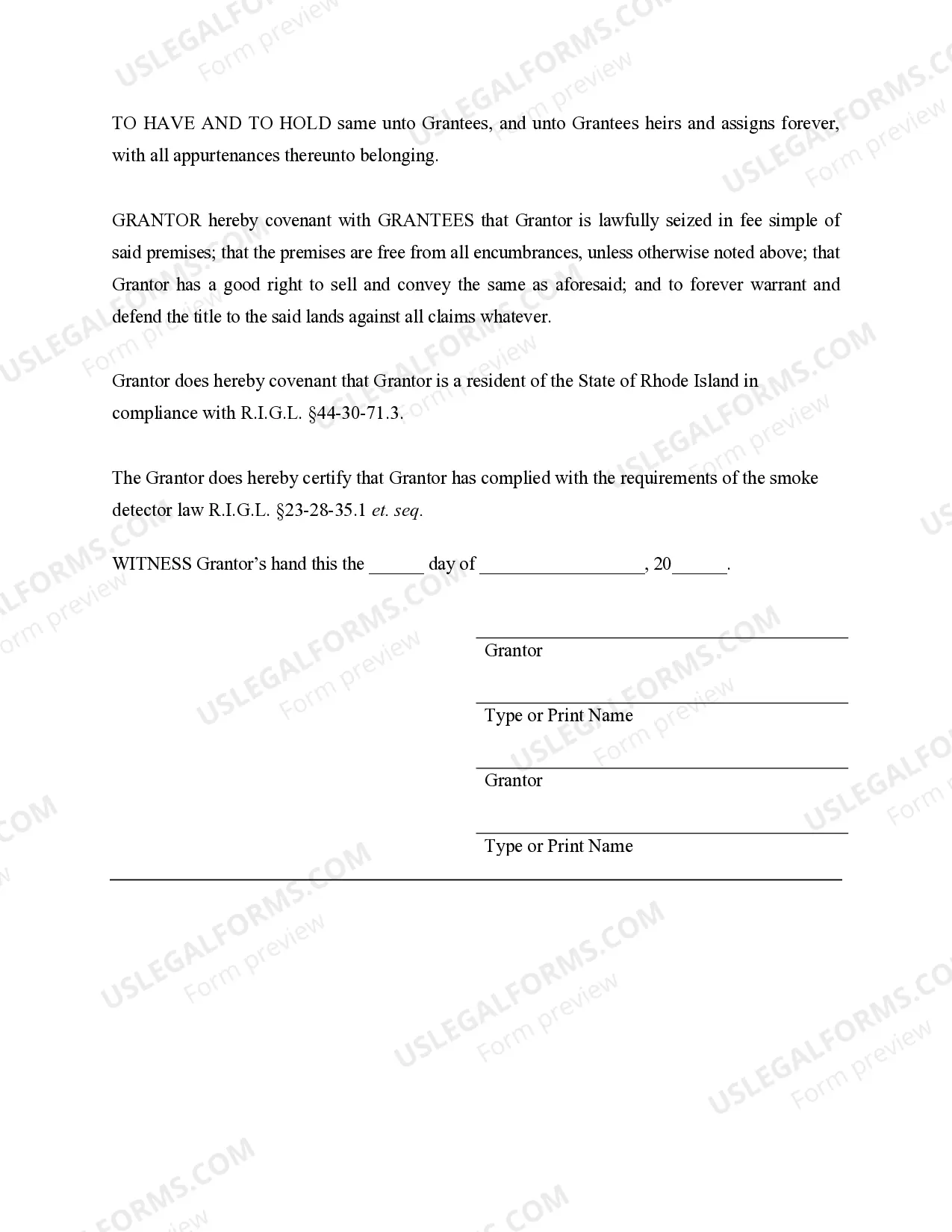
- Identification of the grantors (husband and wife) and the grantees.
- Description of the property being conveyed.
- Legal assurances regarding the grantors' ownership and freedom from encumbrances.
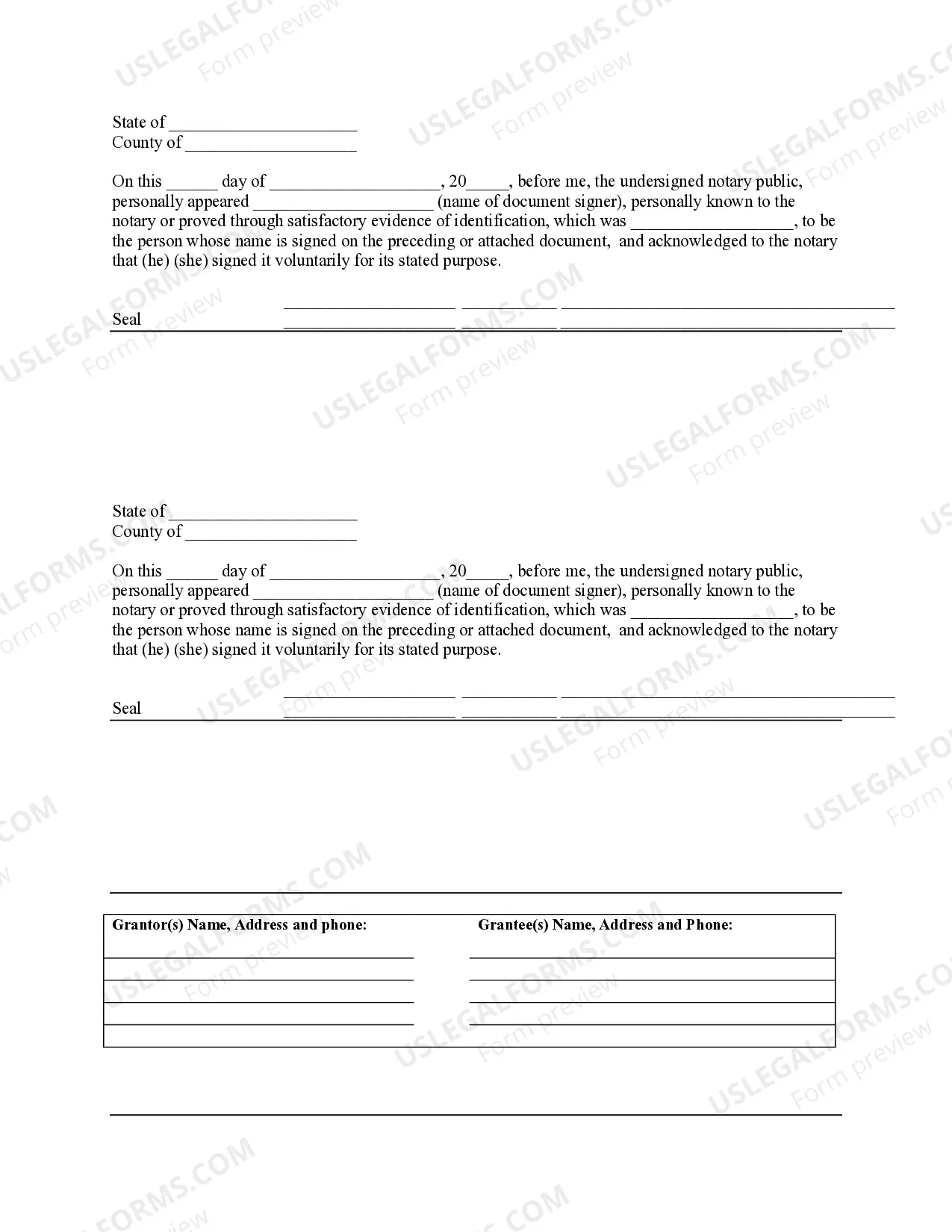
- Signatures of grantors indicating their consent to the transfer.
- Provision for notarization to validate the deed.





Situations where this form applies
This form should be used when a married couple who owns property as tenants in common wishes to change their ownership status to joint tenants. This situation may arise in the context of estate planning or when a couple decides to consolidate their property rights for ease of transfer in the event of death.
Who should use this form
This form is intended for:
- Married couples who currently own property as tenants in common.
- Individuals wishing to convert their property ownership status to simplify estate planning.
- Couples looking to ensure property passes directly to the surviving spouse without probate complications.
Instructions for completing this form
- Identify the parties involved by entering the names of the grantors (husband and wife).
- Specify the property being converted by providing a detailed description.
- Review the legal assurances and ensure all information matches ownership records.
- Obtain signatures from both grantors indicating their agreement to the transfer.
- Ensure notarization of the document for it to be legally valid.
Does this document require notarization?
This form needs to be notarized to ensure legal validity. US Legal Forms provides secure online notarization powered by Notarize, allowing you to complete the process through a verified video call, available anytime.
Get your form ready online
Our built-in tools help you complete, sign, share, and store your documents in one place.
Make edits, fill in missing information, and update formatting in US Legal Forms—just like you would in MS Word.
Download a copy, print it, send it by email, or mail it via USPS—whatever works best for your next step.
Sign and collect signatures with our SignNow integration. Send to multiple recipients, set reminders, and more. Go Premium to unlock E-Sign.
If this form requires notarization, complete it online through a secure video call—no need to meet a notary in person or wait for an appointment.
We protect your documents and personal data by following strict security and privacy standards.

Make edits, fill in missing information, and update formatting in US Legal Forms—just like you would in MS Word.

Download a copy, print it, send it by email, or mail it via USPS—whatever works best for your next step.

Sign and collect signatures with our SignNow integration. Send to multiple recipients, set reminders, and more. Go Premium to unlock E-Sign.

If this form requires notarization, complete it online through a secure video call—no need to meet a notary in person or wait for an appointment.

We protect your documents and personal data by following strict security and privacy standards.
Avoid these common issues
- Failing to accurately describe the property being conveyed.
- Not obtaining the necessary signatures from both grantors.
- Omitting notarization, which could invalidate the deed.
- Not consulting local laws that may affect the transfer.
Benefits of using this form online
- Convenience of downloading and completing the form at your own pace.
- Editability allows you to update details as needed before finalizing.
- Access to a reliable form reviewed by licensed attorneys for accuracy.
- Protected structure to ensure you do not miss filling critical information.
Main things to remember
- The Warranty Deed enables married couples to convert property ownership from tenants in common to joint tenants.
- This legal form can simplify estate transfer upon death, avoiding probate.
- Proper completion includes accurate property description, necessary signatures, and notarization.
- Consulting local laws is vital to ensure compliance during property transfers.
Looking for another form?


Form popularity
FAQ
Joint tenants with right of survivorship means that you both own the property equally, and if one dies, the property is then owned by the survivor. Tenants in common means that you each own the whole property, but there is no right of survivorship with this type of tenancy.
When joint tenants have right of survivorship, it means that the property shares of one co-tenant are transferred directly to the surviving co-tenant (or co-tenants) upon their death. While ownership of the property is shared equally in life, the living owners gain total ownership of any deceased co-owners' shares.
Survivorship rights take precedence over any contrary terms in a person's will because property subject to rights of survivorship is not legally part of their estate at death and so cannot be distributed through a will.
Danger #1: Only delays probate. Danger #2: Probate when both owners die together. Danger #3: Unintentional disinheriting. Danger #4: Gift taxes. Danger #5: Loss of income tax benefits. Danger #6: Right to sell or encumber. Danger #7: Financial problems.
Since the joint tenants have equal interest, the property cannot be sold without all parties' consent. Instead of selling, a joint tenant can choose to transfer their interest to another party. When interest is transferred, the new party may not enter the joint tenancy.
One of the main differences between the two types of shared ownership is what happens to the property when one of the owners dies. When a property is owned by joint tenants with survivorship, the interest of a deceased owner automatically gets transferred to the remaining surviving owners.
For one, if property is held in tenancy by the entirety, neither spouse can transfer his or her half of the property alone, either while alive or by will or trust. It must go to the surviving spouse. This is different from joint tenancy; a joint tenant is free to break the joint tenancy at any time.
Deeper definitionTenancy by the entirety describes a married couple that jointly owns real estate as one legal entity. Tenancy by the entirety can only be created by spouses.Tenancy by the entirety assumes rights of survivorship for when one spouse dies, similar to a joint tenancy with rights of survivorship.
While the joint tenant with right of survivorship can't will his share in the property to his heir, he can sell his interest in the property before his death. Once a joint tenant sells his share, this ends the joint tenancy ownership involving the share.