Deed Conveying Property held by Spouses as Tenants in Common to Husband and Wife as Community Property
What this document covers
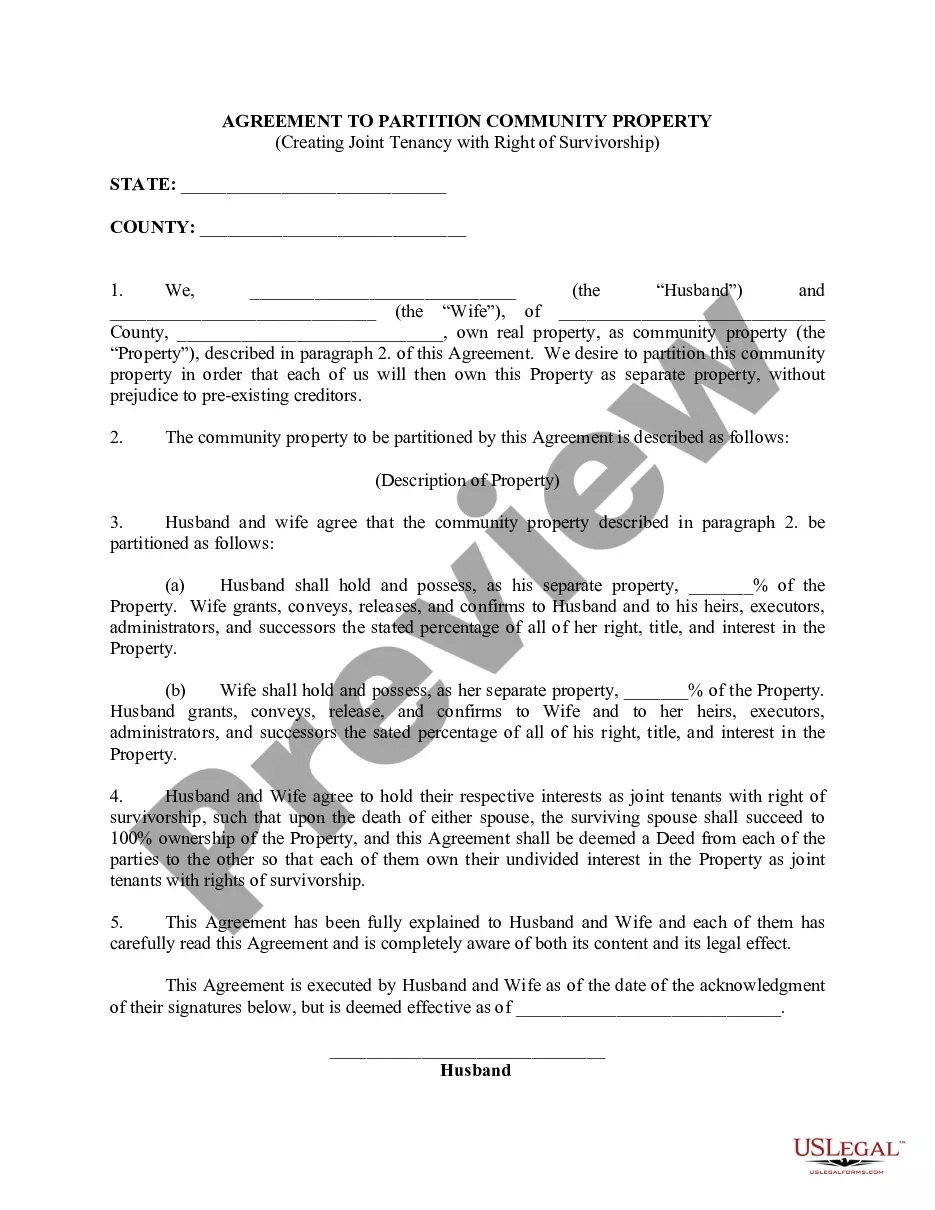
The Deed Conveying Property held by Spouses as Tenants in Common to Husband and Wife as Community Property is a legal document used to transfer ownership of real property from spouses who share tenancy in common to joint ownership as community property. This transition is important for couples in certain states where community property laws apply, differentiating it from other property ownership arrangements. It helps clarify the joint ownership status of the property, especially in the context of marital assets during a divorce or inheritance situations.
Key parts of this document
- Name of Husband and Wife as Grantors.
- Names of Husband and Wife as Grantees.
- Description of the real property being conveyed.
- Signature and printed names of both spouses.
- Acknowledgment section for the Notary Public.
- Date of the conveyance.

Common use cases
This form is typically used when a married couple wishes to change the legal ownership of their property from tenants in common to community property. This situation may arise if they want to clarify their shared ownership or prepare for future legal considerations such as divorce or inheritance proceedings. It is most relevant in jurisdictions where community property laws are in effect.
Intended users of this form
- Married couples who own property as tenants in common.
- Couples residing in community property states.
- Individuals seeking to ensure their property reflects community ownership status.
- Anyone interested in understanding property ownership terms during marriage.
Completing this form step by step
- Identify the full names of both spouses as Grantors.
- Enter the names of the husband and wife as Grantees.
- Provide the complete legal description of the property specified.
- Fill in the current date when the deed is executed.
- Both spouses should sign and provide their printed names.
- Complete and sign the acknowledgment section in front of a Notary Public.
Does this document require notarization?
Yes, this form must be notarized to be legally valid. This will ensure that the identities of the signers are verified, enhancing the document's enforceability. US Legal Forms offers an integrated online notarization service available 24/7, providing a secure video call environment to complete the notarization process without the need for travel.
Get your form ready online
Our built-in tools help you complete, sign, share, and store your documents in one place.
Make edits, fill in missing information, and update formatting in US Legal Forms—just like you would in MS Word.
Download a copy, print it, send it by email, or mail it via USPS—whatever works best for your next step.
Sign and collect signatures with our SignNow integration. Send to multiple recipients, set reminders, and more. Go Premium to unlock E-Sign.
If this form requires notarization, complete it online through a secure video call—no need to meet a notary in person or wait for an appointment.
We protect your documents and personal data by following strict security and privacy standards.

Make edits, fill in missing information, and update formatting in US Legal Forms—just like you would in MS Word.

Download a copy, print it, send it by email, or mail it via USPS—whatever works best for your next step.

Sign and collect signatures with our SignNow integration. Send to multiple recipients, set reminders, and more. Go Premium to unlock E-Sign.

If this form requires notarization, complete it online through a secure video call—no need to meet a notary in person or wait for an appointment.

We protect your documents and personal data by following strict security and privacy standards.
Avoid these common issues
- Forgetting to include the legal description of the property.
- Not providing signatures of both spouses.
- Failing to have the form notarized, if required by state law.
- Using incorrect or outdated language for the deed.
Main things to remember
- The form is essential for transferring property from tenants in common to community property.
- It must be completed accurately to reflect ownership rights between spouses.
- Consultation with local laws is crucial to meet specific state requirements.
- Notarization is typically required for the form to be considered valid.
Looking for another form?
Form popularity
FAQ
In California, all property bought during the marriage with income that was earned during the marriage is deemed "community property." The law implies that both spouses own this property equally, regardless of which name is on the title deed.
The Title Register Document will show the names of the people that own the property and, if you are tenants in common will also have wording similar to: "No disposition by a sole proprietor of the registered estate (except a trust corporation) under which capital money arises is to be registered unless authorised by an
If a home is owned by only one person then it is not registered with the Land Registry as either Joint Tenants or Tenants in Common. It is registered as a Sole Owner, you can only be a joint tenant or tenant in common if there is more than one owner of the property.
Look on the deed itself. If after the owner's names it reads as "Tenants in Common" then that's what it is; if there is no notation the law will presume that it is as tenants in common.
You can change from being either: joint tenants to tenants in common, for example if you divorce or separate and want to leave your share of the property to someone else. tenants in common to joint tenants, for example if you get married and want to have equal rights to the whole property.
The Title Register Document will show the names of the people that own the property and, if you are tenants in common will also have wording similar to: "No disposition by a sole proprietor of the registered estate (except a trust corporation) under which capital money arises is to be registered unless authorised by an
California married couples generally have three options to take title to their community (vs separate) property real estate: community property, joint tenancy or Community Property with Right of Survivorship. The latter coming into play in California July of 2001.
The most common of these methods of title holding are: Joint tenancy. Tenancy in common. Tenants by entirety.
' Spouses typically acquire title as tenants by the entireties, which only applies to spouses. Sometimes you will see a couple who acquired the property before marriage. In some states, a pre-marital joint tenancy automatically becomes tenants by the entireties upon marriage.