Nevada Paving Contractor Package
About this form package
The Nevada Paving Contractor Package is a comprehensive set of legal documents specifically designed for paving contractors, owners, suppliers, and subcontractors involved in the installation, creation, or maintenance of paved surfaces on residential properties. This package not only enables users to assert their legal rights but also addresses essential legal issues that may arise during such projects. The centerpiece of this package is a paving contract that complies with Nevada state law, ensuring that all aspects of the contract are legally sound and enforceable.
Forms you’ll find in this package
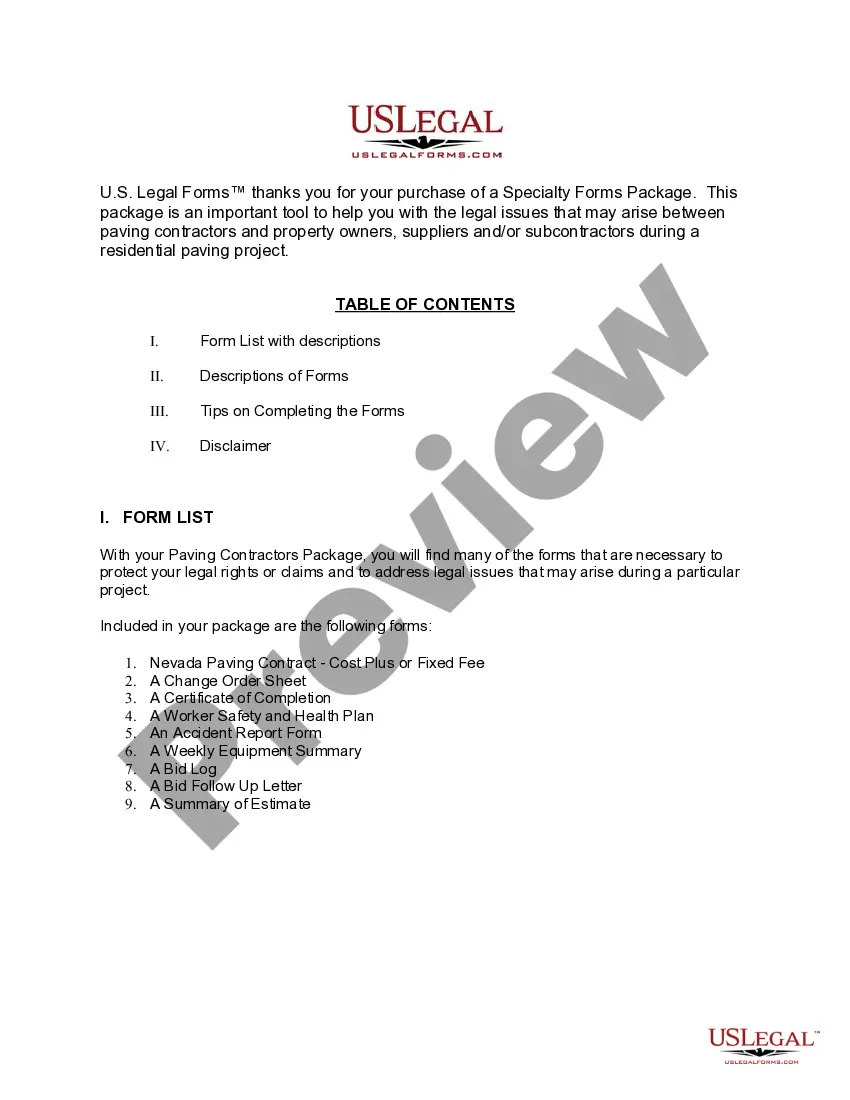
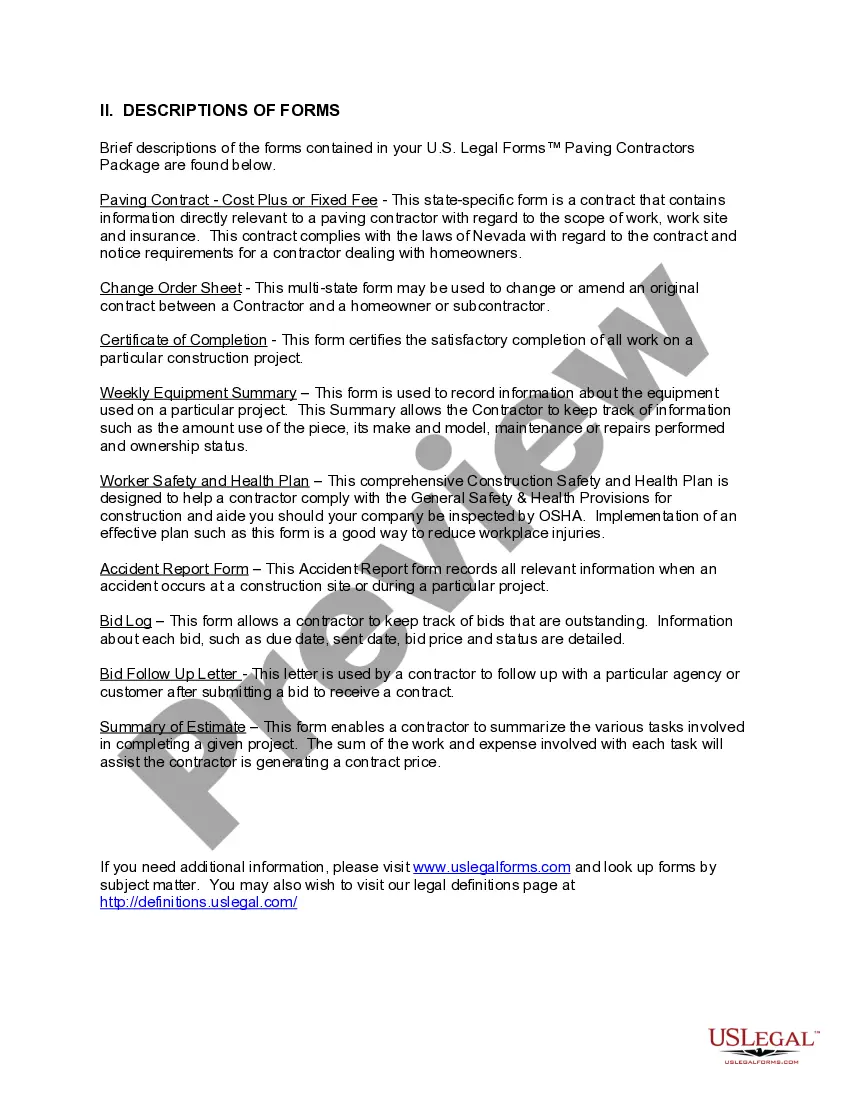
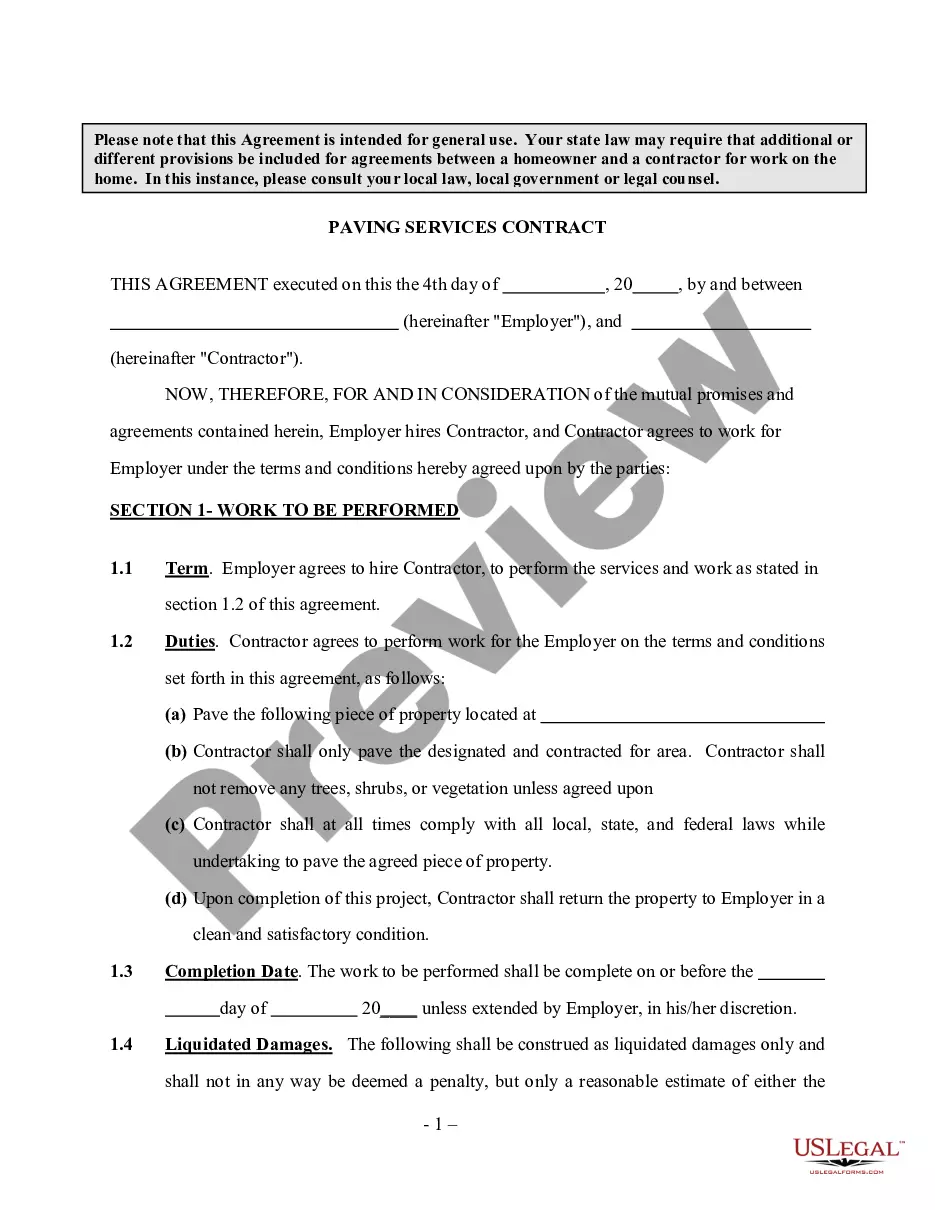
- Paving Contract for Contractor
- Contractor's Weekly Equipment Summary
- Contractor's Bid Log
- Contractor's Bid Follow Up Letter
- Contractor's Summary of an Estimate
- Construction Accident Report
- Construction Safety and Health Plan
- Change Order for Construction or Repairs by Contractor
- Certification of Completion by Contractor
Common use cases
This package is particularly useful in various scenarios such as:
- Entering into a contract with a homeowner or subcontractor for paving services.
- Documenting changes to a project with a change order.
- Certifying project completion with the appropriate certificate.
- Logistically managing bids and project estimates.
- Ensuring workplace safety and compliance with health regulations.
Who should use this form package
- Paving contractors looking for structured legal documentation.
- Property owners hiring paving services for their residential projects.
- Subcontractors involved in paving work seeking to formalize agreements.
- Suppliers providing materials for paving projects requiring legal forms for transactions.
How to prepare this document
- Review all included forms to understand their purpose and requirements.
- Identify the parties involved in the contract and legality of the work.
- Fill in all necessary fields, including dates, names, and descriptions of services.
- Make copies of signed documents for all parties involved.
- Store completed forms in a secure location for future reference.
Do forms in this package need to be notarized?
Notarization is generally not required for forms in this package. However, specific circumstances or local laws may require it. You can complete notarization remotely through US Legal Forms, powered by Notarize, with 24/7 availability.
Get your form ready online
Our built-in tools help you complete, sign, share, and store your documents in one place.
Make edits, fill in missing information, and update formatting in US Legal Forms—just like you would in MS Word.
Download a copy, print it, send it by email, or mail it via USPS—whatever works best for your next step.
Sign and collect signatures with our SignNow integration. Send to multiple recipients, set reminders, and more. Go Premium to unlock E-Sign.
If this form requires notarization, complete it online through a secure video call—no need to meet a notary in person or wait for an appointment.
We protect your documents and personal data by following strict security and privacy standards.

Make edits, fill in missing information, and update formatting in US Legal Forms—just like you would in MS Word.

Download a copy, print it, send it by email, or mail it via USPS—whatever works best for your next step.

Sign and collect signatures with our SignNow integration. Send to multiple recipients, set reminders, and more. Go Premium to unlock E-Sign.

If this form requires notarization, complete it online through a secure video call—no need to meet a notary in person or wait for an appointment.

We protect your documents and personal data by following strict security and privacy standards.
Mistakes to watch out for
- Failing to provide complete information on the forms.
- Not reviewing forms for accuracy before signing.
- Ignoring specific state requirements related to contracts.
- Neglecting to obtain necessary signatures from all parties involved.
Why complete this package online
- Convenience of downloading forms instantly at any time.
- Editability that allows customization of the forms to fit specific project needs.
- Reliability guaranteed by documents drafted with input from licensed attorneys.
Legal use & context
- This package includes legally binding documents that can help enforce agreements between parties in a paving project.
- Failure to use proper documentation can lead to disputes and may limit enforceability of contracts.
- Each form complies with Nevada law, offering appropriate legal protection as needed.
Main things to remember
- The Nevada Paving Contractor Package is essential for legal compliance in paving projects.
- Using this package minimizes risks associated with ambiguities in contracts.
- All forms are designed to be straightforward and cater specifically to paving industry needs.
Looking for another form?
Form popularity
FAQ
You shouldn't pay more than 10 percent of the estimated contract price upfront, according to the Contractors State License Board.
Never pay the full amount up front for your swimming pool. According to the law, you should not pay more than 10% or $1,000; whichever is less, to get your project started.
To receive your contractor's license, you must take and pass the Business and Law exam and the trade exam for your classification of license. You'll schedule your test date after you submit your application and get approval from the Nevada State Contractors Board (NSCB).
In Nevada, you need to apply for a license and prove you have at least 4 years of experience or 3 years of education and a year of experience. There are also a number of fees and forms along the way. Becoming a Nevada licensed contractor requires a considerable commitment of time and money.
A: It's not uncommon for contractors to ask for a down payment up front to secure your spot on their schedule or purchase some of the job materials in advance. Asking for more than half of the project cost up front, though, is a big red flag.I recommend tying payments to progress made during the job.
In addition to the initial $300 application fee, you'll also be required to pay a biennial (every two years) $600 license fee if your application is approved.
Payment Schedule In Your Contract Before any work begins, a contractor will ask a homeowner to secure the job with a down payment. It shouldn't be more than 10-20 percent of the total cost of the job. Homeowners should never pay a contractor more than 10-20% before they've even stepped foot in their home.
The answer is quite simple. If you are performing work over $1,000 or that requires pulling building permits, then you will need a contractor license. Anything under $1,000 that can be considered casual or minor in nature does not require a Contractor License in Nevada.
If the contractor requests a large sum of money before work has begun, Mozen says you should ask specifically what types of work or materials those payments are covering.Contractors sometimes have other motives, other than purchasing materials, when they ask for large amounts of money in advance, Fowler says.