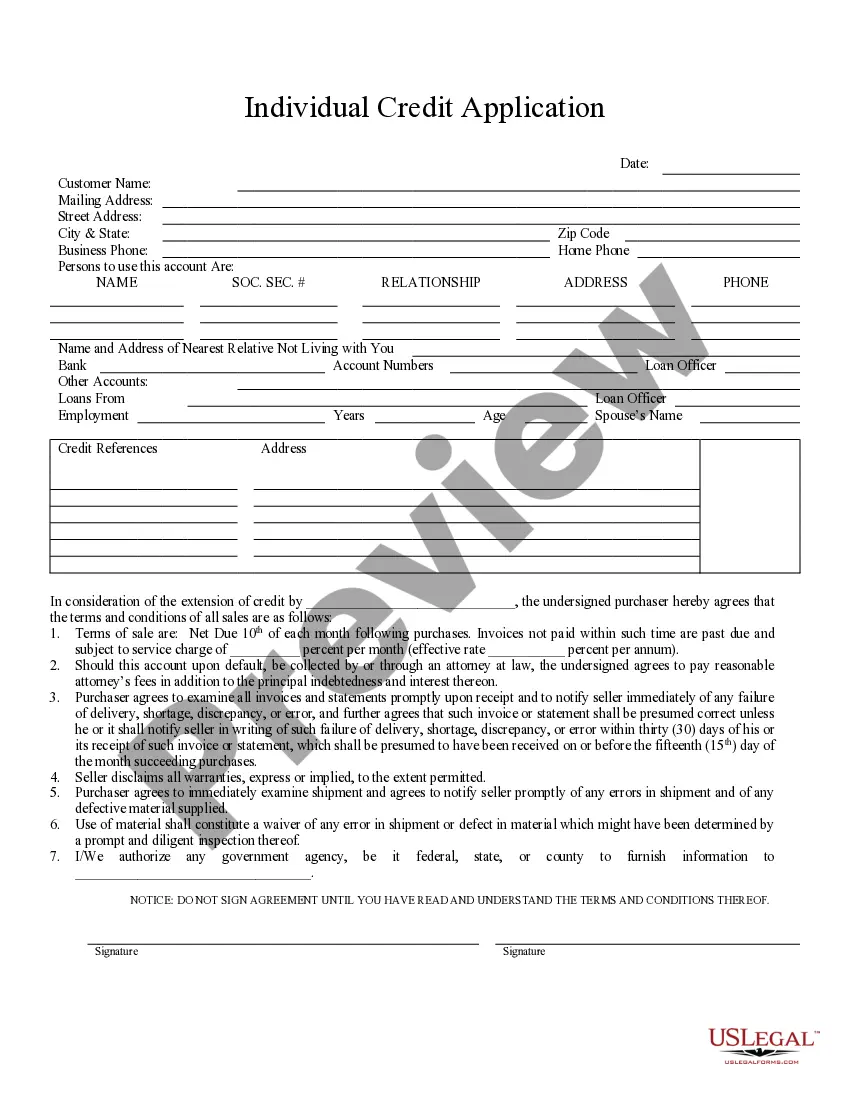
North Carolina Individual Credit Application
What is this form?
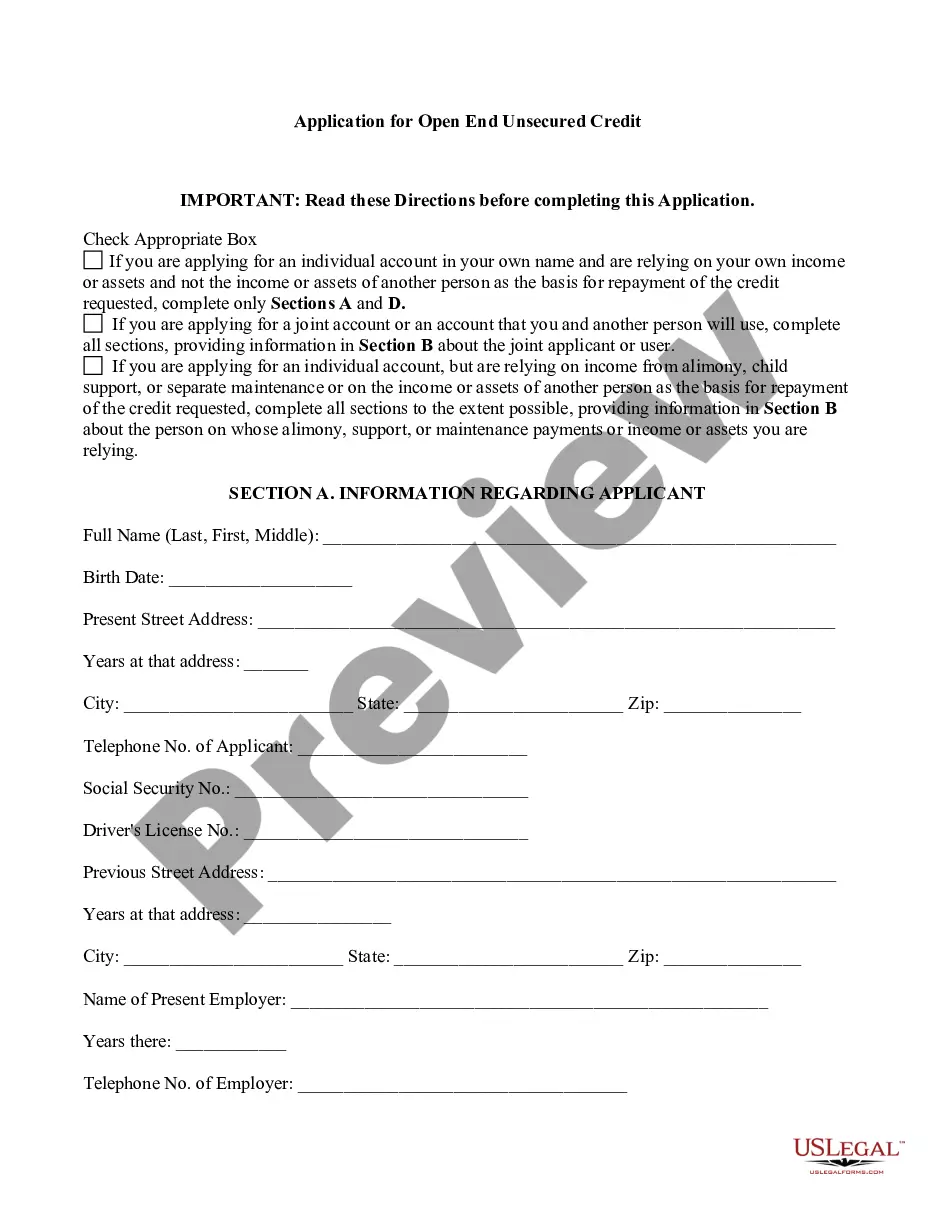
The Individual Credit Application is a legal document used by individuals seeking to obtain credit for personal or business purchases. This application outlines the terms of credit, including repayment obligations, interest rates, and conditions under which the seller can seek personal information from government agencies. It ensures both the buyer and seller understand their rights and responsibilities during the credit process, differing from standard loan applications by focusing specifically on terms related to purchases and defaults.
Key parts of this document
- Credit terms: Details of payment schedules and penalties for late payment.
- Default provisions: Clauses outlining the consequences if the borrower fails to repay.
- Seller disclaimers: Waivers of warranties regarding the quality of goods.
- Personal information authorization: Allows the seller to gather credit history from government sources.
- Examination of invoices: Obligates the purchaser to review and report discrepancies promptly.
- Signatures: Validation of the agreement through signatures of both parties.
When to use this document
This form is useful in various situations, including when an individual wishes to purchase goods on credit from a retailer or supplier. It is particularly relevant for individuals making larger purchases that require financing, such as appliances, vehicles, or construction materials, where an agreement on repayment terms and responsibilities is essential. Using this form can help prevent misunderstandings between buyers and sellers regarding payment obligations and product expectations.
Who can use this document
- Individuals seeking credit for personal or business purchases.
- Retailers or suppliers extending credit to customers.
- Customers with limited credit history who need formal credit arrangements.
- Buyers who wish to clarify terms of payment and liability in a credit sale.
Instructions for completing this form
- Enter the name of the seller extending credit.
- Specify the terms of payment, including due dates and interest rates.
- Provide personal information and authorize the seller to access relevant credit history.
- Review the invoice terms and ensure you understand the obligations.
- Sign and date the application to finalize the agreement.
Does this form need to be notarized?
This form usually doesn’t need to be notarized. However, local laws or specific transactions may require it. Our online notarization service, powered by Notarize, lets you complete it remotely through a secure video session, available 24/7.
Get your form ready online
Our built-in tools help you complete, sign, share, and store your documents in one place.
Make edits, fill in missing information, and update formatting in US Legal Forms—just like you would in MS Word.
Download a copy, print it, send it by email, or mail it via USPS—whatever works best for your next step.
Sign and collect signatures with our SignNow integration. Send to multiple recipients, set reminders, and more. Go Premium to unlock E-Sign.
If this form requires notarization, complete it online through a secure video call—no need to meet a notary in person or wait for an appointment.
We protect your documents and personal data by following strict security and privacy standards.
Make edits, fill in missing information, and update formatting in US Legal Forms—just like you would in MS Word.
Download a copy, print it, send it by email, or mail it via USPS—whatever works best for your next step.
Sign and collect signatures with our SignNow integration. Send to multiple recipients, set reminders, and more. Go Premium to unlock E-Sign.

If this form requires notarization, complete it online through a secure video call—no need to meet a notary in person or wait for an appointment.
We protect your documents and personal data by following strict security and privacy standards.
Common mistakes to avoid
- Not reviewing the terms of the agreement thoroughly before signing.
- Failing to notify the seller of any discrepancies in invoices within the required timeframe.
- Ignoring the implications of the default provisions and potential fees.
- Leaving out necessary personal information for credit checks.
Why complete this form online
- Immediate access to professionally drafted legal templates.
- Convenient download options for easy completion.
- Ability to customize the form to fit specific credit agreements.
- Secure storage of completed forms for future reference.
Legal use & context
- The Individual Credit Application is legally binding once both parties have signed it.
- It provides a framework for the seller to collect outstanding debts legally.
- Consumers should ensure the agreement complies with their state's consumer protection laws.
Quick recap
- The Individual Credit Application is essential for defining credit terms between buyers and sellers.
- Know the obligations you are agreeing to before signing the document.
- Always review invoices and report issues promptly within thirty days.
- This form helps prevent disputes by clarifying expectations from the outset.
Looking for another form?
Form popularity
FAQ
The extra credit grant is a $335 payment to you from the State of North Carolina.The payment is to help families with qualifying children in North Carolina by providing economic support to assist with virtual schooling and child-care costs during the COVID-19 pandemic.
A fiduciary required to pay an income tax to North Carolina for a trust for which he acts may claim a credit for tax imposed and paid to another state or country on income from sources within that state or country under the provisions of G.S. § 105-160.4(a).
Pay individual income tax. Pay a balance due on your Individual Income Tax Return for the current tax year, and prior years through tax year 2003.
Yes, you should include it as income on your federal return. (Whether the grant is included in federal gross income is determined under federal law. Generally, however, all income is taxable for federal tax purposes unless specifically exempted by federal law.)
North Carolina families with qualifying children who were 16 or younger at the end of 2019 who did not already receive the $335 check from the NC Department of Revenue. Qualifying individuals who were not required to file a 2019 state tax return and have NOT already received the $335 grant.
Use Form NC-1105 to apply for the payment authorized under the Extra Credit Grant Program if you did not file a 2019 North Carolina individual income tax return, Form D-400, solely because your gross income (and your spouse's gross income, if applicable) for 2019 did not exceed the State's filing requirement for your
To grant credit to someone is to trust that person and to take a risk in handing over a sum of money or goods, on the undertaking that the sum of money or goods will be repaid by a certain date plus an additional amount (of money or goods), called interest.