Access Control Easement
What this document covers
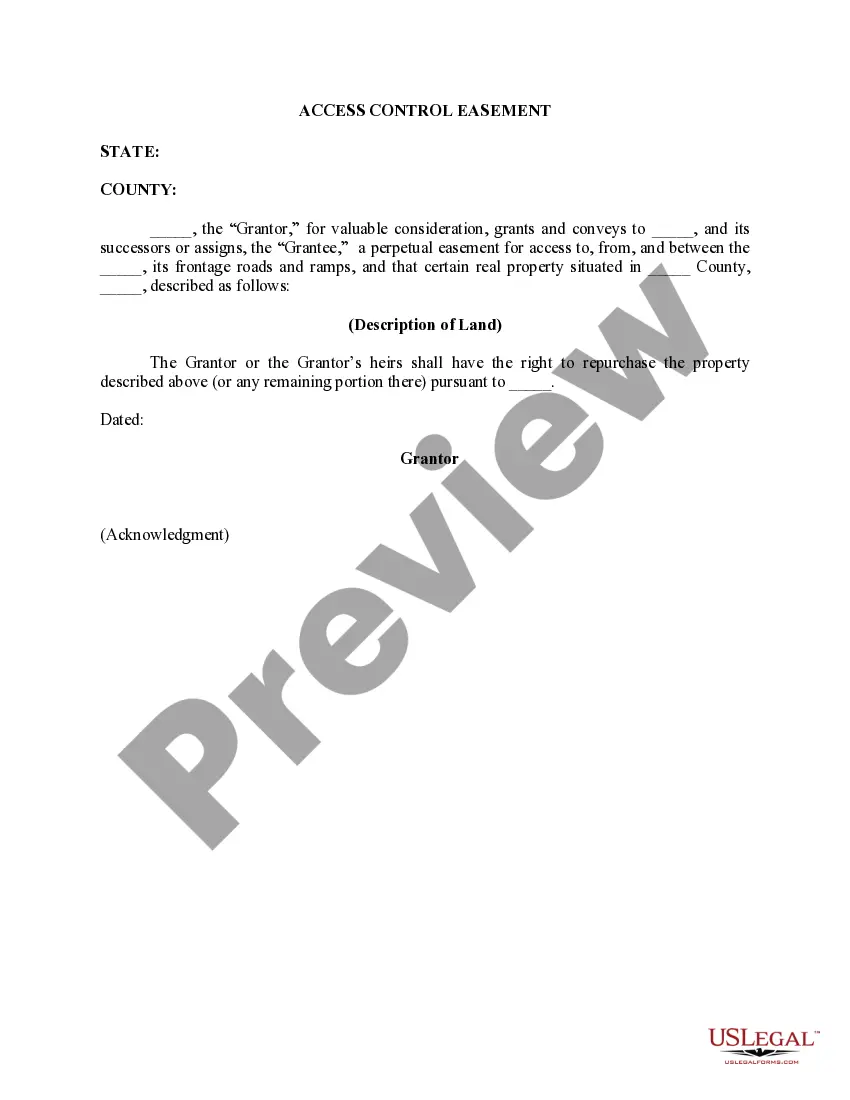
The Access Control Easement form is a legal document that grants a perpetual easement to a grantee, allowing access to specific property and its surrounding roads. This type of easement is used to ensure that the grantee can access their property, differentiating itself from other easements, such as utility easements, as it focuses specifically on access control. This form establishes the rights of the parties involved and outlines the terms for its use, making it an essential tool for property owners and developers.
What’s included in this form
- Identification of the Grantor and Grantee, including their legal names.
- Description of the property involved in the easement.
- Details regarding the terms of access, including frontage roads and ramps.
- Provision for the Grantor's rights to repurchase the property.
- Signature section for the Grantor to indicate consent and acknowledgment.
When this form is needed
This form should be used when a property owner wants to grant another party access to their property through designated routes. It is particularly necessary in situations where access routes are not immediately apparent, such as in developments where access roads are shared or in cases where property lines require formal recognition for legal access. This can occur in residential, commercial, or industrial property situations when establishing clear access rights is essential for operations or property value.
Who this form is for
This form is meant for:
- Property owners (Grantors) who wish to grant access to another party.
- Individuals or entities (Grantees) who need legal access to a parcel of land.
- Real estate developers involved in planning and constructing properties.
- Attorneys or legal representatives drafting easement agreements on behalf of clients.
Instructions for completing this form
- Identify the parties involved by entering the Grantor's and Grantee's legal names.
- Clearly describe the property to which access is being granted, noting any relevant details.
- Specify the terms of access, including routes and any restrictions.
- Fill in the date of the agreement and provide a section for signatures.
- Consider including a clause regarding the Grantor's rights to repurchase.
Notarization requirements for this form
This form does not typically require notarization unless specified by local law. However, notarization could enhance the legality and credibility of the document in certain cases, so it is advisable to verify your local requirements.
Get your form ready online
Our built-in tools help you complete, sign, share, and store your documents in one place.
Make edits, fill in missing information, and update formatting in US Legal Forms—just like you would in MS Word.
Download a copy, print it, send it by email, or mail it via USPS—whatever works best for your next step.
Sign and collect signatures with our SignNow integration. Send to multiple recipients, set reminders, and more. Go Premium to unlock E-Sign.
If this form requires notarization, complete it online through a secure video call—no need to meet a notary in person or wait for an appointment.
We protect your documents and personal data by following strict security and privacy standards.

Make edits, fill in missing information, and update formatting in US Legal Forms—just like you would in MS Word.

Download a copy, print it, send it by email, or mail it via USPS—whatever works best for your next step.

Sign and collect signatures with our SignNow integration. Send to multiple recipients, set reminders, and more. Go Premium to unlock E-Sign.

If this form requires notarization, complete it online through a secure video call—no need to meet a notary in person or wait for an appointment.

We protect your documents and personal data by following strict security and privacy standards.
Typical mistakes to avoid
- Failing to accurately describe the property involved can lead to misunderstandings.
- Not defining the terms of access clearly, which can result in disputes later.
- Neglecting to obtain all necessary signatures, which can invalidate the form.
- Overlooking the inclusion of a clause regarding repurchase rights, if applicable.
Why use this form online
- Convenience: Access the form anytime and from anywhere without the need for in-person visits.
- Editability: Easily customize the form to reflect specific terms and conditions.
- Reliability: Ensure you are using an up-to-date form created by licensed attorneys.
Looking for another form?


Form popularity
FAQ
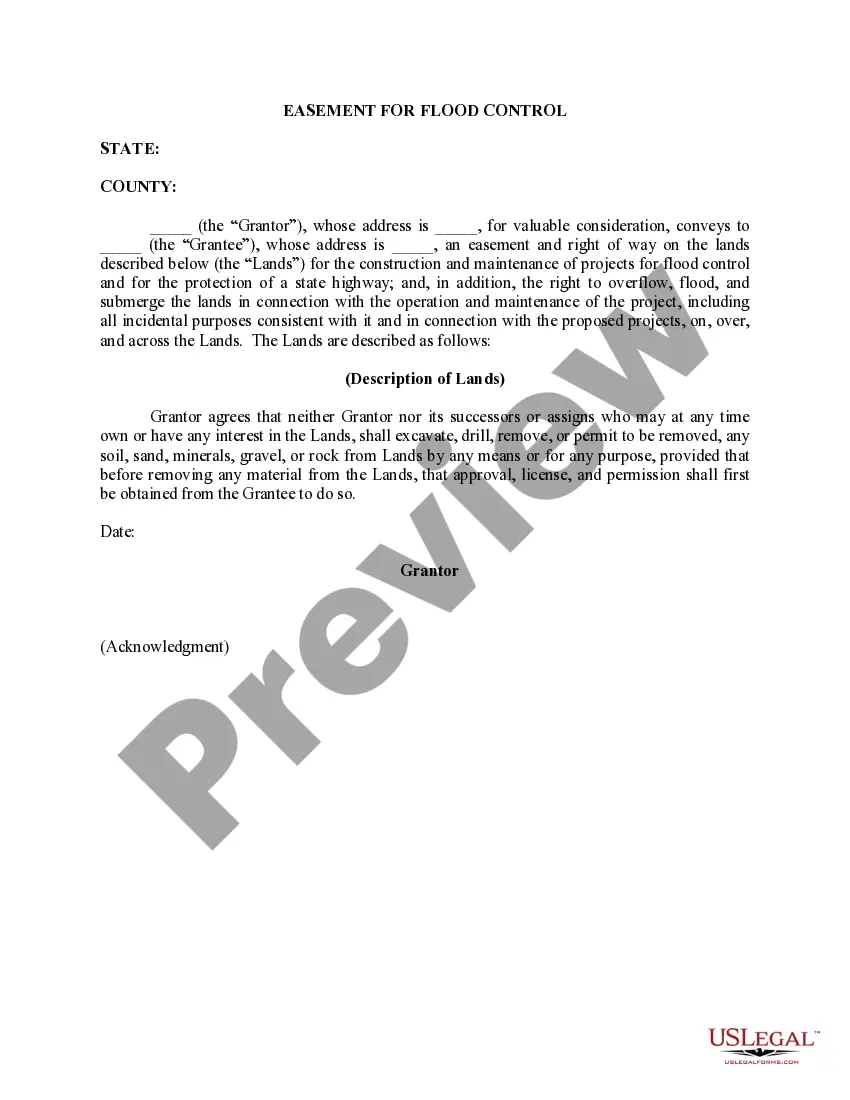
Although an easement grants a possessory interest in the land for a specific purpose, the landowner retains the title to the property. Easements may be given to anyone, such as neighbors, government agencies, and private parties.
In most situations, easements will not decrease the value of the property. If the easement has strict rules or requirements the property owner must follow, however, it can affect property value and marketability.
The value of the easement is based on the difference between the value of the whole property before the taking and its value after the taking with the easement in place.
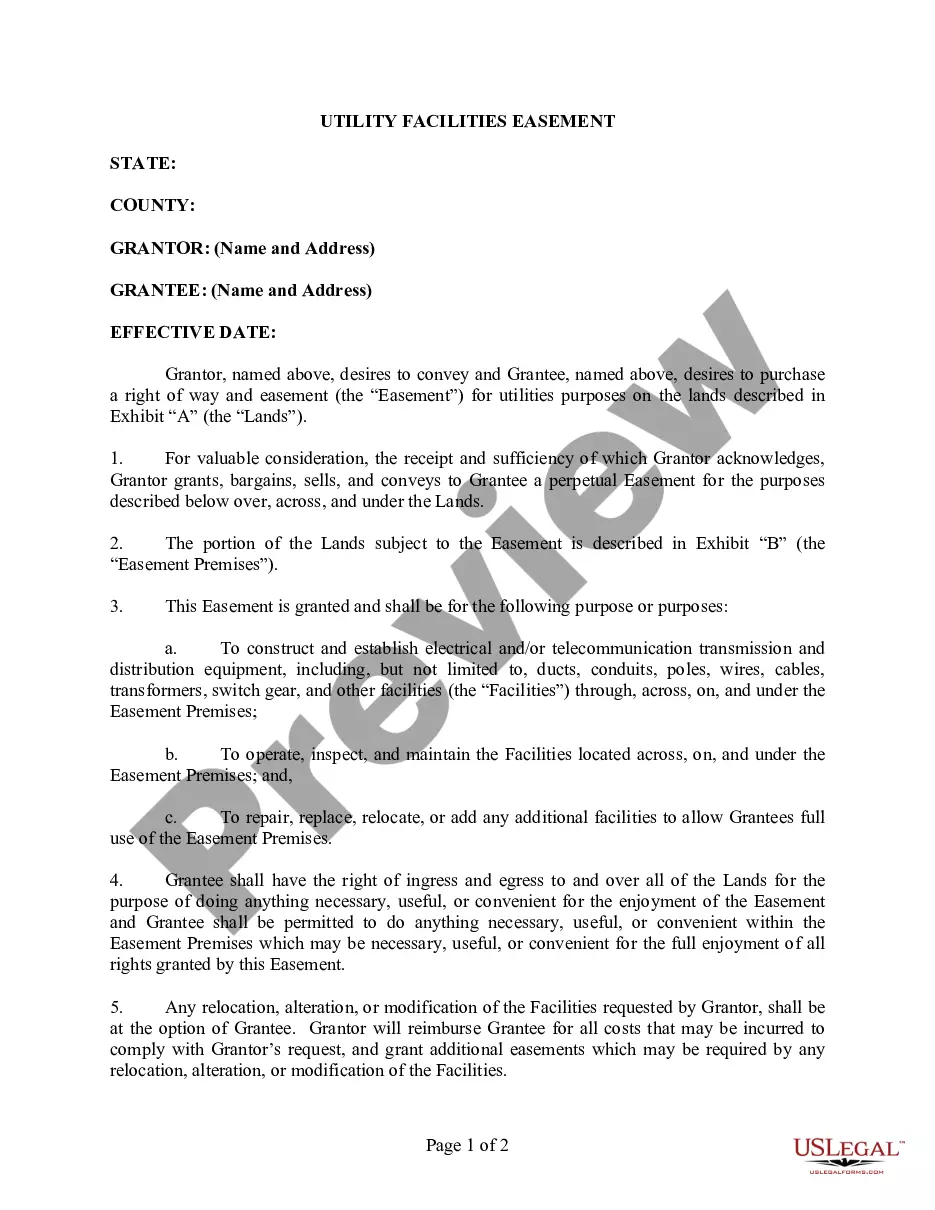
When termed as a utility easement, it means a utility company's right to access and control the portion of another person's land that is located near utility facilities and structures (i.e. utility poles, transformers, overhead or underground electrical lines).
Include the whole length and width. Do this by reference to plans and a ground inspection. Deduct the "after scenario" value from the "before scenario" value to arrive at a value per unit of the easement land. Multiply by the measured area of the easement land to arrive at a total market value.
The party gaining the benefit of the easement is the dominant estate (or dominant tenement), while the party granting the benefit or suffering the burden is the servient estate (or servient tenement). For example, the owner of parcel A holds an easement to use a driveway on parcel B to gain access to A's house.
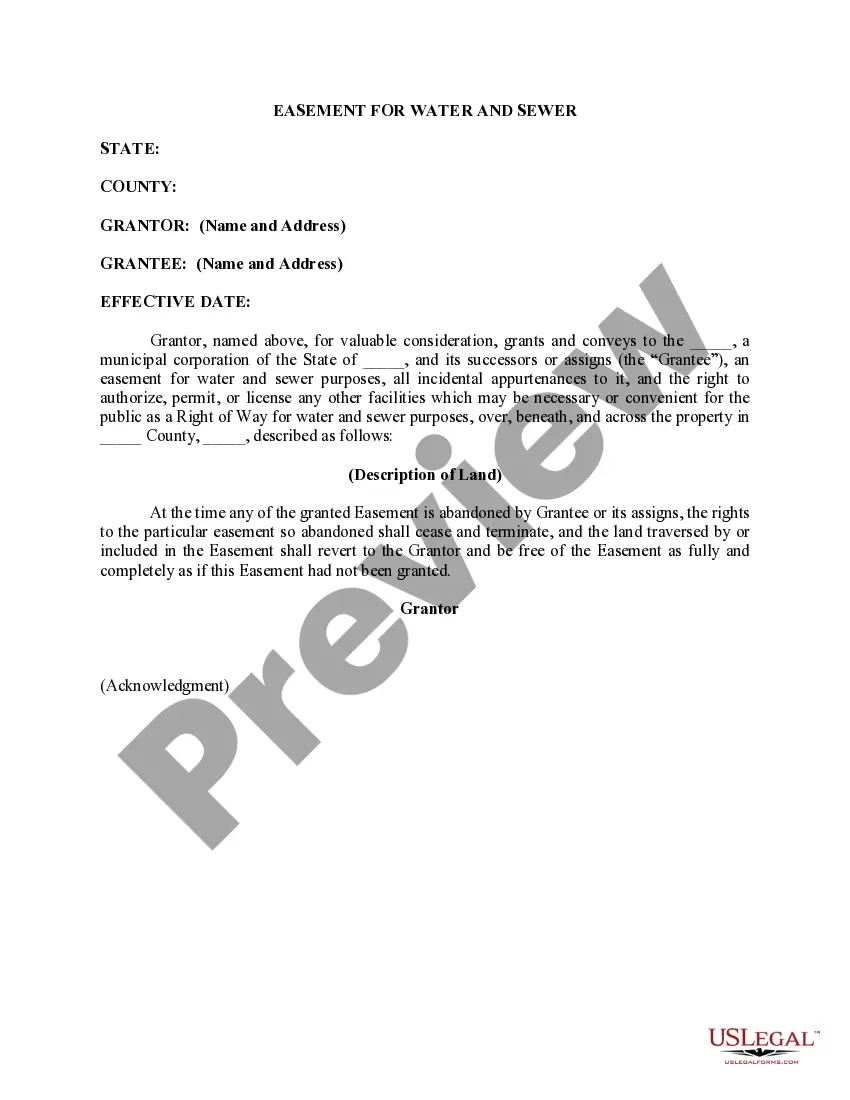
Rights of way (similar to the driveway example, but also including walkways or pathways); Public utilities, such as gas, electricity or water and sewer mains; Parking areas; Access to light and air; and. Shared walls.
Express Grant by Instrument. An express grant by written instrument is the most common source of an easement. Implied. The owner of a large tract of land splits up the land with one or more parcels that do not abut a public highway or road. Necessity. Dedication.
An easement is a "nonpossessory" property interest that allows the holder of the easement to have a right of way or use property that they do not own or possess. An easement doesn't allow the easement holder to occupy the land or to exclude others from the land unless they interfere with the easement holder's use.