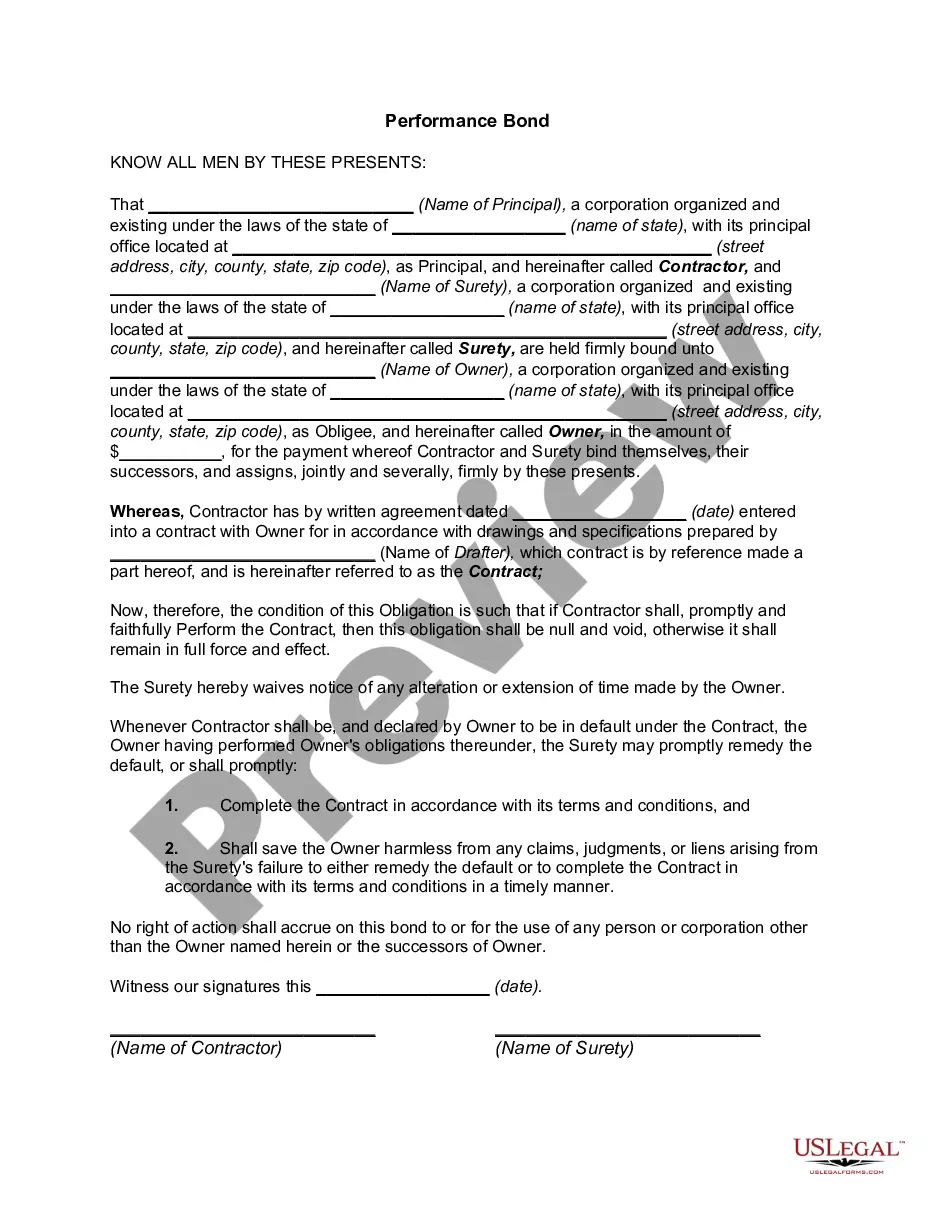
Performance Bond
About this form
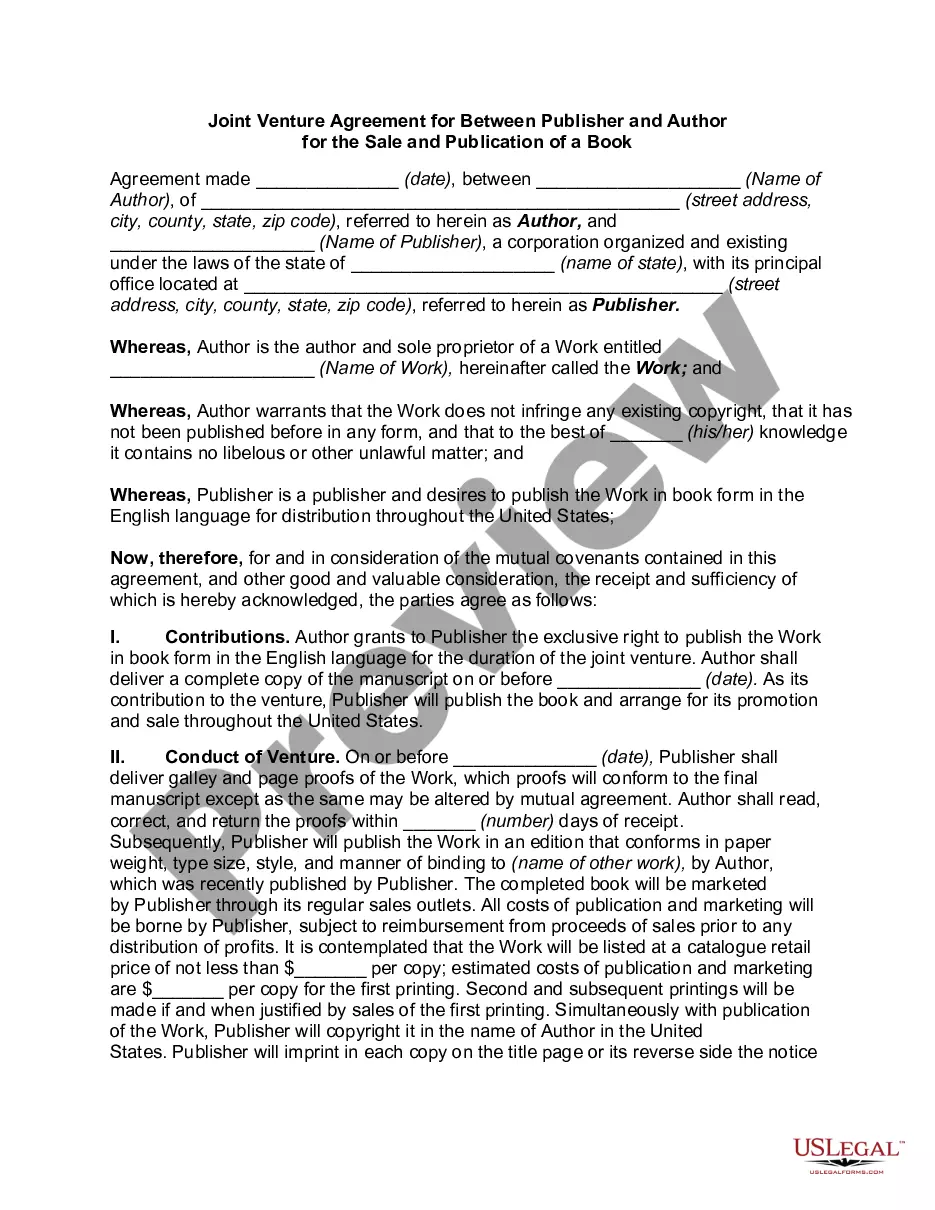
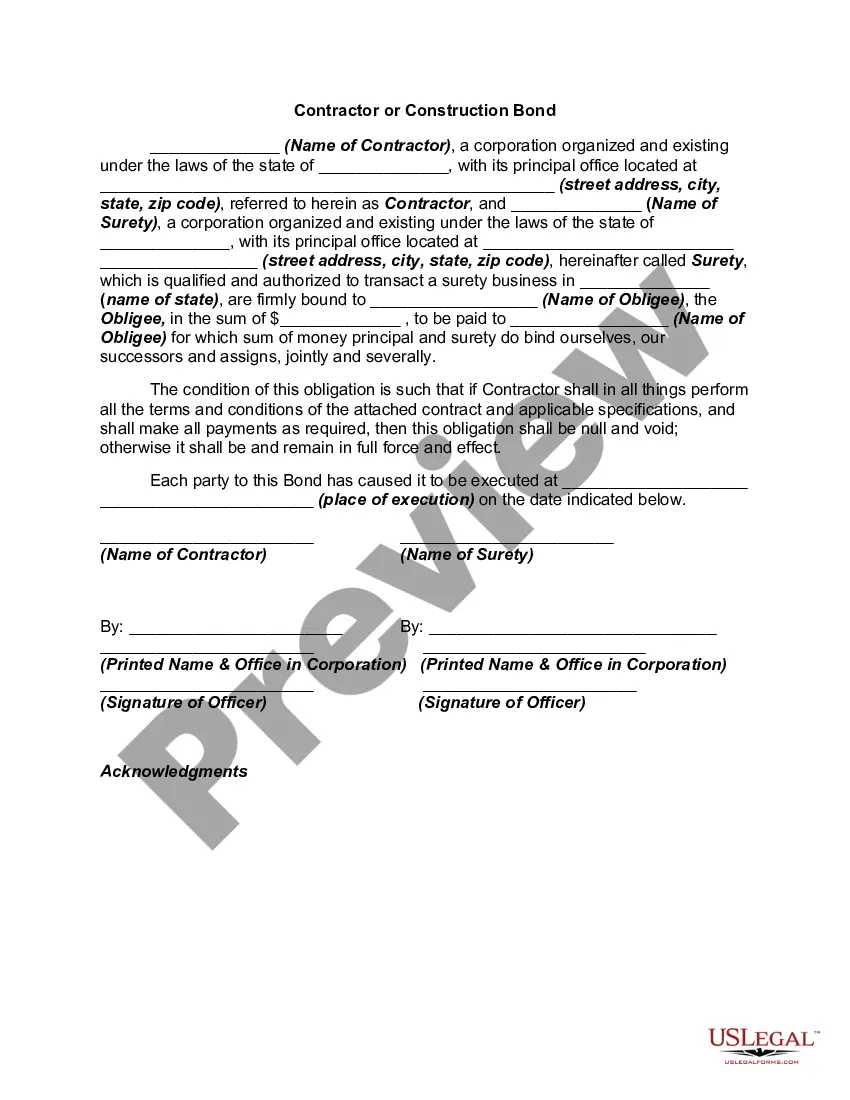
The Performance Bond is a legal document typically used in a joint venture agreement, which outlines the responsibilities of parties involved in a project or transaction. It ensures that one party fulfills its obligations to the other, particularly in the context of publishing a work. Unlike a regular partnership, a joint venture is often focused on a single venture and can hold different legal implications. This form serves to define the relationship between the author and publisher, specifying contributions, profit sharing, and terms for the sale and publication of a book.
Key parts of this document
- Details of the author and publisher, including names and contact information.
- Exclusive rights granted by the author to the publisher for the work's publication.
- Terms for the conduct of the venture, including timelines for proof submissions.
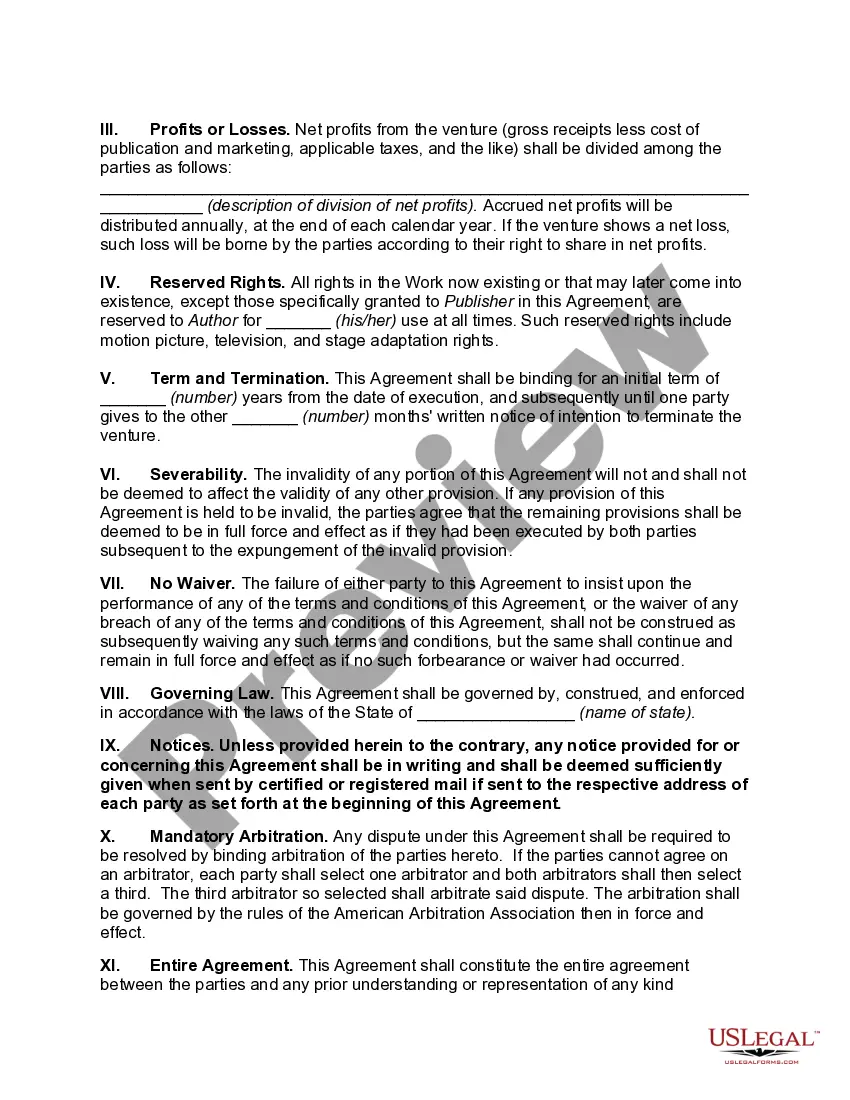
- Profit-sharing arrangements and responsibilities for losses.
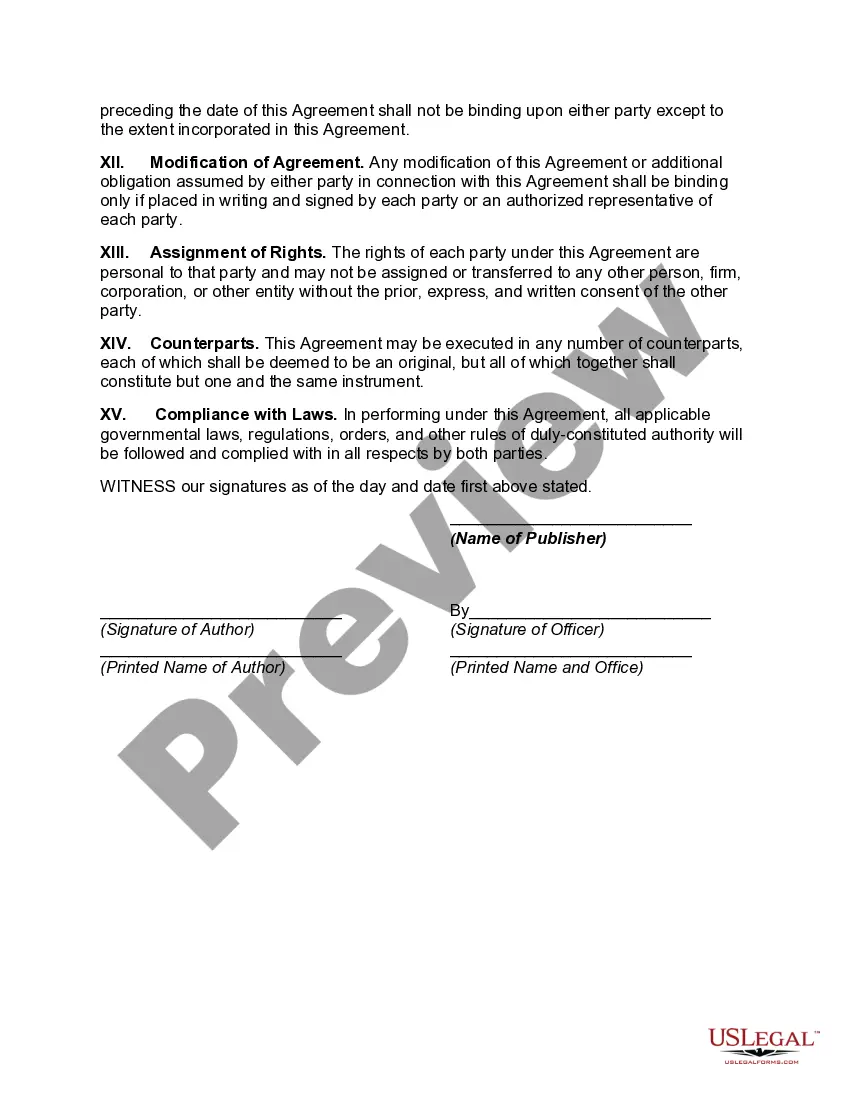
- Termination provisions and duration of the agreement.
- Governing law and dispute resolution methods through arbitration.


Situations where this form applies
This form is essential when an author collaborates with a publisher for the sale and publication of a book. It is particularly useful in scenarios involving the establishment of a joint venture for a specific project, where both parties need clarity on their roles, contributions, and financial arrangements. If you're planning to publish a written work and need to formalize your partnership with a publisher, this agreement ensures that expectations are clearly laid out and legally backed.
Who this form is for
- Authors looking to publish their work through a collaborative agreement.
- Publishers seeking to define their rights and responsibilities in the publication process.
- Individuals or organizations engaging in a singular joint venture for publishing.
- Legal professionals drafting or reviewing publishing agreements.
Completing this form step by step
- Identify and enter the names and addresses of the author and publisher at the beginning of the agreement.
- Specify the title of the work and the exclusive rights being granted to the publisher.
- Detail the contributions expected from both parties, including timelines for submissions and publication.
- Outline the profit distribution and how any losses will be managed.
- Sign and date the agreement to make it legally binding, ensuring all parties have copies.
Notarization requirements for this form
This form does not typically require notarization unless specified by local law. Users are advised to check their state regulations to ensure compliance.
Get your form ready online
Our built-in tools help you complete, sign, share, and store your documents in one place.
Make edits, fill in missing information, and update formatting in US Legal Forms—just like you would in MS Word.
Download a copy, print it, send it by email, or mail it via USPS—whatever works best for your next step.
Sign and collect signatures with our SignNow integration. Send to multiple recipients, set reminders, and more. Go Premium to unlock E-Sign.
If this form requires notarization, complete it online through a secure video call—no need to meet a notary in person or wait for an appointment.
We protect your documents and personal data by following strict security and privacy standards.

Make edits, fill in missing information, and update formatting in US Legal Forms—just like you would in MS Word.

Download a copy, print it, send it by email, or mail it via USPS—whatever works best for your next step.

Sign and collect signatures with our SignNow integration. Send to multiple recipients, set reminders, and more. Go Premium to unlock E-Sign.

If this form requires notarization, complete it online through a secure video call—no need to meet a notary in person or wait for an appointment.

We protect your documents and personal data by following strict security and privacy standards.
Common mistakes to avoid
- Failing to clearly define the contributions of each party.
- Not specifying timelines for manuscript submission and publication.
- Overlooking the need to include terms for termination of the joint venture.
- Neglecting to state how profits and losses are shared.
- Signing the agreement without reviewing all terms thoroughly.
Why use this form online
- Instant access to a professionally drafted performance bond tailored for your publishing needs.
- Easy to download and edit, allowing you to personalize the agreement to fit specific circumstances.
- Convenient online storage and access, preventing loss of important documents.
- Cost-effective solution compared to hiring a legal professional for basic agreements.
Quick recap
- The Performance Bond is essential for formalizing the relationship between authors and publishers in a joint venture.
- It clearly outlines each party's contributions, responsibilities, profit sharing, and legal recourse.
- Completing this form accurately helps prevent misunderstandings and disputes down the line.
Looking for another form?
Form popularity
FAQ
Performance bonds are typically provided by a financial institution such as a bank or an insurance company. The bond would be paid for by the party providing the services under the agreement. Performance bonds are common in industries like construction and real estate development.
In order to get a performance bond, contractors must usually pay a premium on the bond amount as well as interest on the bond. Again, the price will depend on the cost of the bond and the risk (creditworthiness) the principal presents. In most cases, you will first need to obtain a bid bond before bidding on a project.
The cost of a performance bond usually is less than 1% of the contract price; however, if the contract is under $1 million, the premium may run between 1% and 2%. Bonds may be more costly, depending upon the credit-worthiness of the contractor. Labor and material payment bonds are companions to the performance bond.
A performance bond is issued to one party of a contract as a guarantee against the failure of the other party to meet obligations specified in the contract.A performance bond is usually provided by a bank or an insurance company to make sure a contractor completes designated projects.
A performance bond is a bond that guarantees that the bonded contractor will perform its obligations under the contract in accordance with the contract's terms and conditions. Performance bonds are typically in the amount of 50% of the contract amount, but can also be issued for 100% of the contract amount.