Louisiana Motion to Compel Disclosure of Confidential Information
Overview of this form
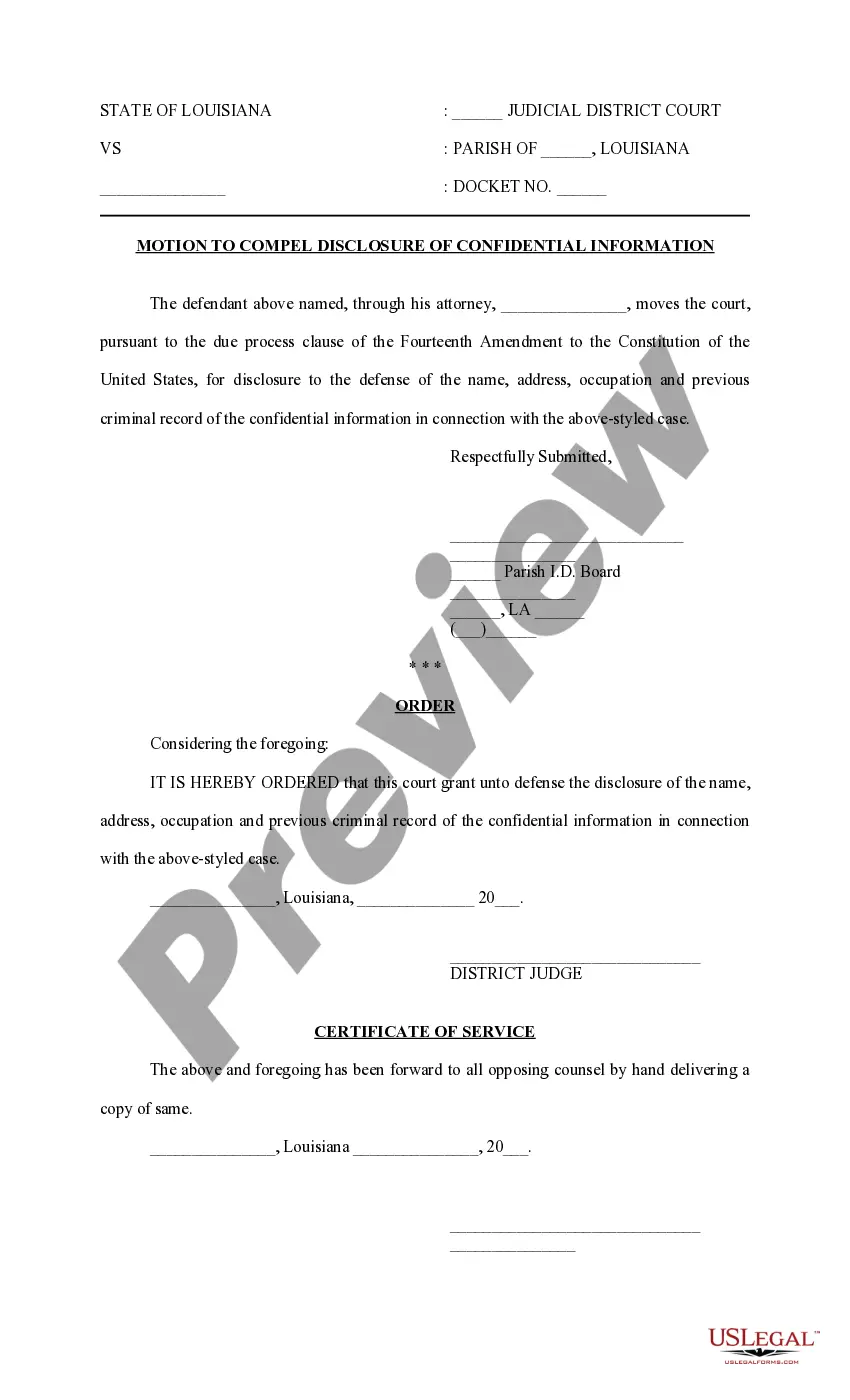
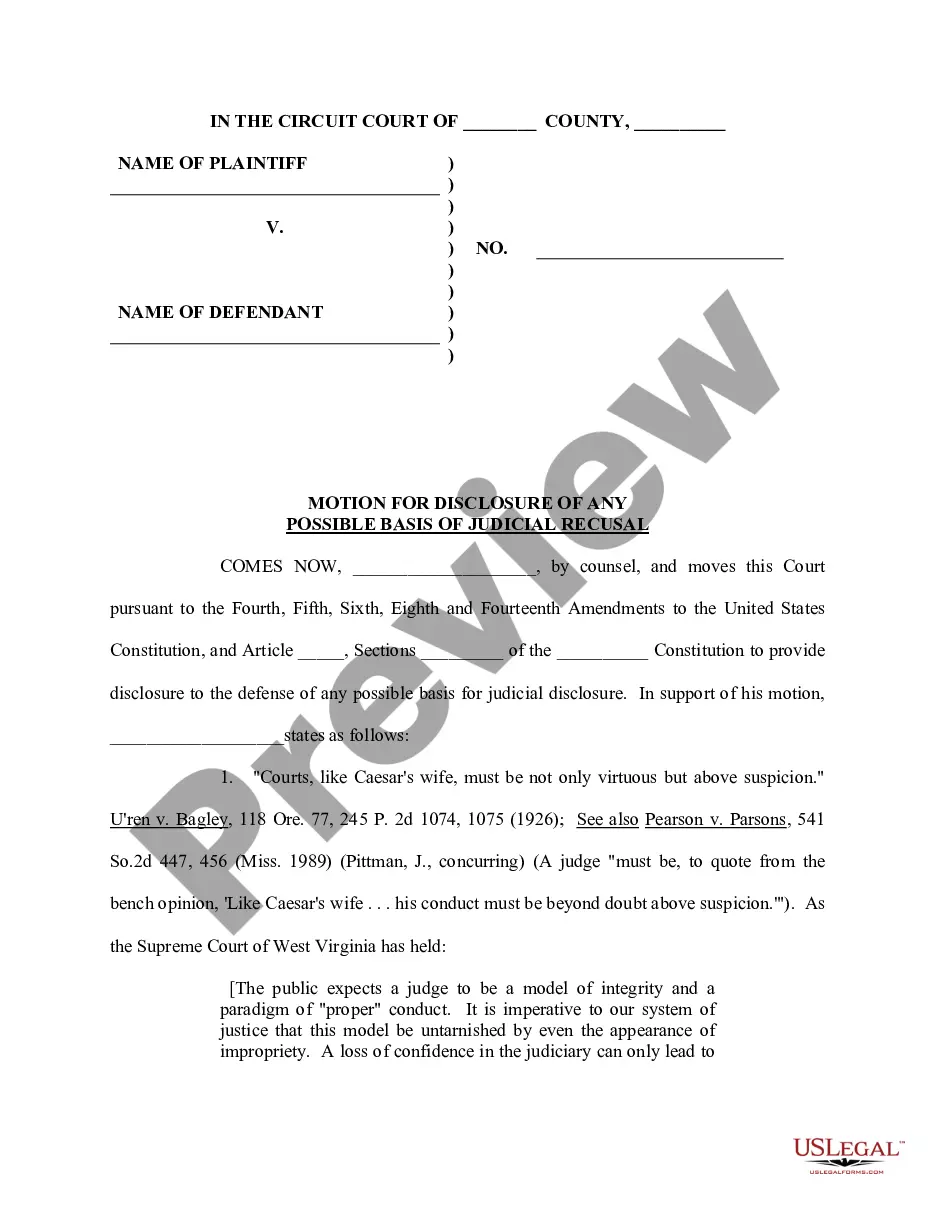
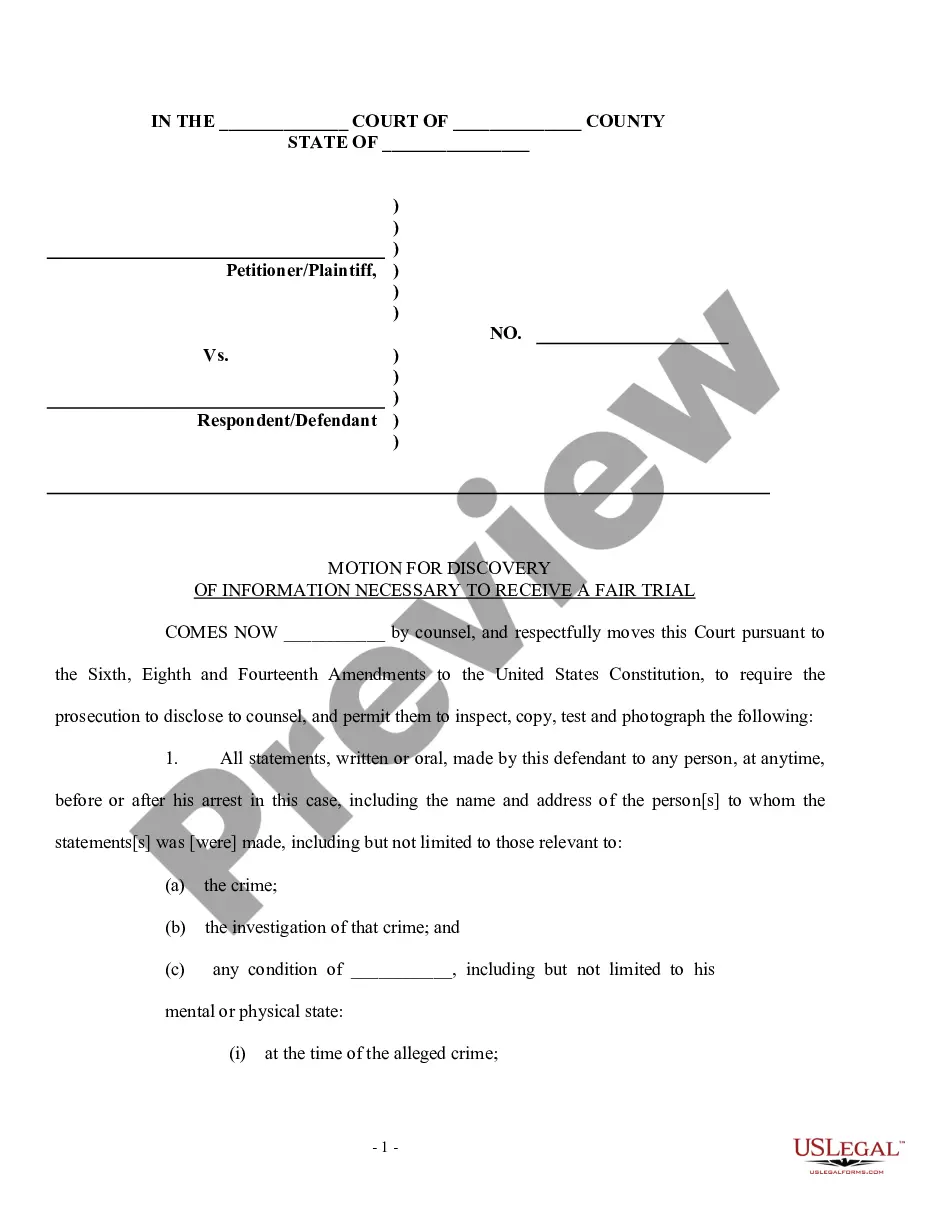
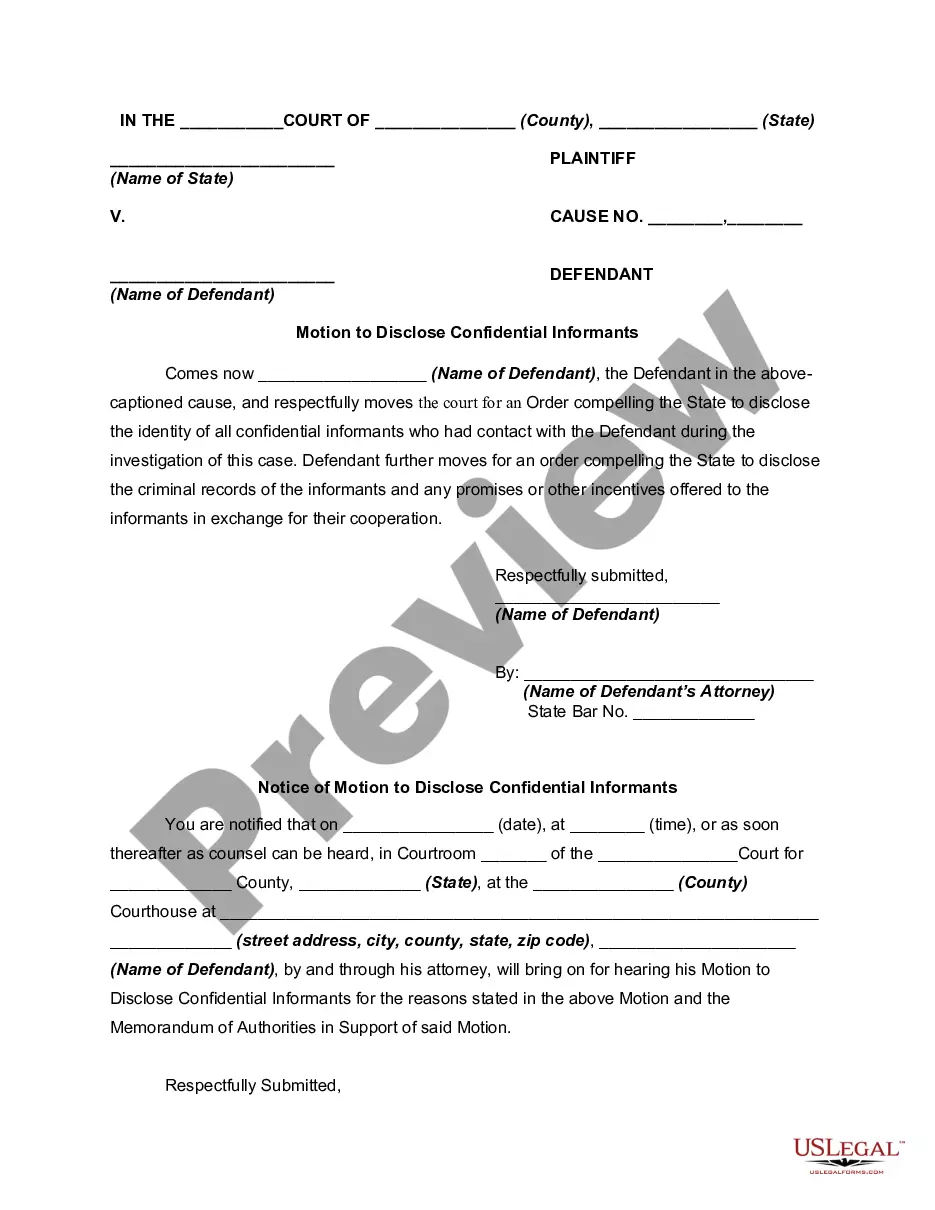
The Motion to Compel Disclosure of Confidential Information is a legal document used by defendants in criminal cases to request essential information about confidential informants. This form seeks the name, address, occupation, and previous criminal record of the informant to ensure fair trial rights as protected under the Fourteenth Amendment. Unlike other motions, this document specifically targets the disclosure of confidential details necessary for building a defense.
Key parts of this document
- Introduction of the motion with the defendant's name and case details.
- Request for disclosure of the informant's name, address, occupation, and criminal record.
- Citation of the Fourteenth Amendment as the legal basis for the request.
- Order section for the court to grant the motion with space for the judge's signature.
- Certificate of service indicating that all parties have been notified of the motion.
Situations where this form applies
This form is applicable when a defendant in a criminal case requires access to the identity and background of a confidential informant that may impact their case. Situations include preparing for trial or hearings where the informant's credibility is crucial to the defense. It helps ensure that the defendant's right to a fair trial is protected by enabling them to challenge potentially inaccurate or misleading testimony from the informant.
Who needs this form
- Defendants in criminal cases seeking to obtain information about confidential informants.
- Defense attorneys representing clients involved in criminal proceedings.
- Individuals ensuring their legal rights to a fair defense are upheld during court proceedings.
How to prepare this document
- Identify and enter the defendant's name, case number, and the parish where the case is filed.
- Fill in the name of the attorney representing the defendant, along with their contact information.
- Clearly outline the request for the informant's name, address, occupation, and criminal history in the designated section.
- Review and sign the motion to indicate the respect for the court and the legal process.
- Complete the order section with the judge's signature after the court grants the motion.
Notarization guidance
Notarization is not commonly needed for this form. However, certain documents or local rules may make it necessary. Our notarization service, powered by Notarize, allows you to finalize it securely online anytime, day or night.
Get your form ready online
Our built-in tools help you complete, sign, share, and store your documents in one place.
Make edits, fill in missing information, and update formatting in US Legal Forms—just like you would in MS Word.
Download a copy, print it, send it by email, or mail it via USPS—whatever works best for your next step.
Sign and collect signatures with our SignNow integration. Send to multiple recipients, set reminders, and more. Go Premium to unlock E-Sign.
If this form requires notarization, complete it online through a secure video call—no need to meet a notary in person or wait for an appointment.
We protect your documents and personal data by following strict security and privacy standards.

Make edits, fill in missing information, and update formatting in US Legal Forms—just like you would in MS Word.

Download a copy, print it, send it by email, or mail it via USPS—whatever works best for your next step.

Sign and collect signatures with our SignNow integration. Send to multiple recipients, set reminders, and more. Go Premium to unlock E-Sign.

If this form requires notarization, complete it online through a secure video call—no need to meet a notary in person or wait for an appointment.

We protect your documents and personal data by following strict security and privacy standards.
Typical mistakes to avoid
- Failing to provide all required information about the informant.
- Not citing the appropriate legal basis for the request.
- Omitting the signature of the attorney or the certificate of service.
- Not following local court formatting requirements.
Advantages of online completion
- Immediate access to a legally vetted template created by licensed attorneys.
- Conveniently editable fields to personalize according to specific case needs.
- Secure download option, allowing for quick filing without the need for physical visits.
- Time-saving with guided instructions ensuring accurate completion.
Looking for another form?
Form popularity
FAQ
You need to give the court a reason to deny the other side's motion to compel. There are many different reasons you could give. Take out your Response to the discovery request. You should have identified reasons in your Response for why you weren't turning over certain information.
Motion for Sanctions If the court issues an order compelling discovery, and the party fails to comply with that order, then the court may sanction the party in numerous ways such as refusing to let in the party's evidence at trial, dismissing their lawsuit or striking their defense to a lawsuit, and imposing
A party may move for an order compelling the deponent's attendance and testimony, and the production for inspection of any document, if after service of a deposition notice, a party to the action, without having served a valid objection, fails to appear for examination, or proceed with it, or to produce for inspection
When a motion to compel is filed with the court, a hearing is scheduled. At the hearing, the party that filed the motion will need to tell the judge why the other party should be compelled to do something.Once that happens, that party will not be able to use the documents at trial.
A motion to compel asks the court to enforce a request for information relevant to a case.The requesting party files a motion to compel discovery responses if the opposing party continues to deny the discovery request.
If a motion to compel is disobeyed, it can lead to consequences such as: another, more serious court order; fines or fees; other different procedural rulings that may affect the outcome of a case.
Consequences of Refusing to Provide Evidence Requested in a Motion to Compel. If the court issues an order that compels your spouse to produce the discovery you are seeking but your spouse still refuses to provide evidence, the judge may impose further sanctions such as: A verdict in your favor.
A motion to compel asks the court to enforce a request for information relevant to a case.The requesting party files a motion to compel discovery responses if the opposing party continues to deny the discovery request.