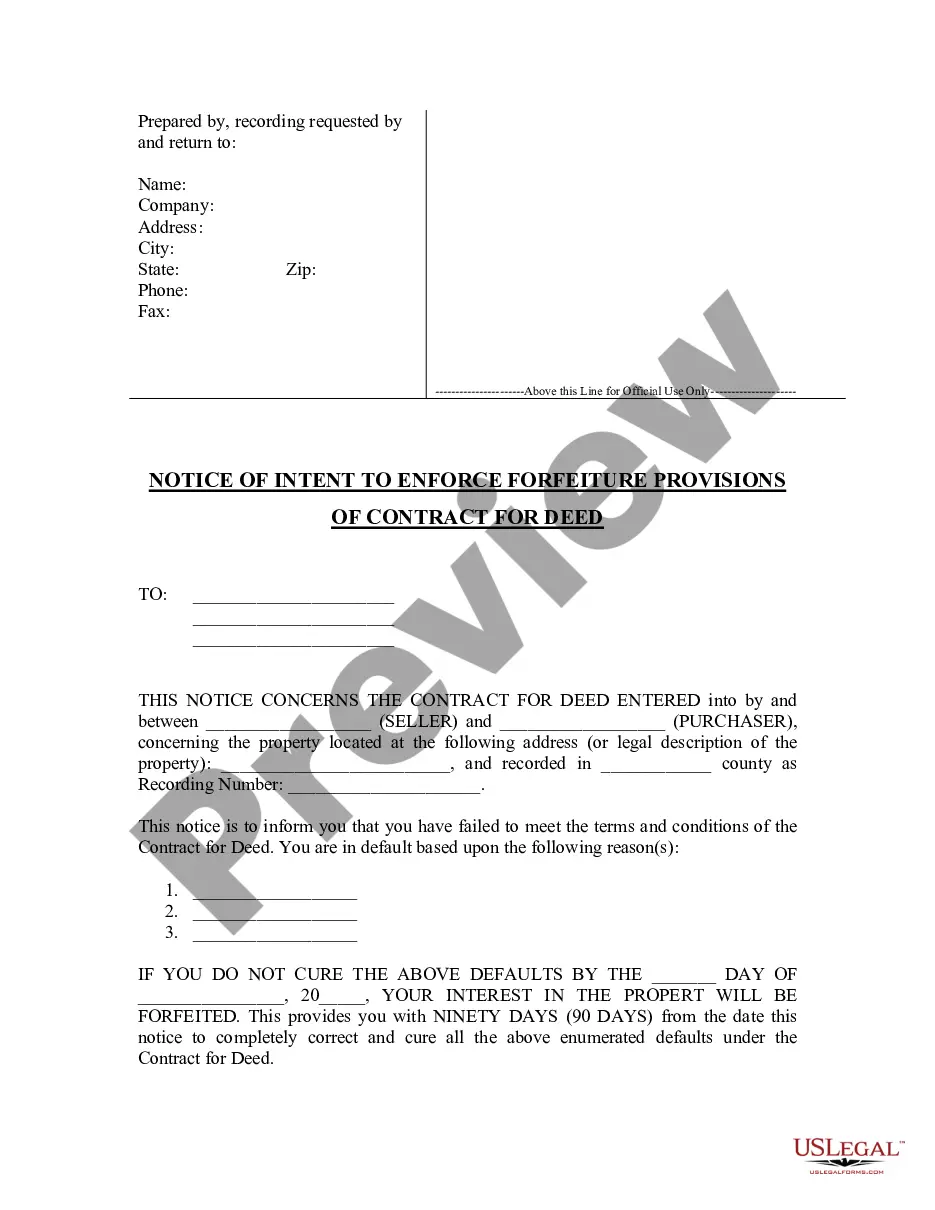
Missouri Financial Account Transfer to Living Trust
What is this form?
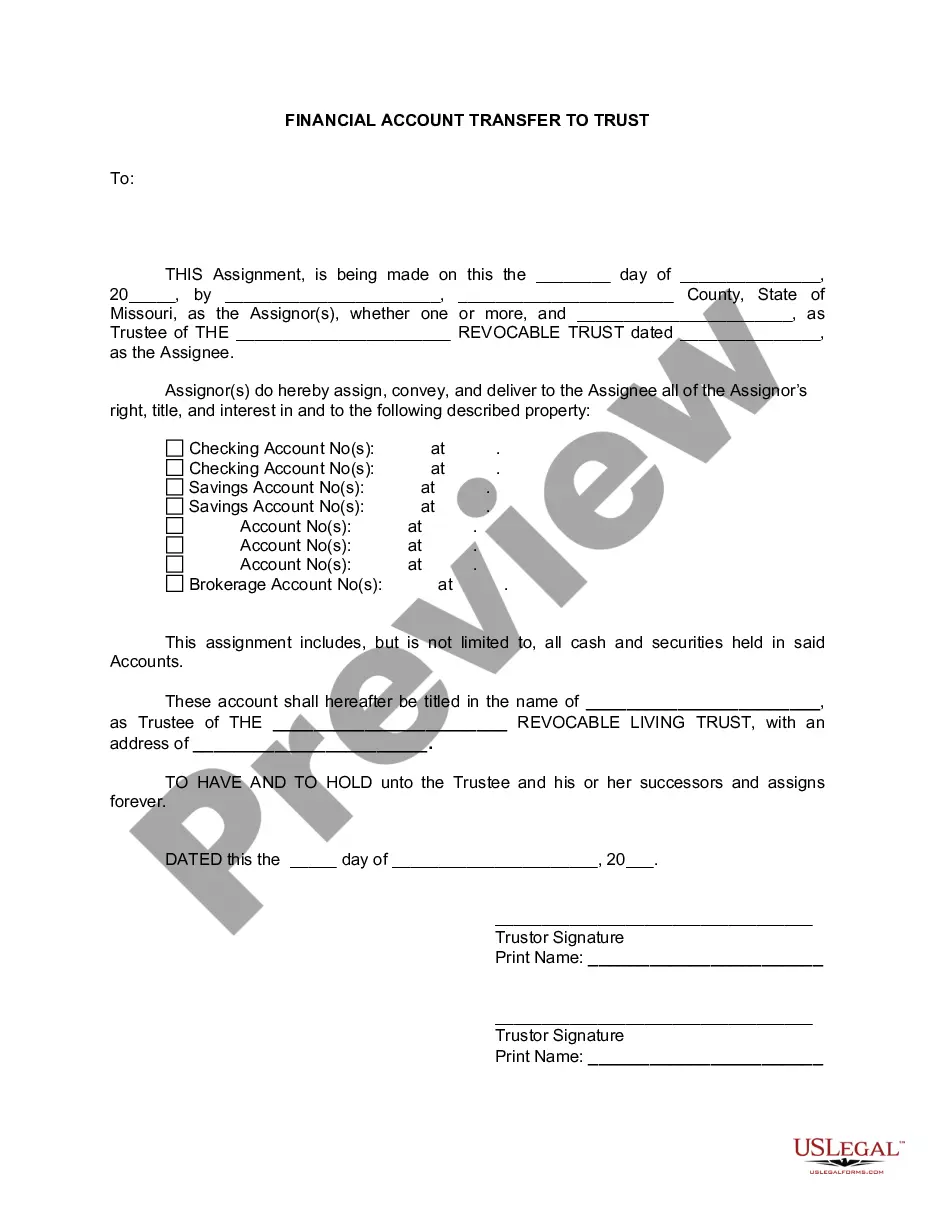
The Financial Account Transfer to Living Trust form allows you to transfer ownership of bank and other financial accounts into a living trust. This legal document is essential for estate planning, as it helps manage your assets while you are alive and ensures a smoother transition of your estate after your passing. Unlike other forms related to trusts, this document specifically deals with the transfer of financial accounts, making the process more straightforward for you and your beneficiaries.
Key parts of this document
- Assignor(s) information: Details of the person transferring the accounts.
- Assignee: Name of the living trust and the designated trustee.
- Property description: Clear identification of the financial accounts being transferred.
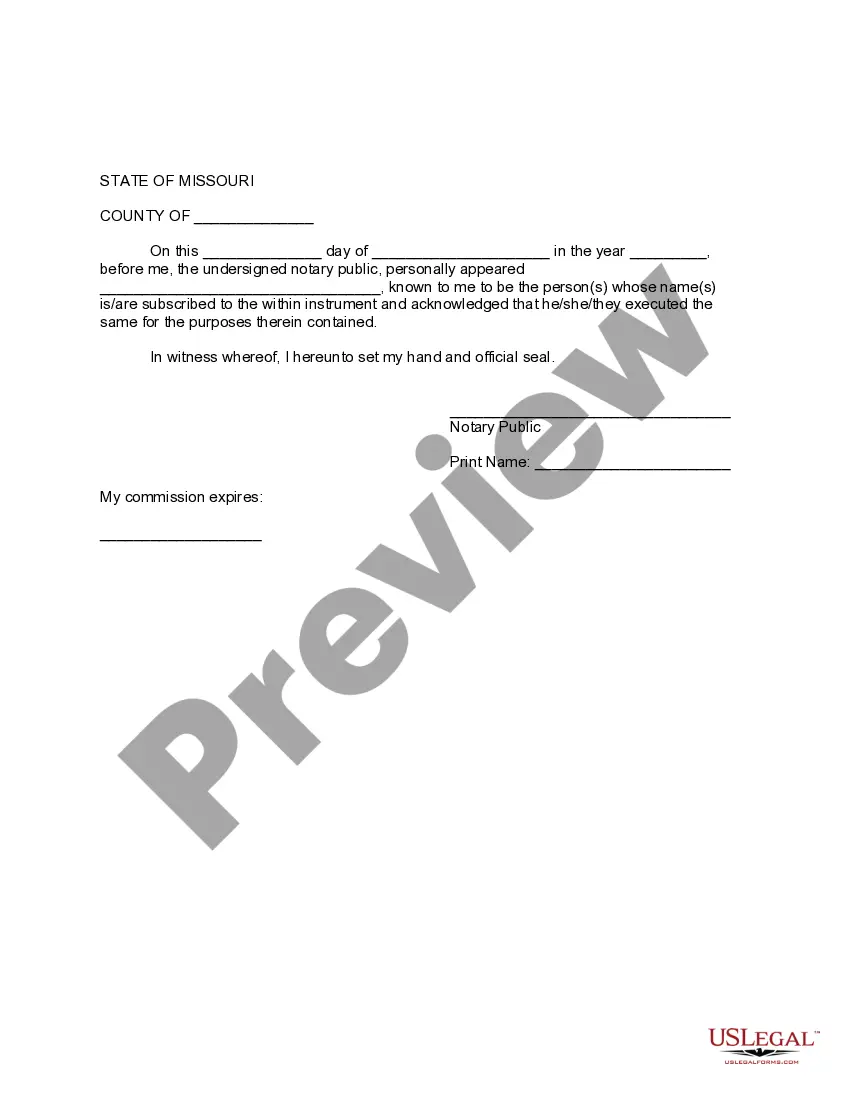
- Signatures: Requires signatures from the Assignor(s) and notarization.
- Notary acknowledgment: Certification confirming the identities of the signers.
- Date of execution: The date the form is signed, which is crucial for record-keeping.

When to use this document
You should use the Financial Account Transfer to Living Trust form when you have established a living trust and want to ensure that your financial accounts are included in it. Common scenarios include when you are creating your estate plan, wanting to manage your finances while establishing a trust, or preparing for potential incapacity by consolidating your assets under the trust. Using this form can also help avoid probate after your death, simplifying the transfer of assets to your beneficiaries.
Who this form is for
- Individuals with established living trusts who need to transfer assets.
- Trustees looking to manage financial accounts for the benefit of beneficiaries.
- Anyone seeking to streamline their estate plan and avoid probate complications.
- Individuals wanting to ensure a smooth transition of their assets after passing.
Steps to complete this form
- Identify the parties: Provide the names of the Assignor(s) and the Assignee (the living trust).
- Specify the property: Clearly describe the financial accounts you are transferring, including account numbers where necessary.
- Enter dates: Fill in the date of transfer and the date of signing to keep accurate records.
- Signatures: Both Assignor(s) must sign the document in the presence of a notary public.
- Notarization: Have the notary public complete the acknowledgment section to validate the form.
Notarization requirements for this form
Yes, this form must be notarized to be legally valid. Notarization ensures the authenticity of the signatures and the identities of the parties involved. US Legal Forms provides integrated online notarization, allowing you to complete this process conveniently via a secure video call without needing to travel.
Get your form ready online
Our built-in tools help you complete, sign, share, and store your documents in one place.
Make edits, fill in missing information, and update formatting in US Legal Forms—just like you would in MS Word.
Download a copy, print it, send it by email, or mail it via USPS—whatever works best for your next step.
Sign and collect signatures with our SignNow integration. Send to multiple recipients, set reminders, and more. Go Premium to unlock E-Sign.
If this form requires notarization, complete it online through a secure video call—no need to meet a notary in person or wait for an appointment.
We protect your documents and personal data by following strict security and privacy standards.

Make edits, fill in missing information, and update formatting in US Legal Forms—just like you would in MS Word.

Download a copy, print it, send it by email, or mail it via USPS—whatever works best for your next step.

Sign and collect signatures with our SignNow integration. Send to multiple recipients, set reminders, and more. Go Premium to unlock E-Sign.

If this form requires notarization, complete it online through a secure video call—no need to meet a notary in person or wait for an appointment.

We protect your documents and personal data by following strict security and privacy standards.
Avoid these common issues
- Failing to accurately describe the financial accounts being transferred.
- Not obtaining the required notarization, making the form legally ineffective.
- Leaving the signature fields blank or not signing in front of a notary.
- Not including the correct date, which may affect the validity of the transfer.
Benefits of using this form online
- Convenient access: Download and complete the form at your convenience, saving time.
- Editability: Easily make adjustments to the template as needed to suit your specific situation.
- Reliability: The form comes drafted by licensed attorneys, ensuring it meets legal requirements.
- Protects your assets: Streamlines the process to safeguard your financial accounts within your living trust.
Quick recap
- The Financial Account Transfer to Living Trust form is essential for including financial accounts in a living trust.
- Accurate descriptions and signatures are crucial for the validity of the document.
- Notarization is required to finalize the transfer legally.
- This form helps simplify estate management and can ultimately expedite the distribution of your assets.
Looking for another form?
Form popularity
FAQ
To transfer assets into a trust, the grantor must transfer titles from their name to the legal name of the trust. A grantor can create a living trust using an online legal document provider or by hiring an attorney. They can transfer almost any asset, including bank accounts, into a trust.
Qualified retirement accounts 401ks, IRAs, 403(b)s, qualified annuities. Health saving accounts (HSAs) Medical saving accounts (MSAs) Uniform Transfers to Minors (UTMAs) Uniform Gifts to Minors (UGMAs) Life insurance. Motor vehicles.
When Should You Put a Bank Account into a Trust?More specifically, you can hold up to $166,250 of real or personal property outside a trust and avoid full probate in California. However, if you have more than $166,250 in a bank account, you should consider transferring it into your trust.
Visit your local bank branch and let the branch manager or representative know you want to transfer your bank account into the trust. Give the bank representative a signed and notarized copy of your trust document. The bank will need to confirm that you're the owner and verify the name of the trust.
Dmitriy Fomichenko, President, Sense Financial Almost all the major banks offer trust accounts. What you need to do is to call their customer representatives and inquire about the features you require. Some of the options include Bank of America, Wells Fargo, US Bank, and TD Bank.
Property you put in a living trust doesn't have to go through probate, which means that the assets won't get tied up in court for months and maybe years. However, you don't have to put bank accounts in a living trust, and sometimes it's not a good idea.
To transfer assets such as investments, bank accounts, or stock to your real living trust, you will need to contact the institution and complete a form. You will likely need to provide a certificate of trust as well. You may want to keep your personal checking and savings account out of the trust for ease of use.
When Should You Put a Bank Account into a Trust?More specifically, you can hold up to $166,250 of real or personal property outside a trust and avoid full probate in California. However, if you have more than $166,250 in a bank account, you should consider transferring it into your trust.