Colorado Tax Free Exchange Package
Understanding this form package
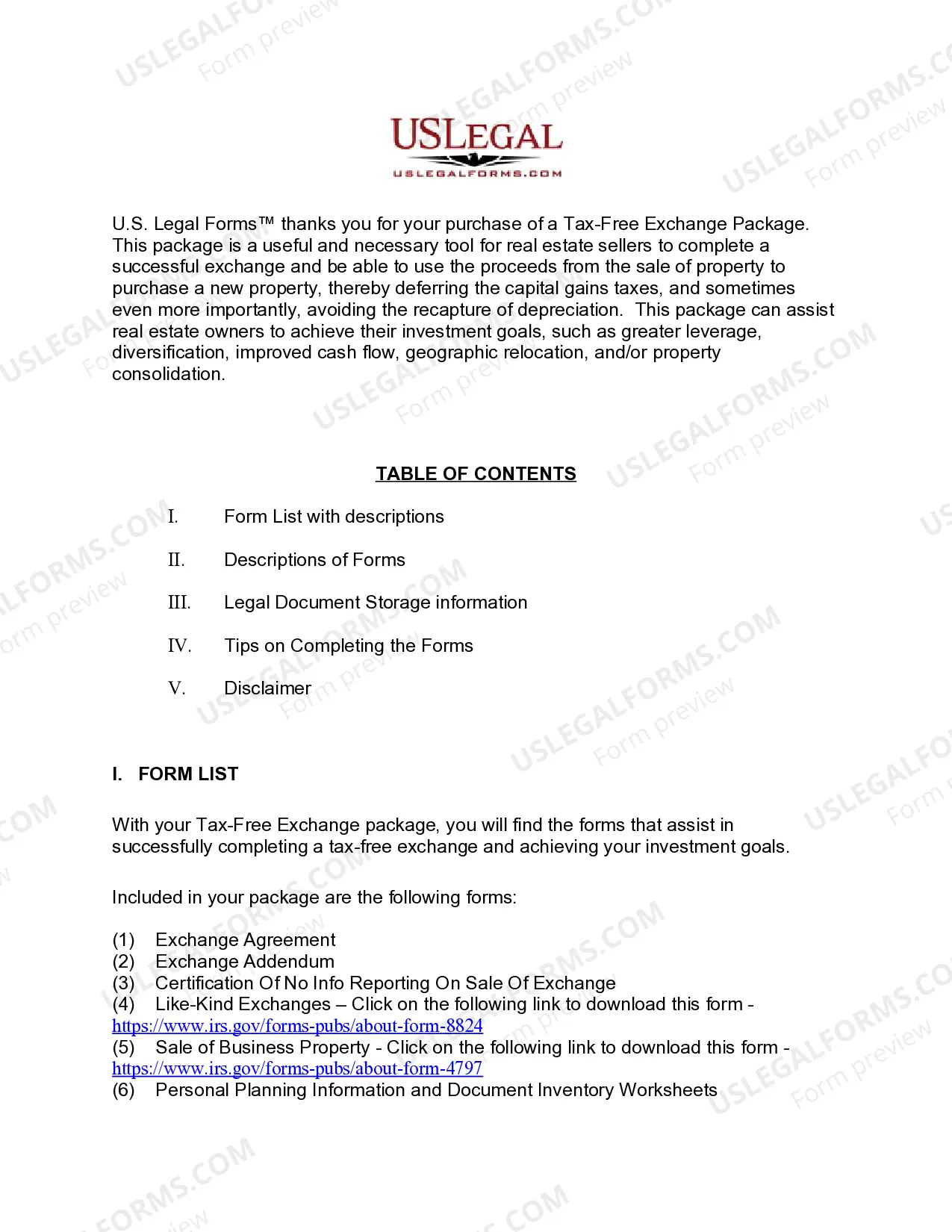
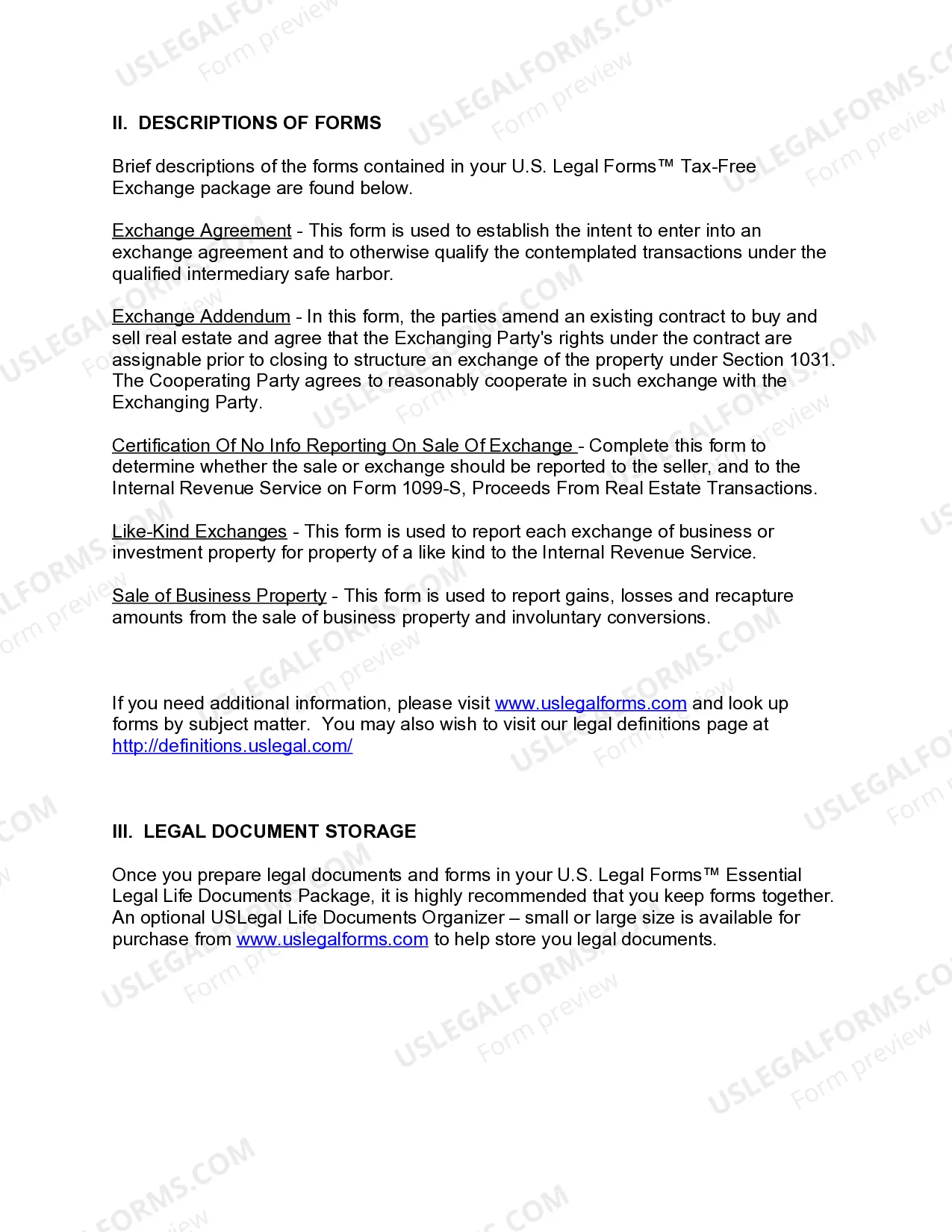
The Colorado Tax Free Exchange Package provides essential forms necessary for completing a tax-free exchange of like-kind properties. This package includes documents that comply with Section 1031 of the Internal Revenue Code, allowing property owners to defer capital gains taxes when exchanging properties. Unlike other legal form packages that may only focus on general property sales, this package specifically addresses the complexities of tax-free exchanges, ensuring accuracy and compliance with Colorado laws.
What’s included in this form package
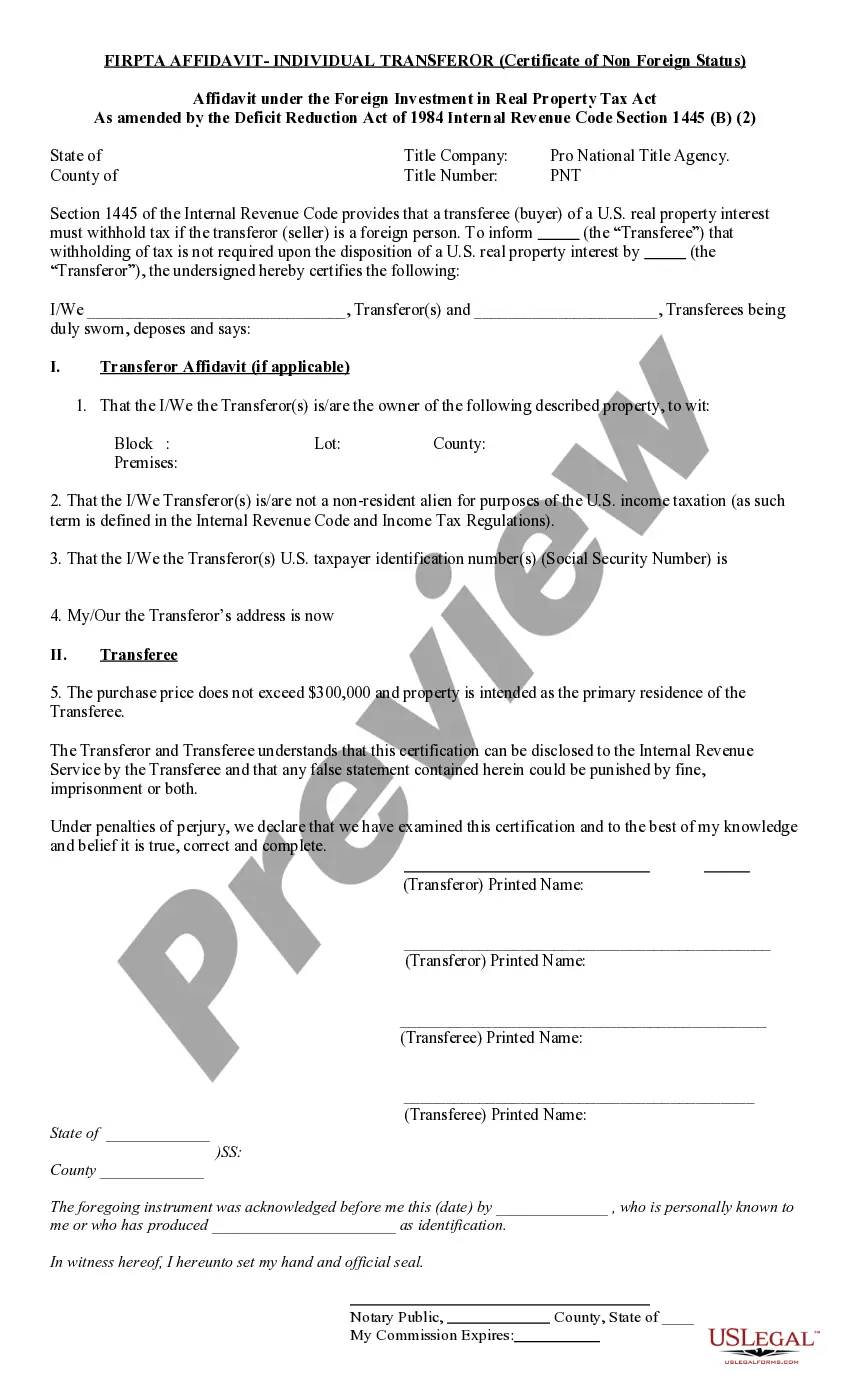
Situations where these forms applies
This form package is suitable for use when:
- You are planning to exchange a property that qualifies as like-kind under Section 1031.
- You wish to defer paying capital gains taxes from the sale of your property.
- You need to amend an existing property sale contract to accommodate an exchange.
- You are selling business or investment property and need to report the transaction to the IRS.
Who should use this form package
- Real estate investors seeking to defer capital gains tax on like-kind property exchanges.
- Property owners looking to create a tax-efficient strategy when acquiring new properties.
- Business owners selling business property and planning to reinvest in similar real estate.
- Individuals or entities involved in real estate transactions that require tax-free exchanges.
How to complete these forms
- Review each included form and familiarize yourself with its purpose.
- Identify all parties involved in the exchange and ensure their agreement on the terms.
- Complete the Exchange Agreement to establish your intent for the property exchange.
- Use the Exchange Addendum to amend any existing contracts as necessary.
- Provide accurate information on the Certification of No Info Reporting On Sale Of Exchange.
- File the required forms with the IRS following the exchange to report the transaction correctly.
Do documents in this package require notarization?
Some forms in this package need notarization to be legally binding. Our online notarization service, powered by Notarize, lets you verify and sign documents remotely through an encrypted video session, available 24/7.
Get your form ready online
Our built-in tools help you complete, sign, share, and store your documents in one place.
Make edits, fill in missing information, and update formatting in US Legal Forms—just like you would in MS Word.
Download a copy, print it, send it by email, or mail it via USPS—whatever works best for your next step.
Sign and collect signatures with our SignNow integration. Send to multiple recipients, set reminders, and more. Go Premium to unlock E-Sign.
If this form requires notarization, complete it online through a secure video call—no need to meet a notary in person or wait for an appointment.
We protect your documents and personal data by following strict security and privacy standards.

Make edits, fill in missing information, and update formatting in US Legal Forms—just like you would in MS Word.

Download a copy, print it, send it by email, or mail it via USPS—whatever works best for your next step.

Sign and collect signatures with our SignNow integration. Send to multiple recipients, set reminders, and more. Go Premium to unlock E-Sign.

If this form requires notarization, complete it online through a secure video call—no need to meet a notary in person or wait for an appointment.

We protect your documents and personal data by following strict security and privacy standards.
Mistakes to watch out for
- Failing to accurately identify properties that qualify as like-kind.
- Neglecting to complete the Certification of No Info Reporting, which can lead to penalties.
- Overlooking the specific deadlines for identifying and closing on replacement properties.
- Not obtaining the necessary signatures on all forms to validate the transaction.
Why use this package online
- Convenience: Access and complete your forms anytime and from anywhere.
- Editability: Easily modify your forms as needed without reprinting everything.
- Reliability: All forms are drafted by licensed attorneys to ensure legal compliance.
- Time-saving: Instant download saves time compared to traditional legal processes.
Summary of main points
- The Colorado Tax Free Exchange Package is essential for deferring taxes in property exchanges.
- Proper completion of the included forms is crucial to ensure compliance with IRS regulations.
- Common errors can jeopardize the exchange, so thorough review and accuracy are important.
- This package is designed to simplify the process for property owners and investors.
Looking for another form?
Form popularity
FAQ
The IRS statute requires that you use a qualified intermediary (QI) to perform your 1031 exchange. While it is possible for an attorney to provide this service, it doesn't have to be an attorney and it can't be an attorney you have utilized for any other matters.
A 1031 exchange gets its name from Section 1031 of the U.S. Internal Revenue Code, which allows you to avoid paying capital gains taxes when you sell an investment property and reinvest the proceeds from the sale within certain time limits in a property or properties of like kind and equal or greater value.
Trade up in real estate value with one or more replacement properties. Reinvest all of your 1031 exchange proceeds from the relinquished property into the replacement property.
Normally the IRS does not allow you to conduct a 1031 exchange with your primary residence. That's because the home that you live in isn't being used as an investment property or being held for business purposes. Instead, your primary residence is used to provide shelter for your family.
Gain deferred in a like-kind exchange under IRC Section 1031 is tax-deferred, but it is not tax-free. The exchange can include like-kind property exclusively or it can include like-kind property along with cash, liabilities and property that are not like-kind.
As mentioned, a 1031 exchange is reserved for property held for productive use in a trade or business or for investment. This means that any real property held for investment purposes can qualify for 1031 treatment, such as an apartment building, a vacant lot, a commercial building, or even a single-family residence.
The 1031 is named for section 1031 of the IRC tax code. It says that you can exchange a business or investment property for a like-kind property.Usually, a 1031 exchange in Colorado occurs when you sell an existing property, and purchase a replacement of equal or greater value within 180 days.
A successful 1031 exchange isn't a do-it-yourself project. You must follow IRS rules to realize the tax deferral benefits, and you'll need a middle person, called a qualified intermediary (QI).
A qualified intermediary is a person or company that agrees to facilitate the 1031 exchange by holding the funds involved in the transaction until they can be transferred to the seller of the replacement property. The qualified intermediary can have no other formal relationship with the parties exchanging property.