Alaska Renunciation and Disclaimer of Property received by Intestate Succession
Understanding this form
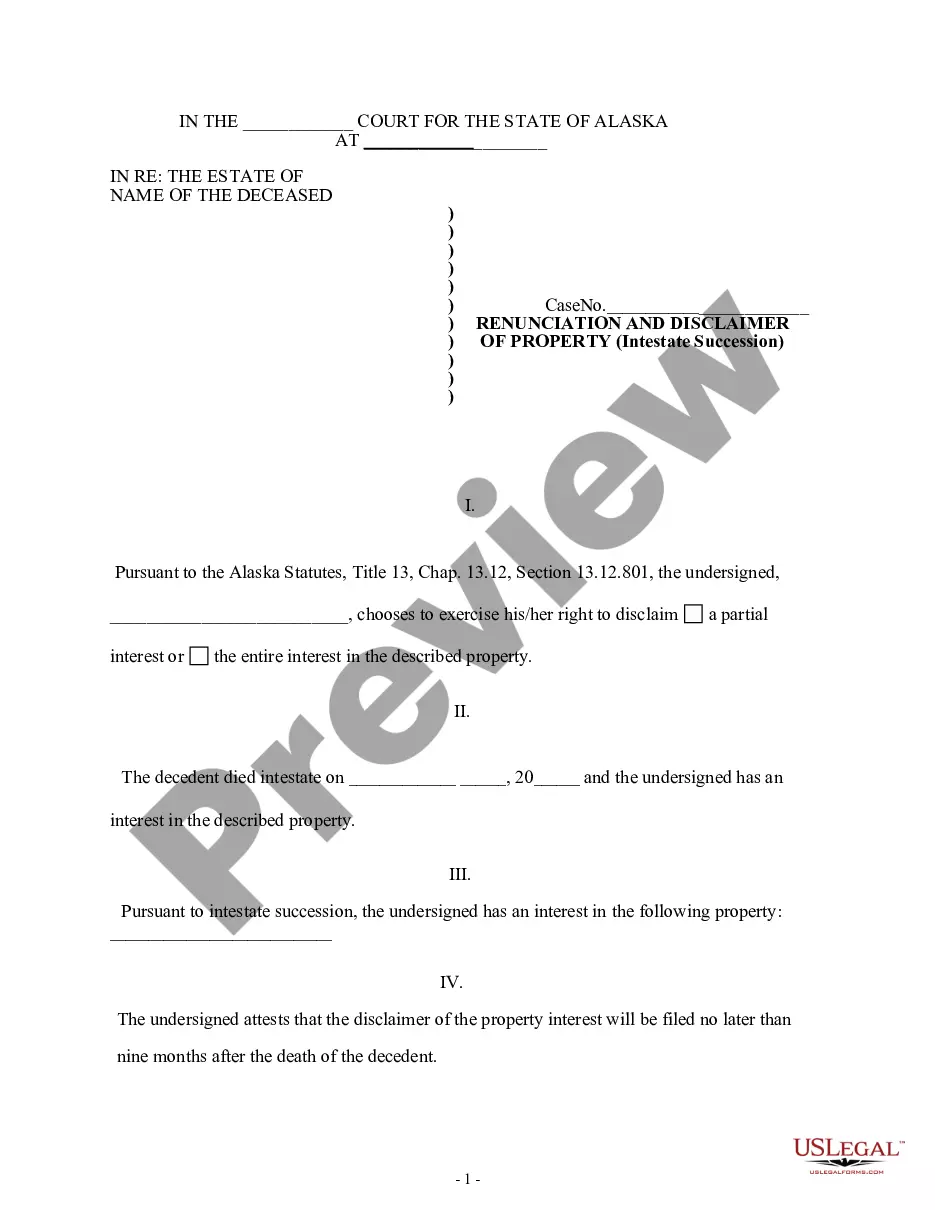
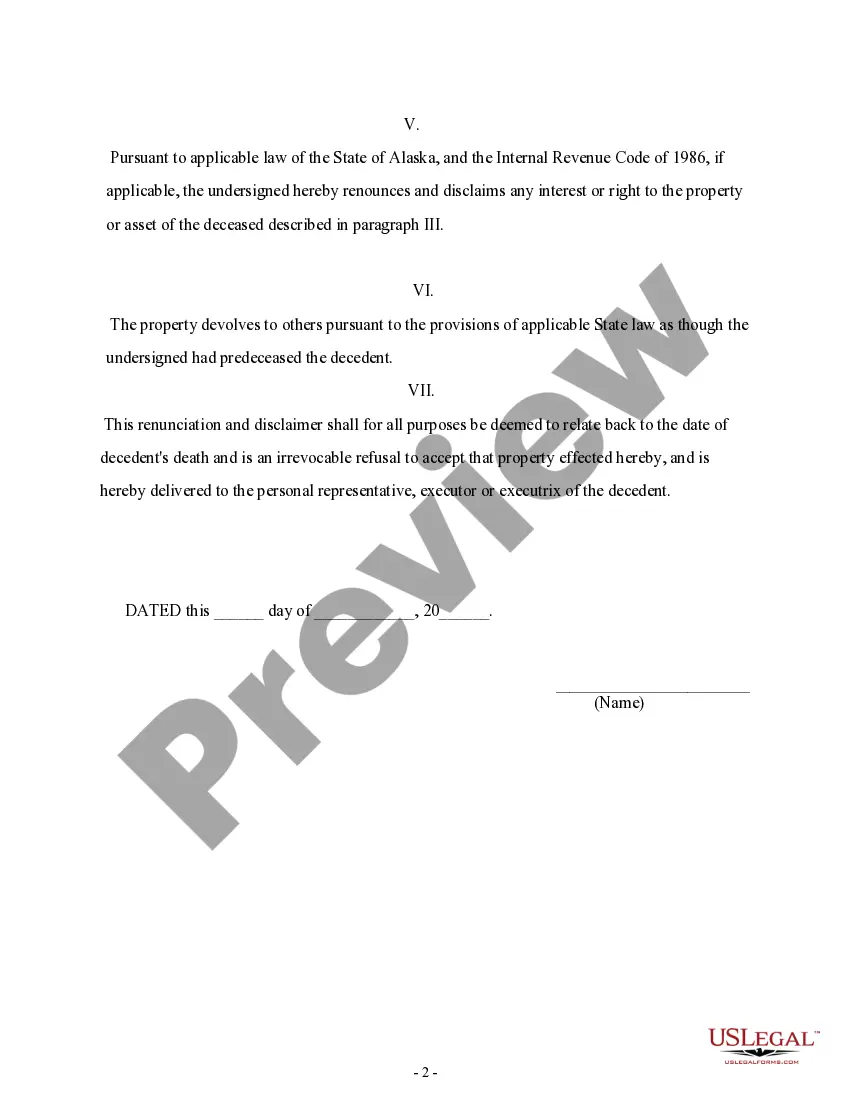
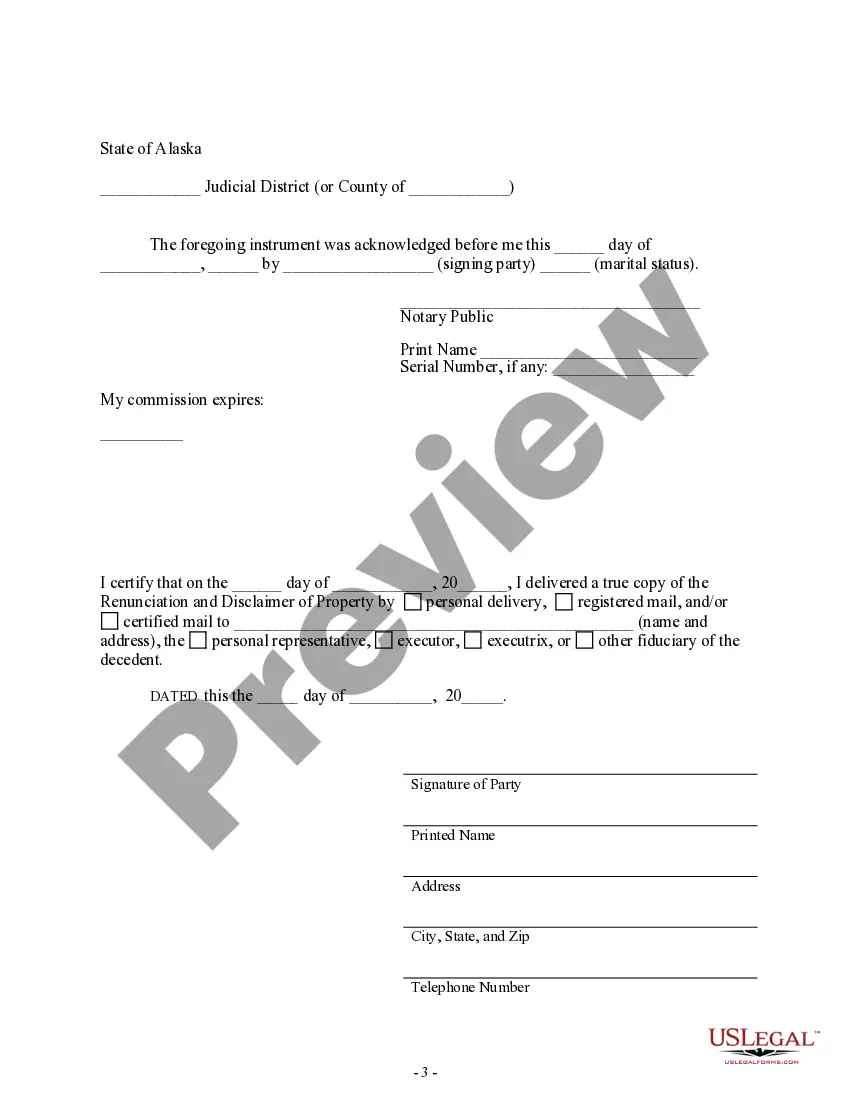
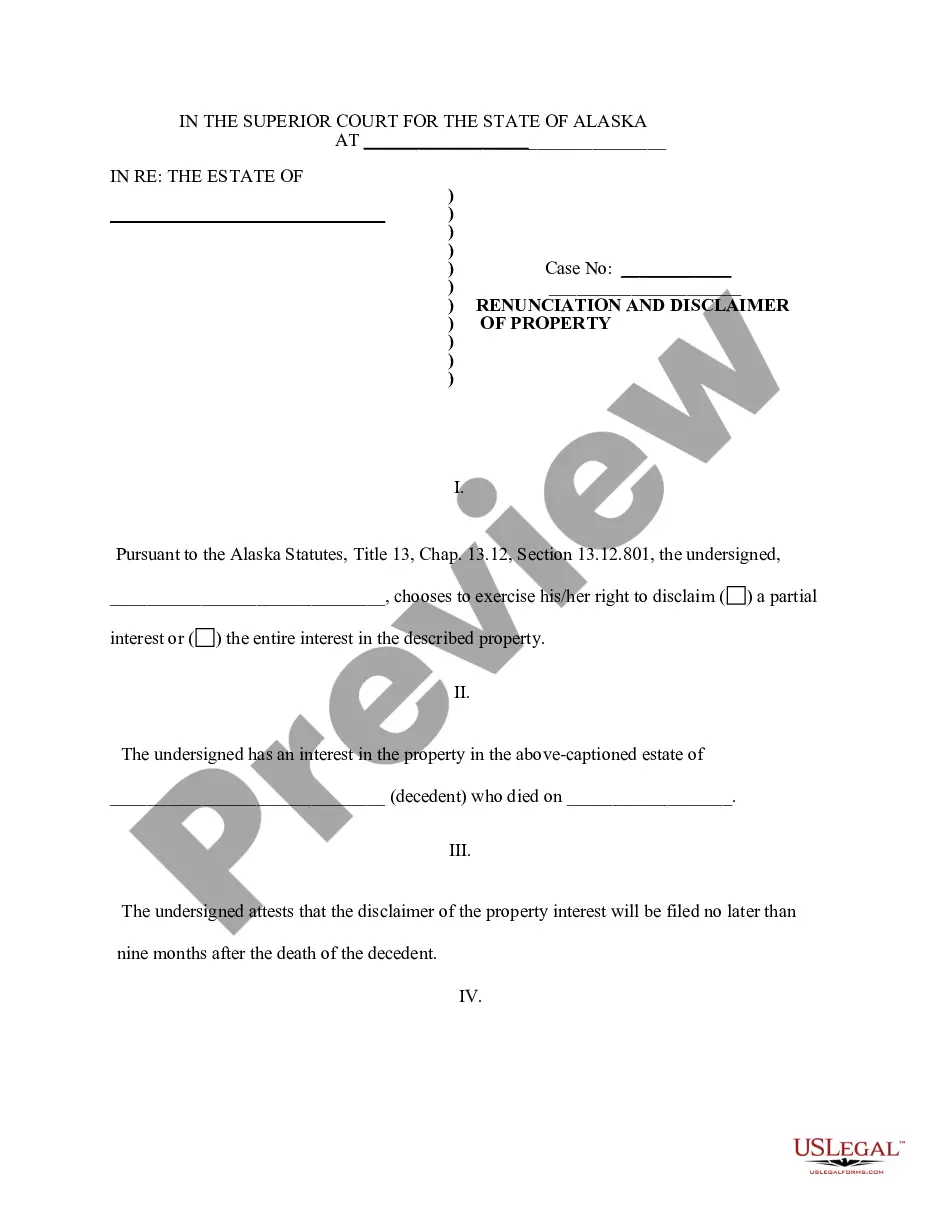
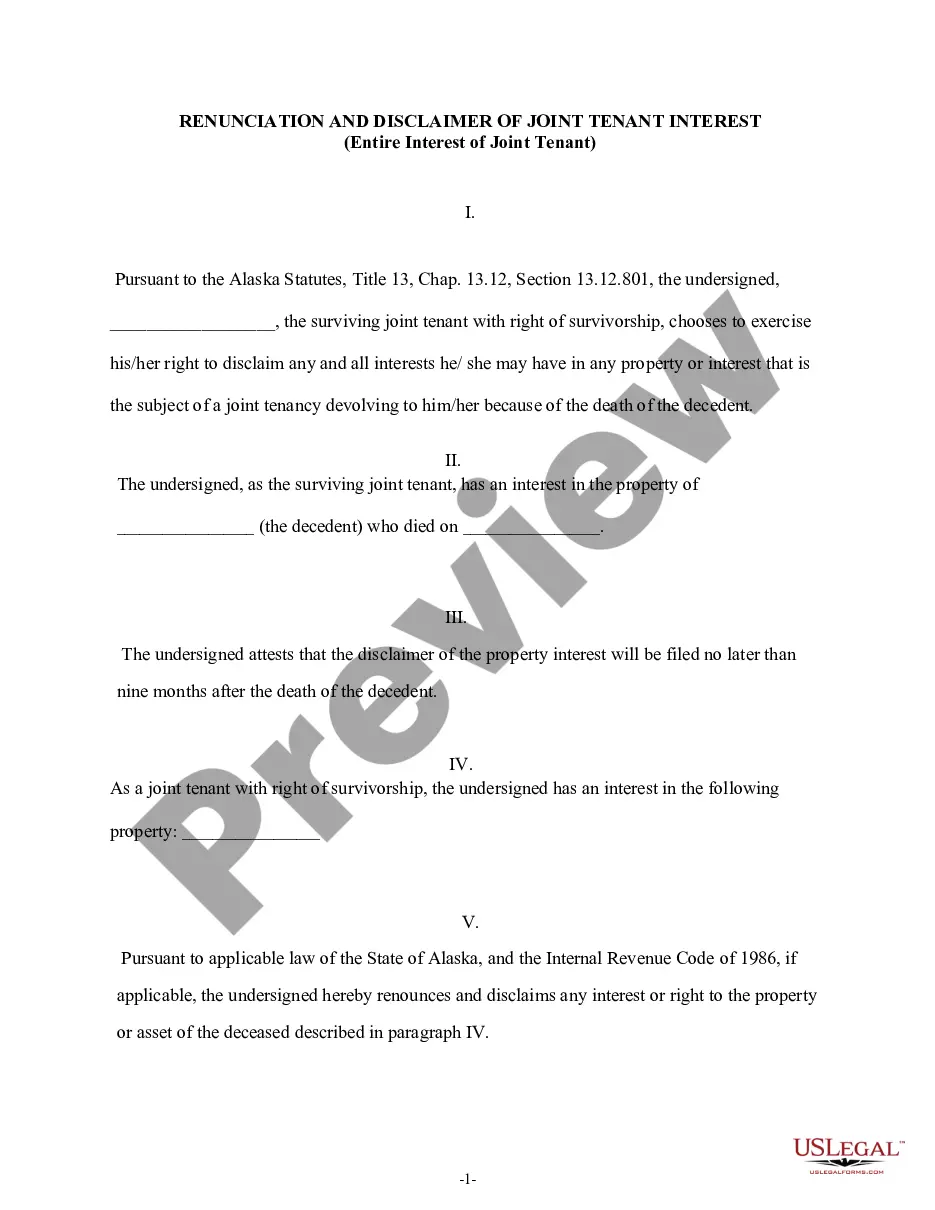
The Alaska Renunciation and Disclaimer of Property received by intestate succession is a legal document that allows a beneficiary to refuse their inherited property rights when the decedent has died without a will. By completing this form, a beneficiary can disclaim either part or all of their interest in the property, allowing it to pass on to other heirs as outlined in Alaska law. This form is specifically tailored to comply with the Alaska Statutes, ensuring that all legal requirements are met for disclaiming property received through intestate succession.
Main sections of this form
- Name of the deceased and case number.
- Statement of the beneficiaryâs decision to disclaim property.
- Date of decedent's death.
- Description of the property being disclaimed.
- Acknowledgment of the disclaimer's timing in relation to the decedent's death.
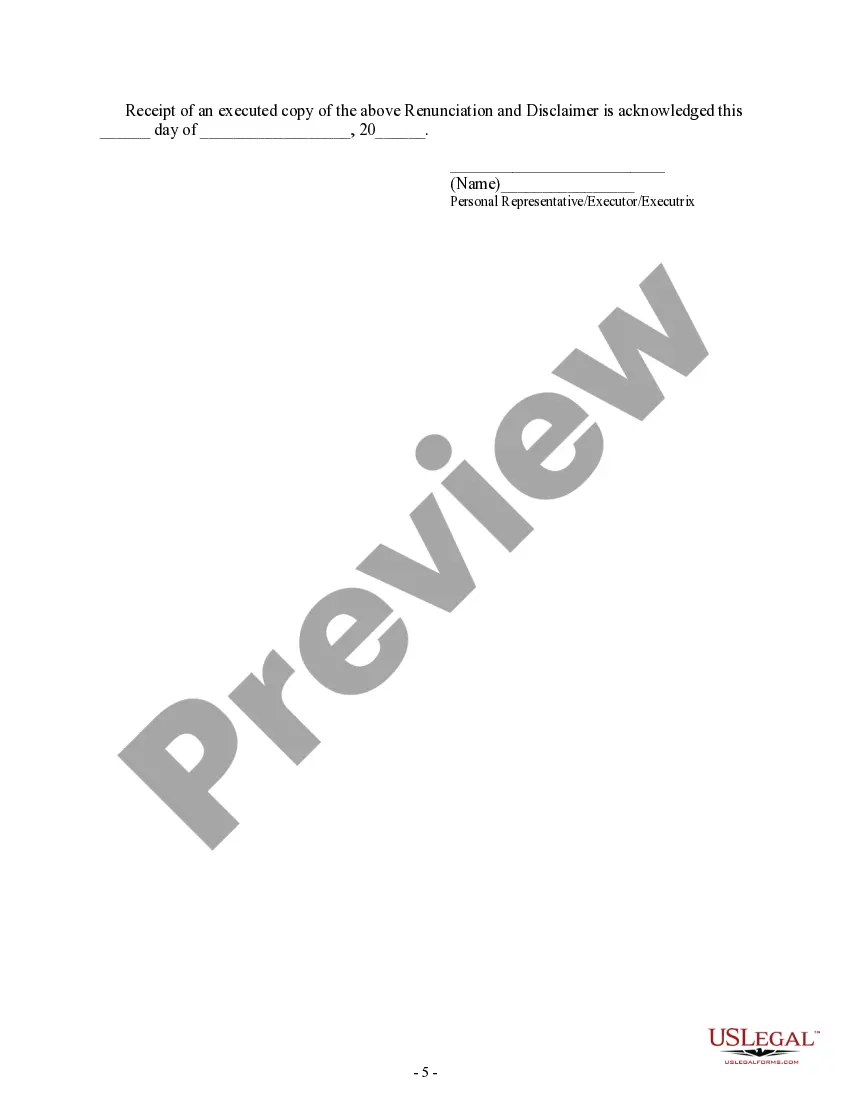
- Notarization section for the signing party.

Situations where this form applies
This form is useful in situations where an individual has inherited property following the intestate death of a family member but chooses not to accept their share. For example, if the property carries significant debts or liabilities, the beneficiary may wish to disclaim their interest to avoid those responsibilities. This form ensures that the disclaimer is executed correctly and legally.
Who needs this form
- Beneficiaries who have inherited property through intestate succession in Alaska.
- Individuals who wish to decline their inheritance for personal or financial reasons.
- Heirs looking to relieve themselves of responsibilities associated with the inherited property.
How to prepare this document
- Identify and enter the name of the deceased and case number at the top of the form.
- Complete the beneficiaryâs declaration regarding their decision to disclaim their interest.
- Fill in the date of the decedent's death.
- Describe the property that is being disclaimed.
- Sign the form in the presence of a notary public to validate your decision.
Does this form need to be notarized?
Yes, this form must be notarized to be legally valid. The signature of the beneficiary must be acknowledged before a notary public to ensure compliance with Alaska laws. US Legal Forms provides integrated online notarization services that are available 24/7, allowing for secure video appointments without the need for physical travel.
Get your form ready online
Our built-in tools help you complete, sign, share, and store your documents in one place.
Make edits, fill in missing information, and update formatting in US Legal Forms—just like you would in MS Word.
Download a copy, print it, send it by email, or mail it via USPS—whatever works best for your next step.
Sign and collect signatures with our SignNow integration. Send to multiple recipients, set reminders, and more. Go Premium to unlock E-Sign.
If this form requires notarization, complete it online through a secure video call—no need to meet a notary in person or wait for an appointment.
We protect your documents and personal data by following strict security and privacy standards.
Make edits, fill in missing information, and update formatting in US Legal Forms—just like you would in MS Word.
Download a copy, print it, send it by email, or mail it via USPS—whatever works best for your next step.
Sign and collect signatures with our SignNow integration. Send to multiple recipients, set reminders, and more. Go Premium to unlock E-Sign.

If this form requires notarization, complete it online through a secure video call—no need to meet a notary in person or wait for an appointment.
We protect your documents and personal data by following strict security and privacy standards.
Common mistakes
- Not filing the form within nine months after the decedent's death.
- Failing to provide a full description of the property being disclaimed.
- Not notarizing the form, which may invalidate the disclaimer.
Advantages of online completion
- Immediate access to a legally compliant form tailored for Alaska.
- The convenience of completing the form from home without needing legal counsel.
- The ability to download and edit the form as necessary before finalizing.
Quick recap
- The form is essential for beneficiaries wishing to disclaim property received through intestate succession.
- Proper completion and notarization are critical for legal validity.
- Using the form online simplifies the process while ensuring compliance with Alaska law.
Looking for another form?
Form popularity
FAQ
Disclaim, in a legal sense, refers to the renunciation of an interest in, or an acceptance of, inherited assets, such as property, by way of a legal instrument. A person disclaiming an interest, right, or obligation is known as a disclaimant.
Disclaimer may be revoked if procured by undue influence The disclaimed property passed to the disclaimant's nephew who was the contingent beneficiary of the will and the executor. The disclaimant then filed a document with the court purporting to revoke the disclaimer. The nephew objected and won summary judgment.
Disclaimer of interest, in the law of inheritance, wills and trusts, is a term that describes an attempt by a person to renounce their legal right to benefit from an inheritance (either under a will or through intestacy) or through a trust. A disclaimer of interest is irrevocable.
A "Disclaimer Will", sometimes referred to as a "Disclaimer Trust", is a flexible estate planning tool that can be implemented to benefit married couples whose combined estates are approaching or exceed the lifetime exemption amount for federal estate tax, resulting in substantial tax savings to the estate of the
A qualified disclaimer is a part of the U.S. tax code that allows estate assets to pass to a beneficiary without being subject to income tax. Legally, the disclaimer portrays the transfer of assets as if the intended beneficiary never actually received them.