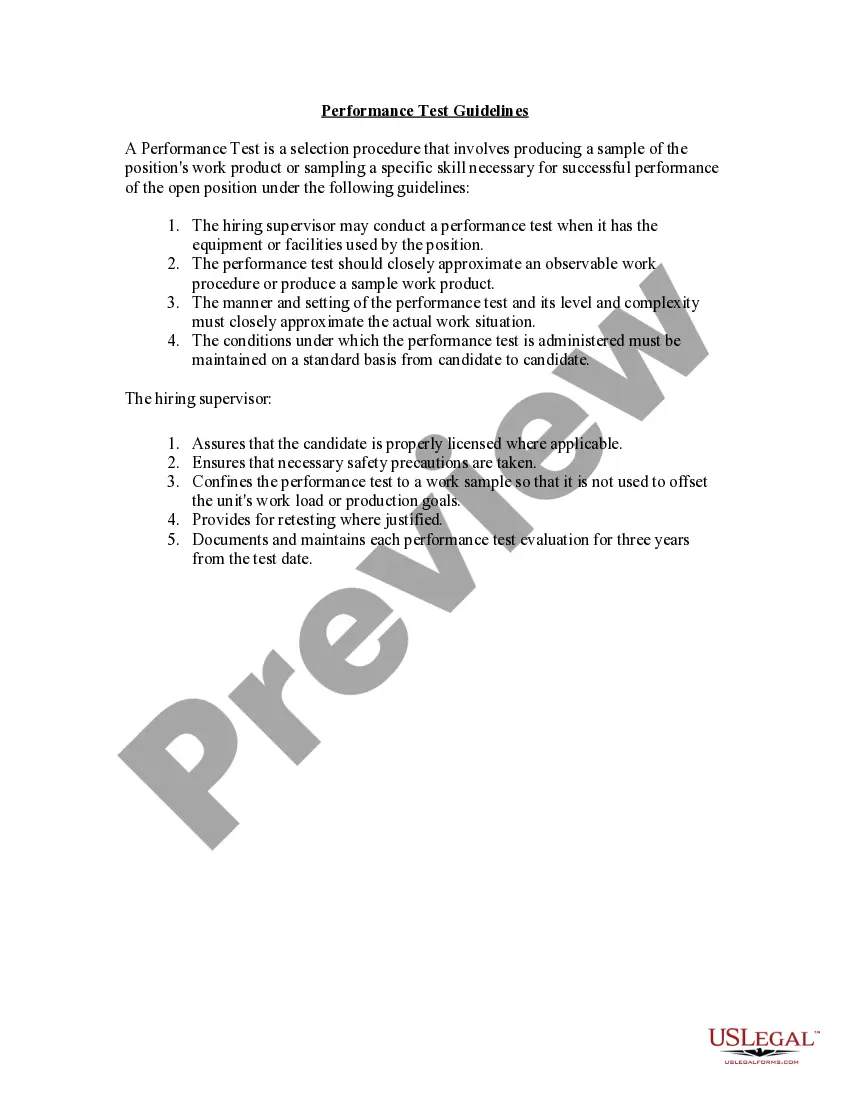
Performance Test Guidelines
Overview of this form
The Performance Test Guidelines form provides a structured approach for management to create effective performance tests for various job positions within a company. Unlike other hiring assessments, these guidelines focus specifically on evaluating a candidate's ability to perform tasks relevant to the job in a realistic work environment. They ensure a standardized method of assessing candidates' skills, thereby enhancing the hiring process and increasing the likelihood of selecting the right candidate for the position.
Main sections of this form
- Definition of a performance test, outlining its purpose and structure.
- Requirements for the hiring supervisor, including facilities and equipment to be used.
- Guidelines for conducting the test to closely mimic actual work tasks.
- Standardization procedures to ensure consistency across candidate evaluations.
- Documentation requirements for maintaining evaluation records for three years.

When this form is needed
This form is used when an employer needs to assess candidates for a job role that requires specific skills or abilities. It is particularly beneficial when the hiring supervisor wishes to evaluate a candidate's performance through practical means rather than solely on interviews or resumes. Common scenarios include hiring for technical positions, skilled trades, or roles that require precise expertise where real-time skills demonstration is critical.
Who should use this form
Ideal users of the Performance Test Guidelines include:
- HR managers looking to formalize their hiring process.
- Hiring supervisors needing to evaluate technical skills in candidates.
- Business owners seeking to implement a fair and objective assessment method.
- Recruiters responsible for assessing candidate qualifications for specific roles.
Instructions for completing this form
- Identify the specific skills or tasks needed for the job position.
- Gather the necessary equipment or materials that candidates will use during the test.
- Design a performance test that closely imitates actual work tasks associated with the position.
- Conduct the test in a consistent setting, ensuring all candidates experience the same conditions.
- Document each candidate's performance and maintain records for three years.
Notarization requirements for this form
In most cases, this form does not require notarization. However, some jurisdictions or signing circumstances might. US Legal Forms offers online notarization powered by Notarize, accessible 24/7 for a quick, remote process.
Get your form ready online
Our built-in tools help you complete, sign, share, and store your documents in one place.
Make edits, fill in missing information, and update formatting in US Legal Forms—just like you would in MS Word.
Download a copy, print it, send it by email, or mail it via USPS—whatever works best for your next step.
Sign and collect signatures with our SignNow integration. Send to multiple recipients, set reminders, and more. Go Premium to unlock E-Sign.
If this form requires notarization, complete it online through a secure video call—no need to meet a notary in person or wait for an appointment.
We protect your documents and personal data by following strict security and privacy standards.

Make edits, fill in missing information, and update formatting in US Legal Forms—just like you would in MS Word.

Download a copy, print it, send it by email, or mail it via USPS—whatever works best for your next step.

Sign and collect signatures with our SignNow integration. Send to multiple recipients, set reminders, and more. Go Premium to unlock E-Sign.

If this form requires notarization, complete it online through a secure video call—no need to meet a notary in person or wait for an appointment.

We protect your documents and personal data by following strict security and privacy standards.
Mistakes to watch out for
- Failing to standardize the testing conditions can lead to unfair assessments.
- Not aligning the performance test closely with job requirements may yield irrelevant results.
- Neglecting to document evaluations thoroughly can complicate future hiring decisions.
- Forgetting to ensure candidates have the necessary licenses or qualifications when applicable.
Why use this form online
- Convenience of accessing the form from anywhere at any time.
- Editability allows customization to meet specific job requirements.
- Quick download enables immediate implementation in the hiring process.
- Reliable templates drafted by licensed attorneys, ensuring legal compliance.
Legal use & context
- The Performance Test Guidelines are designed to ensure fair candidate evaluations.
- Performance tests should be applied consistently to avoid discrimination claims.
- Maintaining records of evaluations protects against legal disputes related to hiring decisions.
What to keep in mind
- The Performance Test Guidelines are essential for evaluating candidates based on practical skills.
- Consistent testing conditions help maintain fairness and objectivity in assessments.
- Documenting evaluations is crucial for compliance and future reference.
- This form is suitable for HR professionals and hiring managers across various industries.
Looking for another form?
Form popularity
FAQ
While performing Black box testing, the tester does not require the knowledge of coding. Tester simply tests the software by inputting the data and then checks the output. White box testing or code-driven testing requires code knowledge. Knowing various programming concepts like C, C#, C++, RDBMS concept, etc.
Build a Complete Test Strategy. Start with a detailed test strategy to determine the types of tests that you need to perform to perfect the application. Try to Include Think Time in Testing. Identify the Performance Bottleneck. Learn from Earlier Experiences. Emphasize on Baseline Tests.
Requirements testing is done to clarify whether project requirements are feasible or not in terms of time, resources and budget. Many bugs emerge in software because of incompleteness, inaccuracy and ambiguities in functional requirements.
Performance requirements typically comprise a set of criteria which stipulate how things should perform or the standards that they must achieve in a specific set of circumstances. This is as opposed to prescriptive specifications which set out in precise detail how something should be done.
Determine a suitable software candidate; clarify performance goals; create meaningful test cases; use suitable performance testing tools; and. mimic the production environment.
Performance Testing is a software testing process used for testing the speed, response time, stability, reliability, scalability and resource usage of a software application under particular workload. It is a subset of performance engineering and also known as Perf Testing.
Speed It determines whether the application responds quickly. Scalability It determines maximum user load the software application can handle. Stability It determines if the application is stable under varying loads.
Load testing is one of the simplest forms of performance testing and is usually conducted to understand the behaviour of the system under a specific expected load, for example, the amount of concurrent users on the application performing a specific number of functions within a set duration.
The type of the test to be executed (Load/Stress etc) The load profile/load model should be agreed for each test type (ramp-up/down, steps etc) Incorporate think time into the scenarios.