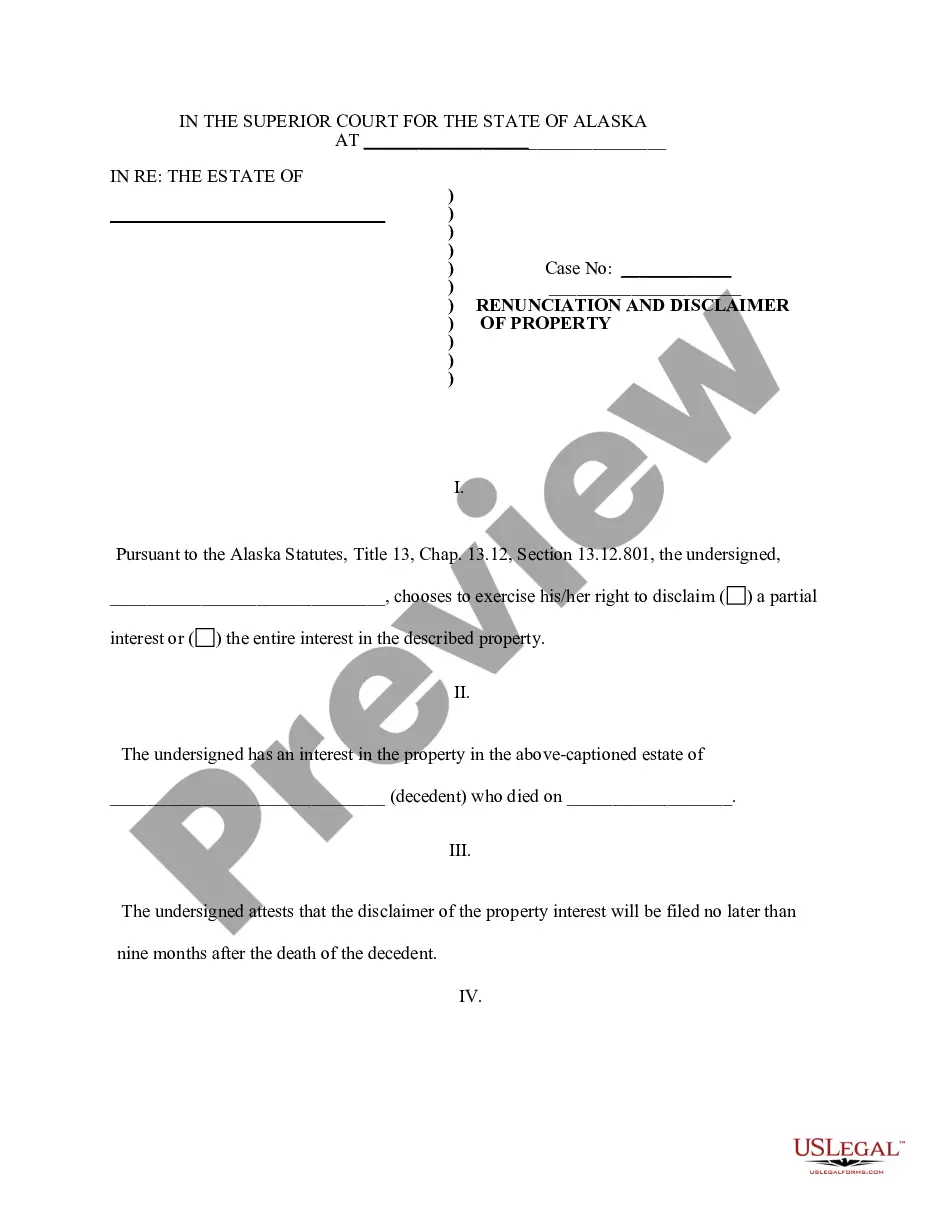
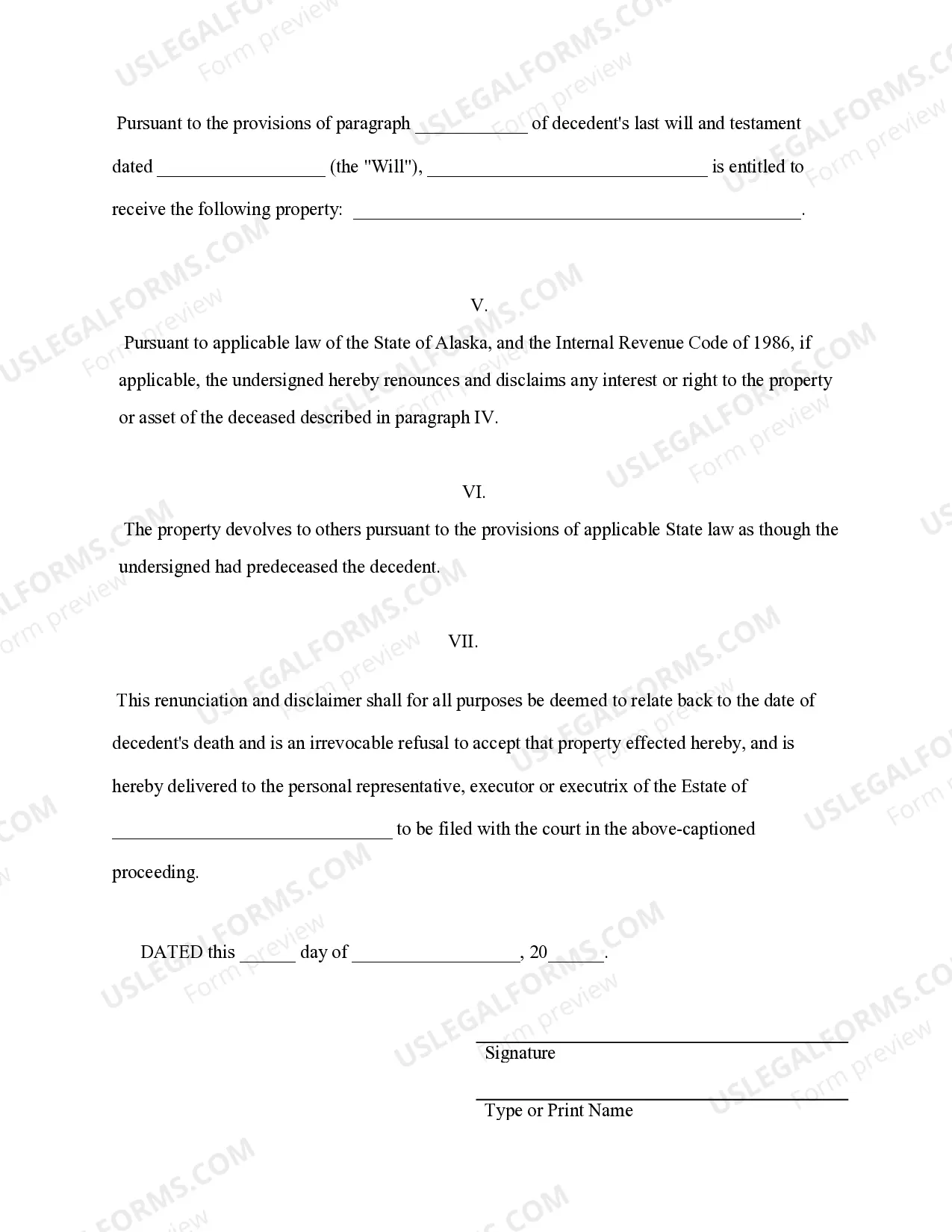
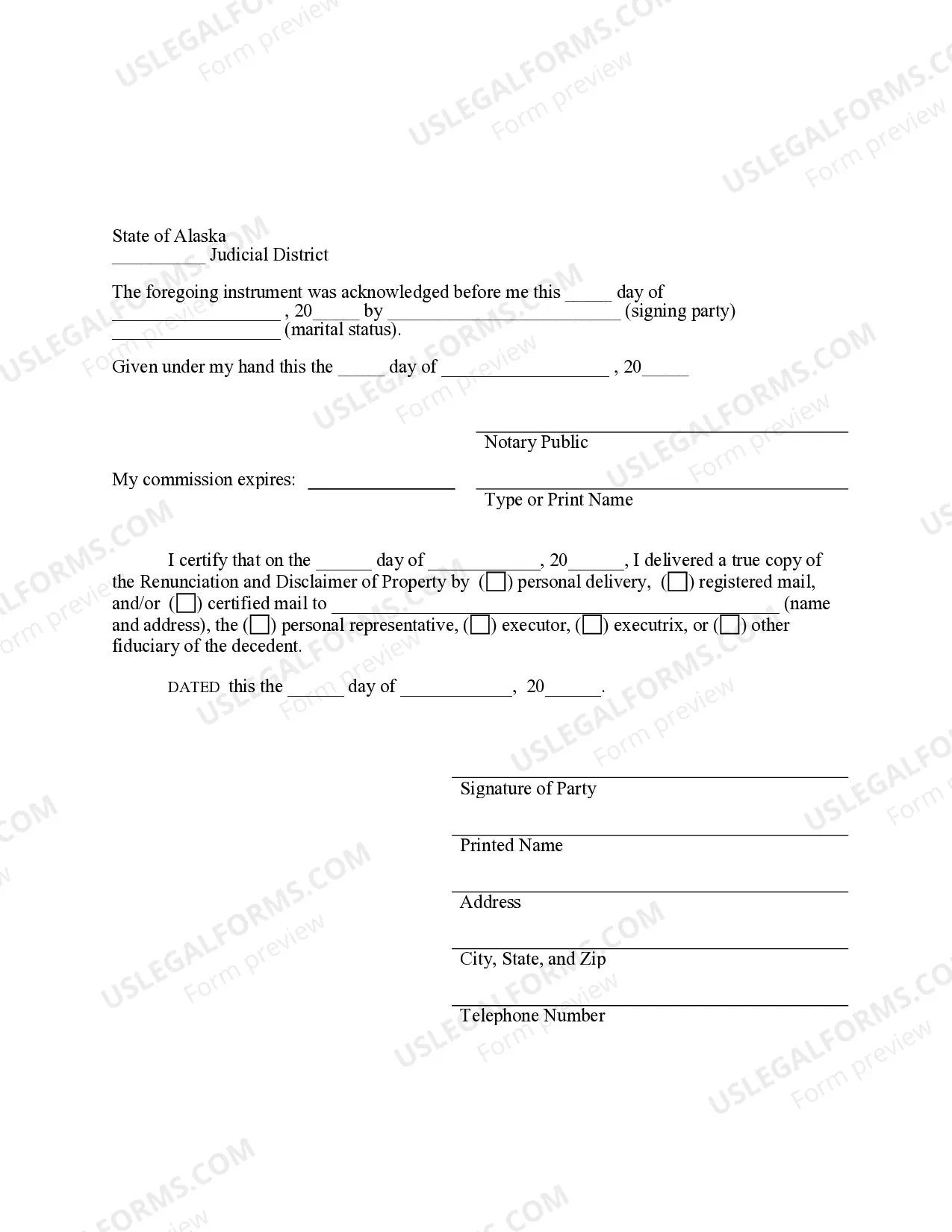
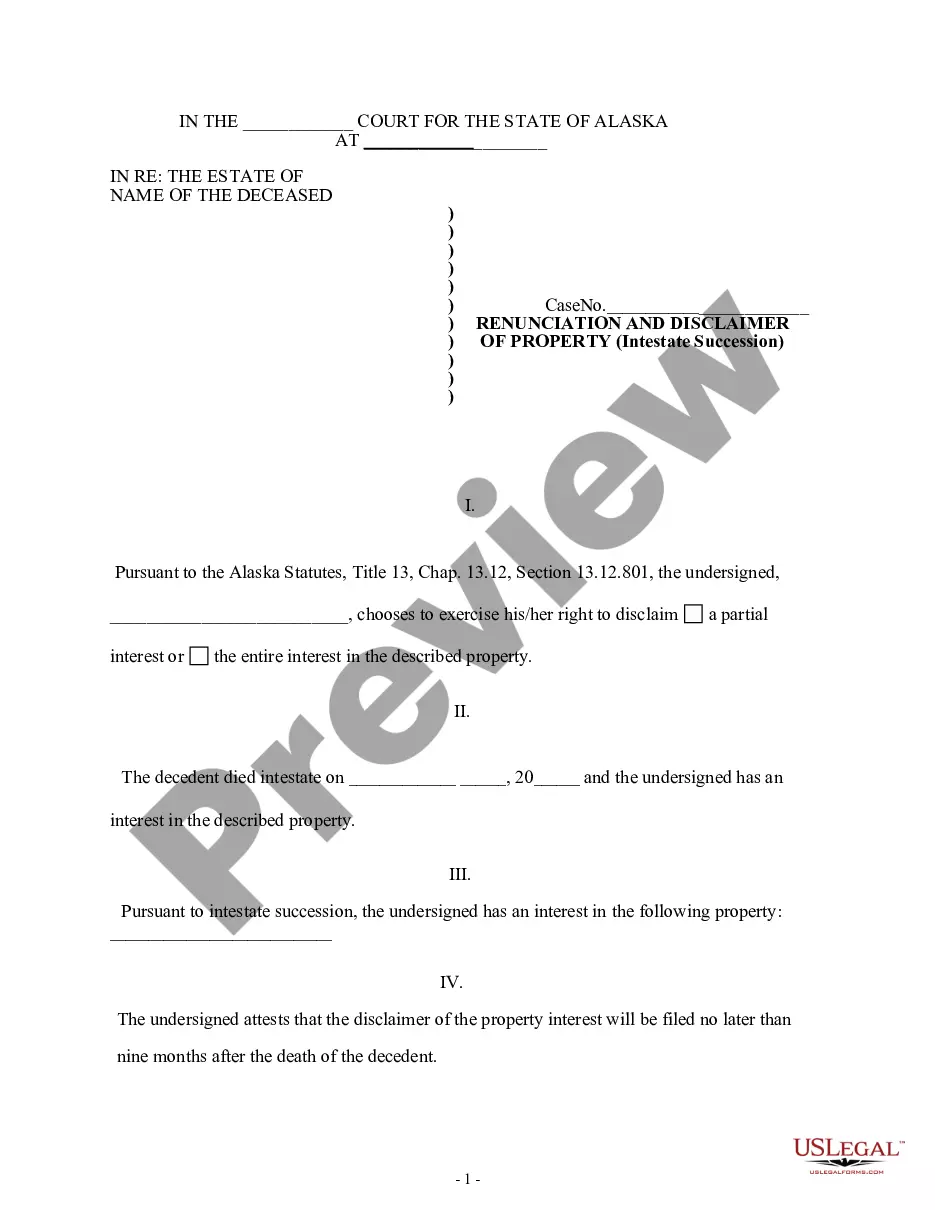
Alaska Renunciation and Disclaimer of Property from Will by Testate
Title 13. DECEDENTS' ESTATES, GUARDIANSHIPS, TRANSFERS, AND TRUSTS
Chapter 13.12. INTESTACY, WILLS, AND DONATIVE TRANSFERS
Disclaimer of property interests.
(a) A person, or the representative of a person, to whom
an interest in or with respect to property, or an interest in the property,
devolves by whatever means, may disclaim it in whole or in part by delivering
or filing a written disclaimer under this section. The right to disclaim
exists notwithstanding a limitation on the interest of the disclaimant
in the nature of a spendthrift provision or similar restriction, and notwithstanding
a restriction or limitation on the right to disclaim contained in the governing
instrument. In this subsection, the "representative of a person" includes
a personal representative of a decedent, a conservator of a disabled person,
a guardian of a minor or incapacitated person, and an agent acting on behalf
of the person within the authority of a power of attorney.
(b) If a property or interest has devolved to a disclaimant under
a testamentary instrument or by the laws of intestacy, a disclaimer shall
be filed, if of a present interest, not later than nine months after the
death of the deceased owner or deceased donee of a power of appointment
and, if of a future interest, not later than nine months after the event
determining that the taker of the property or interest is finally ascertained
and the taker's interest is indefeasibly vested. The disclaimer shall be
filed in the court of the judicial district in which proceedings for the
administration of the estate of the deceased owner or deceased donee of
the power are commenced. A copy of the disclaimer shall be delivered in
person or mailed by registered or certified mail, return receipt requested,
to a personal representative or other fiduciary of the decedent or donee
of the power.
(c) If a property or interest has devolved to a disclaimant under
a nontestamentary instrument or contract, the disclaimer shall be delivered
or filed, if of a present interest, not later than nine months after the
effective date of the nontestamentary instrument or contract and, if of
a future interest, not later than nine months after the event determining
that the taker of the property or interest is finally ascertained and the
taker's interest is indefeasibly vested. If the person entitled to disclaim
does not know of the existence of the interest, the disclaimer shall be
delivered or filed not later than nine months after the person learns of
the existence of the interest. The effective date of a revocable instrument
or contract is the date on which the maker no longer has power to revoke
it or to transfer to the maker or another the entire legal and equitable
ownership of the interest. The disclaimer or a copy of the disclaimer shall
be delivered in person or mailed by registered or certified mail, return
receipt requested, to the person who has legal title to or possession of
the interest disclaimed.
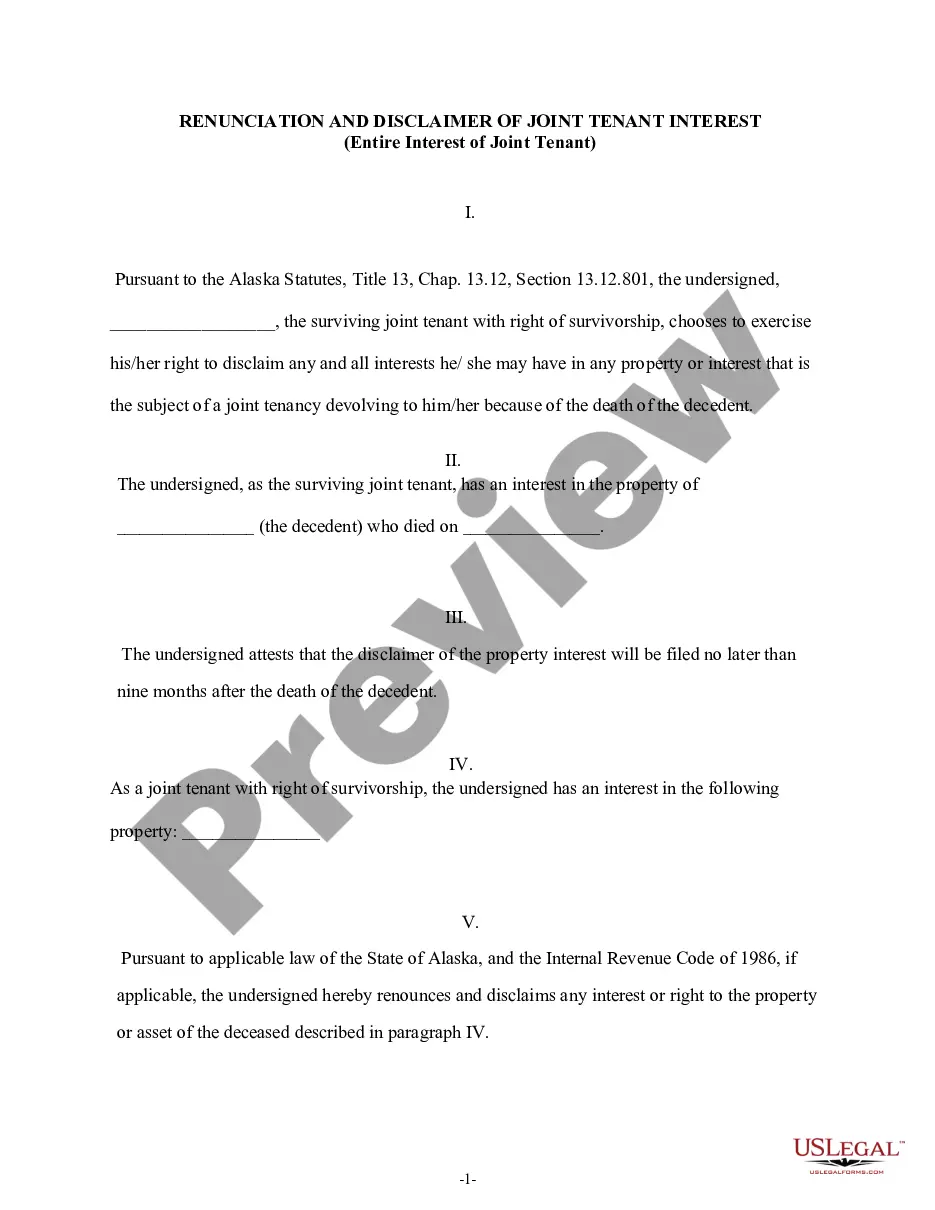
(d) A surviving joint tenant or tenant by the entirety may disclaim
as a separate interest property, or an interest in the property, devolving
to the tenant by right of survivorship. A surviving joint tenant or tenant
by the entirety may disclaim the entire interest in property, or in an
interest in the property, that is the subject of a joint tenancy or tenancy
by the entirety devolving to the tenant, if the joint tenancy or tenancy
by the entirety was created by act of a deceased joint tenant or tenant
by the entirety, the survivor did not join in creating the joint tenancy
or tenancy by the entirety, and the survivor has not accepted a benefit
under it.
(e) If real property, or an interest in real property, is disclaimed,
a copy of the disclaimer may be recorded in the recording district where
the property or interest disclaimed is located.
(f) The disclaimer must describe the property or interest disclaimed,
declare the disclaimer and extent of the disclaimer, and be signed by the
disclaimant.
(g) If property or an interest in property devolves to a disclaimant
under a testamentary instrument, under a power of appointment exercised
by a testamentary instrument, or under the laws of intestacy, and the decedent
has not provided for another disposition of that property or interest,
should it be disclaimed, or of disclaimed or failed interests in general,
the disclaimed property or interest devolves as if the disclaimant had
predeceased the decedent, but if by law or under the testamentary instrument
the descendants of the disclaimant would share in the disclaimed interest
by representation or otherwise were the disclaimant to predecease the decedent,
then the disclaimed property or interest passes by representation, or passes
as directed by the governing instrument, to the descendants of the disclaimant
who survive the decedent. A future interest that takes effect in possession
or enjoyment after the termination of the estate or interest disclaimed
takes effect as if the disclaimant had predeceased the decedent. A disclaimer
relates back for all purposes to the date of death of the decedent.
(h) If property or an interest in property devolves to a disclaimant
under a nontestamentary instrument or contract and the instrument or contract
does not provide for another disposition of that property or interest,
should it be disclaimed, or of disclaimed or failed interests in general,
the disclaimed property or interest devolves as if the disclaimant had
predeceased the effective date of the instrument or contract, but if by
law or under the nontestamentary instrument or contract the descendants
of the disclaimant would share in the disclaimed interest by representation
or otherwise were the disclaimant to predecease the effective date of the
instrument, then the disclaimed property or interest passes by representation,
or passes as directed by the governing instrument, to the descendants of
the disclaimant who survive the effective date of the instrument. A disclaimer
relates back for all purposes to that date. A future interest that takes
effect in possession or enjoyment at or after the termination of the disclaimed
property or interest takes effect as if the disclaimant had died before
the effective date of the instrument or contract that transferred the disclaimed
property or interest.
(i) The disclaimer or the written waiver of the right to disclaim
is binding upon the disclaimant or person waiving and all persons claiming
through or under either of them.
(j) The right to disclaim property or an interest in property is
barred by:
(1) an assignment, conveyance, encumbrance, pledge, or
transfer of the property or interest, or a contract for an assignment,
conveyance, encumbrance, pledge, or transfer of the property or interest;
(2) a written waiver of the right to disclaim;
(3) an acceptance of the property or interest or a benefit under
it; or
(4) a sale of the property or interest under judicial sale made
before the disclaimer is made.
(k) This section does not abridge the right of a person to waive, release,
disclaim, or renounce property or an interest in property under another
statute.
(l) An interest in property that exists on January 1, 1997, as to
which, if a present interest, the time for filing a disclaimer under this
section has not expired or, if a future interest, the interest has not
become indefeasibly vested or the taker finally ascertained, may be disclaimed
within nine months after January 1, 1997.
Title 13, Chap. 13.12, Sec. 13.12.801.