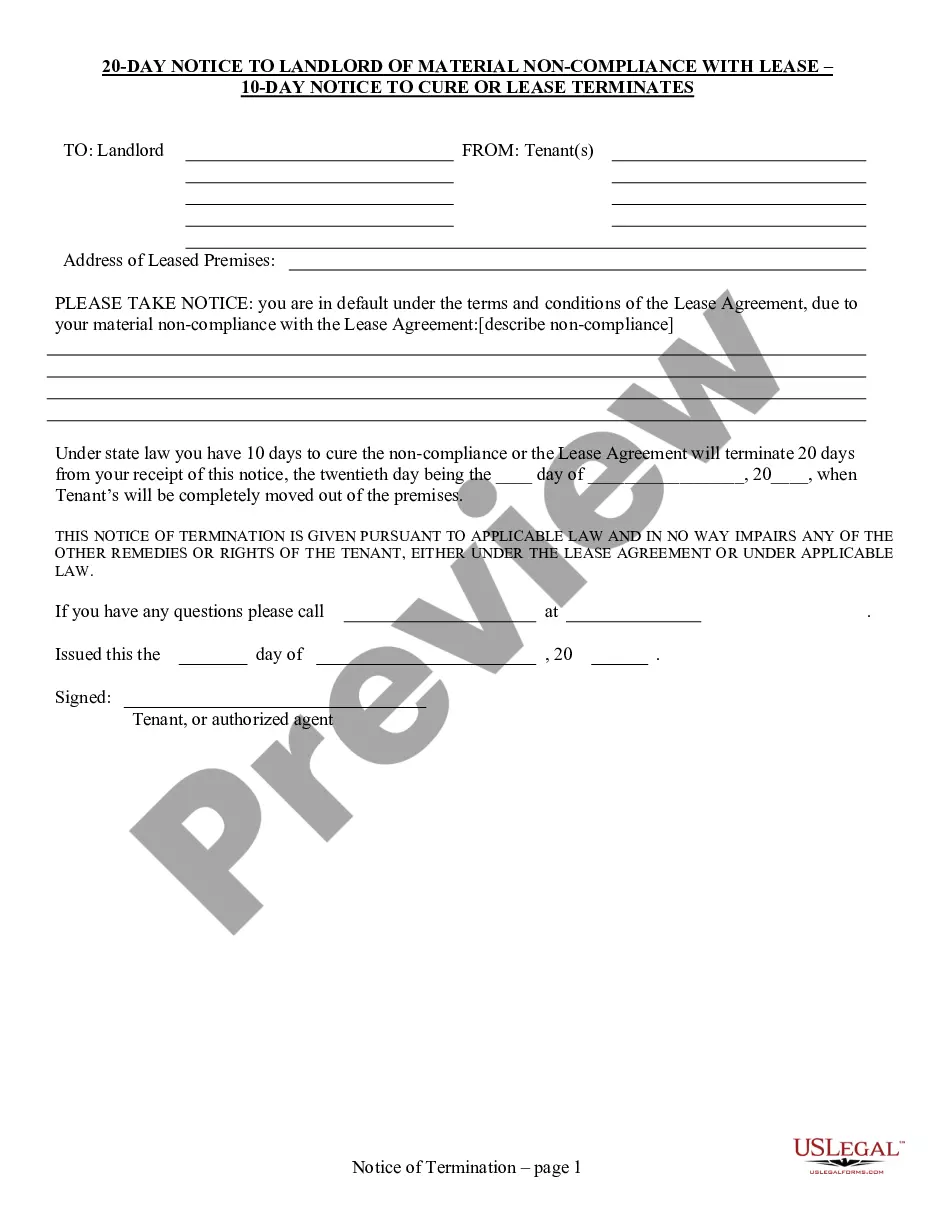
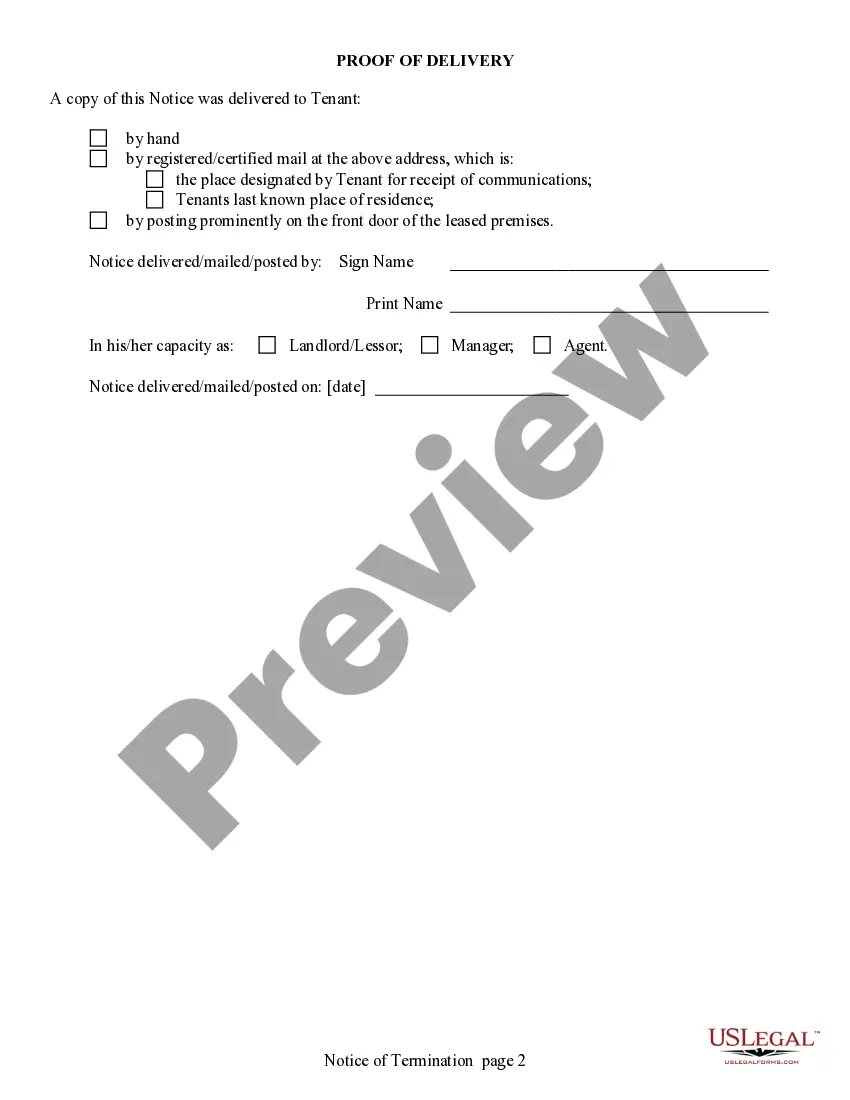
This 20-Day Notice to Landlord of Material Non-Compliance with Lease 10 Days to Cure - Residential - Tenant to Landlord form is for use by Tenant to notify Landlord of Landlord's material non-compliance with the lease agreement, and to demand cure within 10 days, or the lease will terminate, and tenant will vacate, in 20 days.
Alaska 20 Day Notice of Material Noncompliance with Lease - 10 Days to Cure - Residential - Tenant to Landlord
State:
Alaska
Control #:
AK-1225LT
Format:
Word;
Rich Text
Instant download
Description
Free preview


How to fill out Alaska 20 Day Notice Of Material Noncompliance With Lease - 10 Days To Cure - Residential - Tenant To Landlord?
Employing the Alaska 20 Day Notification of Material Noncompliance with Lease - 10 Days to Remedy - Residential - Tenant to Landlord instances crafted by proficient attorneys helps you sidestep frustrations when completing paperwork.
Simply download the template from our site, complete it, and request legal advice to review it. This method will conserve you significantly more time and effort than asking a lawyer to create a document from scratch to meet your specifications.
Should you possess a US Legal Forms subscription, just Log In to your account and revisit the form page. Look for the Download button close to the templates you are reviewing. After downloading a document, your saved samples will be found in the My documents section.
Once you have executed all the steps mentioned above, you'll have the capability to complete, print, and sign the Alaska 20 Day Notification of Material Noncompliance with Lease - 10 Days to Remedy - Residential - Tenant to Landlord template. Remember to double-check all entered information for accuracy prior to submitting or sending it. Reduce the time spent on generating documents with US Legal Forms!
- If you don't possess a subscription, that's perfectly fine.
- Simply adhere to the instructions below to register for an online account, acquire, and complete your Alaska 20 Day Notification of Material Noncompliance with Lease - 10 Days to Remedy - Residential - Tenant to Landlord template.
- Double-check and confirm that you’re obtaining the appropriate state-specific form.
- Employ the Preview function and review the description (if available) to determine if this particular sample is needed and if so, just click Buy Now.
- If needed, locate another template using the Search field.
- Choose a subscription that accommodates your requirements.
- Commence using your credit card or PayPal.
- Opt for a file format and download your document.
Form popularity
FAQ
In cases like this, landlords are entitled to deduct the remaining tax basis in capitalized leasehold improvements made for a particular tenant upon termination of the lease if such improvements are irrevocably disposed of or abandoned and won't be used by a subsequent tenant.
Your name, and the landlord's name and address. The date you're writing the letter. Informing the landlord you're breaking your lease early. The reason why you're breaking your lease. The building and apartment you're vacating. The date by which you're vacating.
The rental property address, including unit number (if applicable) The names of all tenants on the lease agreement. The date the lease violation notice was written. The specific reason for the notice. The time and date the violation occurred (if applicable)
The date that the tenant warning letter was written. The name and the basic personal information of the tenant. The name of the landlord or the owner of the property. The reason why a tenant warning letter has been written.
Can a tenant claim for improvements made during the lease? The position differs in the case of immovable and movable property. Tenant can claim for:The claim arises only once the lease is terminated and lessee vacated the property.
Often, landlords will provide a 'leasehold improvement allowance' for their tenants which is merely a set amount they agree to pay for. If the improvements you want cost more than the allowance, you will be responsible for those extra costs.
If the tenant does not leave by the date and time given in the notice, then the landlord must apply for a court order within 10 days to end the tenancy. If the landlord does not apply within 10 days, the tenancy stays in place and the tenant can continue living in the property.
A lease is automatically void when it is against the law, such as a lease for an illegal purpose. In other circumstances, like fraud or duress, a lease can be declared void at the request of one party but not the other.
When a landlord fails to meet these standards despite reasonable requests by the tenant, he or she may be sued for "material noncompliance." This article covers the basics of material noncompliance, which is essentially a breach of contract in the context of landlord tenant law.