Closing of Ways Code or Ordinance
Overview of this form
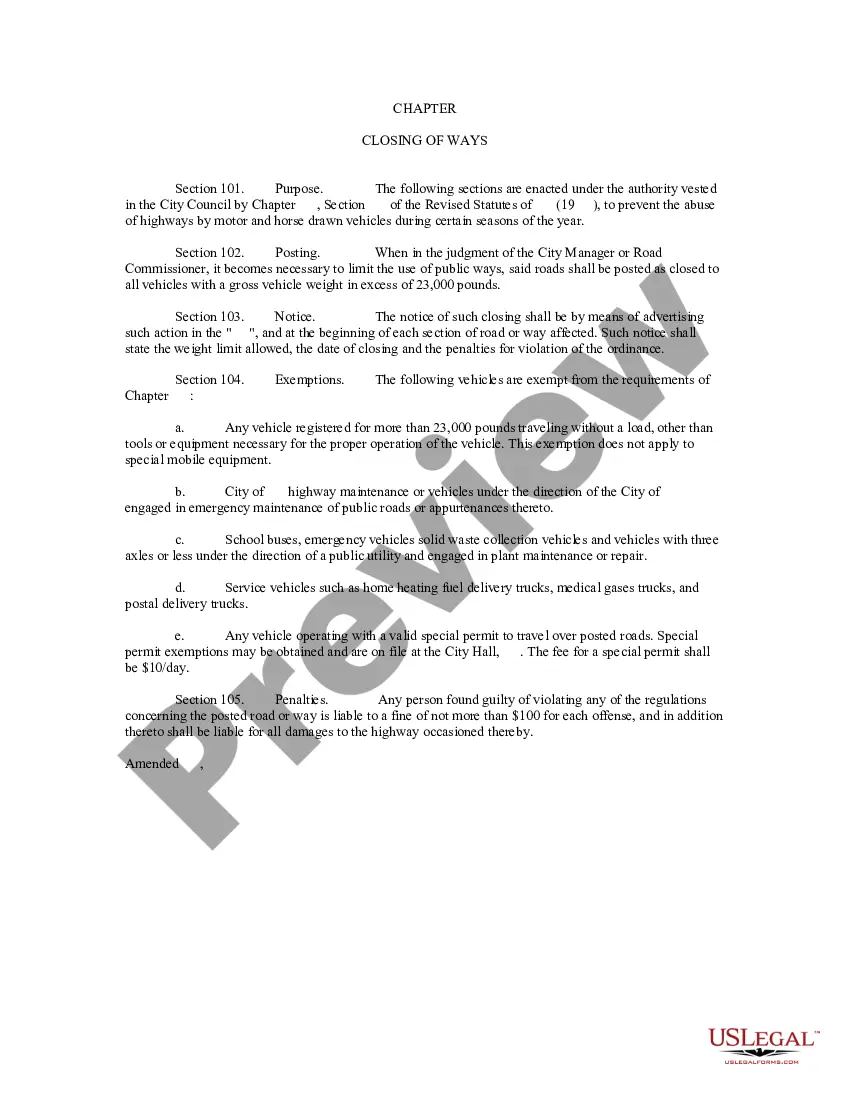
The Closing of Ways Code or Ordinance is a municipal code template that outlines the procedures for temporarily closing certain roads or streets. This form is designed to limit access to public ways to protect highways from damage by heavy vehicles during specific seasons. It is applicable across various jurisdictions in the United States and serves to enforce restrictions on road usage for vehicles exceeding a specified weight limit.
What’s included in this form
- Purpose: Establishes the authority for closing roads during certain seasons.
- Posting Requirements: Details the process for posting closures and the limitations on vehicle weight.
- Notice: Specifies how and where to advertise the closures, including weight limits and penalties.
- Exemptions: Lists vehicles exempt from the weight restrictions, such as emergency and service vehicles.
- Penalties: Outlines fines for violations related to the road closures.
Common use cases
This form should be used by municipal authorities when there is a need to restrict access to certain public roads due to seasonal conditions that could lead to damage from heavy vehicles. It is particularly useful during winter months or periods of road maintenance to protect the infrastructure and ensure public safety.
Who needs this form
- City Councils and Municipalities responsible for maintaining public roads.
- City Managers or Road Commissioners who assess road conditions and determine closure needs.
- Local law enforcement or administrative agencies enforcing road usage regulations.
Steps to complete this form
- Identify the authority under which the ordinance is enacted, including the relevant statutes.
- Specify the streets or ways that will be closed and the criteria for closure.
- Determine and insert the appropriate weight limit for vehicles affected by the closure.
- Prepare and publish the required notices in local media and at the beginning of the affected roads.
- Establish penalties for violations of the ordinance, including fine amounts.
Does this document require notarization?
This form usually doesn’t need to be notarized. However, local laws or specific transactions may require it. Our online notarization service, powered by Notarize, lets you complete it remotely through a secure video session, available 24/7.
Get your form ready online
Our built-in tools help you complete, sign, share, and store your documents in one place.
Make edits, fill in missing information, and update formatting in US Legal Forms—just like you would in MS Word.
Download a copy, print it, send it by email, or mail it via USPS—whatever works best for your next step.
Sign and collect signatures with our SignNow integration. Send to multiple recipients, set reminders, and more. Go Premium to unlock E-Sign.
If this form requires notarization, complete it online through a secure video call—no need to meet a notary in person or wait for an appointment.
We protect your documents and personal data by following strict security and privacy standards.

Make edits, fill in missing information, and update formatting in US Legal Forms—just like you would in MS Word.

Download a copy, print it, send it by email, or mail it via USPS—whatever works best for your next step.

Sign and collect signatures with our SignNow integration. Send to multiple recipients, set reminders, and more. Go Premium to unlock E-Sign.

If this form requires notarization, complete it online through a secure video call—no need to meet a notary in person or wait for an appointment.

We protect your documents and personal data by following strict security and privacy standards.
Common mistakes to avoid
- Failing to adequately publicize closures, leading to confusion among road users.
- Not specifying exemptions clearly, which can cause frustration for essential services.
- Neglecting to update the ordinance for changes in legislation or policy.
Why use this form online
- Convenience of instant access and download, allowing for quick implementation.
- Editability to customize the ordinance based on local conditions and needs.
- Reliability since the forms are drafted by licensed attorneys familiar with legal requirements.
Key takeaways
- The Closing of Ways Code or Ordinance is essential for managing road closures effectively and legally.
- Clear communication through notices is critical to inform the public about road restrictions.
- Proper documentation ensures local authorities comply with legal standards and protect public infrastructure.
Looking for another form?



Form popularity
FAQ
To close the deal on your home, you need a closing agent (also called a settlement or escrow agent). They'll coordinate document signing for all the parties, verify that both you and the seller have met the terms of the purchase agreement, and finally pay out all funds, transfer the title, and record the deed.
If you need to bump your closing date, check with the other parties involved in the sale to make sure the new date works. The real estate agent or attorney of the party who needs the date change will make phone calls on behalf of their client to get the date moved.
If the sale of their house is delayed or unlikely, the seller has the right to terminate the contract. When the closing date was originally determined and the contract signed by both parties, that contract is binding.
California Real Estate Disclosure Requirements In California, sellers must provide a Transfer Disclosure Statement (TDS) to any potential buyer whose offer has been accepted.It asks about the condition of the roof, the electrical wiring, appliances, smoke detectors and other relevant features of the property.
The seller of a one-to-four unit residential property completes and delivers to a prospective buyer a statutory form called a Transfer Disclosure Statement (TDS), more generically called a Condition of Property Disclosure Statement.
Failing to close on the agreed-upon date would be a breach of contract (assuming that the closing date was one of the contractual terms).In that case, the buyer would not be in breach of the contract for not having financing, since the buyer's breach was caused by seller's.
Do not exclude any information. Be honest. Write clearly. Use simple words in writing your income statement for disclosure. Attach necessary documents to your disclosure statement. Review and revise.
If that date passes and the sale has not closed, either party can back out of the deal. For example, a buyer's penalty for missing the closing date might include paying a portion of the seller's mortgage to compensate the seller for keeping her property longer than planned.
The Transfer Disclosure Statement, also known as the TDS, is a form required by California law in most residential real estate transactions pursuant to California Civil Code 1102.The items seller will disclose here are material facts of seller's actual knowledge regarding the subject property.