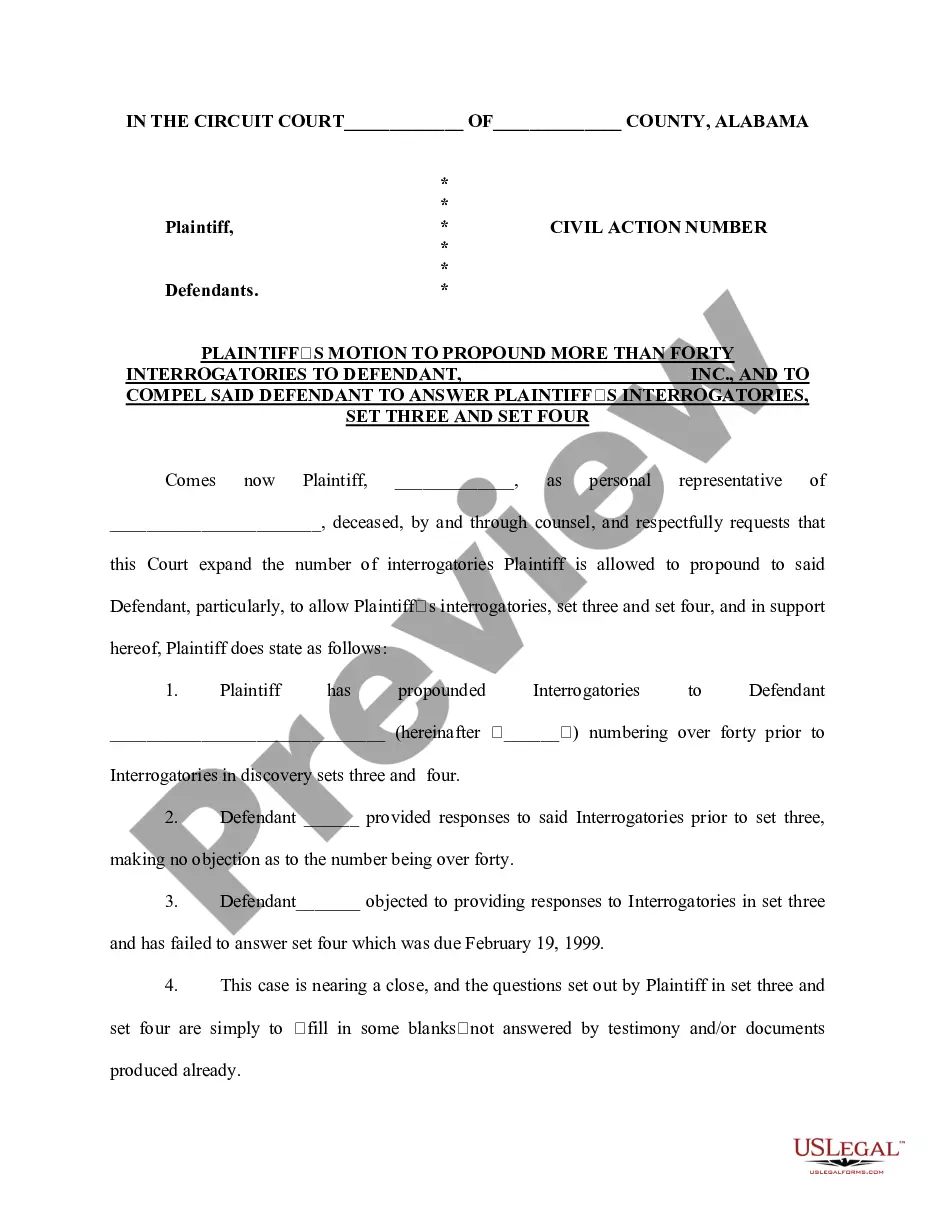
Ohio Unsecured Installment Payment Promissory Note for Fixed Rate
What this document covers
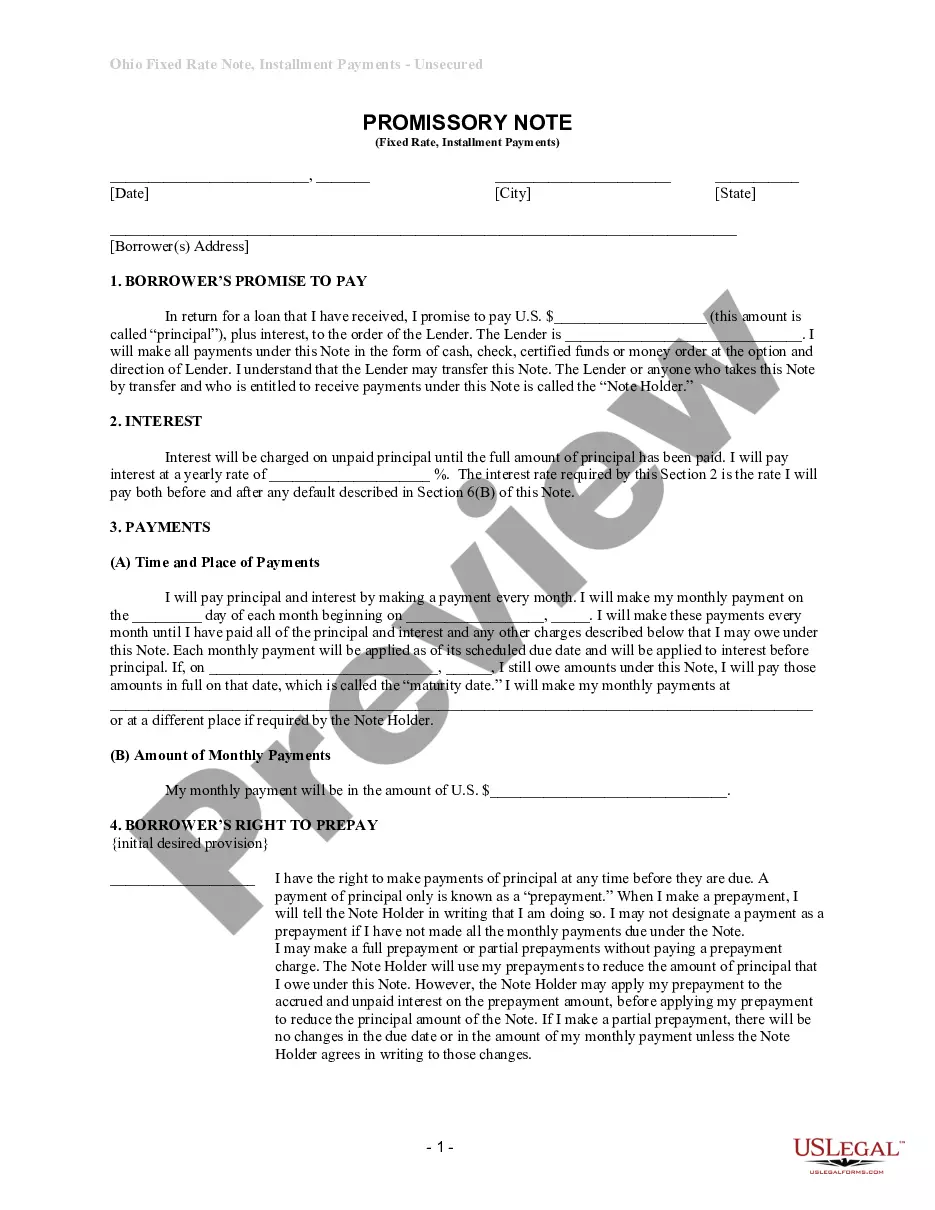
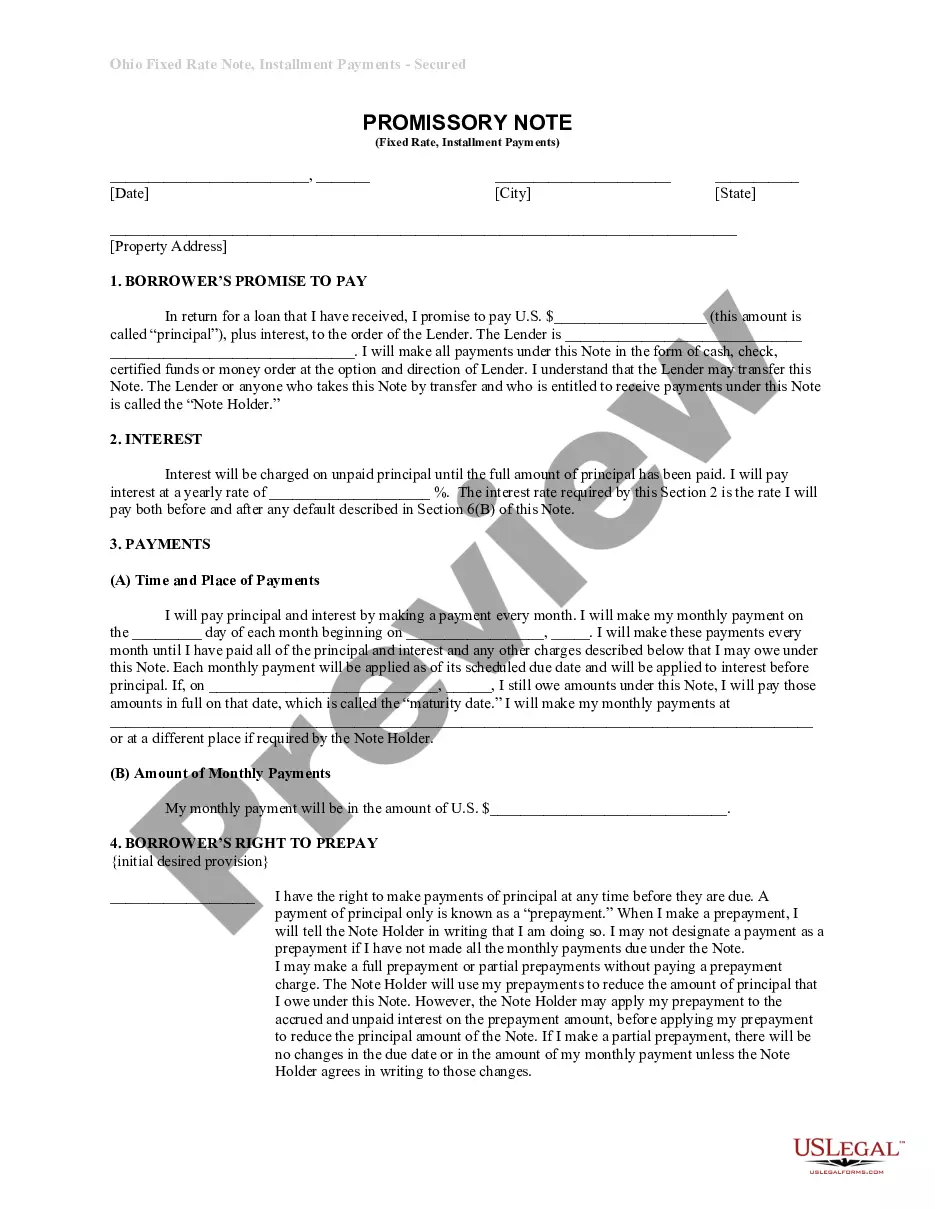
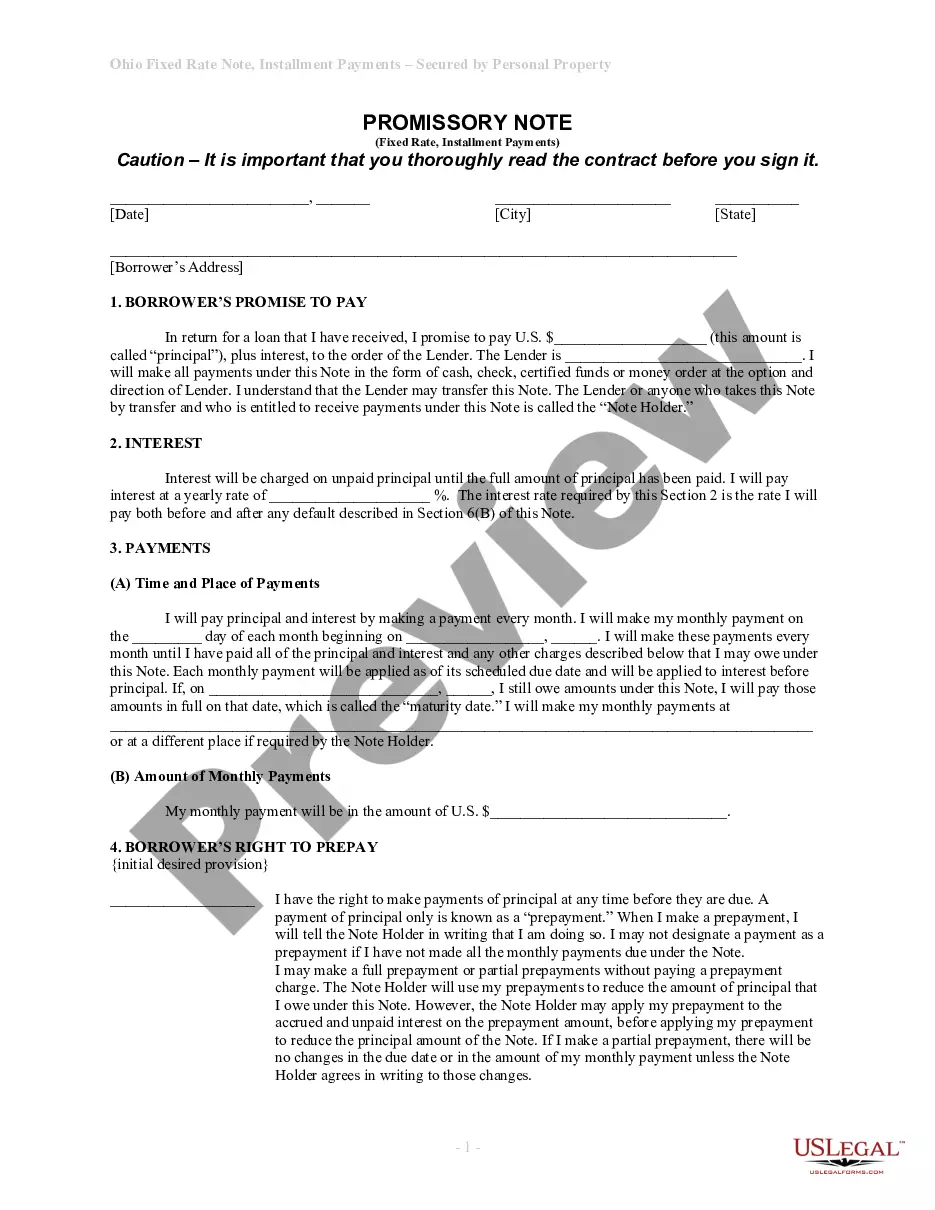
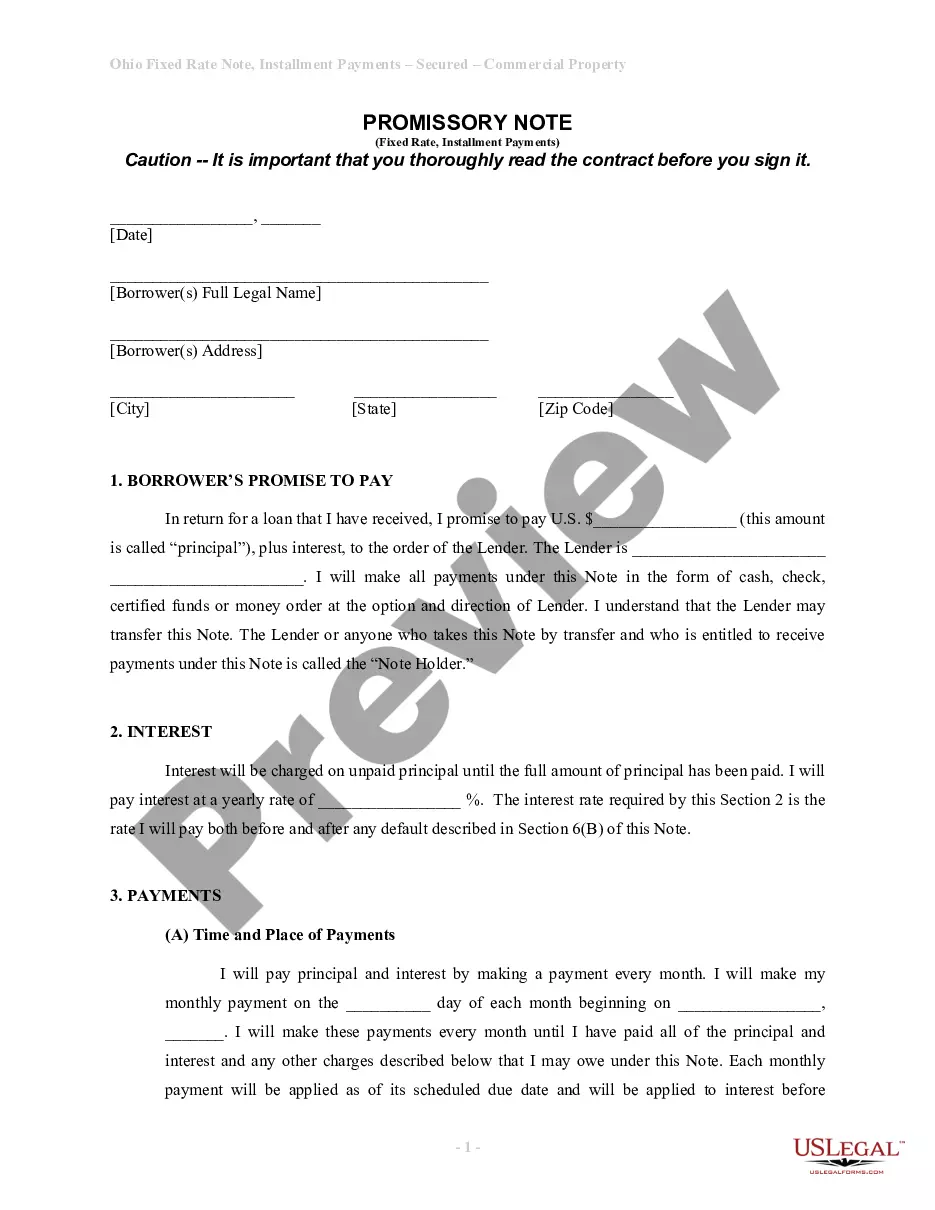
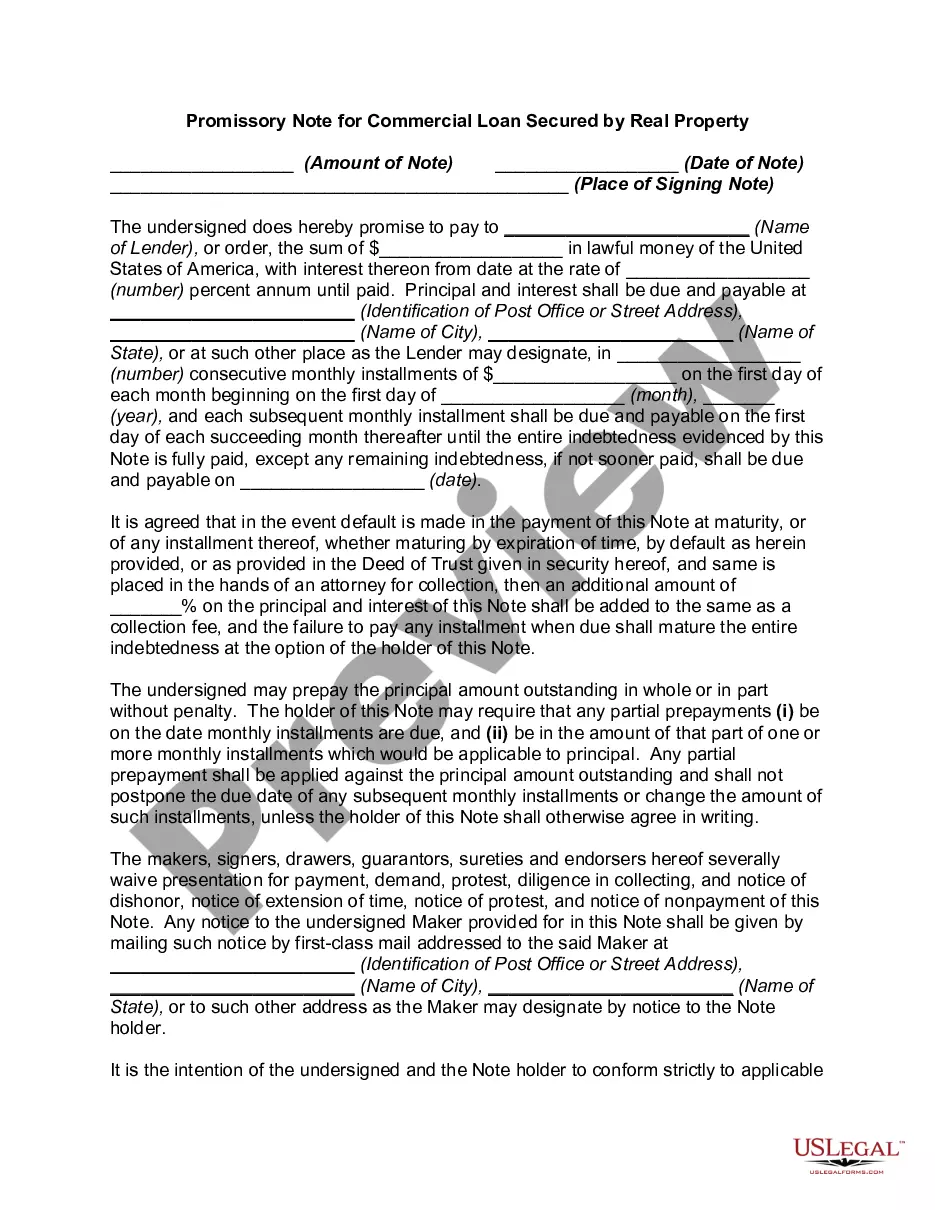
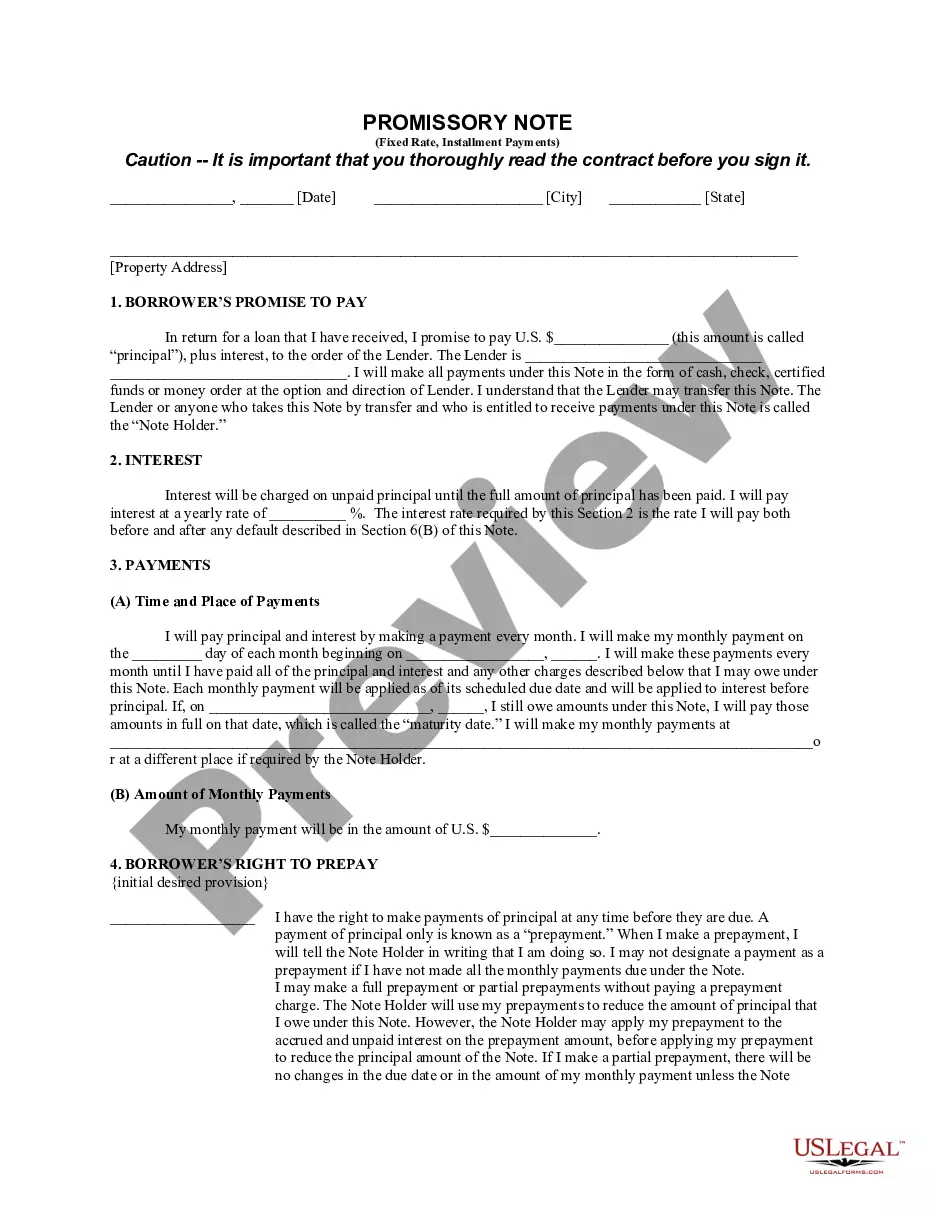
The Ohio Unsecured Installment Payment Promissory Note for Fixed Rate is a legal document where a borrower agrees to repay a loan in fixed monthly installments at a predetermined interest rate. This promissory note is unsecured, meaning no collateral is required. It is essential for clearly outlining the terms of the loan, including repayment schedules and interest rates, distinguishing it from secured promissory notes that require collateral.
Key parts of this document
- Borrower's promise to repay the loan amount (principal) plus interest.
- Details of the interest rate applied to the loan.
- Repayment schedule, including monthly payment amounts and due dates.
- Provisions for prepayment of the loan without penalties.
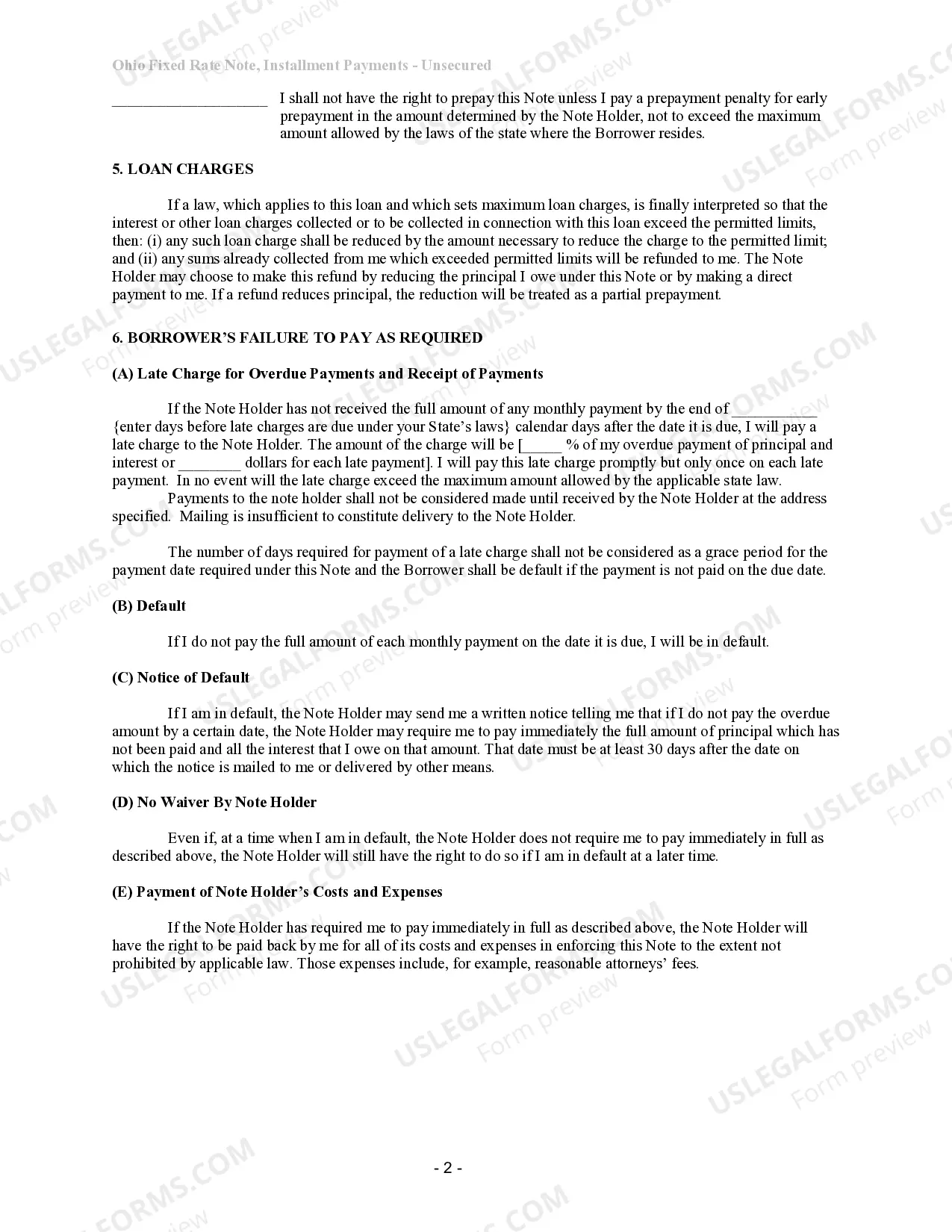
- Consequences of failure to make payments, including late charges and default notice.
When to use this document
This form is necessary when you are borrowing money from a lender and wish to formalize the loan terms. It is commonly used for personal loans, business loans, or any instance where a borrower needs to repay a debt in installments without providing collateral. This document serves to protect both the lender's investment and the borrower's commitment to repay the loan.
Who can use this document
This form is designed for the following individuals:
- Borrowers who require a structured repayment plan with fixed monthly payments.
- Lenders looking for a reliable method to document loan agreements without collateral.
- Individuals or businesses engaged in personal loans, peer-to-peer lending, or informal lending arrangements.
Steps to complete this form
- Enter the date, city, and state where the agreement is made.
- Fill in the borrower's name and address carefully.
- Specify the loan amount (principal) and the interest rate to be charged.
- Indicate the monthly payment amount and the start date for payments.
- Review sections regarding late payments and defaults to understand obligations.
Is notarization required?
In most cases, this form does not require notarization. However, some jurisdictions or signing circumstances might. US Legal Forms offers online notarization powered by Notarize, accessible 24/7 for a quick, remote process.
Get your form ready online
Our built-in tools help you complete, sign, share, and store your documents in one place.
Make edits, fill in missing information, and update formatting in US Legal Forms—just like you would in MS Word.
Download a copy, print it, send it by email, or mail it via USPS—whatever works best for your next step.
Sign and collect signatures with our SignNow integration. Send to multiple recipients, set reminders, and more. Go Premium to unlock E-Sign.
If this form requires notarization, complete it online through a secure video call—no need to meet a notary in person or wait for an appointment.
We protect your documents and personal data by following strict security and privacy standards.

Make edits, fill in missing information, and update formatting in US Legal Forms—just like you would in MS Word.

Download a copy, print it, send it by email, or mail it via USPS—whatever works best for your next step.

Sign and collect signatures with our SignNow integration. Send to multiple recipients, set reminders, and more. Go Premium to unlock E-Sign.

If this form requires notarization, complete it online through a secure video call—no need to meet a notary in person or wait for an appointment.

We protect your documents and personal data by following strict security and privacy standards.
Common mistakes to avoid
- Failing to specify the correct interest rate or payment amounts.
- Not entering the correct dates for payments or maturity.
- Overlooking the requirements for notices of default and late charges.
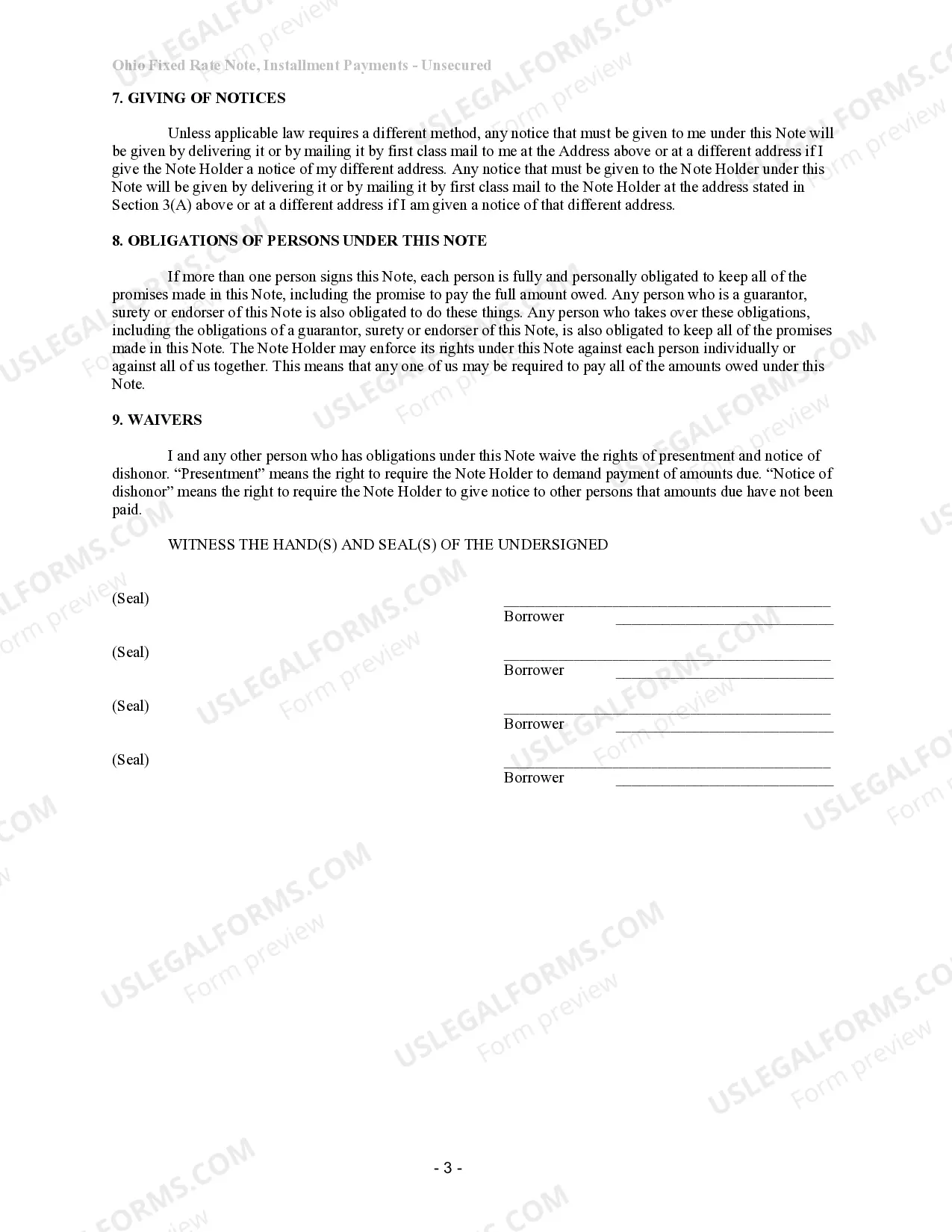
- Not ensuring all parties involved in the loan sign the document.
Why complete this form online
- Convenience of downloading and filling out from anywhere.
- Editable fields allow for customization to suit specific agreements.
- Reliability as the form is drafted by licensed attorneys to meet legal standards.
Key takeaways
- The Ohio unsecured installment payment promissory note formalizes the terms of a loan without collateral.
- This document is essential for ensuring clarity and legal protection for both borrowers and lenders.
- Completing this form involves specifying amounts, interest rates, and payment schedules accurately.
Looking for another form?



Form popularity
FAQ
Musical notes are named using the first seven letters of the alphabet: A, B, C, D, E, F, and G. These letter names indicate notes in an ascending sequence-from low to high. After the final G note, the sequence begins again: A, B, C, D, E, F, G; A, B, C, D, E, F, G; and so on.
The musical alphabet is, in ascending order by pitch, A, B, C, D, E, F and G. After G, the cycle repeats going back to A. Each line and space on the staff represents a different pitch.
We're going to learn four types of notes and rests; whole, half, quarter and eighth.
A whole note, also called a semibreve (British) is the note with the longest time value in modern music. Its length is equal to four beats and takes up an entire bar in 4/4 time. It's equivalent in value to four quarter notes.
The symbol for a whole note is a circle. A whole note is held for 4 beats.
: a musical note equal in time value to four quarter notes or two half notes see note illustration.
There are only seven note names (A, B, C, D, E, F, G), and each line or space on a staff will correspond with one of those note names. To get all twelve pitches using only the seven note names, we allow any of these notes to be sharp, flat, or natural. Look at the notes on a keyboard. Figure 1.33.
In the chromatic scale there are 7 main musical notes called A, B, C, D, E, F, and G. They each represent a different frequency or pitch. For example, the "middle" A note has a frequency of 440 Hz and the "middle" B note has a frequency of 494 Hz.
In Western music, there are a total of twelve notes per octave, named A, A#, B, C, C#, D, D#, E, F, F#, G and G#. The sharp notes, or 'accidentals', fall on the black keys, while the regular or 'natural' notes fall on the white keys. As well as sharps, the black keys can also be flats - ie, Bb, Db, Eb, Gb, and Ab.