Ordinance Authorizing a Contract Agreement
Overview of this form
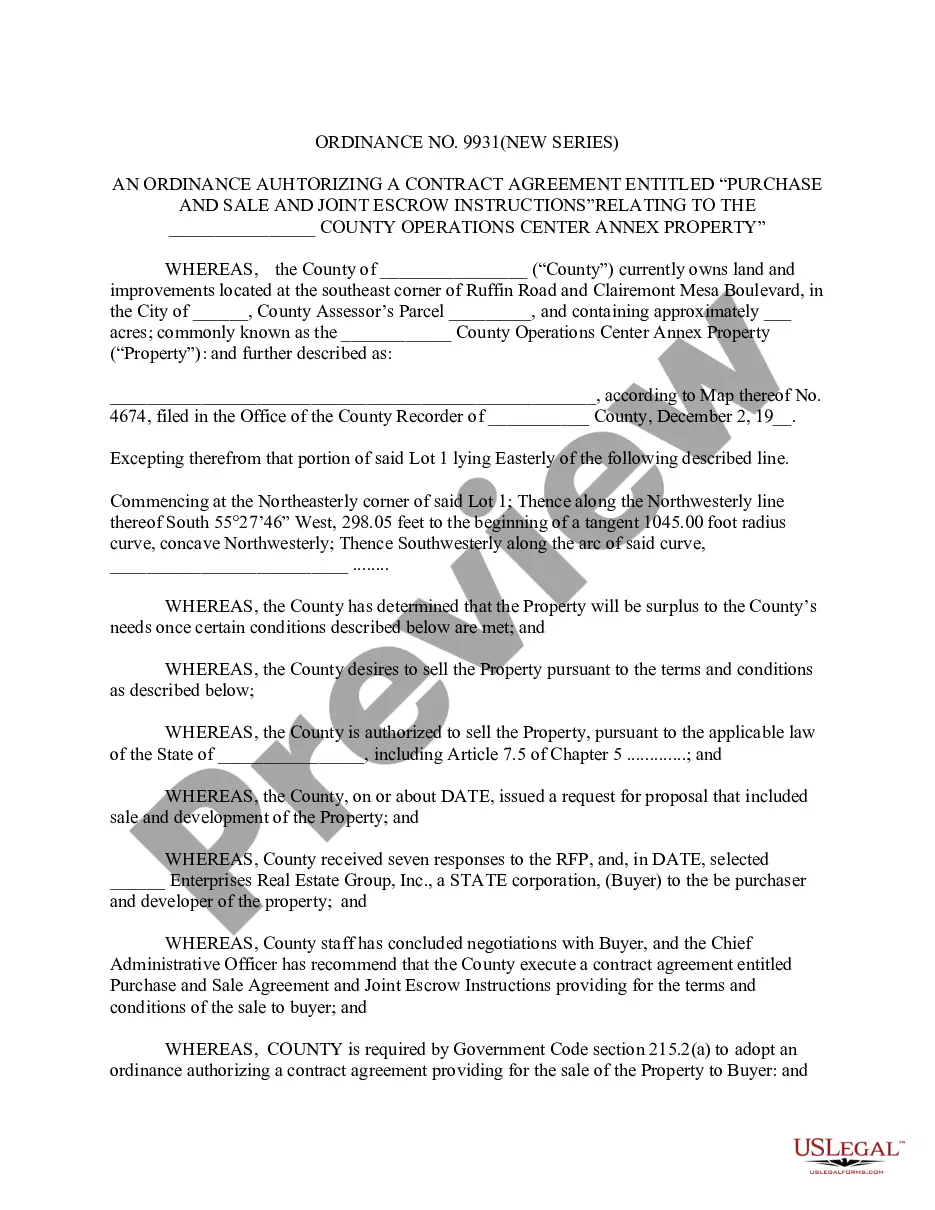
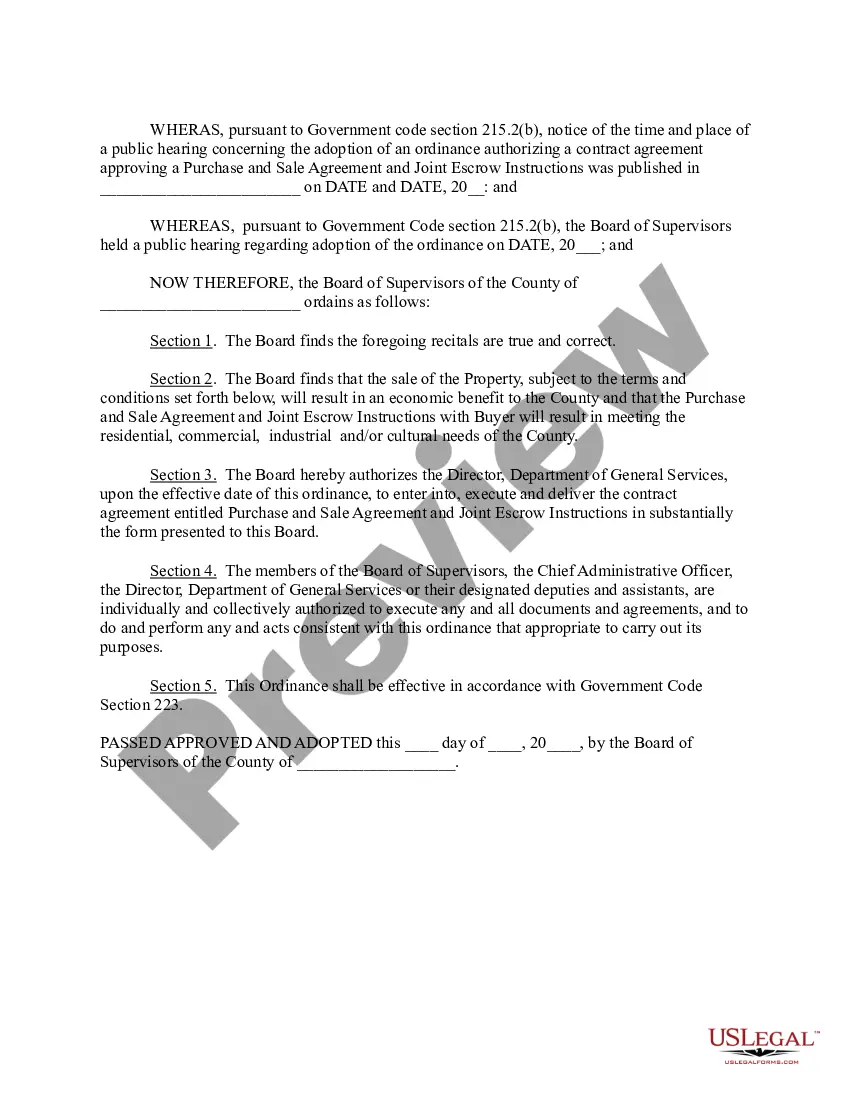
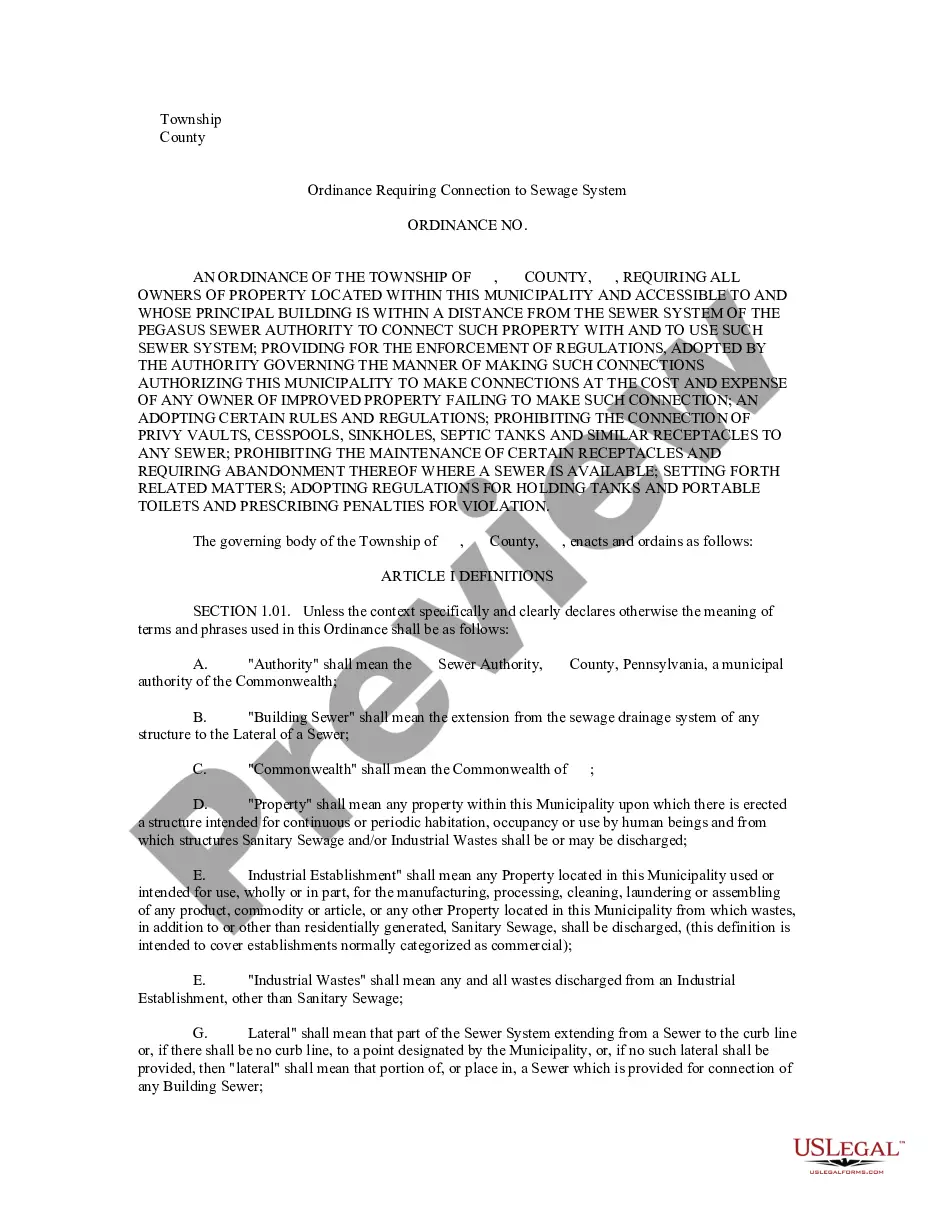
The Ordinance Authorizing a Contract Agreement is a legal document used by a county's Board of Supervisors to formally authorize the sale or transaction of county property. This ordinance is essential for establishing the terms of agreement, facilitating a public hearing, and complying with state laws governing property sales. Unlike other legal forms, this ordinance contains specific requirements that ensure the transaction is completed according to public law and county regulations.
Main sections of this form
- Title of the ordinance, including ordinance number and series.
- Recitals that explain the background and purpose of the contract agreement.
- Details about the property being sold, including location and legal description.
- Authorization for the Director of General Services to execute the agreement.
- Effective date and adoption clauses, confirming compliance with local law.
When to use this document
This form should be used when a county is looking to sell surplus property. It is essential in situations where an ordinance is required to formalize the sale, particularly when the county has determined the property is no longer needed for its operations and has followed necessary procedures for public engagement and compliance.
Who should use this form
- County officials intending to sell county-owned property.
- Legal counsel representing the county in property transactions.
- Real estate groups interested in purchasing county property.
Completing this form step by step
- Identify the property by filling in the legal description, location, and parcel number.
- Outline the terms of the contract agreement, including sale conditions and buyer details.
- Complete all recitals to provide context for the ordinance authorization.
- Ensure a public hearing is conducted and properly documented prior to adoption.
- Finalize the ordinance by entering the date of adoption and signatures of board members.
Is notarization required?
This form does not typically require notarization unless specified by local law. However, it is advisable to check with local authorities or legal counsel for any specific requirements related to notarization for property sales in your jurisdiction.
Get your form ready online
Our built-in tools help you complete, sign, share, and store your documents in one place.
Make edits, fill in missing information, and update formatting in US Legal Forms—just like you would in MS Word.
Download a copy, print it, send it by email, or mail it via USPS—whatever works best for your next step.
Sign and collect signatures with our SignNow integration. Send to multiple recipients, set reminders, and more. Go Premium to unlock E-Sign.
If this form requires notarization, complete it online through a secure video call—no need to meet a notary in person or wait for an appointment.
We protect your documents and personal data by following strict security and privacy standards.

Make edits, fill in missing information, and update formatting in US Legal Forms—just like you would in MS Word.

Download a copy, print it, send it by email, or mail it via USPS—whatever works best for your next step.

Sign and collect signatures with our SignNow integration. Send to multiple recipients, set reminders, and more. Go Premium to unlock E-Sign.

If this form requires notarization, complete it online through a secure video call—no need to meet a notary in person or wait for an appointment.

We protect your documents and personal data by following strict security and privacy standards.
Typical mistakes to avoid
- Failing to provide a complete legal description of the property.
- Neglecting to document the public hearing process properly.
- Omitting required signatures or dates on the ordinance.
- Not complying with state-specific legal requirements for property sales.
Why use this form online
- Easy access to legal templates drafted by licensed attorneys.
- Convenient download options for immediate use and editing.
- Reduced risk of errors with clear, structured guidance on form completion.
- Time-saving compared to manually creating legal documents from scratch.
Looking for another form?

Form popularity
FAQ
The right of a third party to enforce a term of contract does not affect the promisee's right to enforce a term of the contract. However, a promisor is discharged from the obligations owed by the promisor to the promisee, to the extent of having performed the same obligations to the third party.
The doctrine of privity provides that only parties to a contract can enforce or be subject to the benefits or obligations under that contract. A third party has no such rights or obligations, even if the contract was made for the benefit of that party.
A third party may assign to another person a right under a term of a contract enforceable by the third party under section 4 in the same way as a party to the contract may assign a right under the contract. on a proper construction of the contract, the right is personal to the third party and is not assignable.
For a contract to be valid and recognized by the common law, it must include certain elements? offer, acceptance, consideration, intention to create legal relations, authority and capacity, and certainty. Without these elements, a contract is not legally binding and may not be enforced by the courts.
The Ordinance gives a third party the right to enforce a contractual term if either the contract expressly provides for this, or the term purports to confer a benefit on the third party.
The basic elements required for the agreement to be a legally enforceable contract are: mutual assent, expressed by a valid offer and acceptance; adequate consideration; capacity; and legality. In some states, elements of consideration can be satisfied by a valid substitute.
Third-party liability refers to the right of a person to seek remedies for damages suffered as a result of the performance of a contract they are not a party to.
Capacity to contract means a party has the legal ability to enter into a contract. Capacity also means a person has to be competent as defined by law.