Fence Ordinance
What is this form?
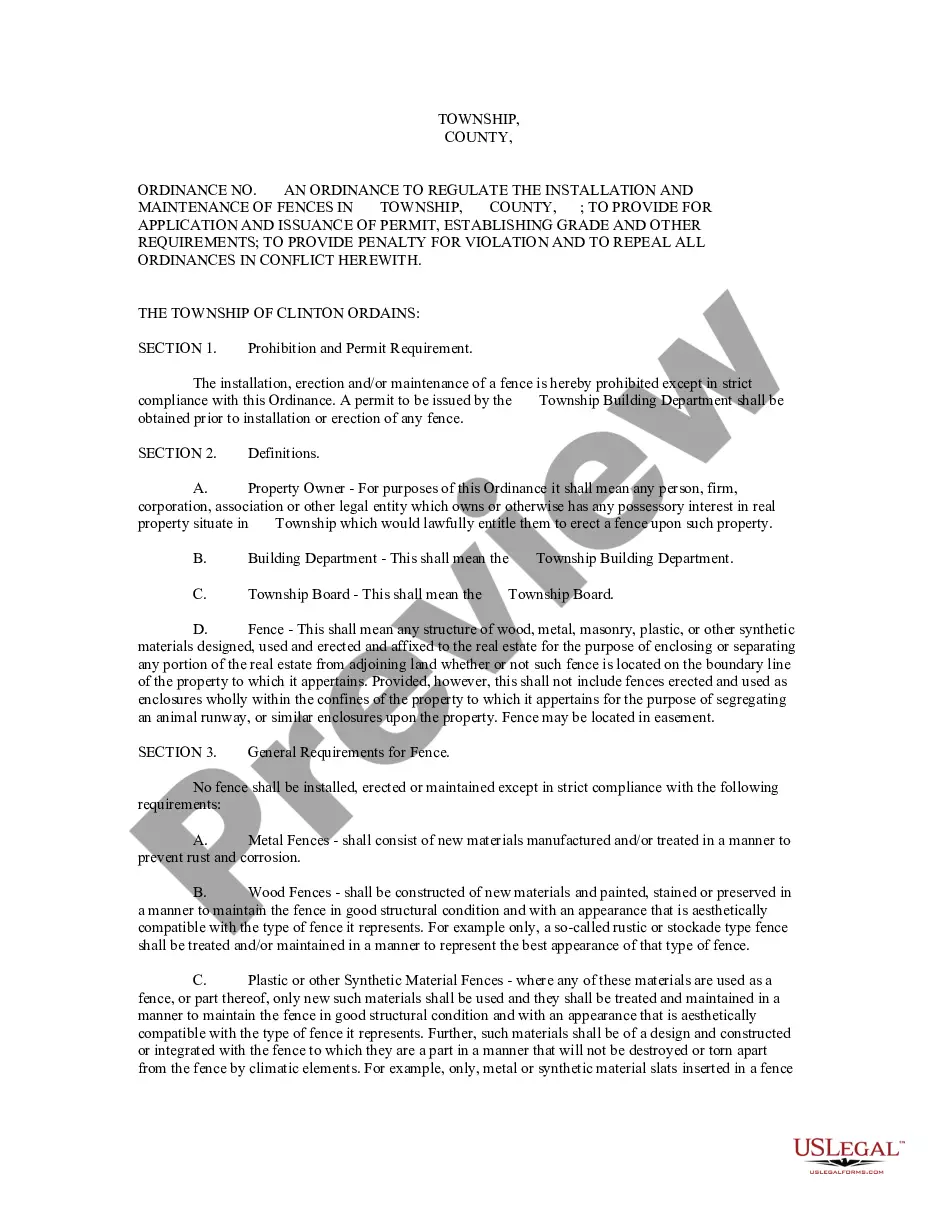
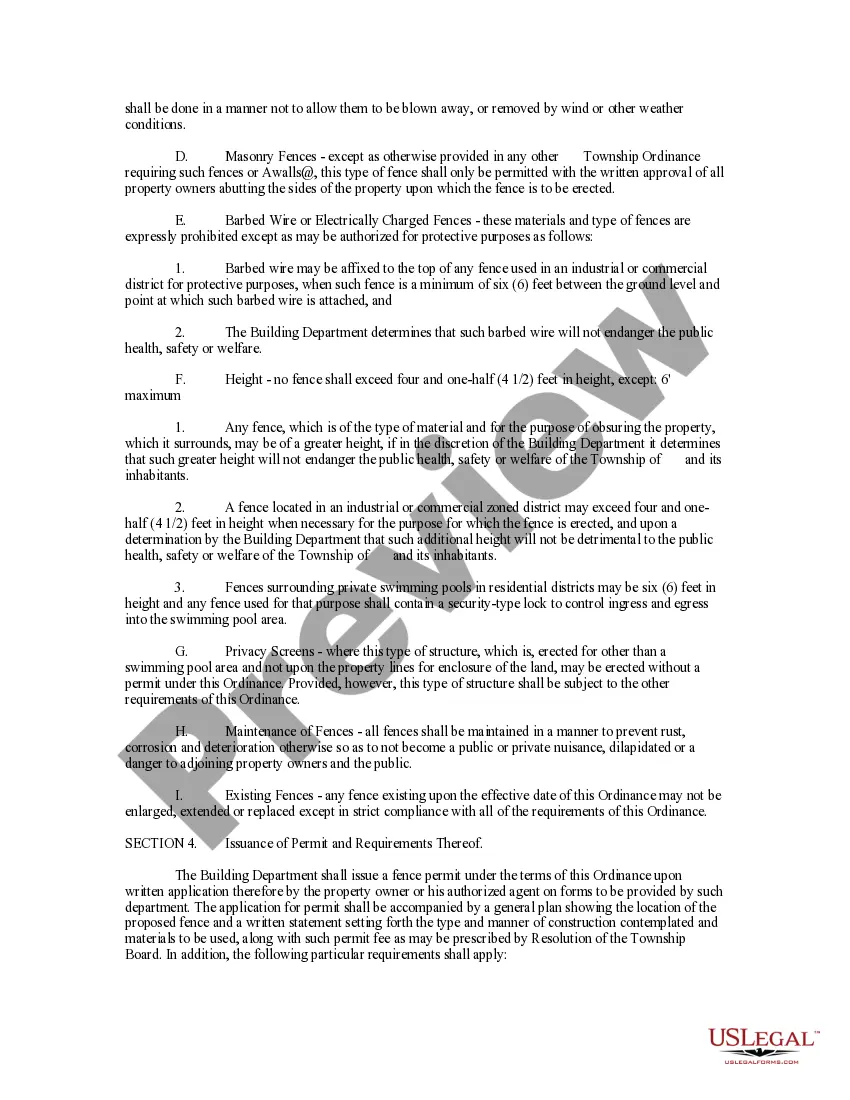
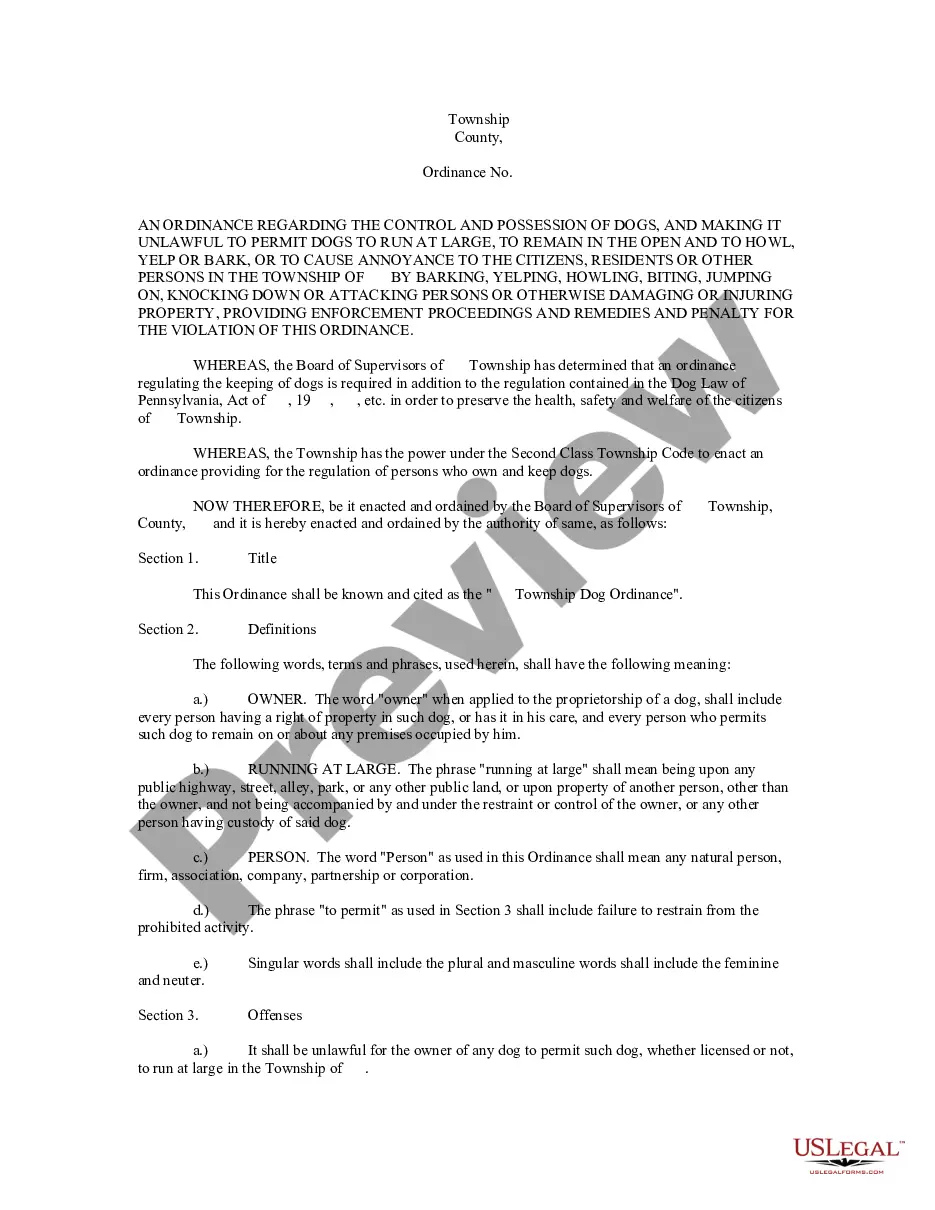
The Fence Ordinance is a legal framework governing the installation and maintenance of fences within a municipality. This form outlines the specific requirements that property owners must follow to ensure compliance, including permit application processes and the regulations surrounding various types of fencing. Unlike generic forms, this ordinance offers jurisdiction-specific guidelines to ensure public safety and aesthetic harmony within neighborhoods.
What’s included in this form
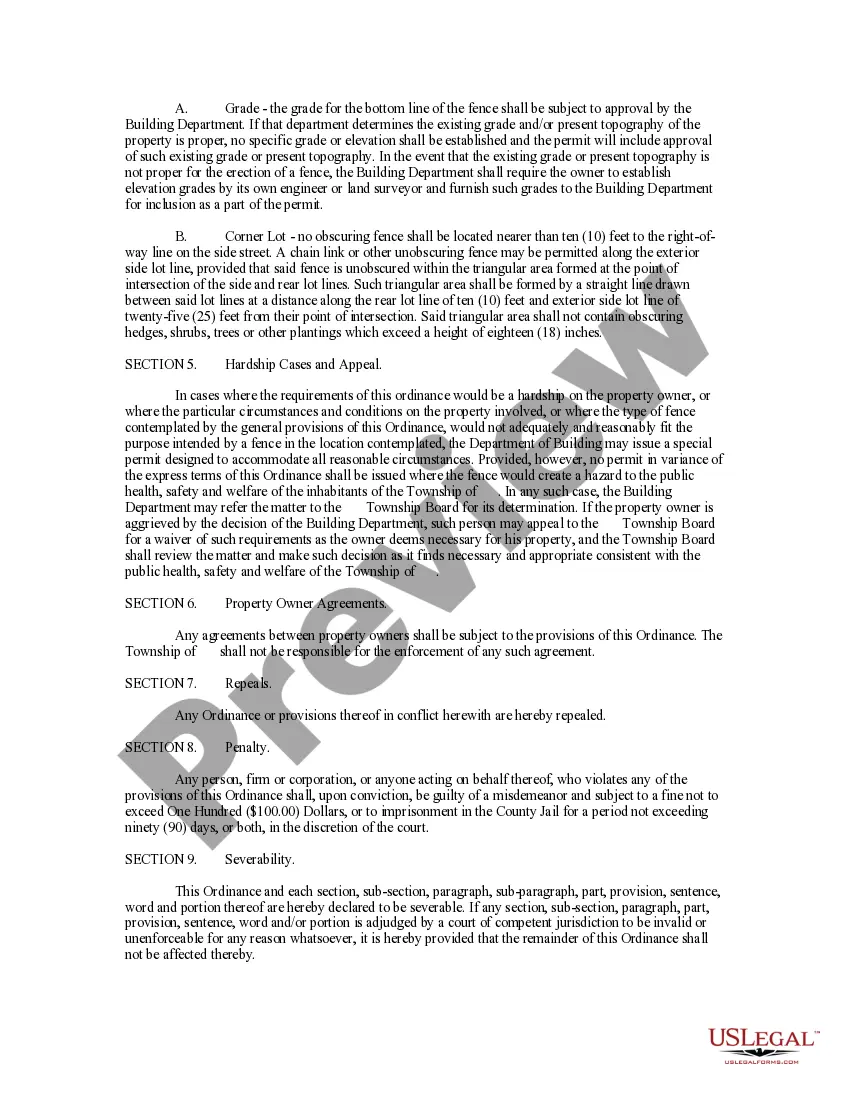
- Prohibition of fence installation without a permit from the Township Building Department.
- Definitions of key terms, including "property owner," "building department," and "fence."
- General requirements for material and construction quality for various types of fences.
- Specific height limitations and conditions for erecting fences in different zoning districts.
- Procedures for applying for a fence permit and requirements for submission.
- Maintenance obligations for fences to prevent becoming a nuisance or hazard.
- Provisions for appealing decisions made by the Building Department regarding permit issuance.

Common use cases
This Fence Ordinance should be utilized when a property owner wishes to construct a fence on their property. It is particularly important to refer to this ordinance when installing a fence for reasons such as security, privacy, or property delineation, ensuring compliance with local regulations and avoiding potential penalties.
Who needs this form
- Property owners seeking to install a fence on their property.
- Real estate developers planning residential or commercial projects requiring fencing.
- Contractors tasked with building fences for clients.
- Individuals involved in disputes regarding fence installation between neighboring properties.
How to prepare this document
- Identify the proposed location of the fence on your property.
- Complete the application for a fence permit provided by the Township Building Department.
- Include a detailed plan outlining the type of fence and materials to be used.
- Attach any required fees as specified by the Township.
- Submit the application to the Building Department and await approval before beginning construction.
Notarization guidance
Notarization is not commonly needed for this form. However, certain documents or local rules may make it necessary. Our notarization service, powered by Notarize, allows you to finalize it securely online anytime, day or night.
Get your form ready online
Our built-in tools help you complete, sign, share, and store your documents in one place.
Make edits, fill in missing information, and update formatting in US Legal Forms—just like you would in MS Word.
Download a copy, print it, send it by email, or mail it via USPS—whatever works best for your next step.
Sign and collect signatures with our SignNow integration. Send to multiple recipients, set reminders, and more. Go Premium to unlock E-Sign.
If this form requires notarization, complete it online through a secure video call—no need to meet a notary in person or wait for an appointment.
We protect your documents and personal data by following strict security and privacy standards.

Make edits, fill in missing information, and update formatting in US Legal Forms—just like you would in MS Word.

Download a copy, print it, send it by email, or mail it via USPS—whatever works best for your next step.

Sign and collect signatures with our SignNow integration. Send to multiple recipients, set reminders, and more. Go Premium to unlock E-Sign.

If this form requires notarization, complete it online through a secure video call—no need to meet a notary in person or wait for an appointment.

We protect your documents and personal data by following strict security and privacy standards.
Common mistakes to avoid
- Failing to obtain a permit before starting fence installation.
- Not adhering to the specific height and material requirements outlined in the ordinance.
- Ignoring maintenance obligations, which could result in fines or mandate removal of the fence.
- Submitting incomplete applications for permits.
Benefits of using this form online
- Convenient access to updated legal forms without visiting local authorities.
- Editable templates allow customization to fit specific needs easily.
- Reliable resources drafted by licensed attorneys to ensure compliance with regulations.
- Quick access to information about local codes and requirements.
The Fence Ordinance serves as a legally binding document that outlines expectations for fence installation and maintenance. Failure to comply can lead to fines and other legal penalties. Itâs crucial to ensure all aspects of the installation align with the ordinance to avoid any potential disputes with neighbors or local authorities.
What to keep in mind
- Always secure a permit before installing a fence.
- Follow the specific guidelines in the Fence Ordinance to avoid penalties.
- Understand your rights and responsibilities as a property owner regarding fence installation.
- Consult the Building Department for any clarifications or special circumstances.
- Property Owner: Anyone who has a legal interest in a property.
- Building Department: The local authority responsible for overseeing building regulations and permits.
- Obscuring Fence: A fence that limits visibility from the street or neighboring properties.
Looking for another form?


Form popularity
FAQ
Your jurisdiction may have laws about how far back a fence needs to be set on your property, which is typically 2, 4, 6 or 8 inches from the property line. Other areas will allow you to go right up to the property line.
FREQUENTLY ASKED QUESTION. Fence ownership: Who owns which fence? Is it true that every house owns the fence on its left side, as you look at it from the street? There is no general rule about whether you own the fence on the left or the fence on the right of your property.
The law says that owners must share the cost of building a sufficient dividing fence between your properties. This means that if your neighbour wants a fence, but you do not, you are still responsible for sharing the cost of building it.
There is no general rule about whether you are responsible for the boundary fence on the left or right or rear of the property. If your property is registered at the Land Registry you can obtain what is called an 'office copy' comprising a title plan and register details.
If the structure is classified as fire resistive rated, it may be located closer than five (5) feet, but it shall not be located closer than three (3) feet from the property line.
Provided your fence is definitely within your property lines and complies with neighborhood regulations, you may not actually be required to talk to your neighbors about it. Still, it's common courtesy to askand it could save you future legal trouble if it turns out your neighbor wants to dispute your fence.
A general rule (not sure if your neighbors abide to it) is to build the fence 1-2 feet inside your property line.Your neighbors could have even blocked you from getting a fence because of easement right between yards, all things to look up before this endeavor.
Who owns the dividing fence? In most states, if you and your neighbour are both owner-occupiers, you share equal responsibility for the dividing fence on your land. Generally, that means you pay an equal share of the cost of a 'sufficient' fence. The definition of 'sufficient' differs from state-to-state.