Delaware Warranty Deed to Separate Property of one Spouse to both as Joint Tenants with Right of Survivorship
What this document covers
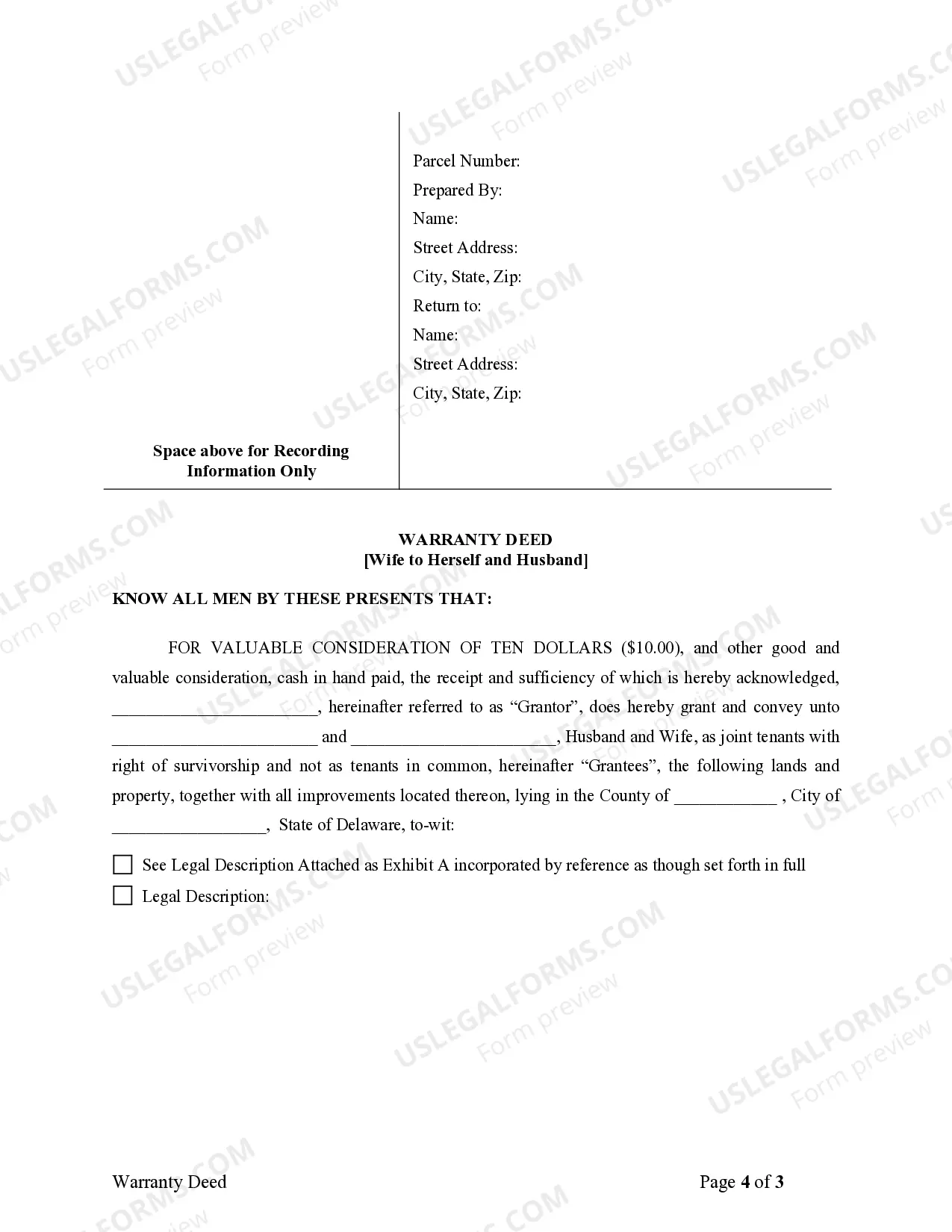
The Warranty Deed to Separate Property of one Spouse to both as Joint Tenants with Right of Survivorship is a legal document that allows one spouse to transfer ownership of property to both spouses as joint tenants. This deed ensures that both spouses have equal rights to the property and includes the right of survivorship, meaning if one spouse passes away, the other automatically inherits the property. This form is particularly useful for couples looking to consolidate ownership and ensure seamless transfer of property between them.
Form components explained
- Details of the Grantor, the spouse transferring the property.
- Name of the Grantees, both spouses receiving the property.
- Legal description of the property being conveyed.
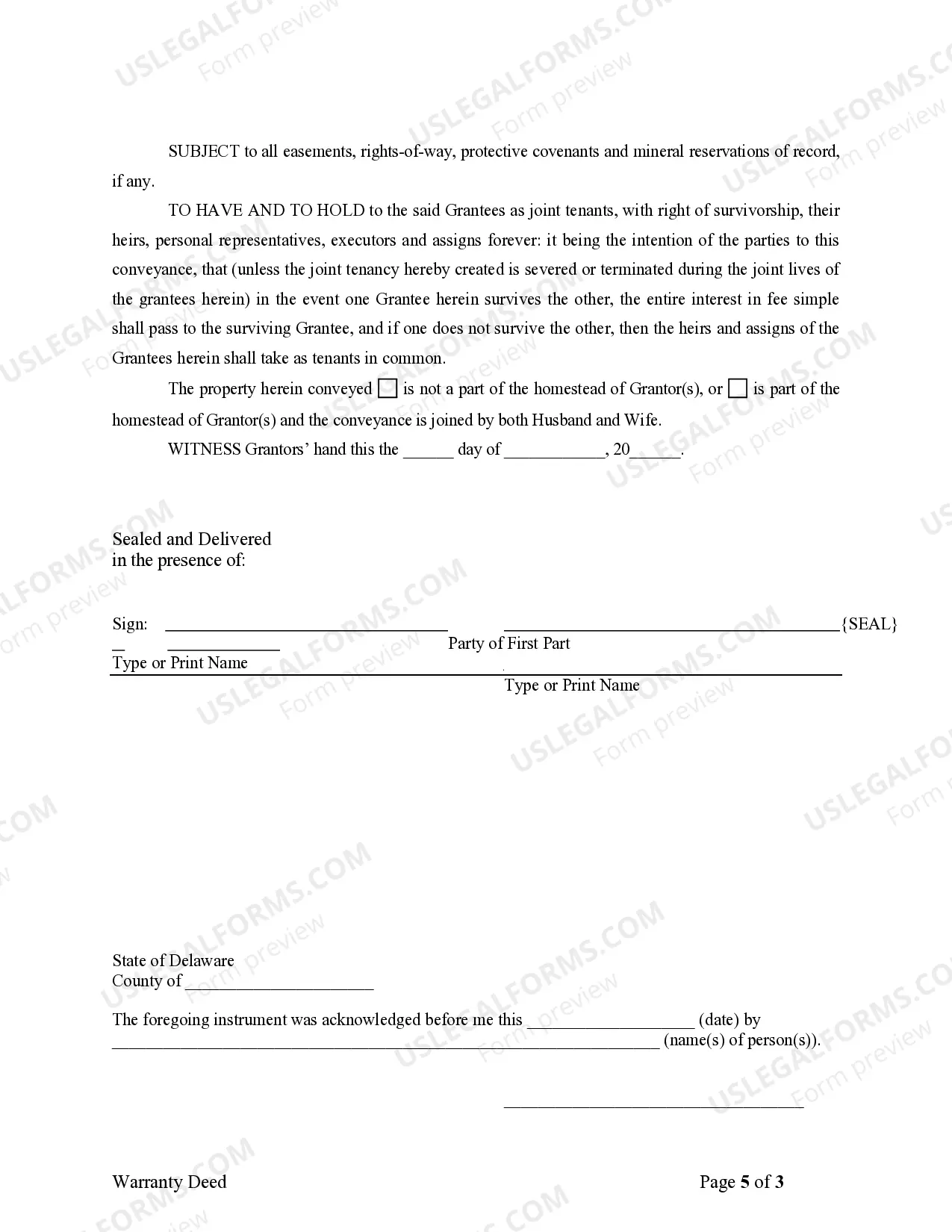
- Statement regarding whether the property is part of the homestead.
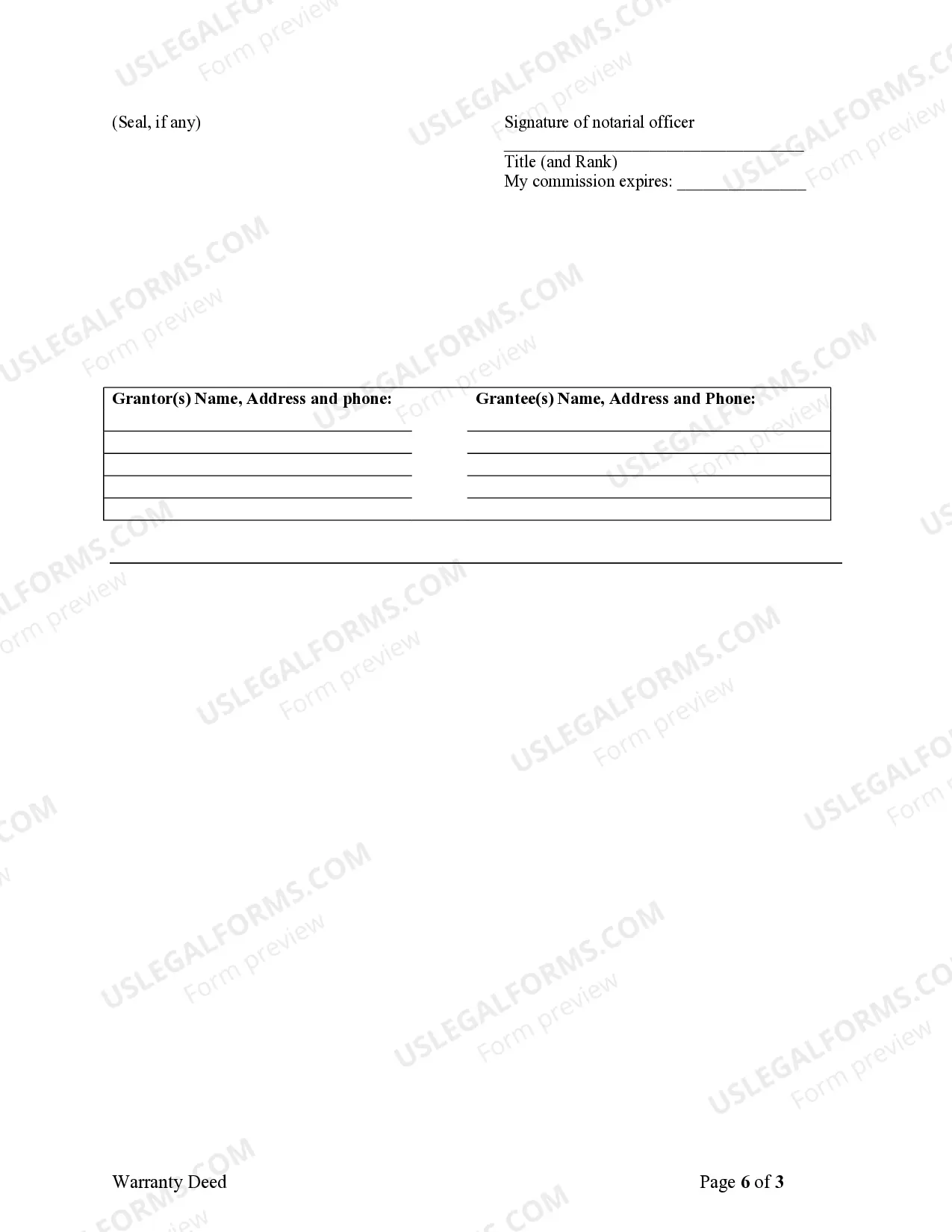
- Signatures of the Grantor, witnesses, and notary public.



When to use this document
This form should be used when a spouse wishes to transfer ownership of separate property to both spouses, enabling them to hold the property as joint tenants with right of survivorship. This situation commonly arises during marriage when one spouse owns property before the marriage or wishes to update ownership to include both parties for legal or estate planning purposes.
Who this form is for
- Married couples who want to simplify property ownership.
- Spouses looking to ensure that property will pass directly to the surviving spouse upon death.
- Individuals who hold separate property and wish to include their spouse in the title.
Instructions for completing this form
- Identify the Grantor, the spouse transferring the property.
- Enter the names of the Grantees, both spouses receiving the property.
- Provide a legal description of the property being transferred.
- Specify if the property is part of the homestead.
- Have the document signed in the presence of a notary public, who will also sign.
Is notarization required?
Notarization is required for this form to take effect. Our online notarization service, powered by Notarize, lets you verify and sign documents remotely through an encrypted video session, available 24/7.
Get your form ready online
Our built-in tools help you complete, sign, share, and store your documents in one place.
Make edits, fill in missing information, and update formatting in US Legal Forms—just like you would in MS Word.
Download a copy, print it, send it by email, or mail it via USPS—whatever works best for your next step.
Sign and collect signatures with our SignNow integration. Send to multiple recipients, set reminders, and more. Go Premium to unlock E-Sign.
If this form requires notarization, complete it online through a secure video call—no need to meet a notary in person or wait for an appointment.
We protect your documents and personal data by following strict security and privacy standards.

Make edits, fill in missing information, and update formatting in US Legal Forms—just like you would in MS Word.

Download a copy, print it, send it by email, or mail it via USPS—whatever works best for your next step.

Sign and collect signatures with our SignNow integration. Send to multiple recipients, set reminders, and more. Go Premium to unlock E-Sign.

If this form requires notarization, complete it online through a secure video call—no need to meet a notary in person or wait for an appointment.

We protect your documents and personal data by following strict security and privacy standards.
Avoid these common issues
- Failing to include a legal description of the property.
- Not having the document notarized, which could invalidate it.
- Leaving out the names of the Grantees or Grantor.
Benefits of completing this form online
- Convenience of filling out the form from home.
- Edit the form easily to reflect your specific situation.
- Access to professionally drafted templates for legal accuracy.
Looking for another form?

Form popularity
FAQ
The right of survivorship in a warranty deed allows for the automatic transfer of property ownership to the surviving co-owner upon the death of one owner. In a Delaware Warranty Deed to Separate Property of one Spouse to both as Joint Tenants with Right of Survivorship, the surviving spouse inherits full ownership without the need for probate. This feature simplifies the transfer process and provides peace of mind regarding property distribution. For additional guidance on creating robust estate plans, consider using the US Legal Forms platform.
The term 'joint tenants' refers to a legal arrangement where two or more individuals own a property together, each having an equal share. In a Delaware Warranty Deed to Separate Property of one Spouse to both as Joint Tenants with Right of Survivorship, both spouses equally share the ownership rights, and upon the death of one tenant, the other automatically inherits the property. This arrangement is beneficial for ensuring seamless transfer of assets while maintaining equal ownership throughout the tenure. It's essential to understand how this designation affects your estate planning.
One notable disadvantage of the right of survivorship is the potential tax implications upon the death of one owner. If property is held as a Delaware Warranty Deed to Separate Property of one Spouse to both as Joint Tenants with Right of Survivorship, the surviving spouse may face a significant tax burden, depending on the property's value. Additionally, joint ownership may limit the ability to sell or transfer interests without consensus from both parties. Consider consulting with a legal professional to navigate these complexities.
Yes, a survivorship deed can override a will. When a Delaware Warranty Deed to Separate Property of one Spouse to both as Joint Tenants with Right of Survivorship exists, the property automatically transfers to the surviving tenant upon one owner's death. This mechanism ensures that the assets will pass directly to the surviving spouse, bypassing the probate process. It's important to ensure that your estate planning reflects your wishes regarding property ownership.
One notable disadvantage of joint tenancy is that it can limit the ability of a co-owner to sell their share independently. If one spouse wishes to sell, both must agree, which can complicate personal decisions. Additionally, creditors may pursue the property for debts incurred by either spouse, impacting both owners. To navigate these complexities, consulting resources like US Legal Forms can assist in understanding your options related to a Delaware Warranty Deed to Separate Property of one Spouse to both as Joint Tenants with Right of Survivorship.
Joint tenancy serves several important purposes. First, it provides a streamlined way for co-owners to share property, enabling easy transfer of ownership upon death. Second, it can protect against the claims of creditors since the property bypasses probate. For those considering such arrangements, a Delaware Warranty Deed to Separate Property of one Spouse to both as Joint Tenants with Right of Survivorship is a favorable option.
The right of survivorship in Delaware allows joint tenants to inherit each other's share of property upon death. This means that when one spouse passes away, their interest automatically transfers to the surviving spouse. This feature ensures that the property remains in the hands of the surviving spouse, avoiding lengthy probate processes. To establish this right formally, couples can use a Delaware Warranty Deed to Separate Property of one Spouse to both as Joint Tenants with Right of Survivorship.
The right of survivorship can pose challenges in family dynamics, particularly if disagreements arise among heirs after one party's death. Additionally, this right may eliminate the decedent’s control over who inherits their share, potentially leading to unanticipated outcomes. Individuals considering a Delaware Warranty Deed to Separate Property of one Spouse to both as Joint Tenants with Right of Survivorship should weigh these factors carefully before making decisions.
One notable disadvantage of joint tenancy is the risk that one tenant's financial problems can affect the shared property. For example, if one joint tenant faces a lawsuit or declares bankruptcy, creditors may seize the entire property. Therefore, it is crucial to understand all implications before entering into a joint tenancy arrangement.
Yes, two people can be listed on a warranty deed, allowing them to hold an ownership interest in the property. When drafting a Delaware Warranty Deed to Separate Property of one Spouse to both as Joint Tenants with Right of Survivorship, it is important to indicate how you want to share ownership. This arrangement can foster shared responsibility and simplify inheritance matters.