Checklist for Investigation Sexual Harassment - Workplace
What this document covers
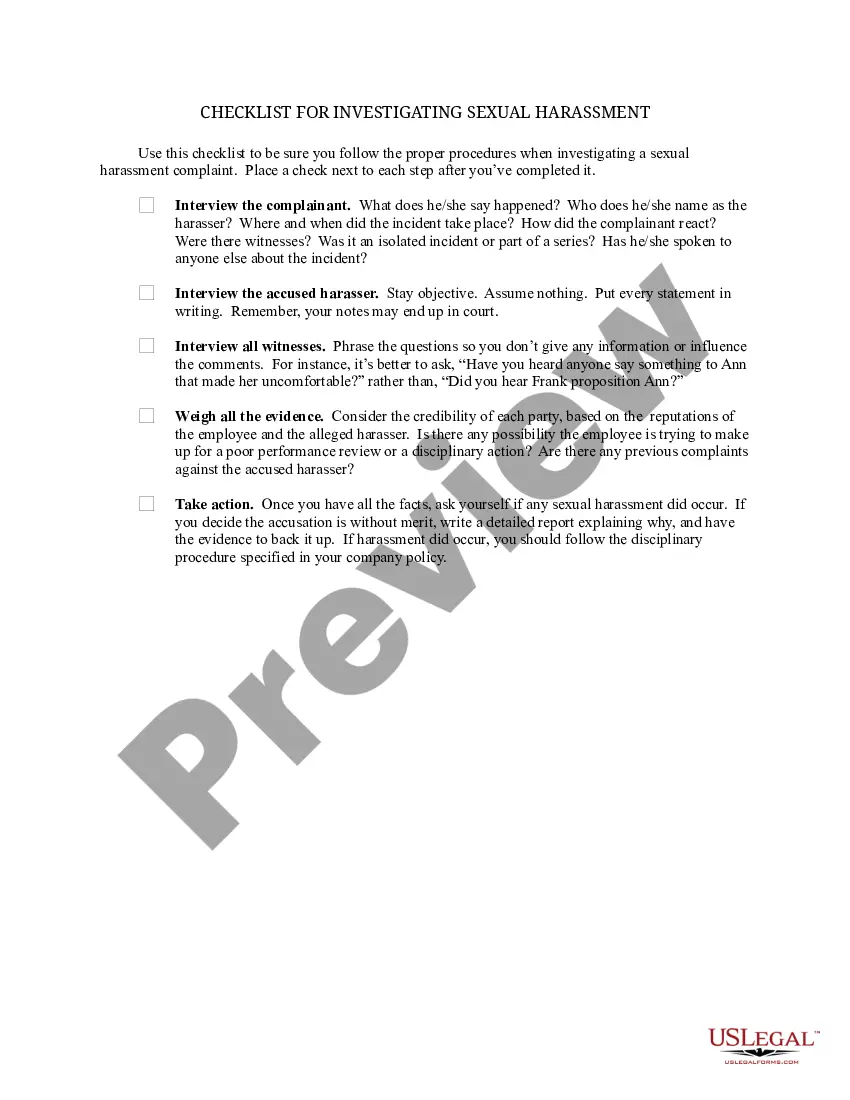
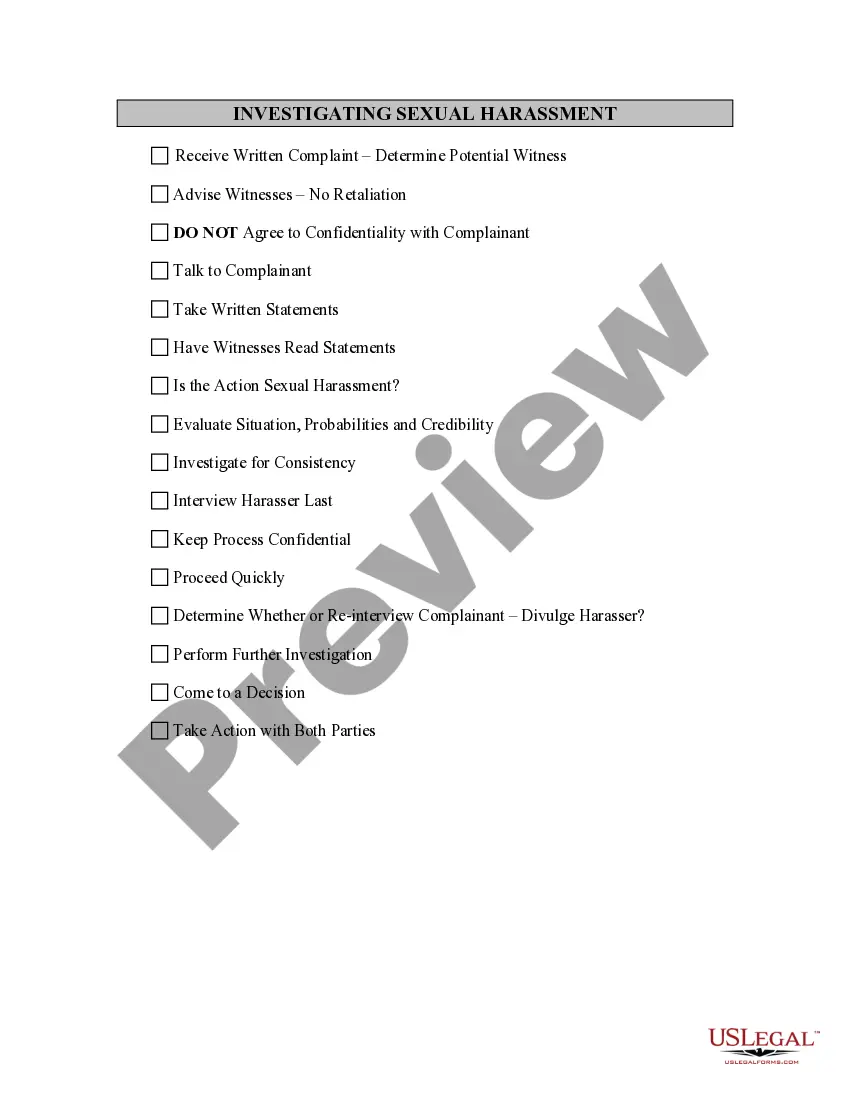
The Checklist for Investigation of Sexual Harassment is a critical tool designed to guide employers and HR professionals through the process of investigating a sexual harassment complaint within the workplace. This checklist is specifically crafted to ensure that all necessary steps are taken and that the investigation is thorough and fair. This form differs from general complaint forms by providing a structured approach to handling sensitive harassment issues effectively.
Key components of this form
- Introduction to the investigation process.
- Steps for interviewing the complainant and collecting information.
- Guidelines for interviewing the accused and witnesses.
- Criteria for assessing evidence and credibility.
- Instructions for documenting findings and taking appropriate action.
Situations where this form applies
Employers should use this checklist when they receive a formal complaint of sexual harassment or when an employee raises concerns regarding inappropriate conduct in the workplace. This form helps to ensure that the investigation is systematic and adheres to company policies and legal obligations.
Who this form is for
- Human resource managers responsible for overseeing workplace conduct.
- Compliance officers ensuring adherence to legal and regulatory standards.
- Supervisors who need guidance in handling harassment complaints.
- Company executives aiming to foster a safe workplace environment.
Steps to complete this form
- Gather initial details regarding the complaint from the employee.
- Interview the complainant to collect comprehensive information about the incident.
- Conduct an interview with the accused harasser, documenting all statements made.
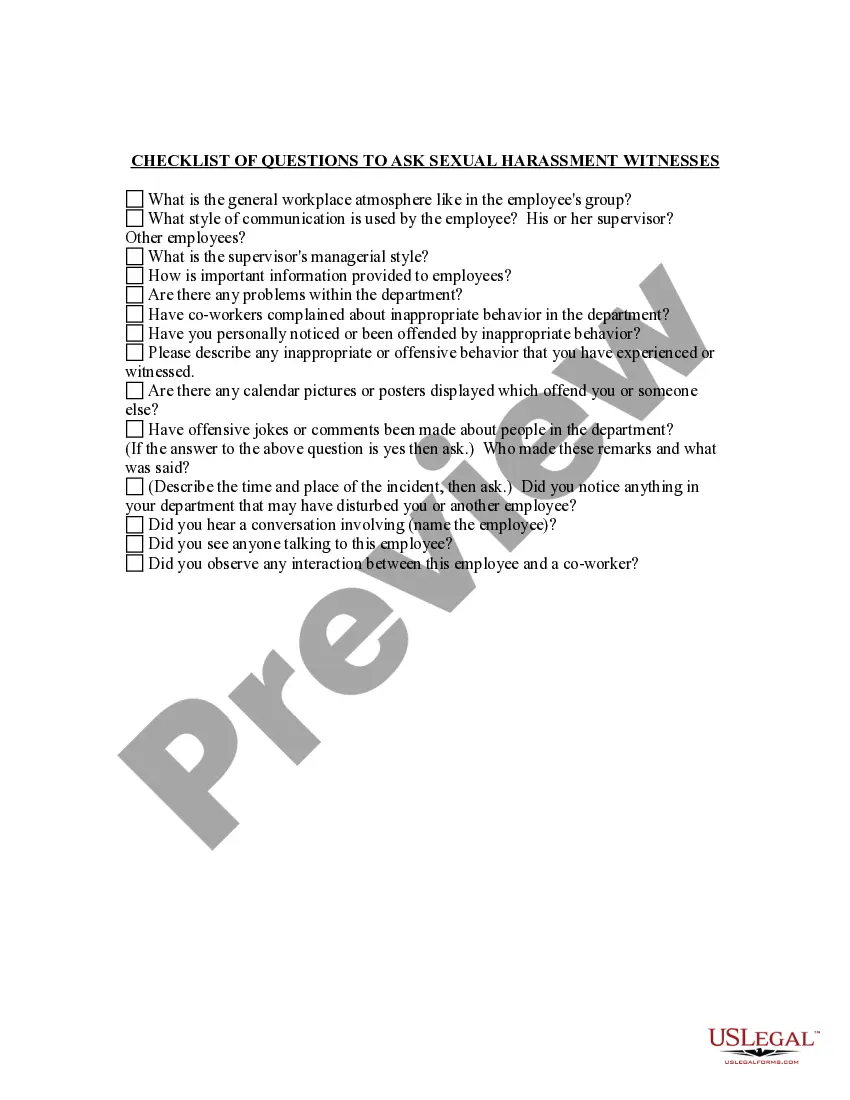
- Talk to witnesses and ask specific questions without leading them.
- Assess all collected evidence objectively and document your findings.
- Finalize the investigation by determining the outcomes and actions to be taken based on the evidence.
Notarization requirements for this form
This form does not typically require notarization unless specified by local law. It is advisable to retain this checklist internally as part of the investigation records.
Get your form ready online
Our built-in tools help you complete, sign, share, and store your documents in one place.
Make edits, fill in missing information, and update formatting in US Legal Forms—just like you would in MS Word.
Download a copy, print it, send it by email, or mail it via USPS—whatever works best for your next step.
Sign and collect signatures with our SignNow integration. Send to multiple recipients, set reminders, and more. Go Premium to unlock E-Sign.
If this form requires notarization, complete it online through a secure video call—no need to meet a notary in person or wait for an appointment.
We protect your documents and personal data by following strict security and privacy standards.

Make edits, fill in missing information, and update formatting in US Legal Forms—just like you would in MS Word.

Download a copy, print it, send it by email, or mail it via USPS—whatever works best for your next step.

Sign and collect signatures with our SignNow integration. Send to multiple recipients, set reminders, and more. Go Premium to unlock E-Sign.

If this form requires notarization, complete it online through a secure video call—no need to meet a notary in person or wait for an appointment.

We protect your documents and personal data by following strict security and privacy standards.
Common mistakes
- Failing to keep detailed records of all interviews and evidence.
- Not remaining objective during the investigation process.
- Overlooking to follow up with both the complainant and the accused throughout the process.
- Assuming the outcome without thorough evidence evaluation.
Benefits of completing this form online
- Convenience of being accessible from any location with internet access.
- Editability allows for customization to fit specific investigations.
- Reliable structure ensures that critical steps are not overlooked during the investigation process.
Legal use & context
- This checklist aids in complying with workplace harassment laws, reducing liability risks.
- Documentation from this checklist can be critical in legal proceedings if allegations escalate.
- Proper use of this form promotes accountability and improves workplace culture.
Main things to remember
- The Checklist for Investigation of Sexual Harassment provides a clear process for investigations.
- Using the checklist helps ensure compliance with workplace policies and legal standards.
- Completing this form can improve workplace safety and trust among employees.
Looking for another form?
Form popularity
FAQ
Take all complaints seriously. Launch a prompt investigation. Protect confidentiality to the extent possible. Create an investigation file. Take steps to prevent retaliation. Prepare to interview appropriate parties. Interview the complainant. Interview witnesses.
Report Immediately When an employee comes to you with a harassment complaint, taking quick action is key. Inform the reporter that you are obligated to involve HR. Whether or not the employee is in danger, immediate reporting of the allegation protects them and your organization.
Assuming that an investigation is the answer to every workplace problem. Acting on complaints that lack substance: Failure to follow the process. The wrong person investigates. The scope of the investigation is unclear. Confidentiality is not respected. Preconceptions about the outcome. Allowing the time frame to blow out.
Under many laws (e.g., Title VII, the Americans with Disabilities Act (ADA), the Age Discrimination in Employment Act (ADEA), the Occupational Safety and Health Act (OSHA), the Sarbanes-Oxley Act, state and local nondiscrimination laws), employers are legally obligated to investigate complaints (harassment,
Harassment based on race. Harassment based on gender. Harassment based on religion. Harassment based on disability. Harassment based on sexual orientation. Age-related harassment. Sexual harassment. Quid pro quo sexual harassment.
What happened? What was the date, time and duration of the incident or behavior? How many times did this happen? Where did it happen? How did it happen? Did anyone else see it happen? Who? Was there physical contact? What did you do in response to the incident or behavior?
Take all complaints seriously. Launch a prompt investigation. Protect confidentiality to the extent possible. Create an investigation file. Take steps to prevent retaliation. Prepare to interview appropriate parties. Interview the complainant. Interview witnesses.
The investigator should start with the complainant and focus on limiting and clarifying the specific allegations. Next, they will go over the details of each alleged incident, asking what was said and by whom, who witnessed what, under what circumstances did the events occur, and what documents, if any, were exchanged.
Any employee who believes he or she has been the target of sexual harassment is encouraged to inform the offending person orally or in writing that such conduct is unwelcome and offensive and must stop.