Self-Employed Independent Contractor Agreement Between an Owner / Operator Truck Driver and Common Carrier Company or Organization

What this document covers
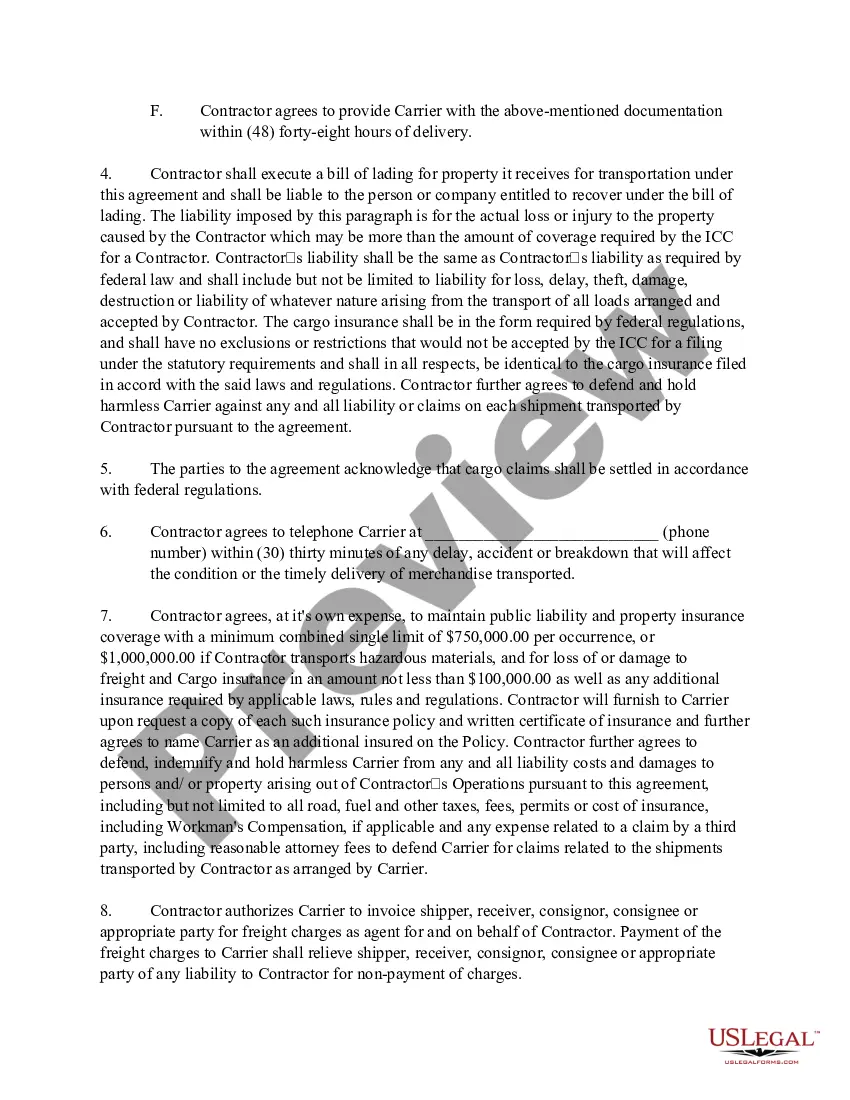
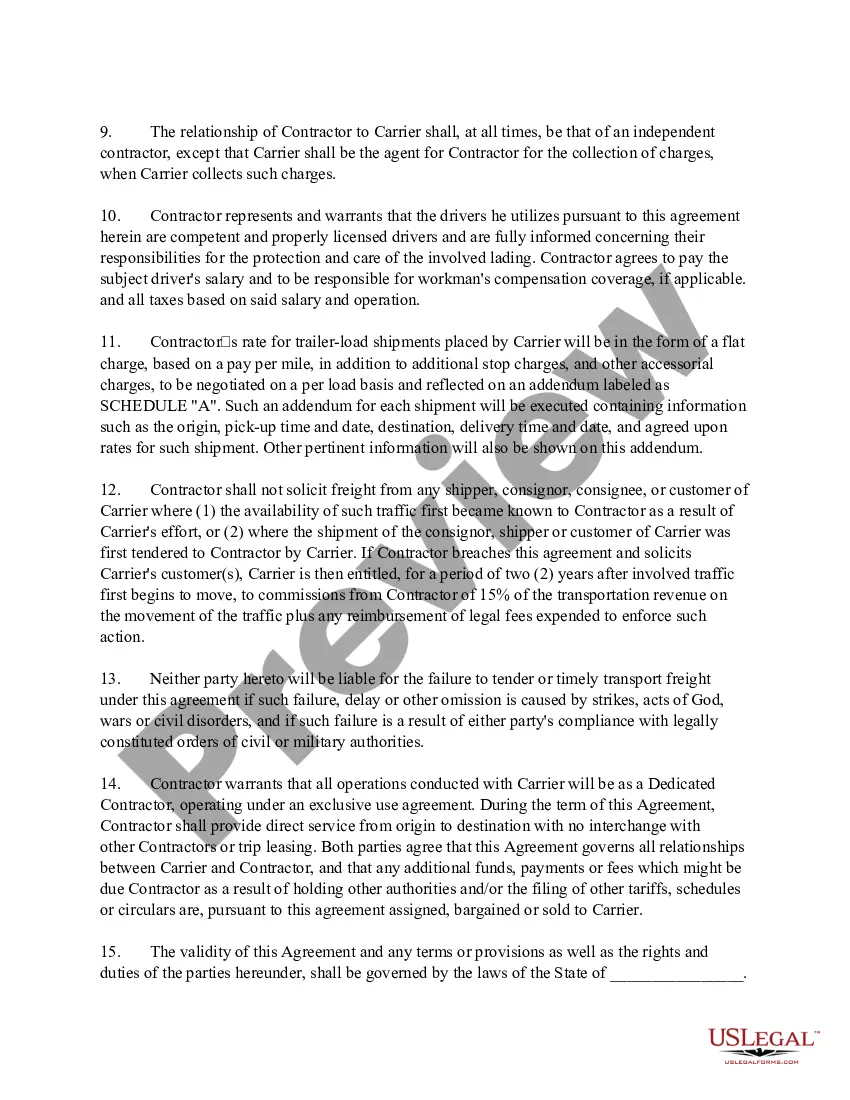
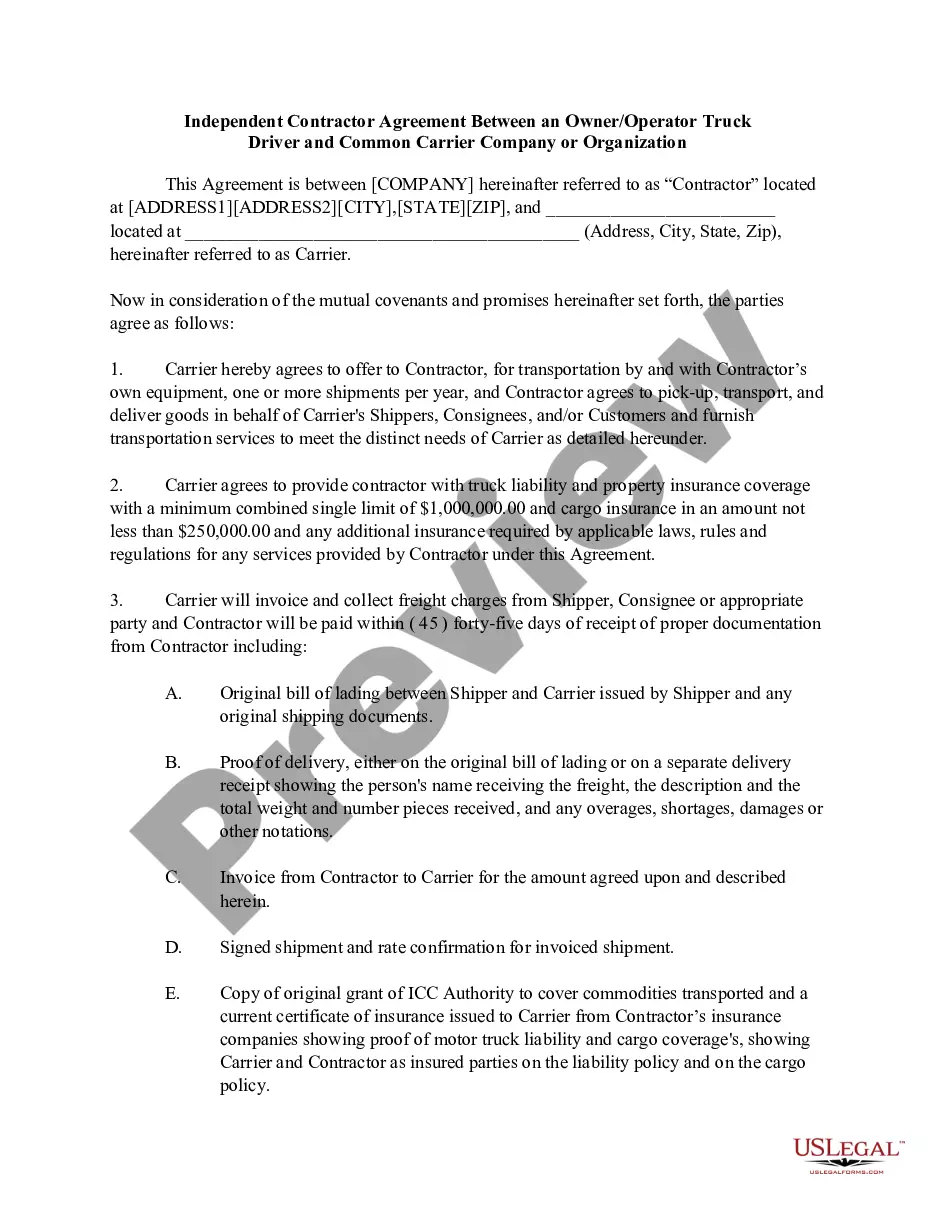
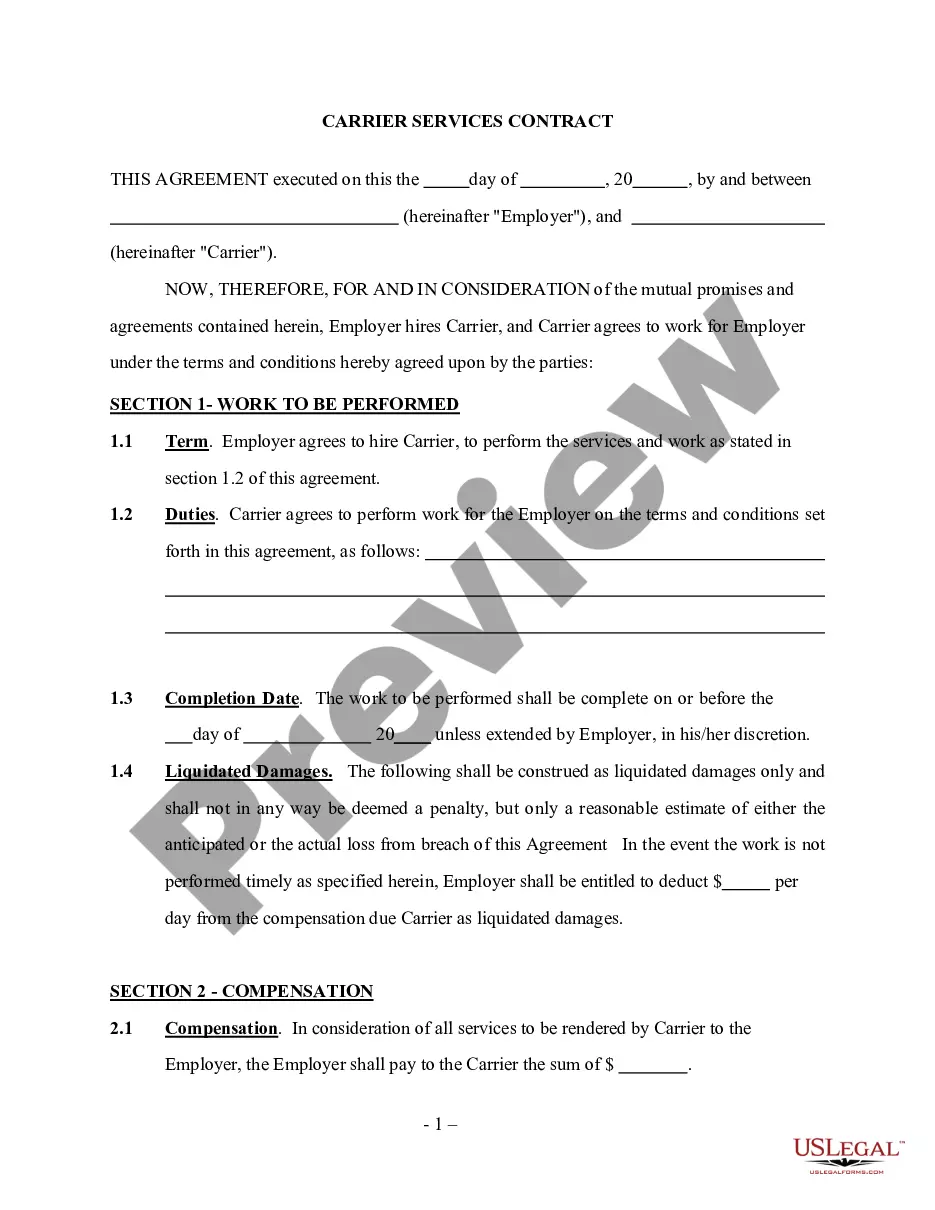
The Self-Employed Independent Contractor Agreement is a legal document that outlines the terms and conditions between an independent contractor truck driver and a common carrier company. This form is essential for clarifying the roles, responsibilities, and expectations of both parties while clearly establishing the independent contractor relationship, which is distinct from that of an employee or agent.
Form components explained
- Identification of the Contractor and Carrier, including contact details.
- Provision of transportation and insurance responsibilities.
- Payment terms, including documentation required for invoicing.
- Liability clauses related to shipment and cargo insurance.
- Indemnification and hold harmless provisions.
- Duration of the agreement and conditions for renewal or termination.


When to use this form
This form should be used when a truck driver operates as an independent contractor for a common carrier company. It is appropriate when establishing the legal framework for responsibilities related to transportation, liability, and insurance, especially in logistics or freight transportation settings.
Who this form is for
- Independent contractor truck drivers seeking to formalize their relationship with a carrier company.
- Common carrier companies looking to define the terms of service with their contracted drivers.
- Legal professionals assisting clients in the transportation sector.
How to prepare this document
- Identify and enter the full names and addresses of both the Contractor and the Carrier.
- Detail the insurance coverage amounts and conditions required from both parties.
- Specify payment terms and the documentation required for invoicing.
- Include the duration of the agreement and conditions for renewal or termination.
- Ensure all parties sign and date the agreement at the bottom to formalize the contract.
Is notarization required?
This form does not typically require notarization to be legally valid. However, some jurisdictions or document types may still require it. US Legal Forms provides secure online notarization powered by Notarize, available 24/7 for added convenience.
Get your form ready online
Our built-in tools help you complete, sign, share, and store your documents in one place.
Make edits, fill in missing information, and update formatting in US Legal Forms—just like you would in MS Word.
Download a copy, print it, send it by email, or mail it via USPS—whatever works best for your next step.
Sign and collect signatures with our SignNow integration. Send to multiple recipients, set reminders, and more. Go Premium to unlock E-Sign.
If this form requires notarization, complete it online through a secure video call—no need to meet a notary in person or wait for an appointment.
We protect your documents and personal data by following strict security and privacy standards.

Make edits, fill in missing information, and update formatting in US Legal Forms—just like you would in MS Word.

Download a copy, print it, send it by email, or mail it via USPS—whatever works best for your next step.

Sign and collect signatures with our SignNow integration. Send to multiple recipients, set reminders, and more. Go Premium to unlock E-Sign.

If this form requires notarization, complete it online through a secure video call—no need to meet a notary in person or wait for an appointment.

We protect your documents and personal data by following strict security and privacy standards.
Common mistakes
- Failing to provide complete insurance documentation required for transportation.
- Omitting clear payment terms and invoicing requirements.
- Not having both parties sign the agreement, making it legally unenforceable.
Benefits of using this form online
- Convenient access to legal forms that can be downloaded and customized easily.
- The ability to generate and edit the agreement as needed before finalization.
- Guaranteed reliability by using templates drafted by licensed attorneys.
Legal use & context
- This agreement establishes a legally binding relationship between the contractor and the carrier.
- It outlines the liabilities and responsibilities of both parties, protecting them in case of disputes.
- Understanding the distinctions between independent contractors and employees is essential for compliance with labor laws.
Key takeaways
- This agreement formalizes the relationship between independent truck drivers and carrier companies.
- Clarification of roles, responsibilities, and liability is crucial for effective and lawful operations.
- Proper completion and understanding of this form can prevent common legal disputes in the transportation industry.
Looking for another form?



Form popularity
FAQ
A 1099 employee is one person or an entire company that you hire to do a specific job for you.In trucking, your 1099 employee would be an owner-operator or an independent contractor. A 1099 employee is not a company driver, so that means you don't provide benefits for them (say, such as health insurance).
A 1099 employee is one person or an entire company that you hire to do a specific job for you.In trucking, your 1099 employee would be an owner-operator or an independent contractor. A 1099 employee is not a company driver, so that means you don't provide benefits for them (say, such as health insurance).
Independent contractors, also called owner-operators, typically earn a percentage of the freight bill for every load. You get to be your own boss and lease the truck of your choice.
Truck drivers' employment status is classified based on a variety of factors. Generally speaking, companies can only classify truck drivers as independent contractors if the truckers have control over how and when they perform their duties.
Independent contractors pay their own Social Security and Medicare taxes and do not receive employee benefits.Truck drivers are often owner-operators of their own freelance business and are therefore considered independent contractors.
Basically, an owner operator is an independent contractor with a business attached to their name. However, you can be an independent contractor in trucking without being an owner operator.
Are Truckers Self Employed Independent Contractors or Employees? According to the National Employment Law Project, four out of every five truck drivers are classified as independent contractors.
1099 employees are generally individuals who are in an independent trade, business, or profession in which they offer their services to the general public (not just a single customer or employer), including: Doctors. Dentists.