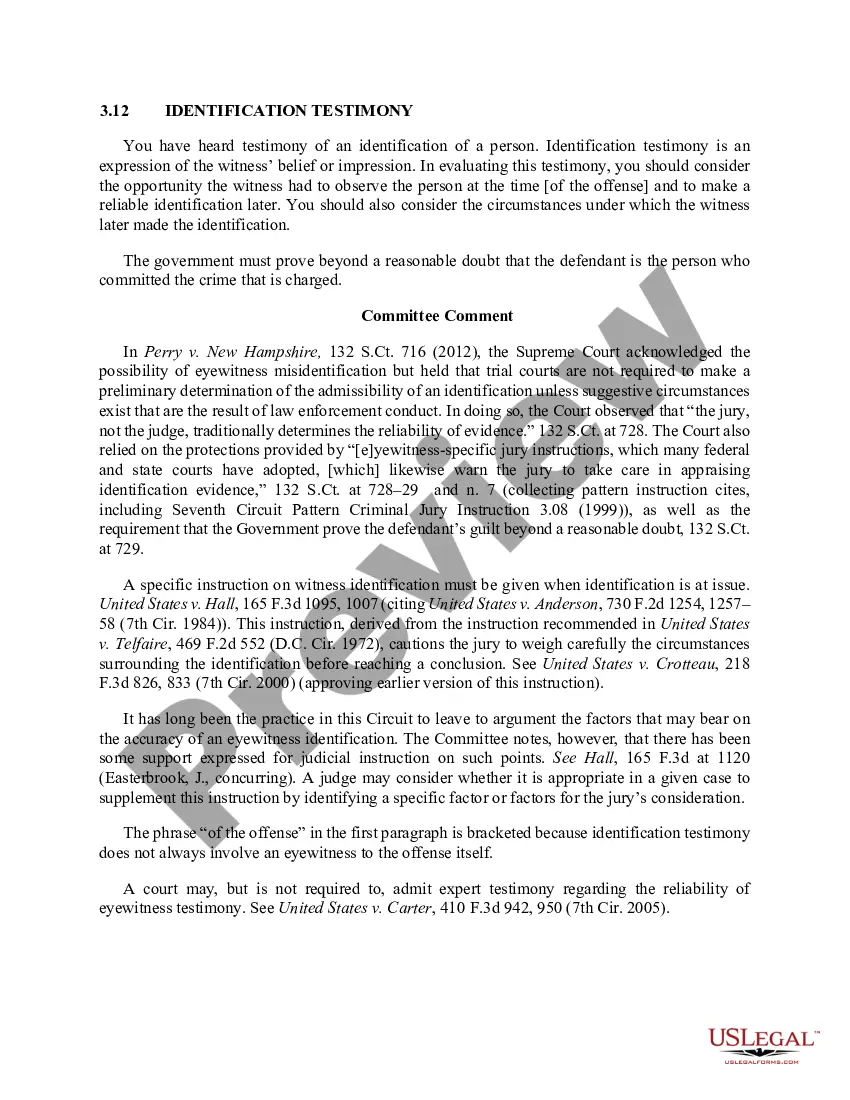
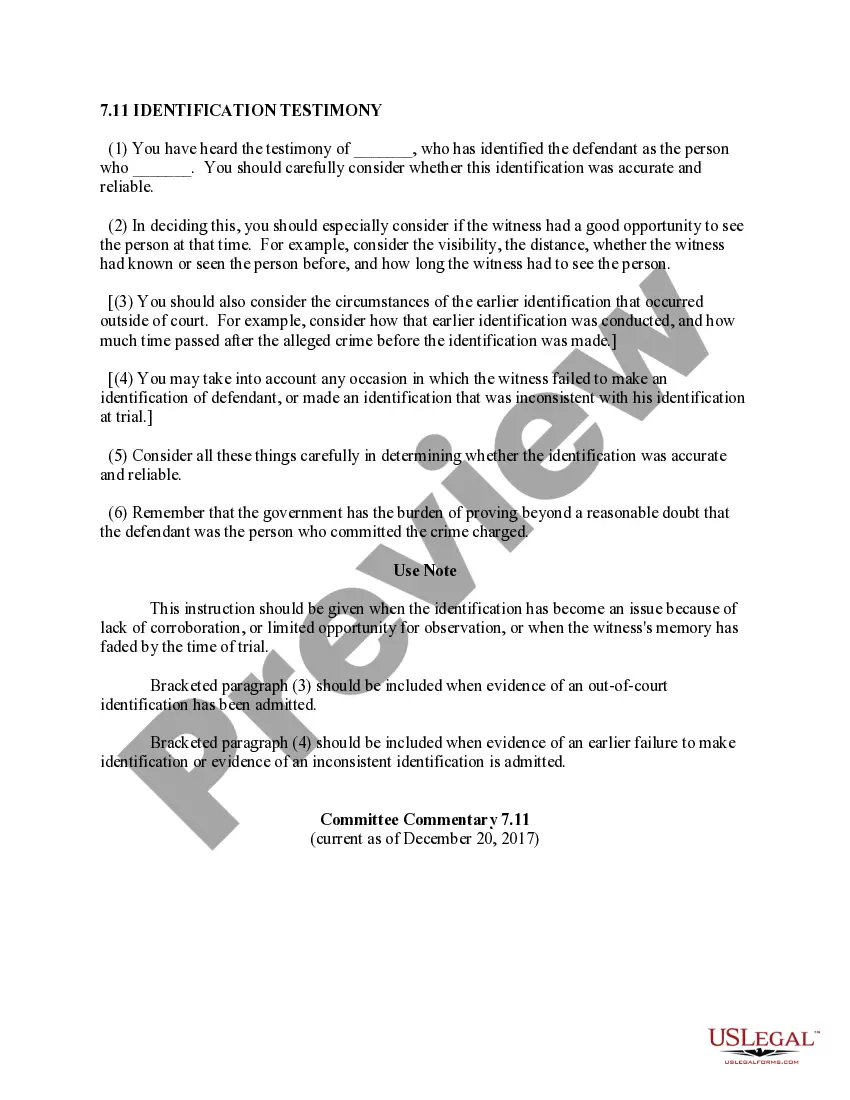
3.12 IDENTIFICATION TESTIMONY
Understanding this form
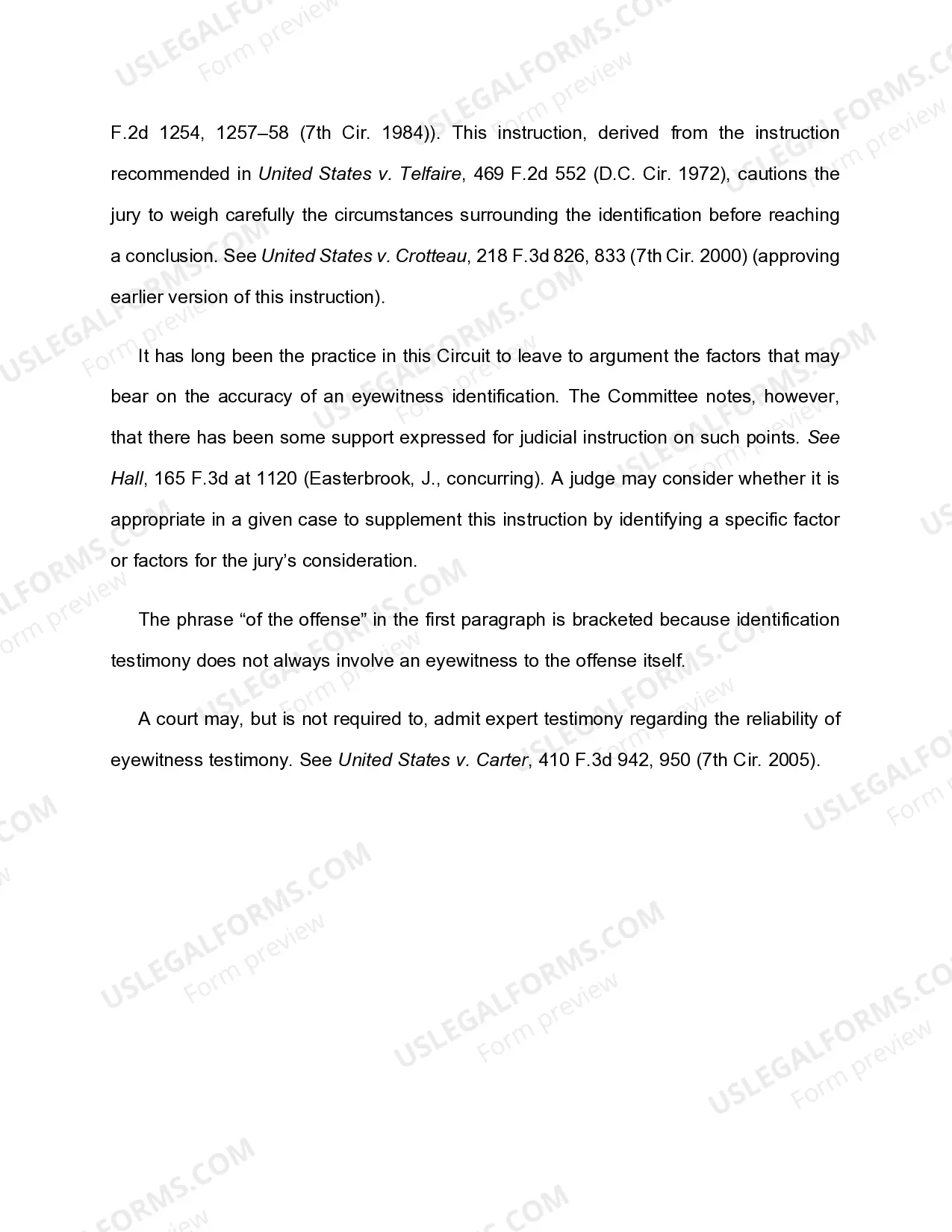
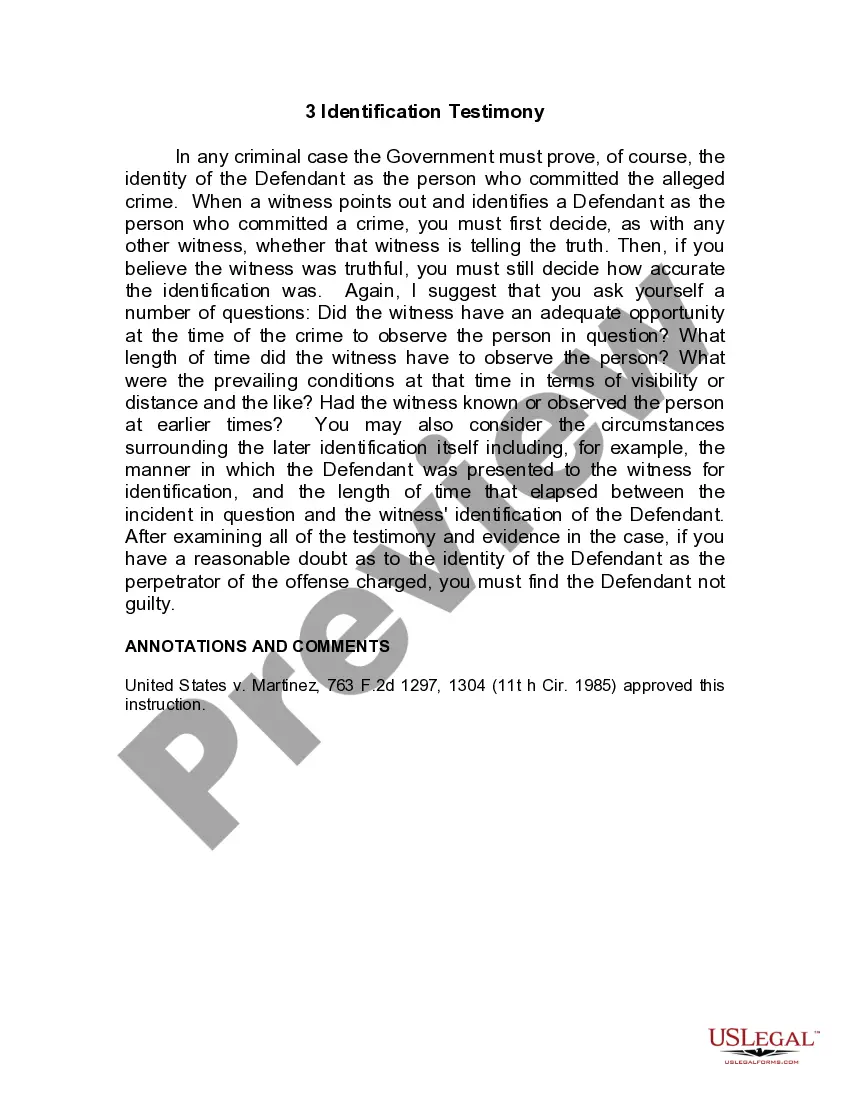
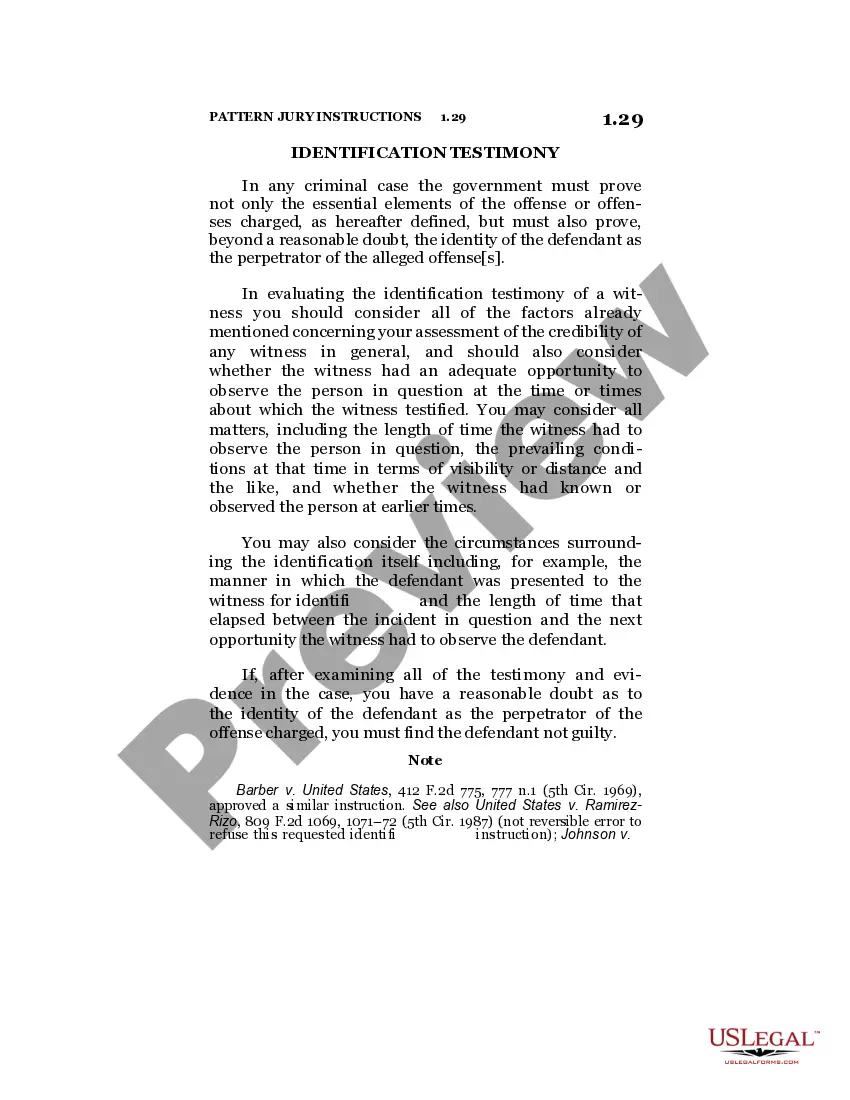
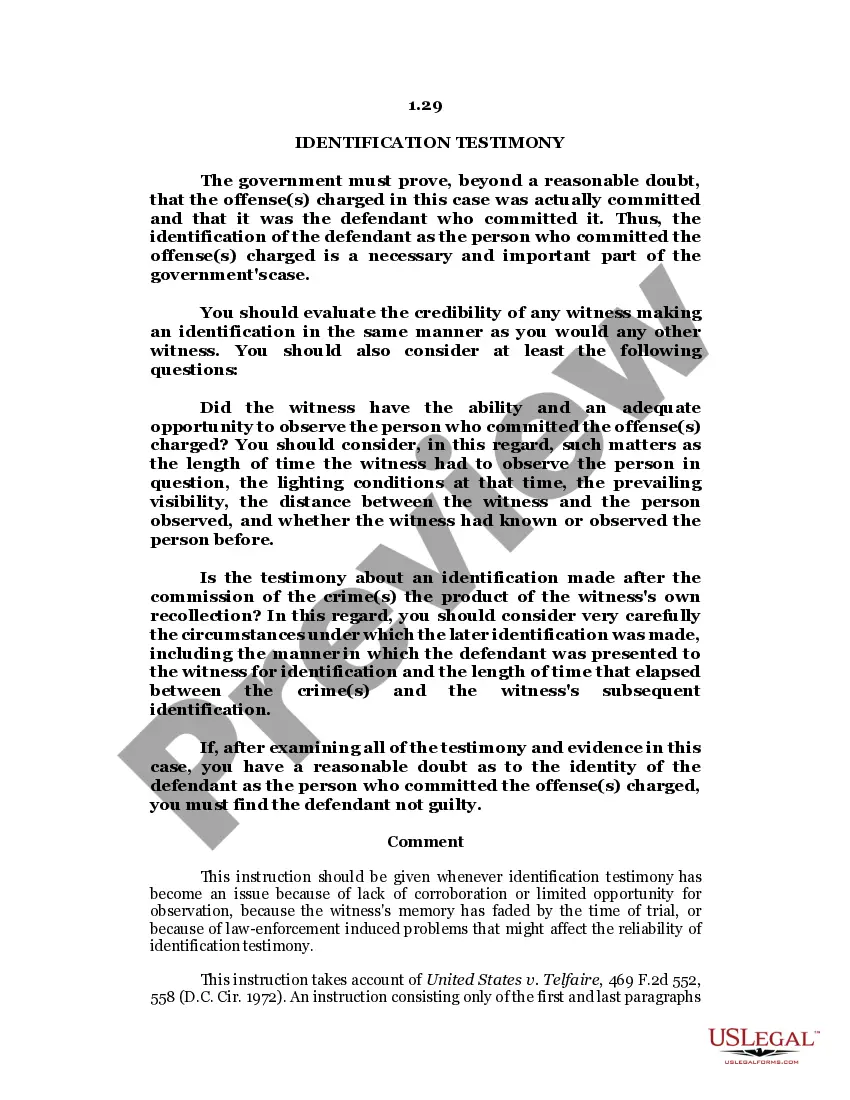
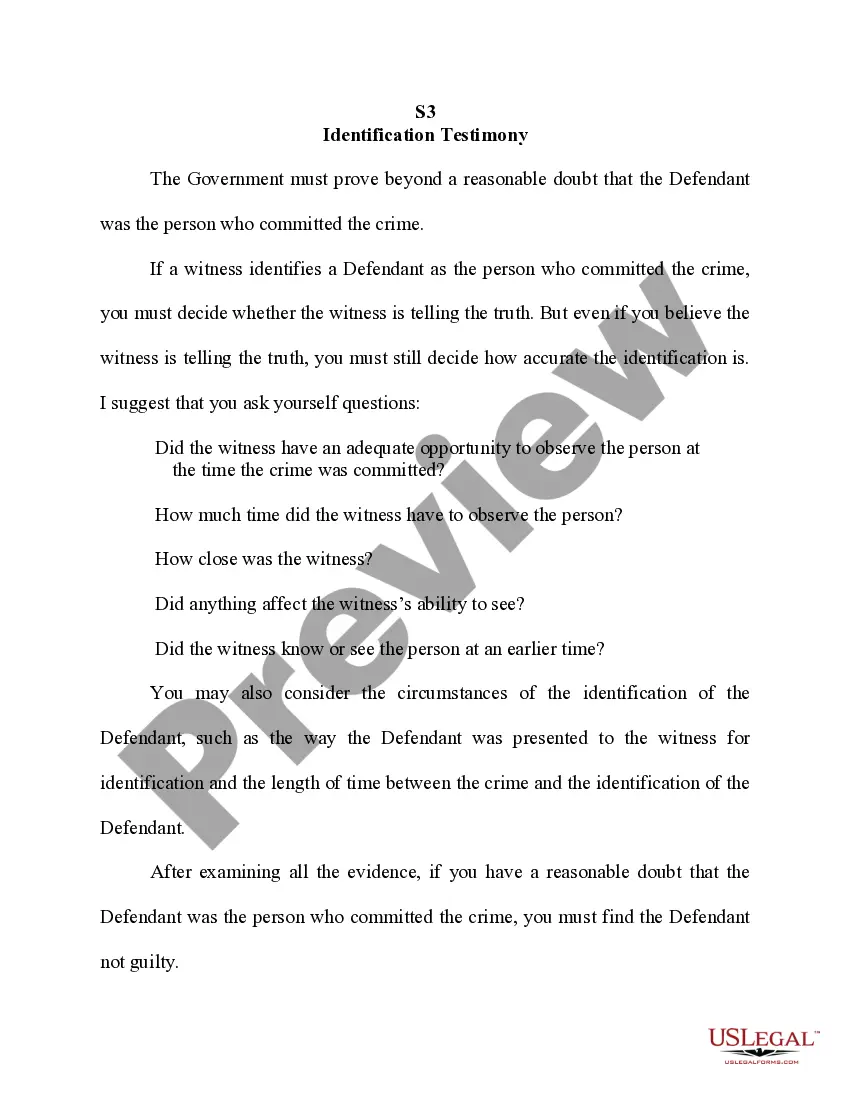
The 3.12 Identification Testimony form is an official jury instruction used in federal court proceedings, specifically adopted by the Federal 7th Circuit Court. This form guides jurors on how to evaluate eyewitness identification testimony, highlighting the significance of the conditions under which such identification is made. Different from other jury instructions, this form emphasizes the need for careful consideration of the witnessâs observations and the reliability of the identification process.
Key components of this form
- Definition of identification testimony and its relevance in court.
- Factors jurors should consider when evaluating identification.
- Clarification that the government must prove the defendantâs identity beyond a reasonable doubt.
- Judicial precedents regarding eyewitness testimony and juror responsibilities.
- Indication that expert testimony about the reliability of eyewitness accounts may be included at the court's discretion.

When to use this document
This form is used during trials where eyewitness identification plays a critical role in establishing the defendant's identity. It provides jurors with the framework to assess the credibility of the testimony presented, ensuring that they recognize the potential pitfalls of relying solely on eyewitness accounts.
Who needs this form
- Judges overseeing federal trials in the 7th Circuit.
- Jury members who need guidance on the evaluation of eyewitness testimony.
- Attorneys representing clients in federal criminal cases where identification is contested.
How to prepare this document
- Provide an overview of the case to contextualize the identification testimony.
- Detail the circumstances under which the witness observed the person involved in the offense.
- Enumerate factors affecting the reliability of the identification made by the witness.
- Confirm that jurors are instructed to evaluate the identification testimony based on provided guidelines.
- Ensure the final instruction is clear and within the bounds of the law as prescribed by relevant case law.
Notarization guidance
Notarization is generally not required for this form. However, certain states or situations might demand it. You can complete notarization online through US Legal Forms, powered by Notarize, using a verified video call available anytime.
Get your form ready online
Our built-in tools help you complete, sign, share, and store your documents in one place.
Make edits, fill in missing information, and update formatting in US Legal Forms—just like you would in MS Word.
Download a copy, print it, send it by email, or mail it via USPS—whatever works best for your next step.
Sign and collect signatures with our SignNow integration. Send to multiple recipients, set reminders, and more. Go Premium to unlock E-Sign.
If this form requires notarization, complete it online through a secure video call—no need to meet a notary in person or wait for an appointment.
We protect your documents and personal data by following strict security and privacy standards.

Make edits, fill in missing information, and update formatting in US Legal Forms—just like you would in MS Word.

Download a copy, print it, send it by email, or mail it via USPS—whatever works best for your next step.

Sign and collect signatures with our SignNow integration. Send to multiple recipients, set reminders, and more. Go Premium to unlock E-Sign.

If this form requires notarization, complete it online through a secure video call—no need to meet a notary in person or wait for an appointment.

We protect your documents and personal data by following strict security and privacy standards.
Common mistakes
- Failing to clarify the burden of proof regarding the defendant's identity.
- Neglecting to emphasize the importance of the conditions under which the identification was made.
- Overlooking the need to address possible eyewitness misidentification issues.
Benefits of using this form online
- Convenient access to the form from any location.
- Editable format allows for customization depending on specific case details.
- Provides a reliable legal framework endorsed by recognized legal standards.
Legal use & context
- This form is vital for ensuring that jurors understand the complexities and limitations of eyewitness testimony.
- It reflects established legal precedents and assists in upholding fair trial standards in criminal cases.
Looking for another form?

Form popularity
FAQ
Quick Reference. A procedure used by police to test the ability of witnesses to identify a person they have seen on a previous occasion?usually the perpetrator of an offence.
(a) Definitions. (1) ?Eyewitness Identification? means witness testimony or conduct in a criminal trial that identifies the defendant as the person who committed a charged crime.
There are three primary forms of eyewitness identification: lineup, showup, and photographic identification. These typically are used in combination with one another and with scientific identifications.
The 'witness box' will generate a new fingerprint and find its similarity with the previously stored registration data. A similarity threshold is calculated from the registered fingerprints and if the new fingerprint is above the threshold, the device is authenticated.
The guidelines a witness who is honest may be wrong even if they are convinced they are right; a witness who is convincing may still be wrong; more than one witness may be wrong; a witness who recognises the defendant, even when the witness knows the defendant very well, may be wrong.
: an enclosure in which a witness sits or stands while testifying in court.
There are three primary forms of eyewitness identification: lineup, showup, and photographic identification.
: the place in a court of law where a witness answers questions and promises to tell the truth : the place where a witness testifies in court. ? called also the stand, (British) witness box.