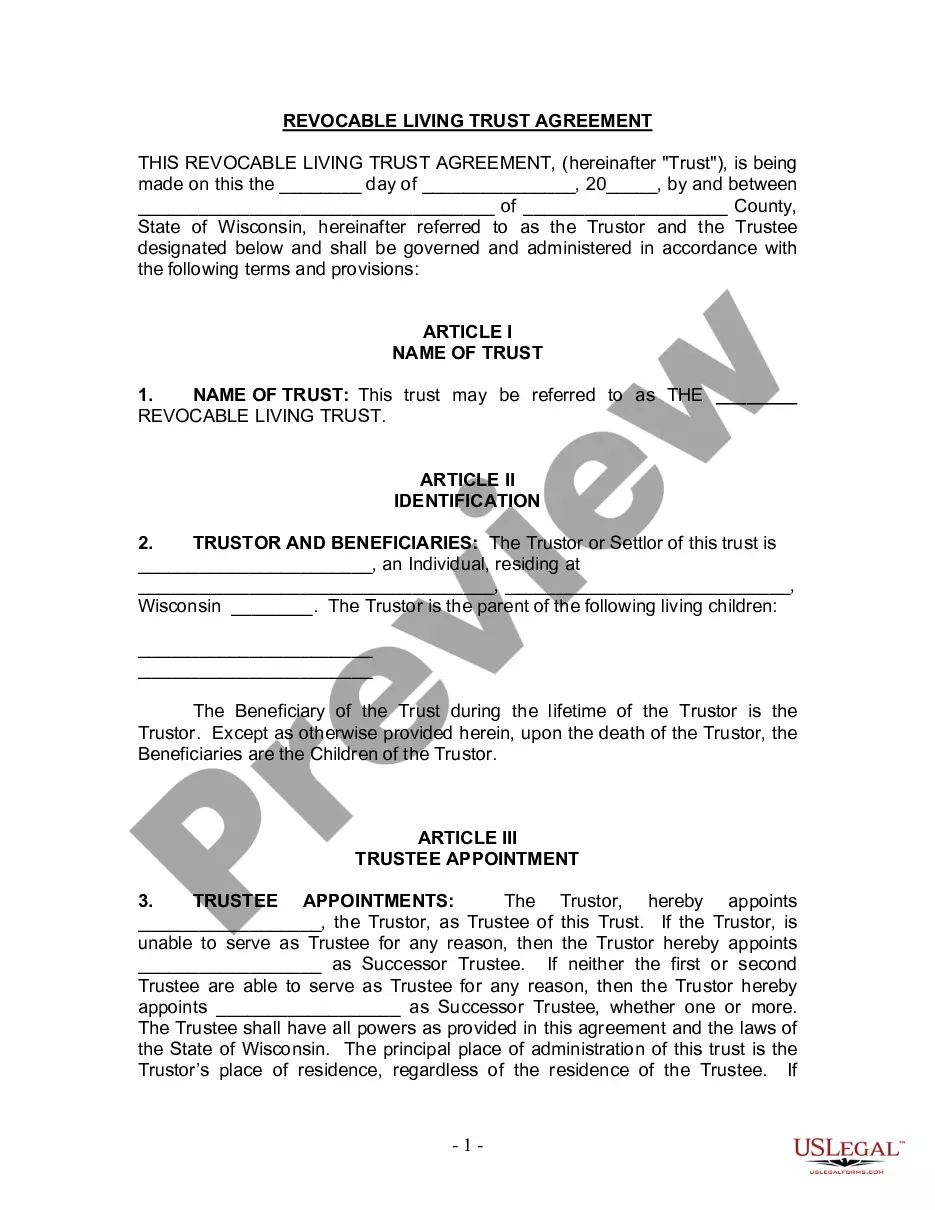
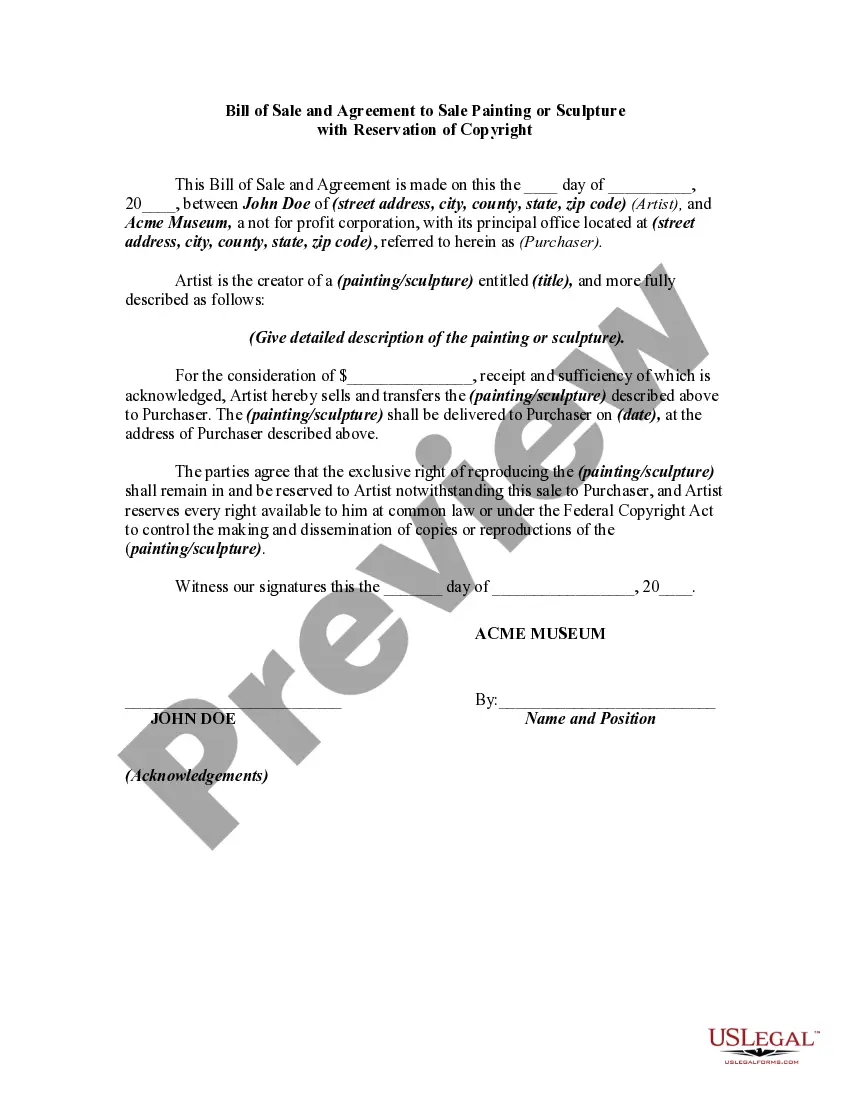
Bill of Sale and Agreement to Sale Painting or Sculpture
What is this form?
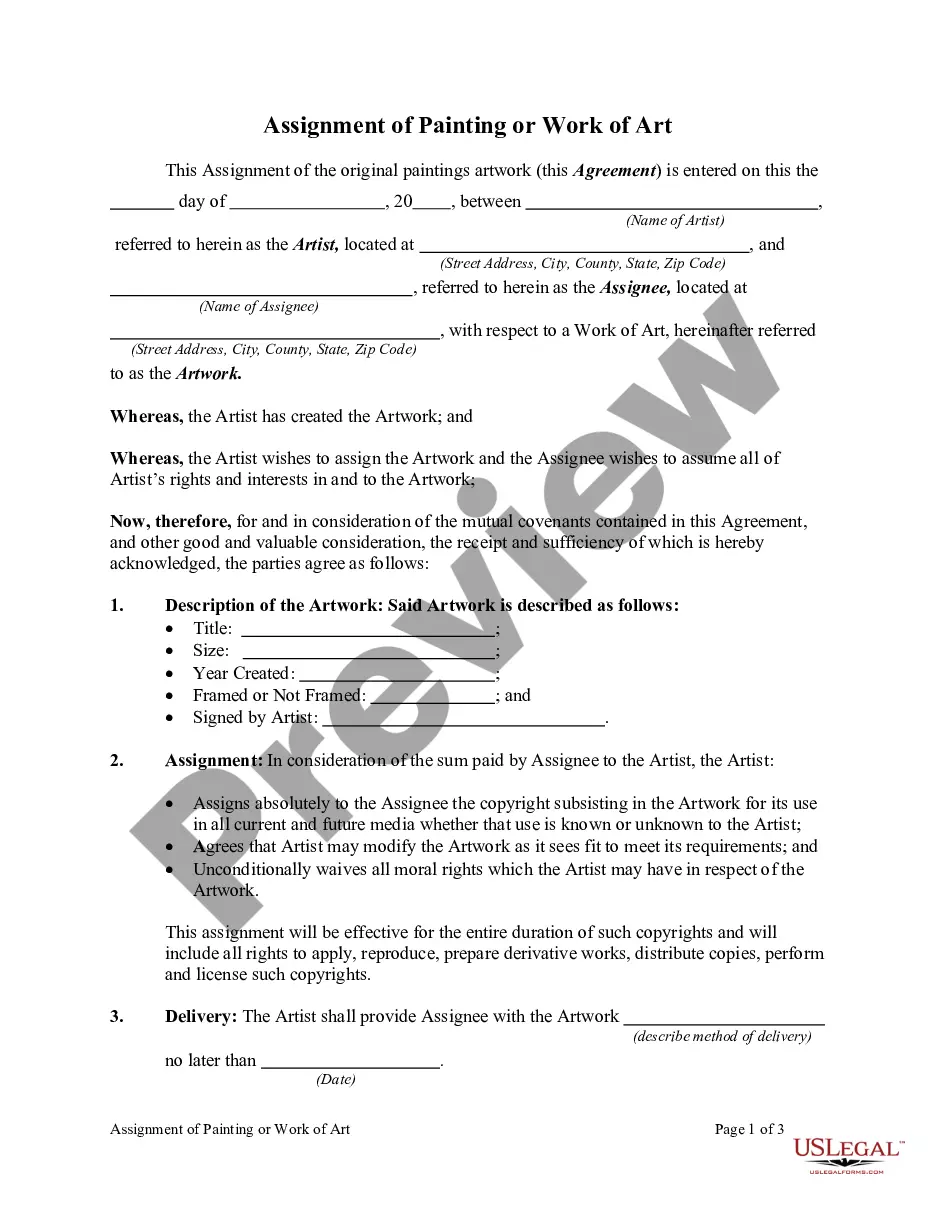
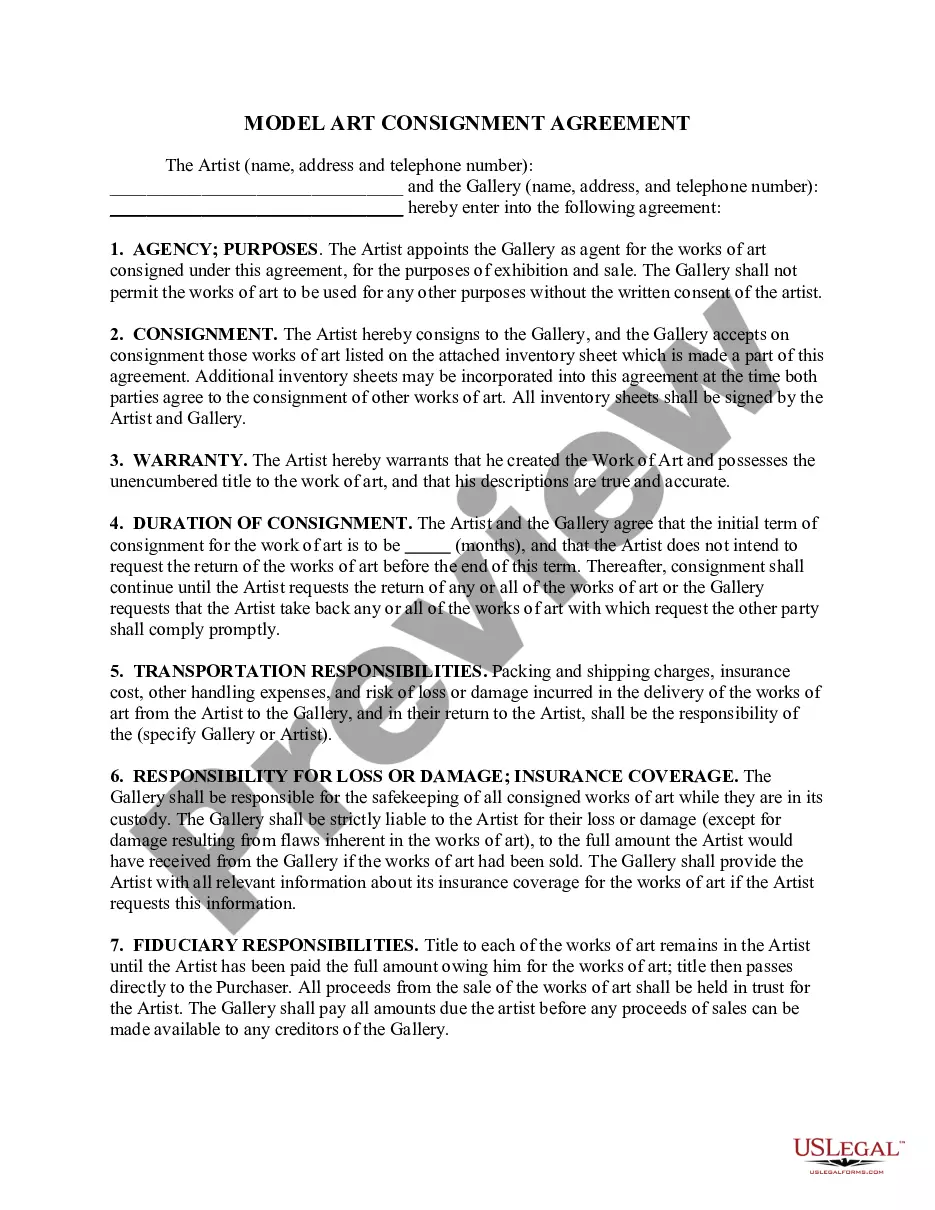
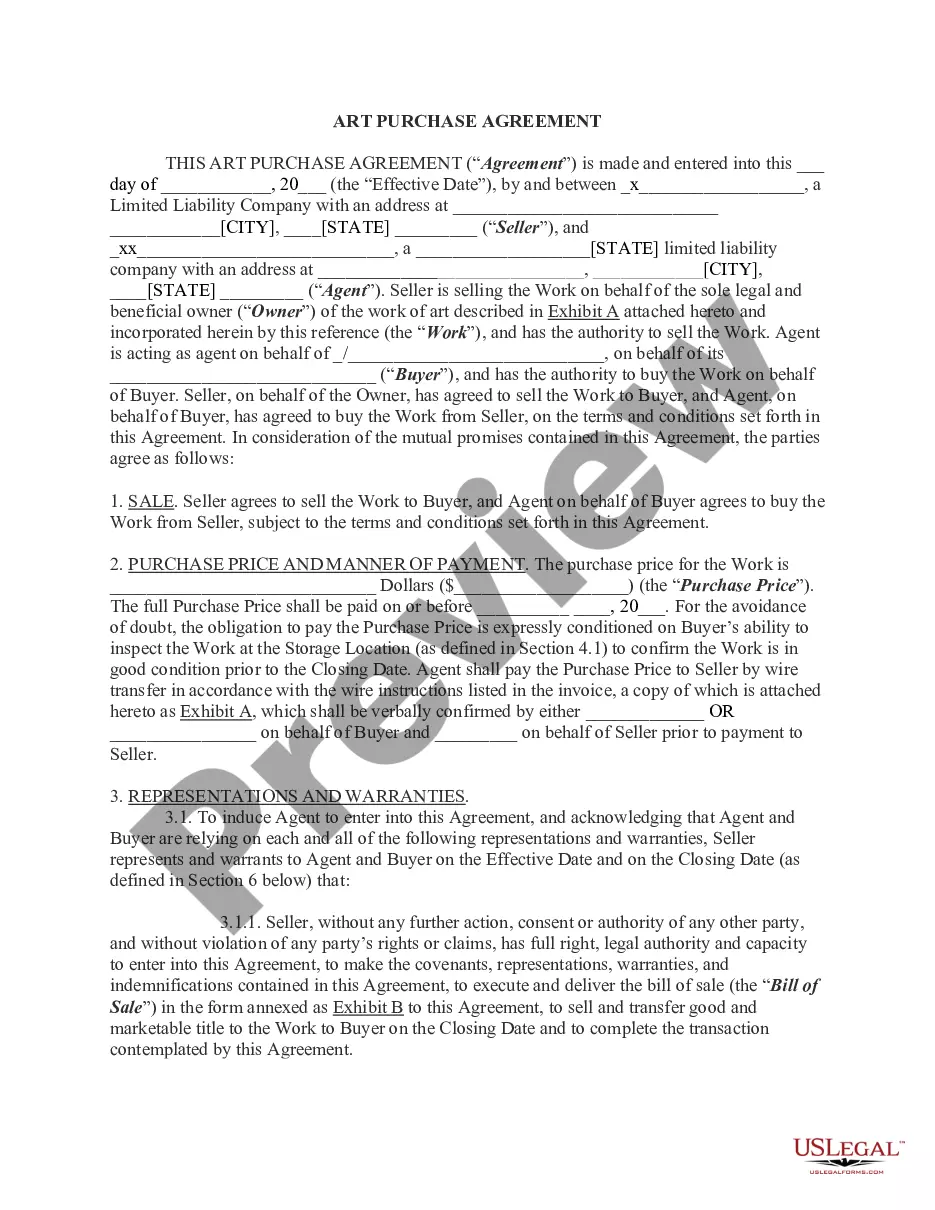
The Bill of Sale and Agreement to Sale Painting or Sculpture is a legal document that facilitates the transfer of ownership of artwork from the artist to the buyer. It serves as proof of the transaction and documents essential details, ensuring both parties are clear on the sale terms. This form specifically emphasizes the seller's rights to copyright and reproduction, distinguishing it from general sales agreements for personal property.
Key parts of this document
- Identification of the seller (artist) and buyer (purchaser).
- Description of the artwork being sold, including title and detailed characteristics.
- Sale price that acknowledges receipt of payment.
- Delivery details regarding when and where the artwork will be handed over.
- Copyright and reproduction rights reserved for the artist post-sale.
- Signatures of both parties to confirm the agreement.
Situations where this form applies
This form is commonly used when an artist sells a painting or sculpture to a buyer, such as an individual or institution like a gallery or museum. It is appropriate during any sale that requires a verifiable record, and when the artist wishes to retain copyright over the artwork, ensuring control over reproductions.
Who needs this form
This form is ideal for:
- Artists looking to sell their original paintings or sculptures.
- Buyers or collectors acquiring artwork and seeking documentation of their purchase.
- Museums or galleries that require a formal agreement during art transactions.
Completing this form step by step
- Identify both parties by entering the names and addresses of the artist and buyer.
- Provide a detailed description of the artwork being sold, including its title and medium.
- Specify the sale price of the artwork.
- Fill in the delivery date and address for the transfer of the artwork.
- Both parties must sign and date the agreement to finalize the sale.
Notarization requirements for this form
Notarization is not commonly needed for this form. However, certain documents or local rules may make it necessary. Our notarization service, powered by Notarize, allows you to finalize it securely online anytime, day or night.
Get your form ready online
Our built-in tools help you complete, sign, share, and store your documents in one place.
Make edits, fill in missing information, and update formatting in US Legal Forms—just like you would in MS Word.
Download a copy, print it, send it by email, or mail it via USPS—whatever works best for your next step.
Sign and collect signatures with our SignNow integration. Send to multiple recipients, set reminders, and more. Go Premium to unlock E-Sign.
If this form requires notarization, complete it online through a secure video call—no need to meet a notary in person or wait for an appointment.
We protect your documents and personal data by following strict security and privacy standards.

Make edits, fill in missing information, and update formatting in US Legal Forms—just like you would in MS Word.

Download a copy, print it, send it by email, or mail it via USPS—whatever works best for your next step.

Sign and collect signatures with our SignNow integration. Send to multiple recipients, set reminders, and more. Go Premium to unlock E-Sign.

If this form requires notarization, complete it online through a secure video call—no need to meet a notary in person or wait for an appointment.

We protect your documents and personal data by following strict security and privacy standards.
Typical mistakes to avoid
- Failing to provide a detailed description of the artwork, which is crucial for identification.
- Not specifying the sale price correctly, leading to disputes post-sale.
- Overlooking the section regarding copyright and reproduction rights.
- Missing signatures from one or both parties, making the document unenforceable.
Benefits of using this form online
- Convenience of immediate access and downloadable format.
- Editability allows customization to meet specific needs.
- Drafted by licensed attorneys for enhanced reliability.
Legal use & context
- This form is legally recognized as proof of ownership transfer in sales of artwork.
- It establishes clear terms that can help prevent disputes over rights and obligations.
- The retention of copyright by the Artist is a critical legal component that preserves their rights.
Looking for another form?



Form popularity
FAQ
When seeking prospective business buyers it's easy to find leads. Look for new companies that are moving into your neighborhood. Contact companies that already own your work to find out if they are expanding in size or building new offices. Contact architects and interior designers who have new corporate clients.
So, if a piece took you 10 hours to make, you want to get $15 per hour, and the materials cost you $45, you could use $195 as your starting point (10 times 15, plus 45). Cost of materials would include your canvas, paper, paint, ink, and so forth.
The answer is, if you are creating fan art whether for profit or not, any copyrighted character or use of trademark in a description or title without prior written consent from the copyright owner, then selling fan art is illegal but making fan art is not illegal.
If you're selling crafts then you will need a permit from the state you're selling your merchandise. Even if you're selling crafts on a part time basis, you still need a permit. The permit will give you a tax identification number.
The general consensus is that in most cases you do need a business license to sell your art. A business license is a local requirement that basically enables you to sell something. It is necessary if you want to collect taxes or for remaining in compliance with your business.
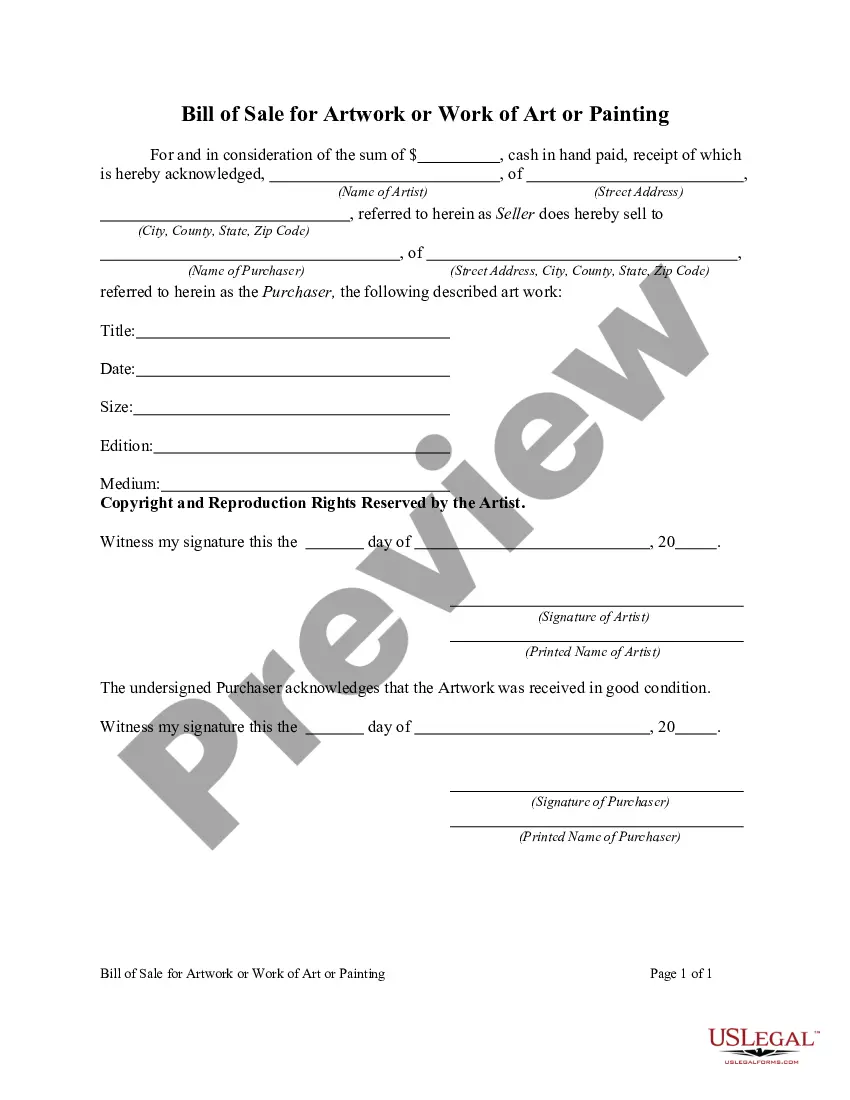
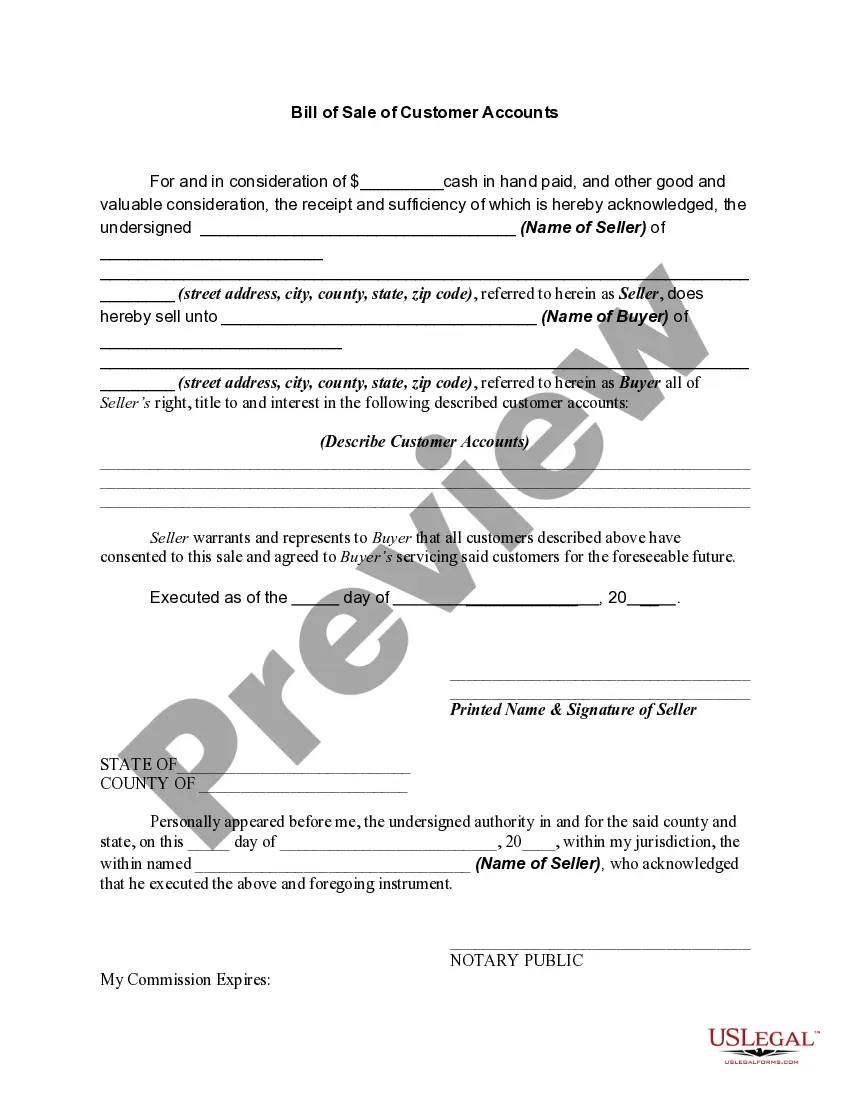
In order to sell your artwork, you will need to provide a Bill of Sale. The Bill of Sale, or invoice, is one of your most important business documents. Artwork in physical form is considered personal property, and therefore a transfer of title will be necessary in the form of a Bill of Sale.
Pay yourself a reasonable hourly wage, add the cost of materials and make that your asking price. For example, if materials cost $50, you take 20 hours to make the art, and you pay yourself $20 an hour to make it, then you price the art at $450 ($20 X 20 hours + $50 cost of materials).
Pay yourself a reasonable hourly wage, add the cost of materials and make that your asking price. For example, if materials cost $50, you take 20 hours to make the art, and you pay yourself $20 an hour to make it, then you price the art at $450 ($20 X 20 hours + $50 cost of materials).
An art gallery is one of the types of dealers. Art dealers are taxed in the same way as any other retail operation. As such, all income including income from the sale of art is taxed as ordinary income (IRC Sections 61, 64). Expenses, if ordinary and necessary, are deductible under IRC Sections 162.