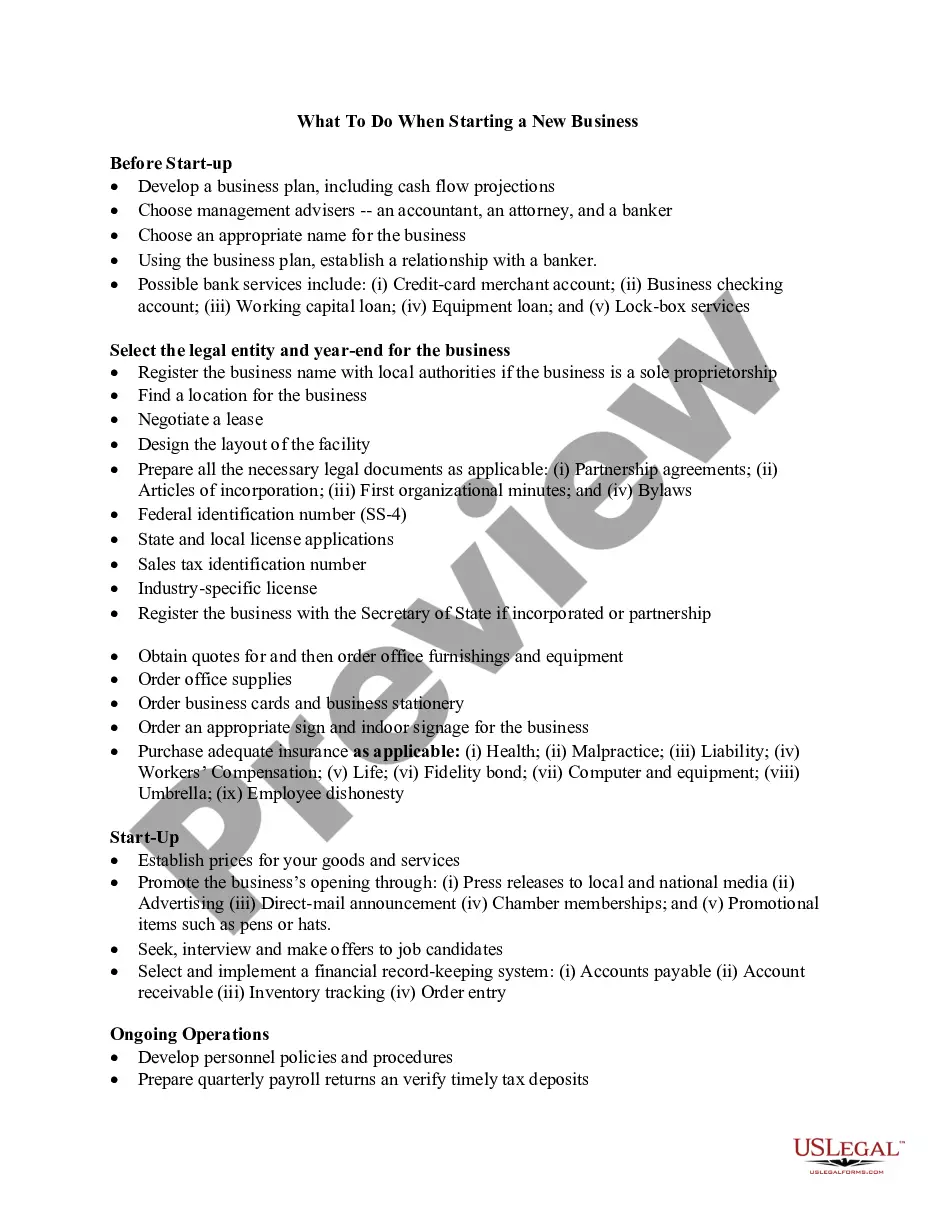
New York Warranty Deed from Corporation to Husband and Wife
Overview of this form
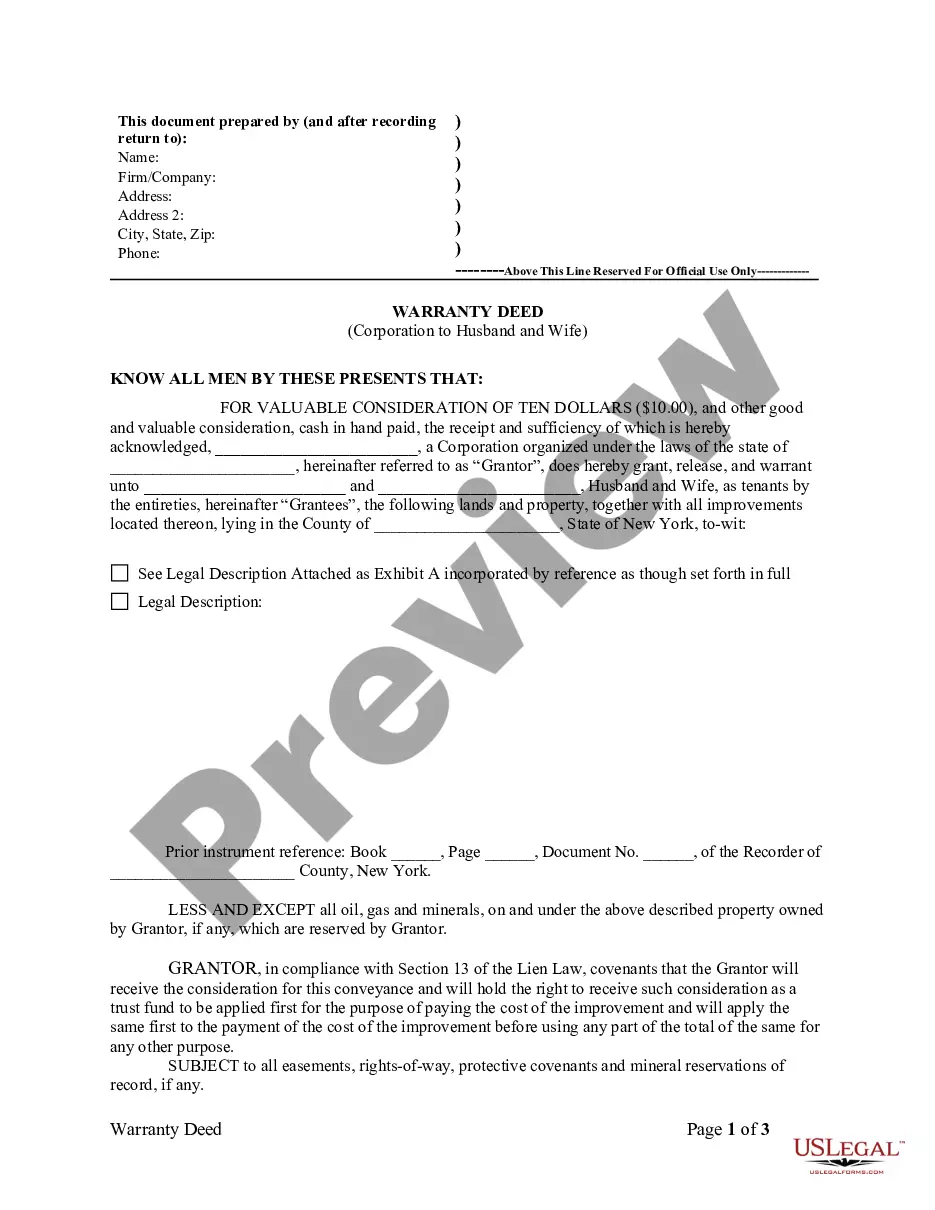
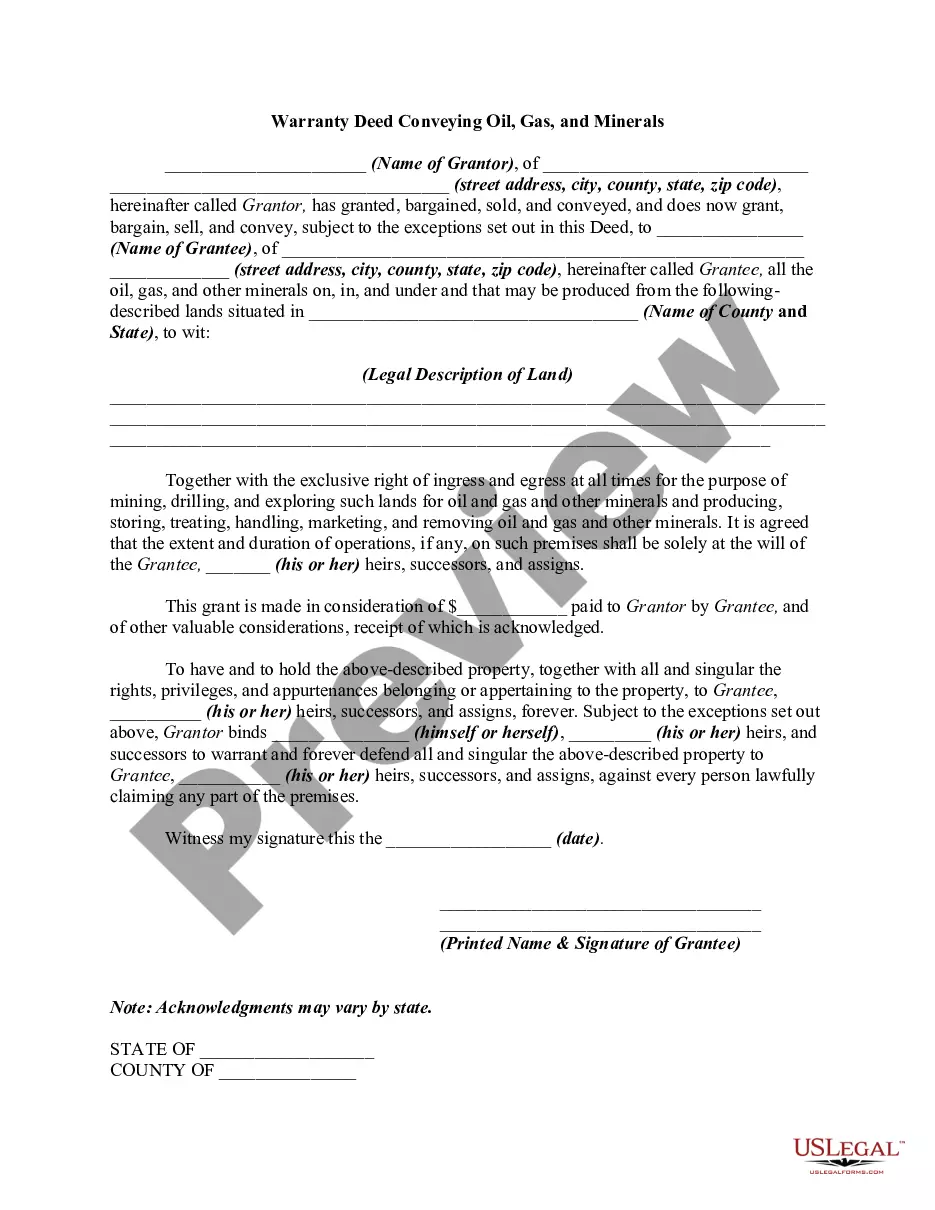
This Warranty Deed from Corporation to Husband and Wife is a legal document that transfers property ownership from a corporation (the Grantor) to a married couple (the Grantees). This deed includes specific covenants and warranties regarding the title, ensuring that the Grantor is legally authorized to convey the property. Unlike other deeds, it specifically addresses the transfer of property to a married couple and includes provisions for joint tenancy with right of survivorship, which allows for automatic transfer of ownership upon death of one spouse.
What’s included in this form
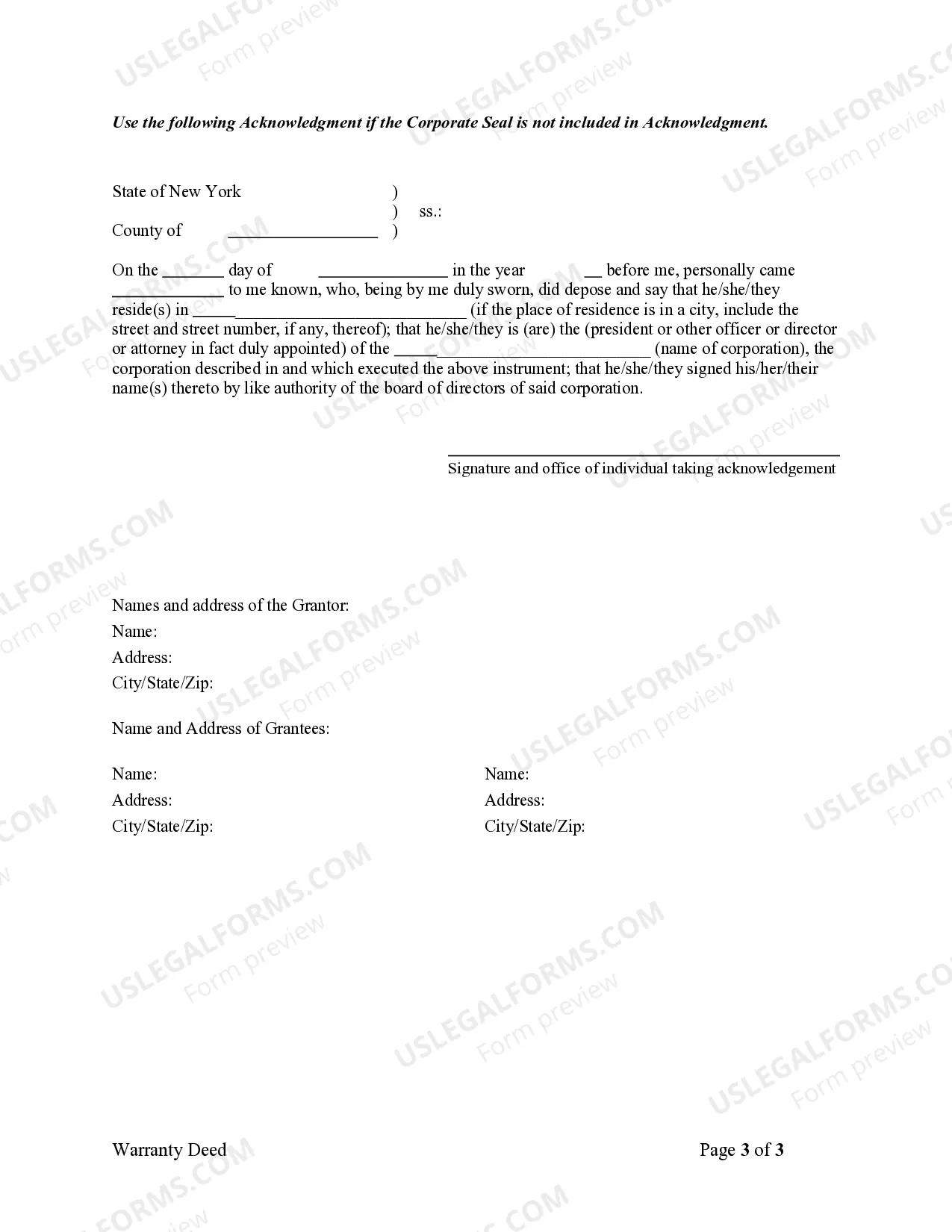
- Grantor and Grantees details, including names and addresses.
- Legal description of the property being transferred.
- Statement of consideration received for the property transfer.
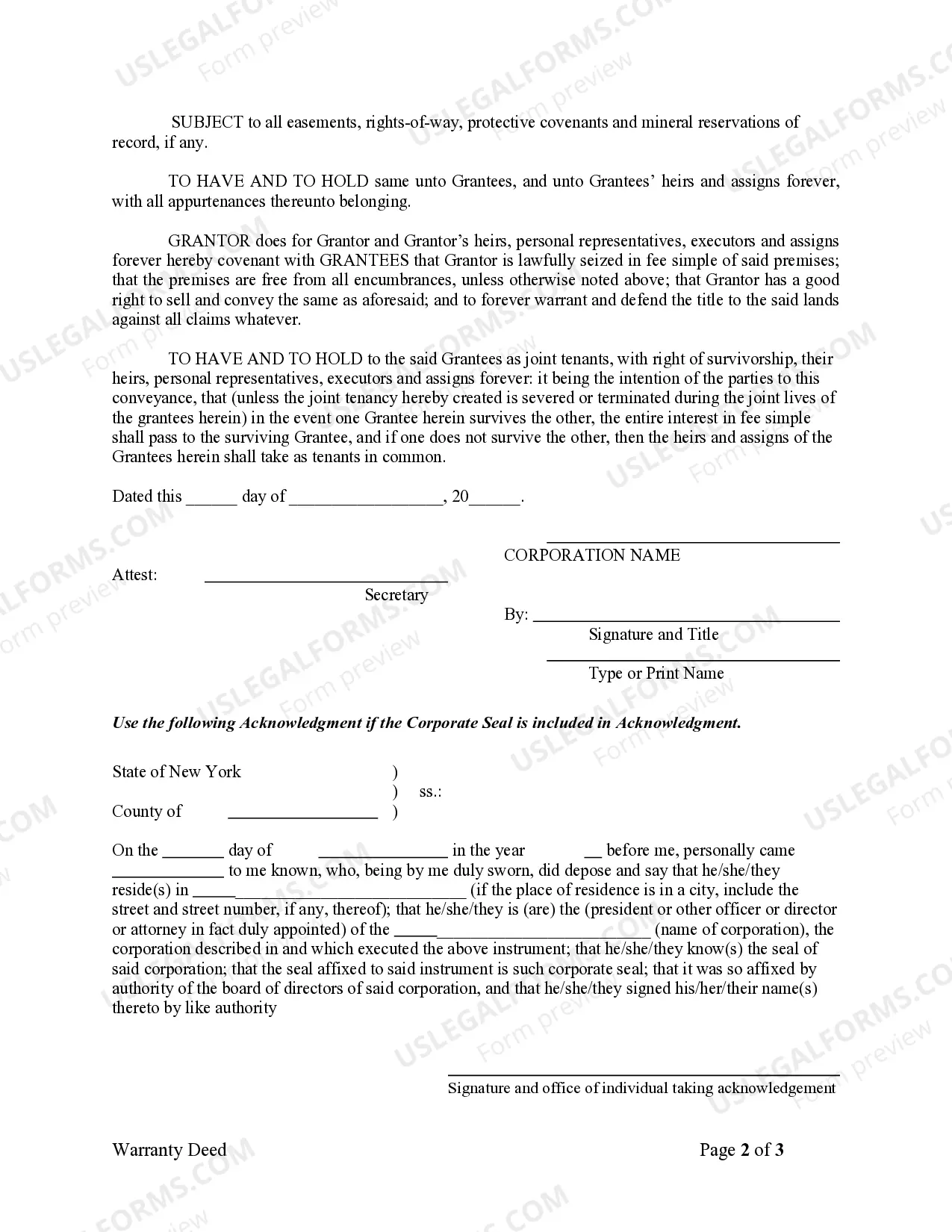
- Covenants assuring that the Grantor holds clear title to the property.
- Provisions for easements and mineral reservations.
- Notarization section for legal verification of signatures.



When to use this document
This form is typically used when a corporation wishes to transfer real estate to a married couple. It is essential in scenarios such as estate planning, where the corporate property needs to be conveyed to individuals, or in a business restructuring where property held by a corporation is being transferred to its owners. Additionally, this deed serves to clarify ownership rights and responsibilities between spouses in the event of death or separation.
Intended users of this form
- Corporations looking to transfer real property to individual owners.
- Husbands and wives wanting to secure joint ownership of property.
- Attorneys or legal representatives handling estate planning or property transactions for clients.
- Couples wishing to understand their rights and responsibilities concerning inherited property from a corporation.
Completing this form step by step
- Identify the Grantor (the corporation) and Grantees (husband and wife) by filling in their names and addresses.
- Include the legal description of the property, outlining its boundaries and any relevant details.
- Specify the consideration (payment) for the property transfer, ensuring this aligns with local requirements.
- Review and confirm the covenants regarding property ownership, encumbrances, and rights retained by the Grantor.
- Ensure all parties sign the document in the presence of a notary public to validate the deed.
Notarization requirements for this form
Yes, this form must be notarized to be legally valid. Notarization ensures that the identities of the signers are verified and adds a layer of protection against fraud. US Legal Forms offers integrated online notarization services, providing a secure and convenient way to get your documents notarized from home through a video call.
Get your form ready online
Our built-in tools help you complete, sign, share, and store your documents in one place.
Make edits, fill in missing information, and update formatting in US Legal Forms—just like you would in MS Word.
Download a copy, print it, send it by email, or mail it via USPS—whatever works best for your next step.
Sign and collect signatures with our SignNow integration. Send to multiple recipients, set reminders, and more. Go Premium to unlock E-Sign.
If this form requires notarization, complete it online through a secure video call—no need to meet a notary in person or wait for an appointment.
We protect your documents and personal data by following strict security and privacy standards.

Make edits, fill in missing information, and update formatting in US Legal Forms—just like you would in MS Word.

Download a copy, print it, send it by email, or mail it via USPS—whatever works best for your next step.

Sign and collect signatures with our SignNow integration. Send to multiple recipients, set reminders, and more. Go Premium to unlock E-Sign.

If this form requires notarization, complete it online through a secure video call—no need to meet a notary in person or wait for an appointment.

We protect your documents and personal data by following strict security and privacy standards.
Common mistakes
- Failing to provide complete and accurate legal descriptions of the property.
- Not properly citing the consideration amount for the property transfer.
- Neglecting to include all required signatures before notarization.
- Overlooking local requirements that may affect the deedâs validity.
Advantages of online completion
- Convenience of downloading and filling out the form at your own pace.
- Editability allows customization to meet specific needs before finalizing the document.
- Access to professionally drafted legal language, ensuring compliance with legal standards.
Main things to remember
- The Warranty Deed from Corporation to Husband and Wife secures the transfer of property ownership with title warranties.
- It is essential for both parties to ensure completeness and accuracy to avoid legal issues.
- Notarization is required for the validity of this deed.
Looking for another form?






Form popularity
FAQ
To change the deed in New York City, as we discussed, we will need a deed signed and notorized by the grantor. Additionally, the deed must also be filed and recorded with the Office of the City Register along with transfer documents which identify if any taxes are due.
Retrieve your original deed. Get the appropriate deed form. Draft the deed. Sign the deed before a notary. Record the deed with the county recorder. Obtain the new original deed.
In order to transfer ownership of the marital home pursuant to a divorce, one spouse is going to need to sign a quitclaim deed, interspousal transfer deed, or a grant deed, in order to convey the title to the property.
The only way to forcibly change the ownership status is through a legal action and the resultant court order. However, if an owner chooses to be removed from the deed, it is simply a matter of preparing a new deed transferring that owner's interest in the property.
The fees to file a New York quitclaim deed vary from county to county, but some of the fees are similar. As of 2018, the basic fee for filing a quitclaim deed of residential or farm property is $125, while the fee for all other property is $250. These fees are for the RP-5217 form.
Although it's possible to change the names on title deeds yourself, we recommend that you seek professional help from a solicitor. The value of property is sufficiently high to make it worthwhile getting the transfer right.
Fill in the deed form. Print it out. Have the grantor(s) sign and get the signature(s) notarized. Complete a transfer tax form, Form TP-584. Complete and print out Form RP-5217 (or, if you are in New York City, Form RP-5217NYC).
Under New York law, a person who wishes to update her name on a deed must execute a new deed and record it with the county clerk where the property is located. Obtain or purchase a New York warranty deed form.