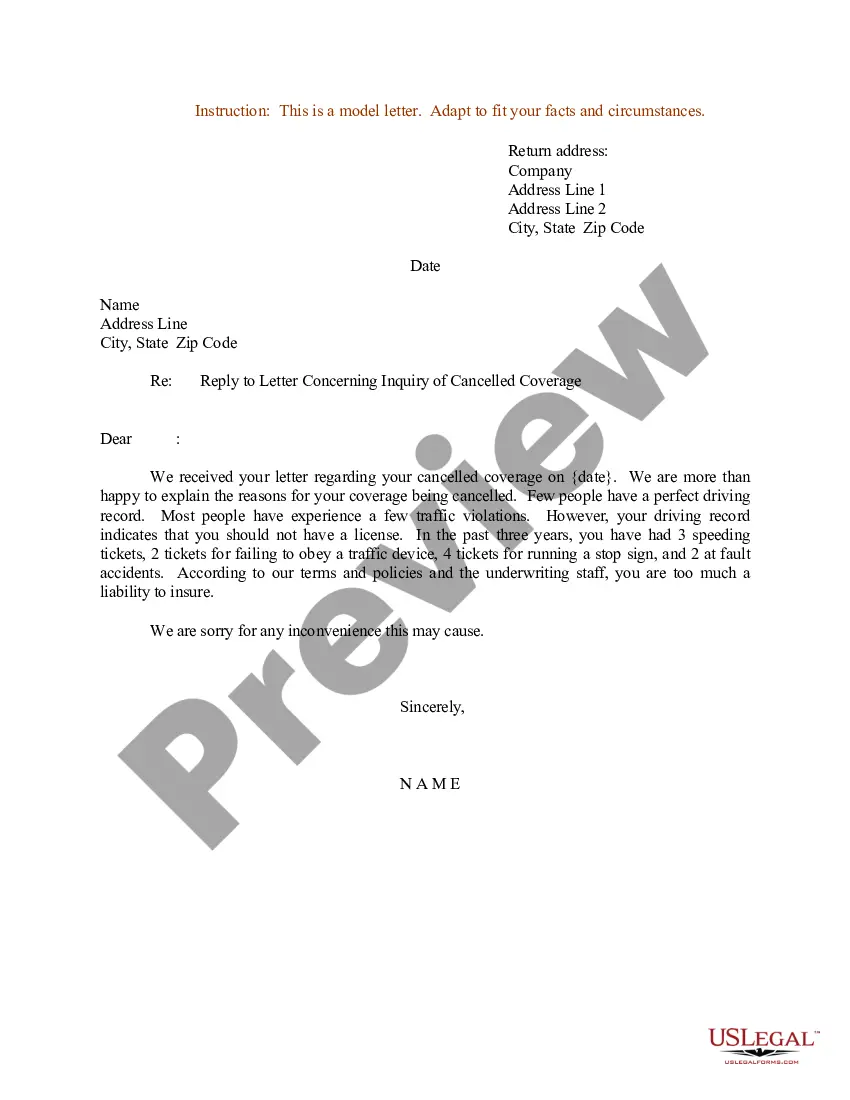
Sample Letter for Reply to Letter Concerning Inquiry of Cancelled Coverage
Understanding this form
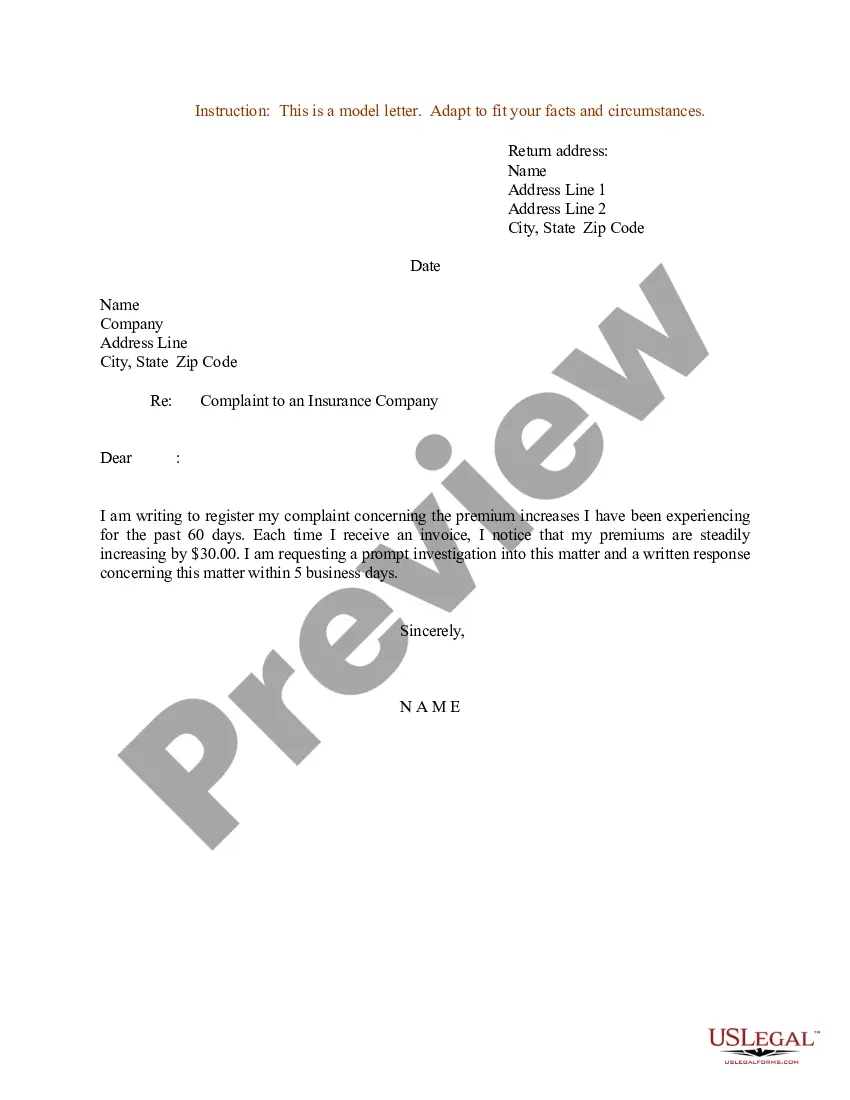
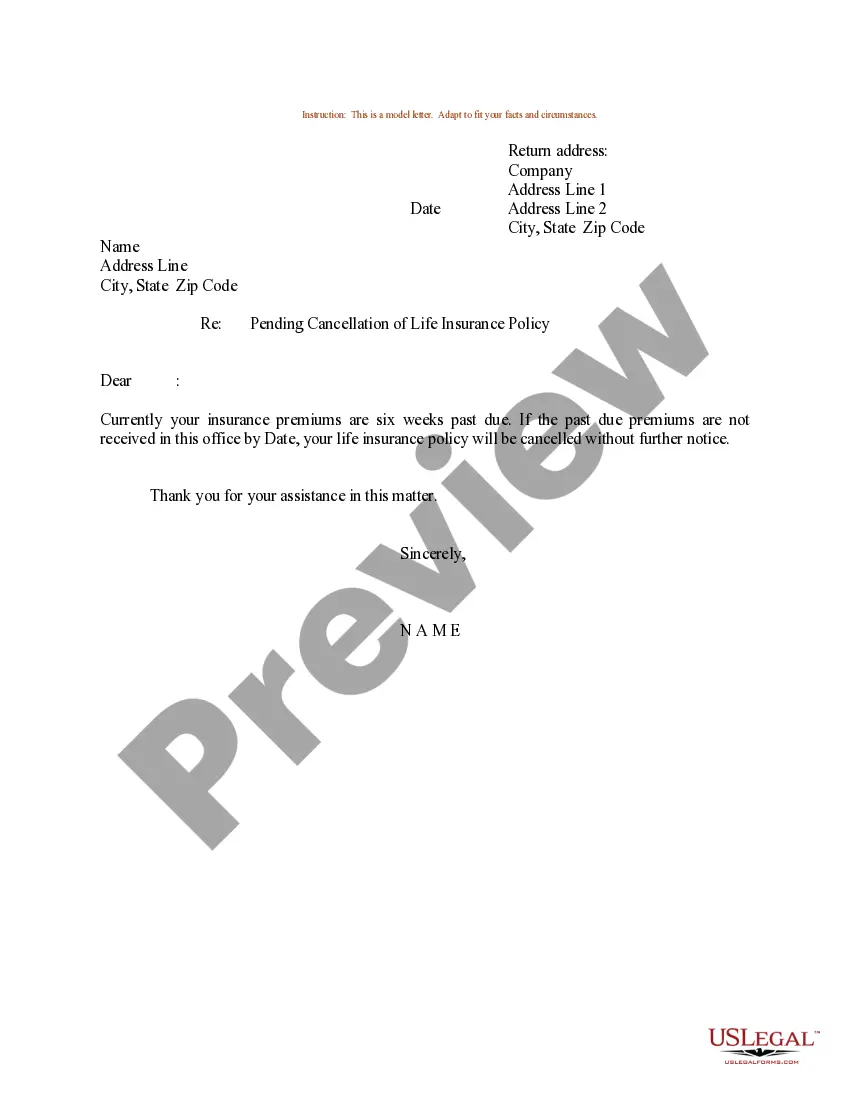
This form is a Sample Letter for Reply to Letter Concerning Inquiry of Cancelled Coverage. It serves as a template for responding to inquiries about canceled coverage, offering a structured way to address concerns while maintaining professionalism. This letter helps clarify the situation and express any necessary apologies to the recipient.
Key parts of this document
- Return address: Includes the sender's company name and full address.
- Date: Specifies when the letter is sent.
- Recipient information: Contains the name and address of the individual or entity receiving the letter.
- Subject line: Clearly states the purpose of the letter regarding canceled coverage.
- Body text: Expresses apology for any inconvenience caused by the cancellation.
- Closing signature: Provides space for the sender's name and title.
When to use this document
This letter should be used when you receive an inquiry about your coverage that has been canceled. It's essential to respond promptly to maintain good communication with clients, customers, or business partners. Using this letter helps you formalize your response and ensures that you address any concerns appropriately.
Who needs this form
- Businesses responding to clients concerned about coverage issues.
- Insurance companies addressing inquiries regarding canceled policies.
- Individuals who need to formally reply to coverage cancellation inquiries.
Completing this form step by step
- Identify the parties involved: Fill in your company name and address at the top.
- Add the date the letter is being sent.
- Enter the recipient's name and address accurately.
- Specify the subject line to reflect the inquiry about canceled coverage.
- Write a concise and respectful body that addresses the cancellation and expresses understanding.
- Sign the letter with your name and title at the bottom.
Notarization guidance
In most cases, this form does not require notarization. However, some jurisdictions or signing circumstances might. US Legal Forms offers online notarization powered by Notarize, accessible 24/7 for a quick, remote process.
Get your form ready online
Our built-in tools help you complete, sign, share, and store your documents in one place.
Make edits, fill in missing information, and update formatting in US Legal Forms—just like you would in MS Word.
Download a copy, print it, send it by email, or mail it via USPS—whatever works best for your next step.
Sign and collect signatures with our SignNow integration. Send to multiple recipients, set reminders, and more. Go Premium to unlock E-Sign.
If this form requires notarization, complete it online through a secure video call—no need to meet a notary in person or wait for an appointment.
We protect your documents and personal data by following strict security and privacy standards.

Make edits, fill in missing information, and update formatting in US Legal Forms—just like you would in MS Word.

Download a copy, print it, send it by email, or mail it via USPS—whatever works best for your next step.

Sign and collect signatures with our SignNow integration. Send to multiple recipients, set reminders, and more. Go Premium to unlock E-Sign.

If this form requires notarization, complete it online through a secure video call—no need to meet a notary in person or wait for an appointment.

We protect your documents and personal data by following strict security and privacy standards.
Avoid these common issues
- Failing to include all necessary address information.
- Wrongly addressing the recipient, which can lead to misunderstandings.
- Neglecting to sign the letter before sending it.
- Using a vague subject line that does not clearly convey the letter's purpose.
Why complete this form online
- Convenience: Easily fill out the form at your own pace, from anywhere.
- Editability: Customize the template to fit your specific situation.
- Reliability: Ensure your response adheres to proper legal language and structure.
Quick recap
- This letter is essential for formal responses to cancelation inquiries.
- Clear communication is crucial to maintain professional relationships.
- Using this template can make the process easier and more reliable.
Looking for another form?
Form popularity
FAQ
1The name, address and phone number of the complainant.2The date of the treatment and name of the person who gave the treatment.3The complaint should be briefly described.4Possible outcomes of the complaint should be mentioned.Writing a Strong Complaint Letter to a Hospital (with Sample Letter\nwww.sample-resignation-letters.com > writing-a-strong-complaint-letter-to-...
Patient name, policy number, and policy holder name. Accurate contact information for patient and policy holder. Date of denial letter, specifics on what was denied, and cited reason for denial. Doctor or medical provider's name and contact information.
1) Start with the basics. To make it easy for your health insurance company to understand the issue, include these details at the beginning of the letter: 2) Include plenty of details. 3) Send your letter. 4) Be patient. 5) Don't back down.
(name of doctor). The operation is expected to be done on 6th September. I, therefore, request you to intimate my insurance company so that my claim may be settled in due time. I am attaching the photocopies of the medical advice letter, health insurance policy details, and his health card.
1Patient name, policy number, and policy holder name.2Accurate contact information for patient and policy holder.3Date of denial letter, specifics on what was denied, and cited reason for denial.4Doctor or medical provider's name and contact information.
It should clearly state the customer's name, address and policy and claim number and be written in formal business style. The letter should be sent by certified mail, so the sender has proof of the time and date that the letter was received.
1keep your letter to the point. You need to give enough detail for your employer to be able to investigate your complaint properly.2keep to the facts.3never use abusive or offensive language.4explain how you felt about the behaviour you are complaining about but don't use emotive language.
1Be clear and direct in your email replies, and avoid being ambiguous. That means, you should know what you want to say; and say it with the shortest possible words.2Make your replies one-to-one.3Keep it Short, Simple and Sweet (KISSS).
1Very simply sating, I am writing in response to your letter from June 13th is a perfect opening for a response letter.2If you aren't the original person that the recipient wrote the letter to, state where you got the letter from.