Maryland Letter from Tenant to Landlord containing Notice that doors are broken and demand repair
Overview of this form
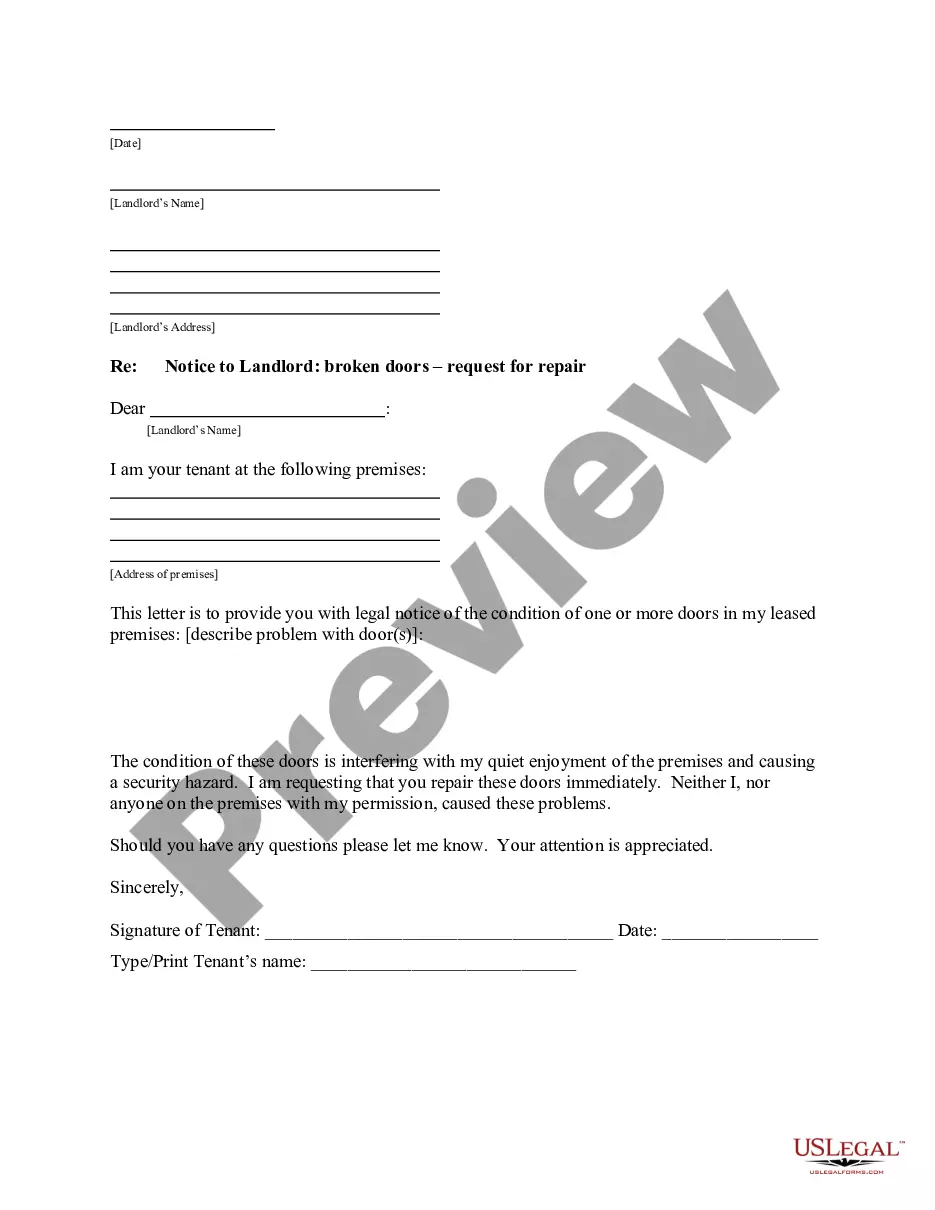
This form, known as the Letter from Tenant to Landlord containing Notice that doors are broken and demand repair, is used by a tenant to formally notify their landlord about issues with the property. Specifically, it addresses problems with broken doors, and it serves as a request for repair in accordance with the lease agreement. This form helps tenants communicate their concerns clearly and ensures that landlords are aware of necessary repairs, which is important for maintaining the property and tenant rights.
Key parts of this document
- Tenant's details: Includes the name and signature of the tenant.
- Landlord's information: Identifies the landlord or authorized agent receiving the notice.
- Description of the issue: Clearly states that the doors are broken and require urgent repair.
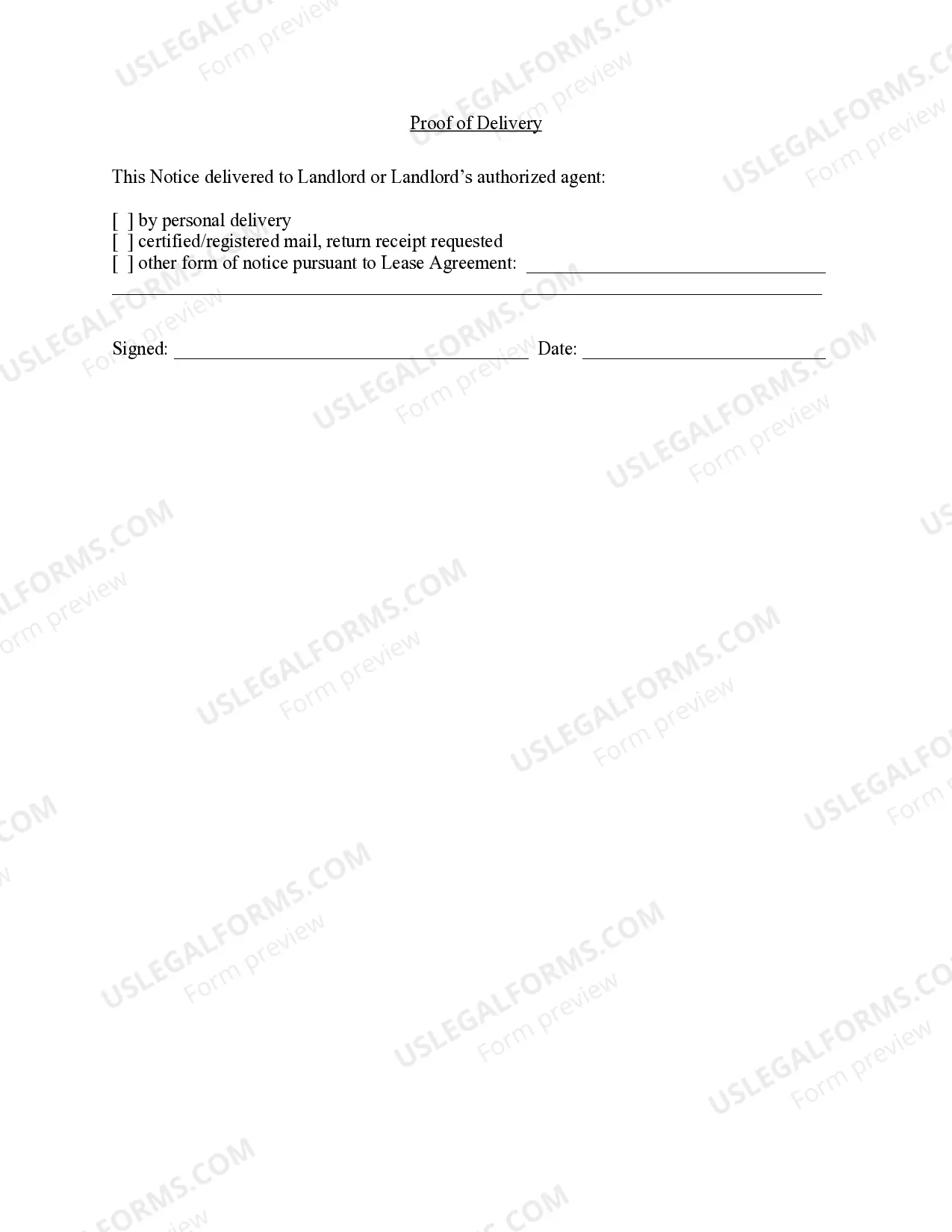
- Delivery method: Specifies how the notice was delivered (personal delivery, certified mail, etc.).
- Date of notice: Indicates when the notice was provided to the landlord.

When to use this document
This form is useful when a tenant discovers broken doors in their rental unit and wishes to notify the landlord formally. It should be used when repairs have not yet been addressed after previous informal communications or when the tenant is ensuring there is a written record of the repair request. Use this form to protect your rights as a tenant and to prompt timely repairs from the landlord.
Who needs this form
This form is intended for:
- Tenants residing in rental properties experiencing issues with broken doors.
- Individuals seeking a formal method to notify landlords or property managers about repair needs.
- Anyone who has previously communicated repair issues informally and requires documentation for further action.
How to prepare this document
- Identify the parties: Fill in your name and the name of your landlord or their authorized agent.
- Describe the property: Specify the address of the rental unit where the broken doors are located.
- Detail the issue: Clearly state that the doors are broken and need repair.
- Sign and date: Provide your signature and the date of the notice.
- Choose delivery method: Indicate how you are delivering the notice (e.g., personal delivery, certified mail).
Notarization guidance
Notarization is generally not required for this form. However, certain states or situations might demand it. You can complete notarization online through US Legal Forms, powered by Notarize, using a verified video call available anytime.
Get your form ready online
Our built-in tools help you complete, sign, share, and store your documents in one place.
Make edits, fill in missing information, and update formatting in US Legal Forms—just like you would in MS Word.
Download a copy, print it, send it by email, or mail it via USPS—whatever works best for your next step.
Sign and collect signatures with our SignNow integration. Send to multiple recipients, set reminders, and more. Go Premium to unlock E-Sign.
If this form requires notarization, complete it online through a secure video call—no need to meet a notary in person or wait for an appointment.
We protect your documents and personal data by following strict security and privacy standards.

Make edits, fill in missing information, and update formatting in US Legal Forms—just like you would in MS Word.

Download a copy, print it, send it by email, or mail it via USPS—whatever works best for your next step.

Sign and collect signatures with our SignNow integration. Send to multiple recipients, set reminders, and more. Go Premium to unlock E-Sign.

If this form requires notarization, complete it online through a secure video call—no need to meet a notary in person or wait for an appointment.

We protect your documents and personal data by following strict security and privacy standards.
Mistakes to watch out for
- Failing to provide complete contact information for both tenant and landlord.
- Not keeping a copy of the notice for personal records.
- Using vague language instead of clearly stating the specific issue with the doors.
Advantages of online completion
- Convenience: Download and complete the form from anywhere at your convenience.
- Editable: Easily customize the document to fit your specific situation.
- Reliable: Ensure you are using a legally vetted template created by licensed attorneys.
Main things to remember
- This form is essential for notifying landlords of repair issues regarding broken doors.
- Clear communication is crucial for timely repairs and maintaining tenant rights.
- Make sure to document how and when you delivered the notice for your records.
Looking for another form?
Form popularity
FAQ
Under the new Maryland break law, employees are entitled to a 30-minute break on a shift of 6 consecutive hours or more. This break can be unpaid, but employees must be relieved of all work duties. The law also requires shorter 15-minute breaks under some conditions.
Under the new Maryland break law, employees are entitled to a 30-minute break on a shift of 6 consecutive hours or more. This break can be unpaid, but employees must be relieved of all work duties. The law also requires shorter 15-minute breaks under some conditions.
Under California law, non-exempt employees are entitled to one unpaid 30-minute meal break, and two paid 10-minute rest breaks, during a typical 8-hour shift.
Your lunch and break times during an 8 hour shift will be included in your employment contract. or HR manual. You need to read your contract or HR policy manual to determine when and how long you can have lunch and breaks.The norm is 1/2 hour lunch and 2 breaks (up to 15 min) in an 8 hour period.
Under the ACA, a full-time employee is one who is employed an average of 30 or more hours of service per week. This policy adopts 130 hours of service per month as the monthly equivalent of 30 hours of service per week.
You're usually entitled to: a 30 minute rest break if you work for more than 4 hours and 30 minutes in a day. 12 hours rest between each working day.
Maryland Law Doesn't Require Meal or Rest Breaks In other words, although breaks are not required, employers must pay employees for time they spend working and for shorter breaks during the day.
Many employers provide employees with a rest or lunch break, whether paid or unpaid. This common practice is not required everywhere, however: The federal wage and hour law, called the Fair Labor Standards Act (FLSA), doesn't require employers to provide meal or rest breaks.you have to work through your break, or.