Evaluating Your Assets
Overview of this form
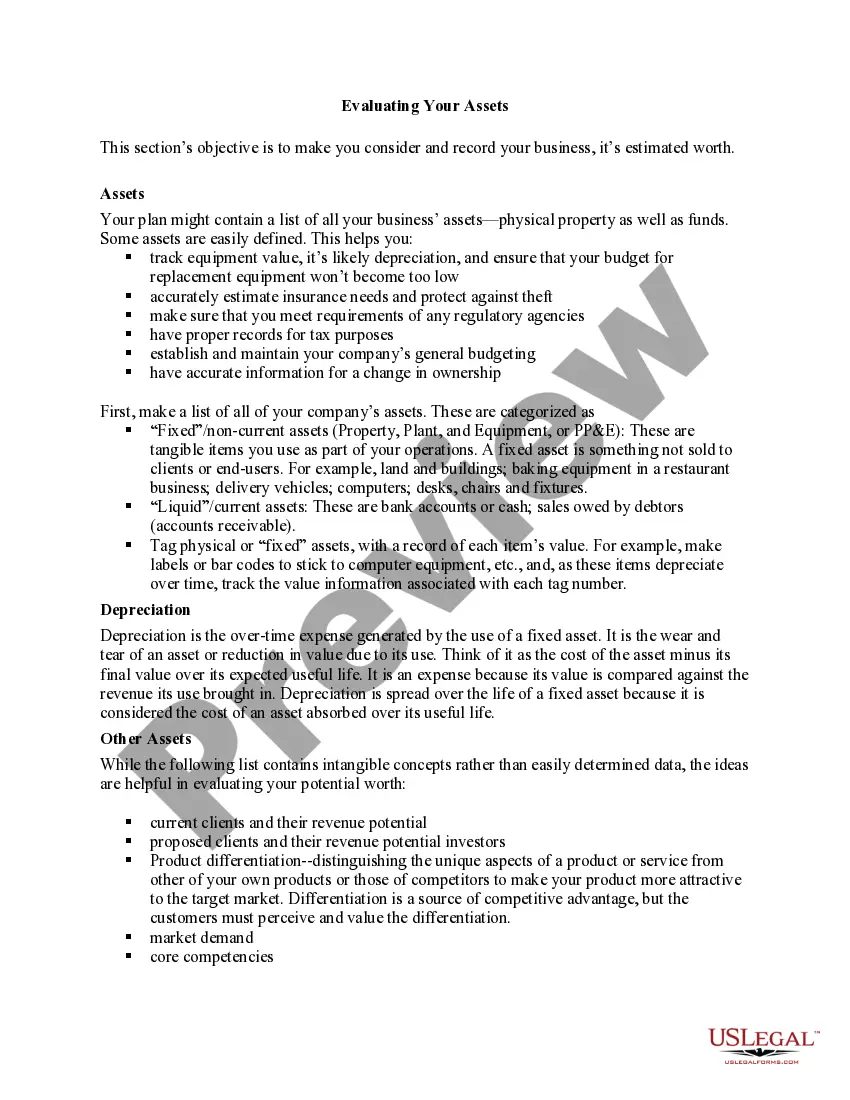
The Evaluating Your Assets form is a legal document designed to help businesses assess their total assets and estimated worth. This form is essential for tracking physical and liquid assets, determining depreciation, and facilitating accurate financial planning. Unlike similar forms, this template is specifically crafted to help businesses document both tangible and intangible assets, providing a comprehensive view of their financial health.
Key parts of this document
- List of fixed/non-current assets, such as buildings, equipment, and vehicles.
- Record of liquid/current assets, including bank accounts and accounts receivable.
- A section for tracking the depreciation of fixed assets over time.
- Information on intangible assets, like client relationships and product differentiation.
- Compliance checks for regulatory and tax purposes.
When to use this form
This form is useful in various scenarios, such as when a business is preparing for financial assessment, seeking investors, or undergoing ownership changes. It is also beneficial for tax preparation and to help ascertain insurance needs or compliance with regulatory agencies.
Who needs this form
- Business owners looking to evaluate the financial standing of their company.
- Entrepreneurs preparing to seek investment or financing.
- Accountants helping clients with formal asset evaluations.
- Individuals managing property or business assets.
How to complete this form
- Identify and list all fixed assets, including buildings and equipment.
- Document all liquid assets, such as cash on hand and receivable accounts.
- Assign a value to each asset, including current depreciation amounts for fixed assets.
- Consider intangible assets like client relationships and potential market advantages.
- Ensure all information meets regulatory standards for tax compliance.
Does this document require notarization?
Notarization is generally not required for this form. However, certain states or situations might demand it. You can complete notarization online through US Legal Forms, powered by Notarize, using a verified video call available anytime.
Get your form ready online
Our built-in tools help you complete, sign, share, and store your documents in one place.
Make edits, fill in missing information, and update formatting in US Legal Forms—just like you would in MS Word.
Download a copy, print it, send it by email, or mail it via USPS—whatever works best for your next step.
Sign and collect signatures with our SignNow integration. Send to multiple recipients, set reminders, and more. Go Premium to unlock E-Sign.
If this form requires notarization, complete it online through a secure video call—no need to meet a notary in person or wait for an appointment.
We protect your documents and personal data by following strict security and privacy standards.

Make edits, fill in missing information, and update formatting in US Legal Forms—just like you would in MS Word.

Download a copy, print it, send it by email, or mail it via USPS—whatever works best for your next step.

Sign and collect signatures with our SignNow integration. Send to multiple recipients, set reminders, and more. Go Premium to unlock E-Sign.

If this form requires notarization, complete it online through a secure video call—no need to meet a notary in person or wait for an appointment.

We protect your documents and personal data by following strict security and privacy standards.
Mistakes to watch out for
- Failing to include all assets, particularly intangible ones.
- Underestimating the depreciation value of fixed assets.
- Not updating the asset list regularly to reflect changes in value.
Benefits of completing this form online
- Convenience of accessing the form from anywhere at any time.
- Editability allows for easy updates to asset information.
- Reliability of getting a professionally drafted form backed by legal expertise.
Quick recap
- The Evaluating Your Assets form is crucial for assessing a business's financial health.
- It includes sections for both physical and intangible assets.
- Regular updates and accurate documentation are essential for maintaining its relevance.
Looking for another form?
Form popularity
FAQ
How to set up a personal net worth statement. List your assets (what you own), estimate the value of each, and add up the total. Include items such as:List your liabilities (what you owe) and add up the outstanding balances.Subtract your liabilities from your assets to determine your personal net worth.
What Are The 5 Areas of Personal Finance? The areas of personal finances include income, spending, savings, investing, and protection.
Here are four financial checkup steps you can take anytime: Step 1: Make sure your budget is ready-to-go.Step 2: Build a rock-solid savings plan.Step 3: Pay off debt with the debt snowball method.Step 4: Chart a successful, sustainable future course.
Here's how to get started tracking your monthly expenses. Check your account statements. Categorize your expenses. Build your budget. The 50/30/20 budget calculator. Budgeting or expense-tracking apps. Explore other expense trackers. Identify room for change.
We've put together some advice from our authors on how to build a healthy relationship with money and stay in control of your personal finances. 1) Let go of your limiting beliefs about money.2) Take ownership of your money.3) Always set a timeline for your money goals.4) Build an emergency fund.
Determine total assets by combining your liabilities with your equity. Since liabilities represent a negative value, the simplest method for finding total assets with this formula is to subtract the value of liabilities from the value of equity or assets. The resulting figure equals your total assets.
Your checkup should include your retirement accounts and other savings, your debts, your estate plan, and your insurance coverage, among other topics. Review Your Life Changes. Set or Reset Financial Goals. Sketch Out a Budget. Assess Your Debt. Check Your Credit Reports. Revisit Your Retirement Savings.
The net asset value ? also known as net tangible assets ? is the book value of tangible assets on the balance sheet (their historical cost minus the accumulated depreciation) less intangible assets and liabilities ? or the money that would be left over if the company was liquidated.