Georgia Letter from Tenant to Landlord containing Notice to landlord to cease retaliatory threats to evict or retaliatory eviction
What this document covers
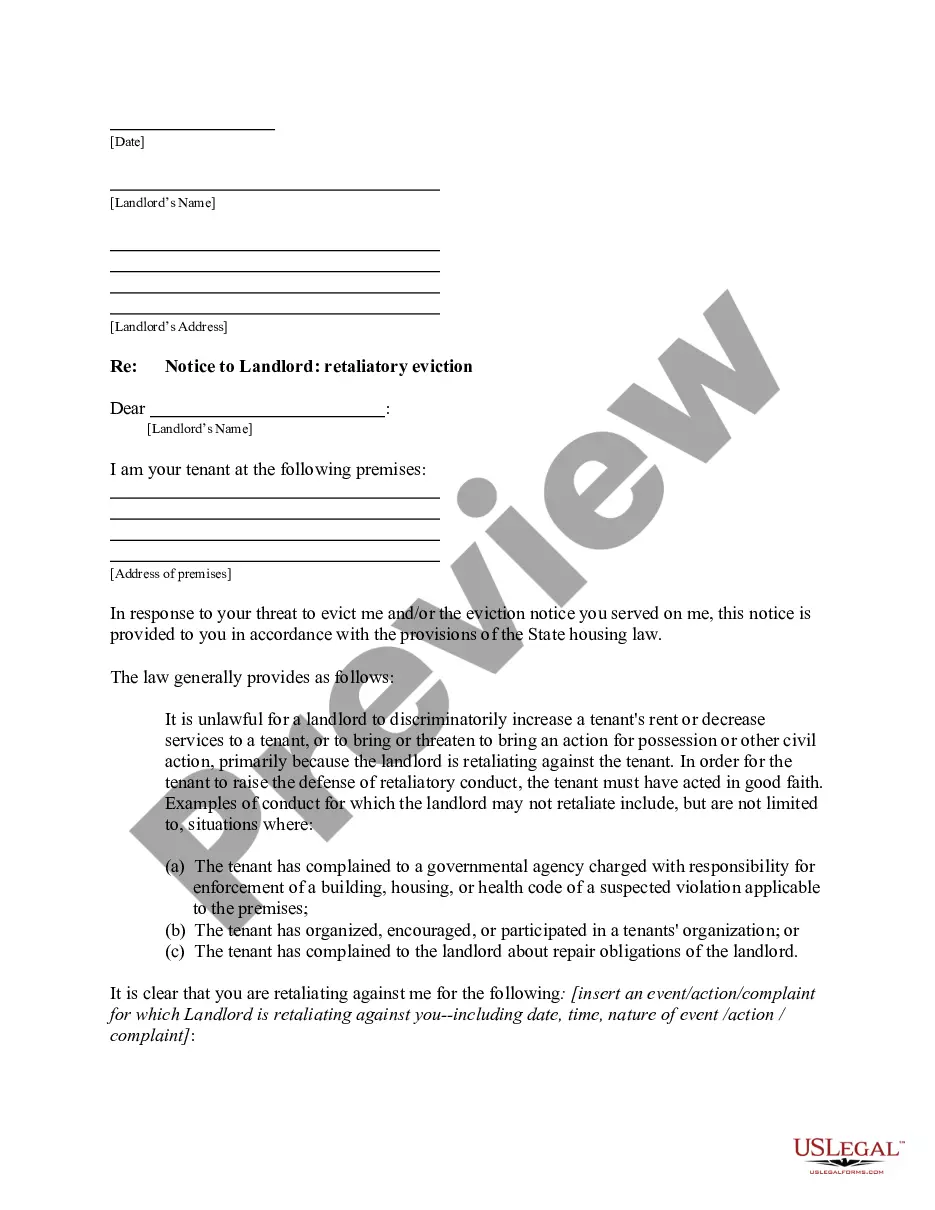
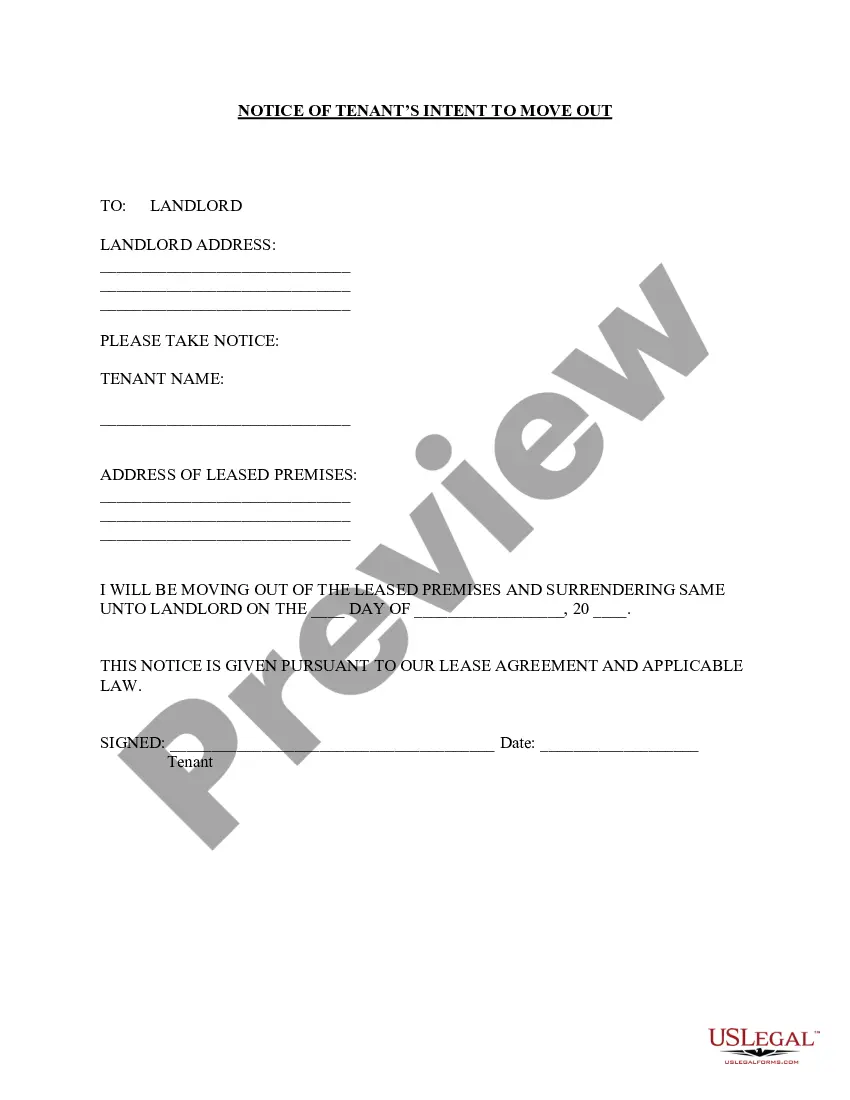
This Letter from Tenant to Landlord containing Notice to landlord to cease retaliatory threats to evict or retaliatory eviction is a legal document that helps a tenant formally respond to their landlord's eviction threats. It asserts that the threat is retaliatory, meaning it is in response to the tenant's lawful actions, such as filing complaints or asserting their rights. This form is aligned with state Housing Laws and can serve to protect tenants from unlawful eviction attempts based on retaliation.
Main sections of this form
- Identification of the tenant and landlord involved in the dispute.
- Statement articulating the tenant's belief that the eviction threat is retaliatory.
- List of specific actions taken by the tenant that may have prompted the retaliation.
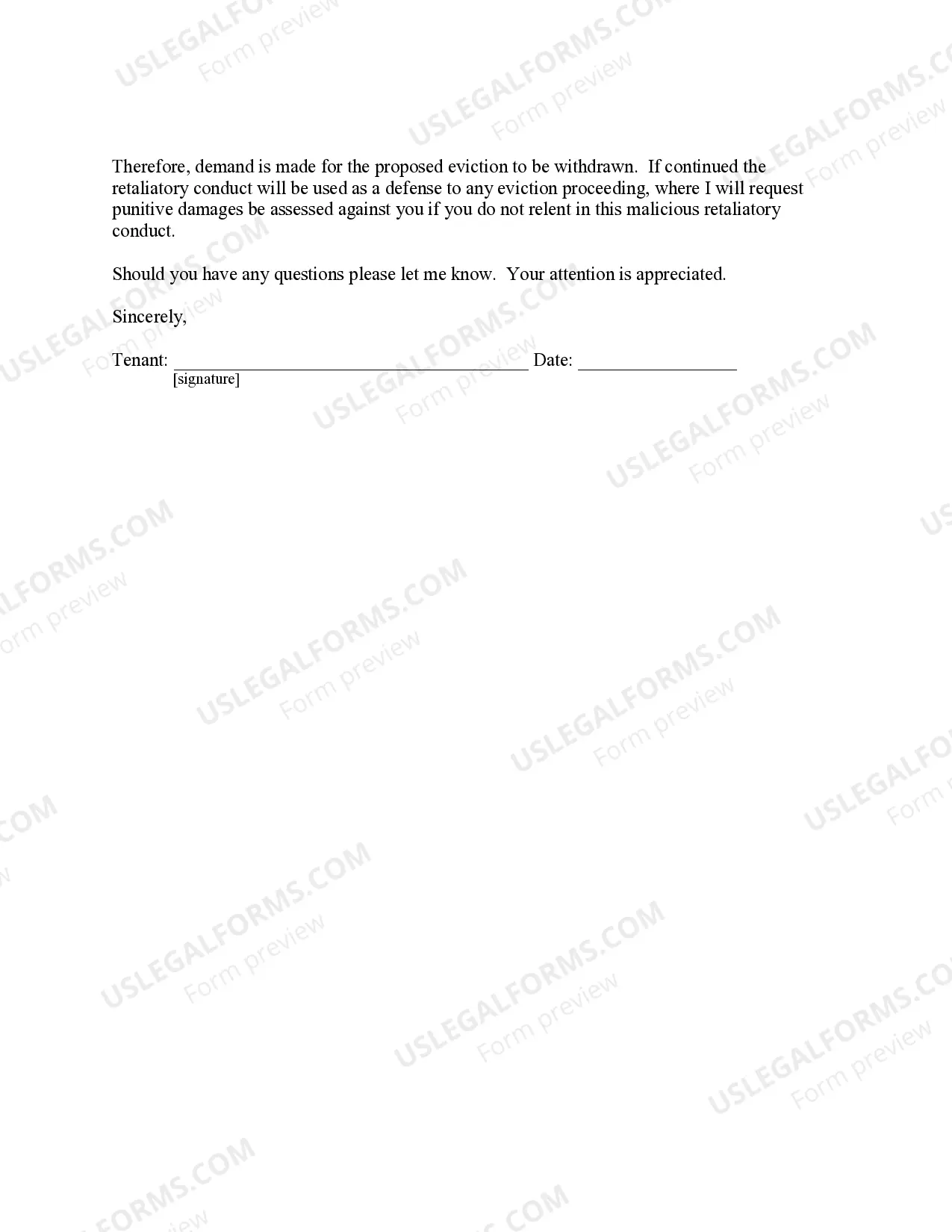
- Signature line for the tenant to formally acknowledge the statement.
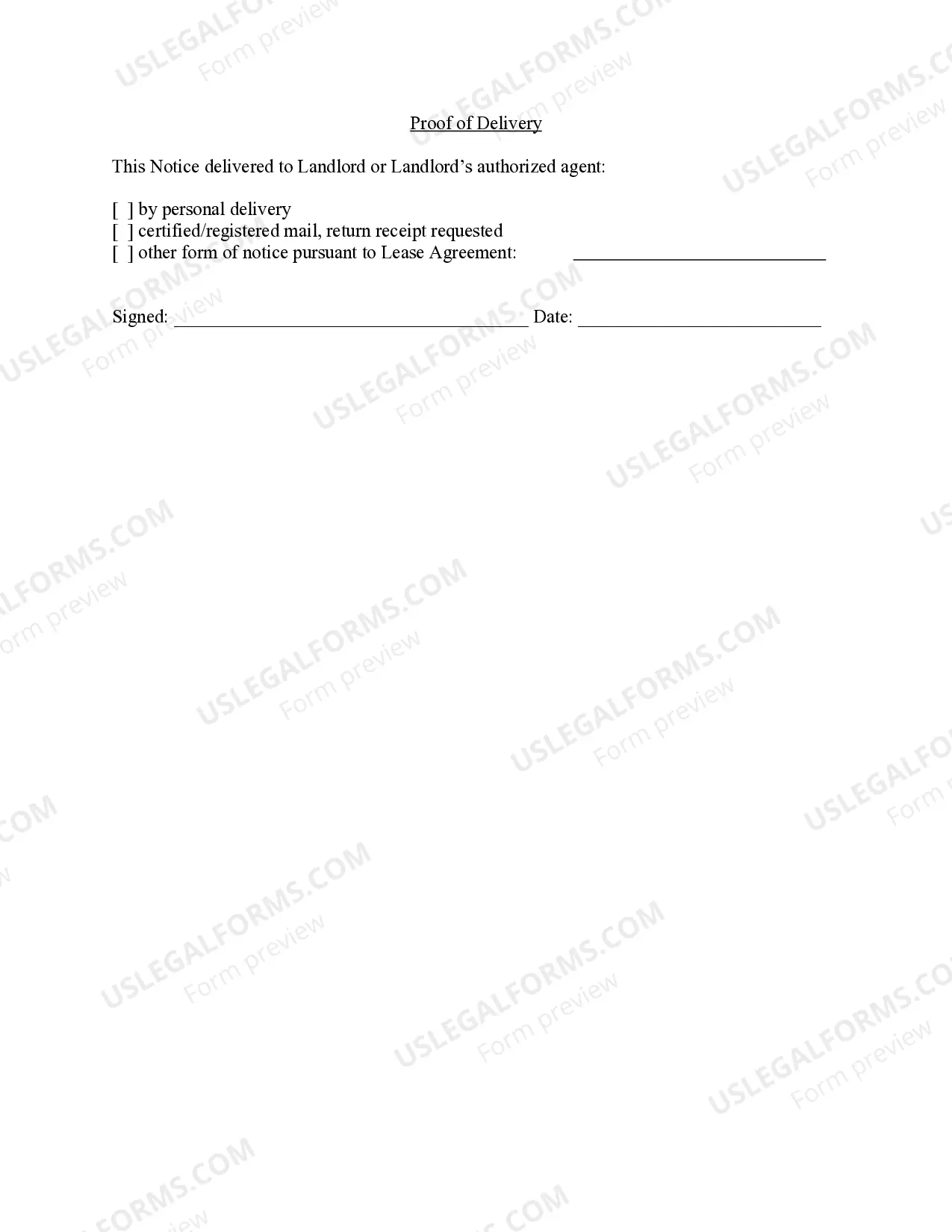
- Proof of delivery methods to confirm receipt by the landlord.




Situations where this form applies
This form should be used when a tenant receives threats of eviction from their landlord and believes those threats are retaliatory. Situations might include cases where the tenant has recently complained about housing code violations, has sought repairs, or has participated in tenant organizing. By using this form, the tenant can assert their rights and formally notify the landlord to cease the eviction threats.
Who this form is for
- Tenants facing eviction threats from their landlord.
- Individuals who have recently made complaints about their living conditions.
- Members of tenant organizations advocating for their rights.
Completing this form step by step
- Identify the parties involved by entering the names of the tenant and landlord.
- Clearly state the reasons you believe the eviction threats are retaliatory.
- Specify any pertinent actions you have taken, such as formal complaints or repair requests.
- Sign and date the form to confirm its validity.
- Deliver the completed notice to the landlord or their authorized agent as required.
Does this form need to be notarized?
Notarization is generally not required for this form. However, certain states or situations might demand it. You can complete notarization online through US Legal Forms, powered by Notarize, using a verified video call available anytime.
Get your form ready online
Our built-in tools help you complete, sign, share, and store your documents in one place.
Make edits, fill in missing information, and update formatting in US Legal Forms—just like you would in MS Word.
Download a copy, print it, send it by email, or mail it via USPS—whatever works best for your next step.
Sign and collect signatures with our SignNow integration. Send to multiple recipients, set reminders, and more. Go Premium to unlock E-Sign.
If this form requires notarization, complete it online through a secure video call—no need to meet a notary in person or wait for an appointment.
We protect your documents and personal data by following strict security and privacy standards.

Make edits, fill in missing information, and update formatting in US Legal Forms—just like you would in MS Word.

Download a copy, print it, send it by email, or mail it via USPS—whatever works best for your next step.

Sign and collect signatures with our SignNow integration. Send to multiple recipients, set reminders, and more. Go Premium to unlock E-Sign.

If this form requires notarization, complete it online through a secure video call—no need to meet a notary in person or wait for an appointment.

We protect your documents and personal data by following strict security and privacy standards.
Mistakes to watch out for
- Failing to clearly state the retaliatory nature of the eviction threat.
- Not providing specific examples of tenant actions that prompted the retaliation.
- Neglecting to deliver the notice appropriately to the landlord.
- Omitting a signature or date, which is essential for the form's validity.
Why complete this form online
- Convenience of immediate access and completion from any device.
- Editability allows for customization based on specific situations.
- Reliability of legally drafted content created by licensed attorneys.
Legal use & context
- This form serves as a formal record of the tenant's assertion against retaliatory eviction.
- It is recognized as part of tenant protection laws under state Housing regulations.
- Ensures tenants are informed of their rights and provides a basis for defense should eviction proceedings occur.
Quick recap
- This letter allows tenants to address retaliatory eviction threats formally.
- It is essential to include specific actions taken by the tenant to support the claim of retaliation.
- Delivery of the notice should be documented to ensure the landlord receives it.
Looking for another form?
Form popularity
FAQ
To write a formal letter to your landlord, start with your name and address at the top, followed by the landlord's name and address. Clearly state the purpose of your letter, focusing on issues like your Georgia Letter from Tenant to Landlord containing Notice to landlord to cease retaliatory threats to evict or retaliatory eviction. Ensure you include specific details and your expectations, and then conclude with your signature and printed name. By using a professional format, you enhance your credibility and ensure your message is taken seriously.
Landlord harassment in Georgia includes actions that disrupt a tenant's right to peaceful enjoyment of their rental property. This can include excessive property visits, threats of eviction, or failure to provide essential services after a tenant reports issues. To combat such behavior, tenants can utilize a Georgia Letter from Tenant to Landlord containing Notice to landlord to cease retaliatory threats to evict or retaliatory eviction, which helps to formally address any harassment and assert the tenant's rights.
In Georgia, landlords are prohibited from taking retaliatory actions against tenants, such as evicting them for asserting their legal rights. Additionally, they cannot harass tenants, refuse to make essential repairs, or retaliate in response to tenants seeking help or reporting issues. If a landlord threatens eviction under these circumstances, a Georgia Letter from Tenant to Landlord containing Notice to landlord to cease retaliatory threats to evict or retaliatory eviction may help clarify the tenant's protections.
Under Georgia law, landlords cannot retaliate against tenants for exercising their rights. For instance, if a tenant complains about unsafe living conditions or joins a tenant union, any attempts by the landlord to threaten eviction can be deemed retaliatory. In such cases, a Georgia Letter from Tenant to Landlord containing Notice to landlord to cease retaliatory threats to evict or retaliatory eviction can be an effective tool to remind landlords of their legal obligations.
When writing a dispute letter to your landlord, make sure to present your case logically and clearly. A Georgia Letter from Tenant to Landlord containing Notice to landlord to cease retaliatory threats to evict or retaliatory eviction should detail the specifics of the dispute, why you disagree with the landlord’s decision, and what resolution you seek. Maintain a respectful tone to encourage constructive dialogue.
In a notice letter to your landlord, you should clearly state your issues, such as retaliatory actions leading to potential eviction. A Georgia Letter from Tenant to Landlord containing Notice to landlord to cease retaliatory threats to evict or retaliatory eviction should include your contact information, the problems faced, and a request for an appropriate resolution. Be clear and concise to facilitate effective communication.
To effectively stop an eviction, write a Georgia Letter from Tenant to Landlord containing Notice to landlord to cease retaliatory threats to evict or retaliatory eviction. In your letter, reference the reasons you believe the eviction is retaliatory. State clearly your request for the landlord to halt the eviction and provide relevant supporting evidence if available.
In Georgia, landlord retaliation may include actions such as attempting to evict you after you have made a complaint about unsafe living conditions. If a landlord threatens eviction after you assert your rights, it is important to document these instances. A Georgia Letter from Tenant to Landlord containing Notice to landlord to cease retaliatory threats to evict or retaliatory eviction can help in articulating these concerns.
An example of written notice to a landlord could be a Georgia Letter from Tenant to Landlord containing Notice to landlord to cease retaliatory threats to evict or retaliatory eviction. In this notice, cite specific incidents that prompted your concerns and your request for action. Ensure to state your expectations clearly, allowing the landlord to understand your position effectively.
A good tenant reference letter speaks positively about the tenant’s rental history, reliability, and respect for property. For a Georgia Letter from Tenant to Landlord containing Notice to landlord to cease retaliatory threats to evict or retaliatory eviction, you might include specific examples of timely rent payments and cooperation during the tenancy. This can strengthen your position in any conflicts with the landlord.