Notice to Tenant and Demand for Delivery of Possession for Disorderly Conduct of Tenant/Lessee
Understanding this form
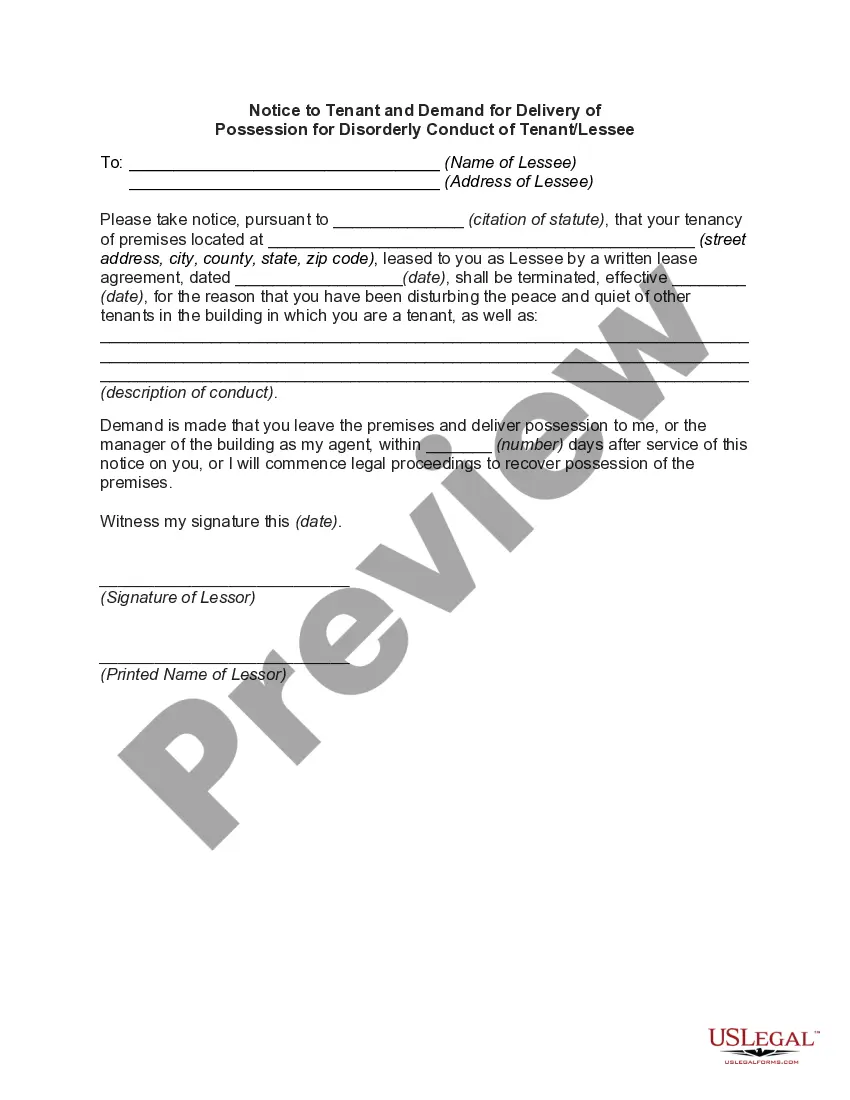
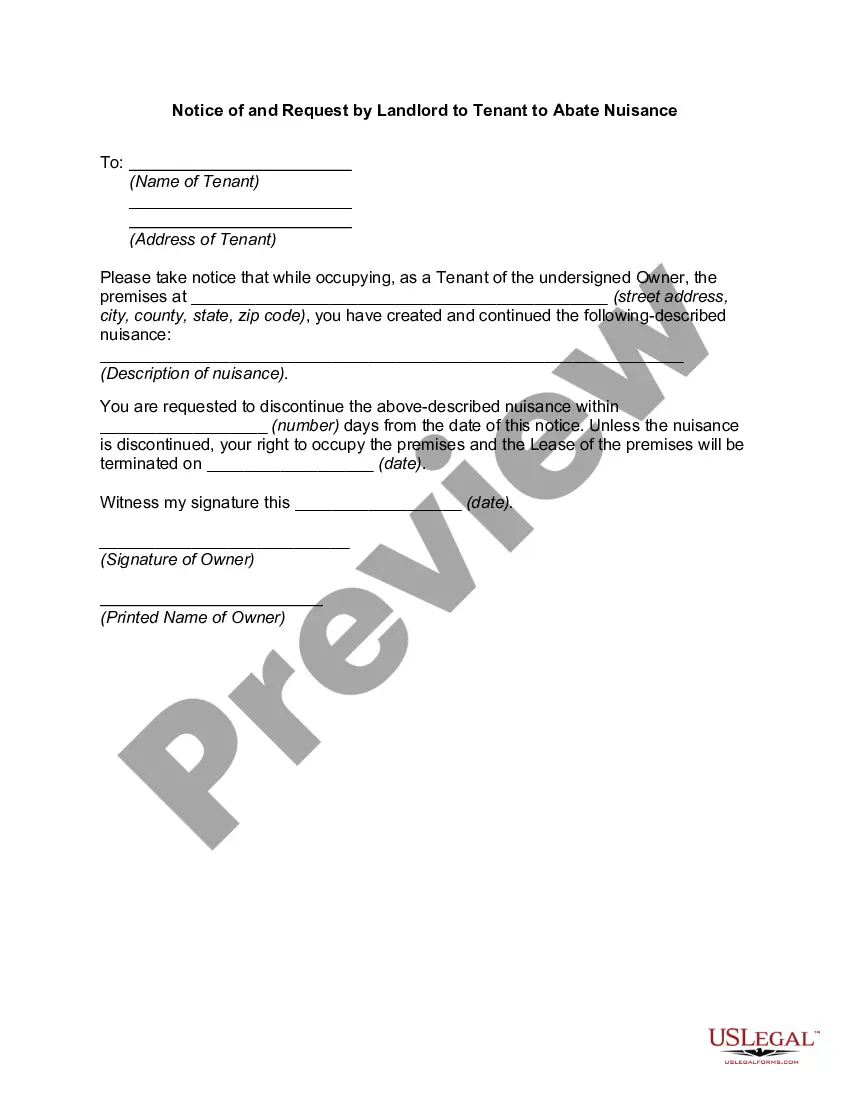
The Notice to Tenant and Demand for Delivery of Possession for Disorderly Conduct of Tenant/Lessee is a legal document used by landlords to notify a tenant that their lease is being terminated due to disruptive behavior. This form serves as a formal demand for the tenant to vacate the premises, specifying the reasons for the termination. Unlike eviction notices, this form specifically addresses issues related to disorderly conduct and provides a timeframe for the tenant to respond and leave the property.
What’s included in this form
- Name and address of the tenant (lessee).
- Citation of the statute authorizing the notice.
- Description of the disorderly conduct leading to termination.
- Effective date of termination.
- Timeframe for vacating the premises.
- Signature and printed name of the landlord (lessor).


When to use this form
This form is essential for landlords who need to address tenant behavior that disrupts the peace, such as excessive noise or illegal activities. Use this form when you have documented instances of disorderly conduct and you wish to formally terminate the tenant's lease to regain possession of the property. This ensures you comply with legal requirements before pursuing further action.
Who needs this form
- Landlords or property managers dealing with disruptive tenants.
- Real estate professionals assisting clients with tenant disputes.
- Leasing agents who need to enforce lease terms due to tenant misconduct.
How to complete this form
- Identify the tenant's name and address at the top of the document.
- Include the appropriate citation of the statute that supports the notice.
- Clearly describe the specific disorderly conduct that prompted the notice.
- Fill in the effective date of termination and the deadline for the tenant to vacate.
- Sign and print your name as the landlord at the bottom of the form.
Is notarization required?
This form does not typically require notarization unless specified by local law. However, it is advisable to check local regulations to ensure compliance with any additional requirements.
Get your form ready online
Our built-in tools help you complete, sign, share, and store your documents in one place.
Make edits, fill in missing information, and update formatting in US Legal Forms—just like you would in MS Word.
Download a copy, print it, send it by email, or mail it via USPS—whatever works best for your next step.
Sign and collect signatures with our SignNow integration. Send to multiple recipients, set reminders, and more. Go Premium to unlock E-Sign.
If this form requires notarization, complete it online through a secure video call—no need to meet a notary in person or wait for an appointment.
We protect your documents and personal data by following strict security and privacy standards.

Make edits, fill in missing information, and update formatting in US Legal Forms—just like you would in MS Word.

Download a copy, print it, send it by email, or mail it via USPS—whatever works best for your next step.

Sign and collect signatures with our SignNow integration. Send to multiple recipients, set reminders, and more. Go Premium to unlock E-Sign.

If this form requires notarization, complete it online through a secure video call—no need to meet a notary in person or wait for an appointment.

We protect your documents and personal data by following strict security and privacy standards.
Typical mistakes to avoid
- Failing to provide a clear and detailed description of the disorderly conduct.
- Not including the correct statutory citation.
- Leaving out the required signature and printed name of the landlord.
- Not specifying the correct timeframe for the tenant to vacate.
Benefits of completing this form online
- Immediate access to legally vetted templates, ensuring compliance with local laws.
- Easy customization to reflect specific details of your situation.
- Convenience of downloading and printing the form from your home or office.
Looking for another form?
Form popularity
FAQ
Dear (Name of landlord or manager), This letter constitutes my written (number of days' notice that you need to give based on your lease agreement)-day notice that I will be moving out of my apartment on (date), the end of my current lease. I am leaving because (new job, rent increase, etc.)
Explain the Situation Tell your tenant in straightforward terms what the problem is, and explain that they cannot stay on the property any longer. Describe the Consequences Calmly explain that they will be evicted with necessary court orders if they remain on the property.
In the notice, you have to provide details of the transaction for which the cheque was issued, details of the cheque, details of dishonor, etc. through a lawyer. Notice to be signed by both lawyer and payee. Notice to be sent through registered post.
Notice to Terminate the Lease A month-to-month tenant must give written notice of lease termination at least one full month prior to moving. Most yearly leases require a 60 to 90 day notice from the tenants in order to terminate the lease.
If you're an assured tenant or protected tenant you need to give notice in writing. You'll need to give at least 28 days notice but this might be longer - look at what it says in your tenancy agreement. If you have a joint agreement, only one tenant needs to give notice. This will end the tenancy for both people.
Give a minimum 14-day termination notice. The termination date in the notice can be the last day of the fixed term or up to 14 days after. You have to give this notice before your fixed-term agreement ends. Vacate by the date in your notice.
You should check that the notice to quit or notice seeking possession meets the right legal requirements. For example, it might need to contain certain information. If the notice isn't correct, this could stop or delay your landlord from taking further action.
Dear (Name of landlord or manager), This letter constitutes my written (number of days' notice that you need to give based on your lease agreement)-day notice that I will be moving out of my apartment on (date), the end of my current lease. I am leaving because (new job, rent increase, etc.)
In Texas, landlords must give tenants 30 days' notice before terminating the lease.Often, month-to-month leases are verbal, so the terms can seem murky. But Texas law is clearboth landlords and tenants can end their agreement at any time, as long as they give the other person 30 days' advance notice.