Washington Transfer on Death Quitclaim Deed from Individual to Individual with Alternate Beneficiary

Overview of this form
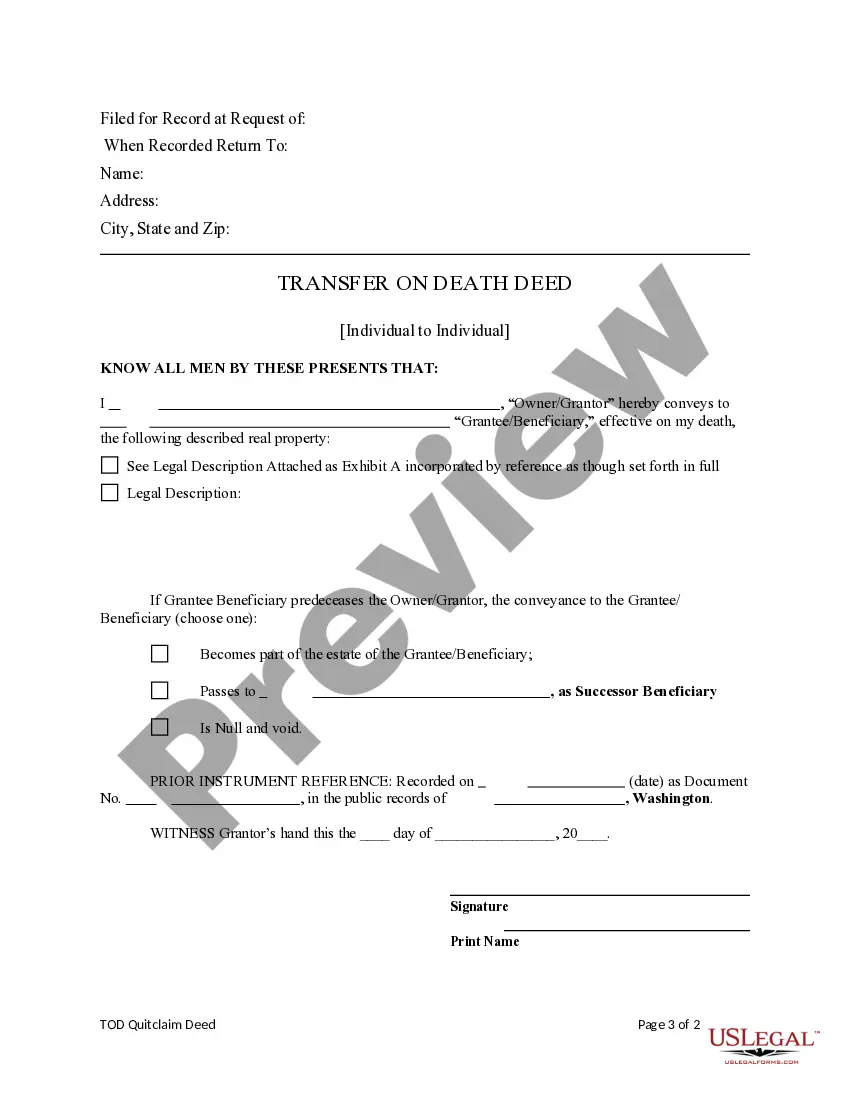
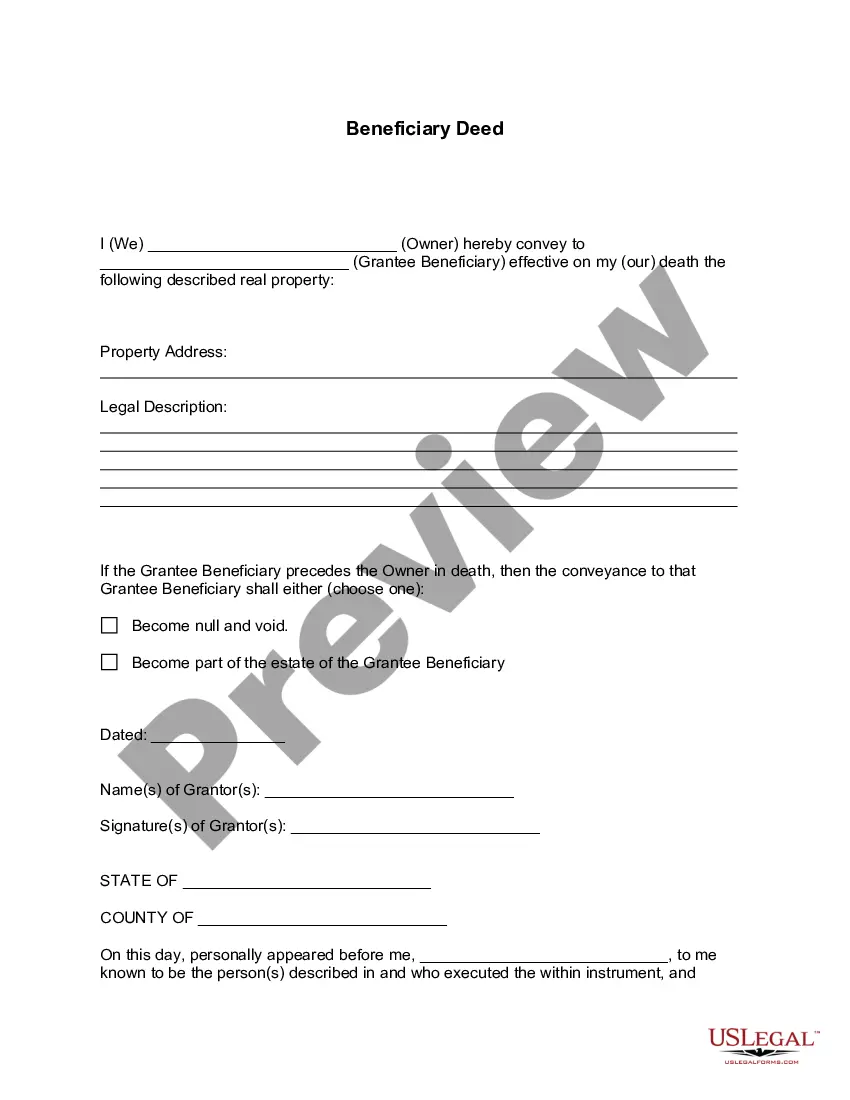
This Transfer on Death Quitclaim Deed is a legal document that enables an individual (the Grantor) to transfer property to another individual (the Grantee) upon the Grantor's death. This deed is revocable during the Grantor's lifetime and becomes effective only after their passing. It differs from a standard quitclaim deed because it includes the crucial feature of a transfer upon death, thus aiding in avoiding probate for the transferred property.
Main sections of this form
- Grantor and Grantee information: Names and addresses of both parties.
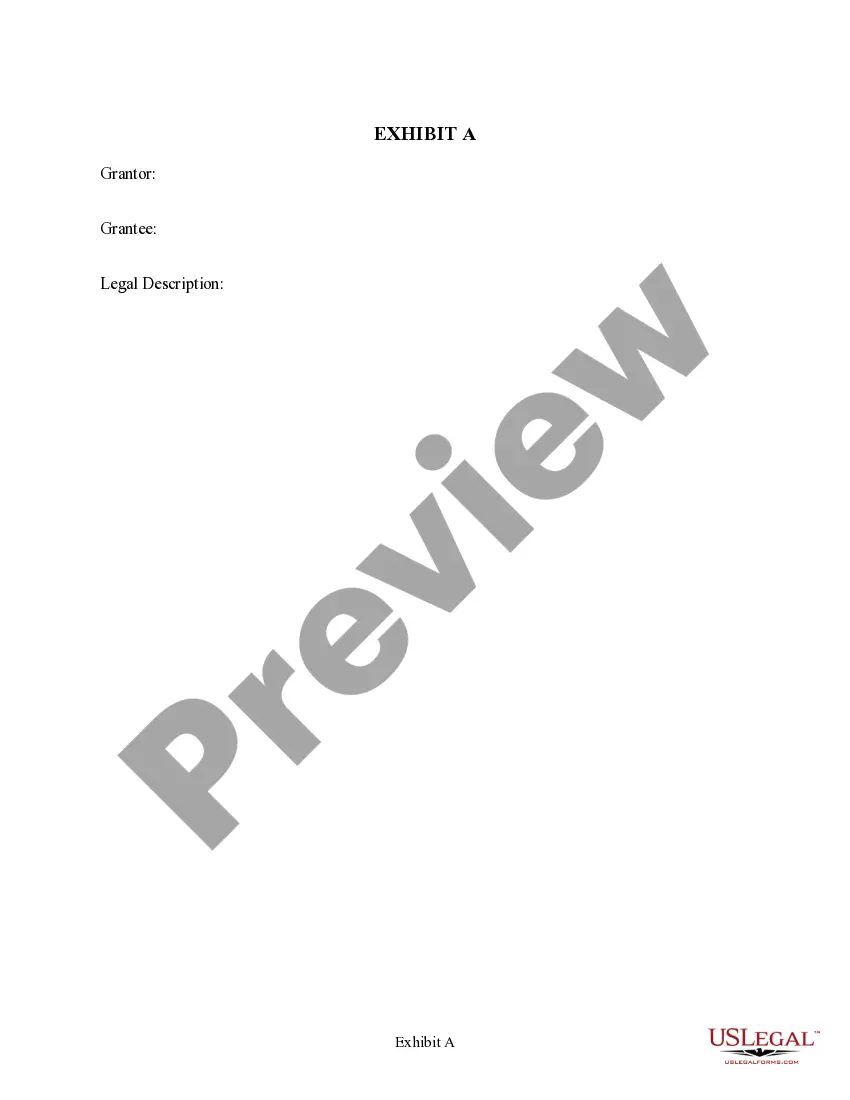
- Property description: A detailed description of the property being transferred.
- Alternate beneficiary: Provision for an alternate individual to inherit if the primary Grantee does not survive the Grantor.
- Revocation clause: Explanation that the Grantor can revoke the deed while alive.
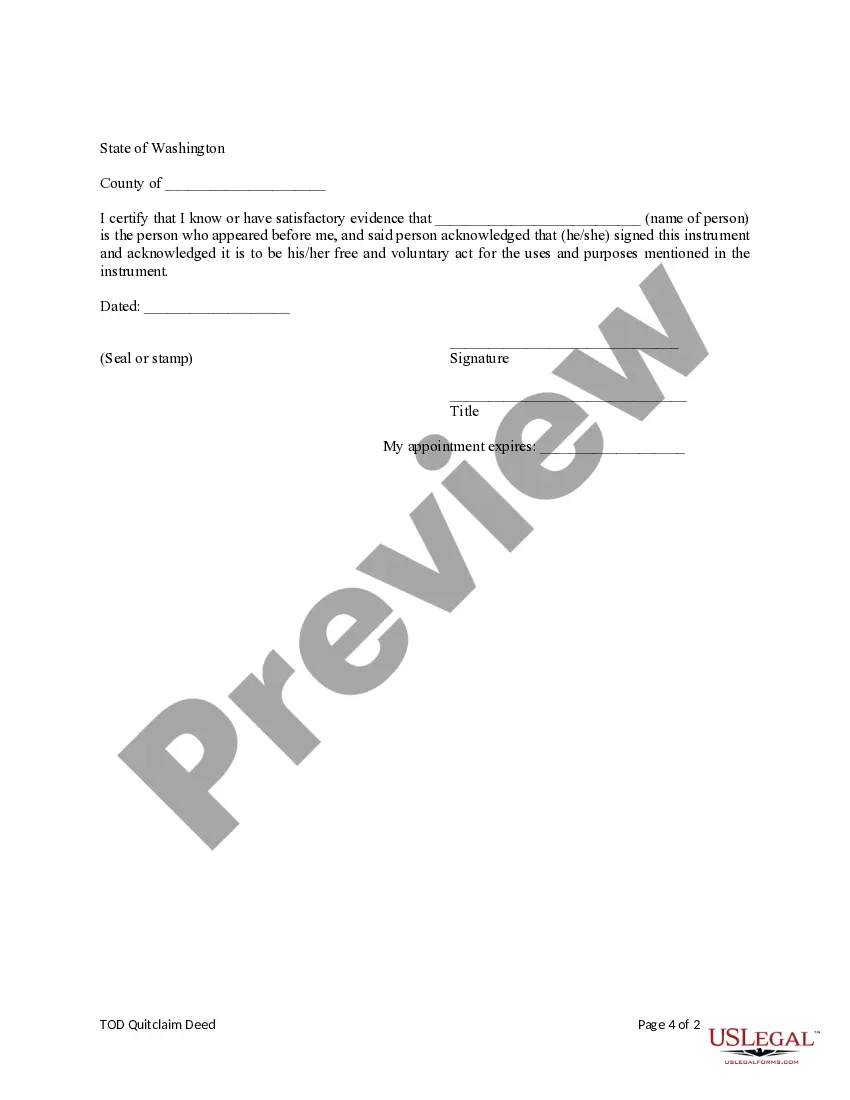
- Notary requirements: Section for notarization to validate the deed.
When to use this form
This form is useful when an individual wishes to ensure that their real estate passes directly to another individual without the need for probate proceedings after their death. It is particularly beneficial for individuals seeking to streamline the transfer of property to family members, friends, or other designated beneficiaries.
Who should use this form
- Individuals who own real estate and want to plan for its future transfer upon death.
- Homeowners looking to avoid probate costs and delays for their heirs.
- Persons seeking to establish an alternate beneficiary for their property in case the primary Grantee cannot inherit.
How to prepare this document
- Identify the Grantor and Grantee: Fill in the full names and addresses of both parties involved.
- Describe the property: Provide a complete legal description of the property being transferred.
- Designate an alternate beneficiary: Include information for another individual to inherit if the Grantee cannot inherit.
- Sign the deed in the presence of a notary public: This ensures the document is valid.
- Record the deed: Ensure it is filed with the local county auditor's office before the Grantor's death to be legally effective.
Notarization guidance
This form must be notarized to be legally valid. US Legal Forms provides secure online notarization powered by Notarize, allowing you to complete the process through a verified video call.
Get your form ready online
Our built-in tools help you complete, sign, share, and store your documents in one place.
Make edits, fill in missing information, and update formatting in US Legal Forms—just like you would in MS Word.
Download a copy, print it, send it by email, or mail it via USPS—whatever works best for your next step.
Sign and collect signatures with our SignNow integration. Send to multiple recipients, set reminders, and more. Go Premium to unlock E-Sign.
If this form requires notarization, complete it online through a secure video call—no need to meet a notary in person or wait for an appointment.
We protect your documents and personal data by following strict security and privacy standards.

Make edits, fill in missing information, and update formatting in US Legal Forms—just like you would in MS Word.

Download a copy, print it, send it by email, or mail it via USPS—whatever works best for your next step.

Sign and collect signatures with our SignNow integration. Send to multiple recipients, set reminders, and more. Go Premium to unlock E-Sign.

If this form requires notarization, complete it online through a secure video call—no need to meet a notary in person or wait for an appointment.

We protect your documents and personal data by following strict security and privacy standards.
Common mistakes to avoid
- Failing to include the correct property description, which can lead to confusion or disputes.
- Not recording the deed in a timely manner, which may result in it not being effective upon death.
- Omitting the alternate beneficiary, which could complicate the inheritance process.
- Not having the deed notarized, which is often a requirement for it to be legally valid.
Advantages of online completion
- Convenience of completing the form at your own pace from anywhere with internet access.
- Editability ensures that you can make changes easily before finalizing the document.
- Reliability of professionally drafted forms that adhere to state-specific legal requirements.
Looking for another form?
Form popularity
FAQ
This form creates a transfer on death arrangement for real estate where the Grantor names a Grantee to receive the property after the Grantor’s death. It’s revocable during the Grantor’s lifetime and becomes effective only at death. It helps avoid probate for the transferred property and includes an alternate beneficiary and a notary requirement.
This form names a single primary Grantee and one alternate beneficiary; it is not designed to transfer to multiple primary recipients in a single deed. If you need multiple beneficiaries, you would typically create separate TOD documents or use different language to designate additional successors.
A standard quitclaim deed transfers the grantor’s interest during life without a death-trigger, while a Washington Transfer on Death Quitclaim Deed transfers ownership only after the grantor’s death and is designed to avoid probate for that property. This form also revokes during life and includes an alternate beneficiary.
This form is designed for use in Washington and provides a transfer on death mechanism to avoid probate for the named property. It includes revocation rights and an alternate beneficiary and requires notary acknowledgment. Always confirm compliance with Washington law and consider legal advice.
Using this Washington TOD Quitclaim Deed can help pass the designated real estate directly to the beneficiary upon death, potentially avoiding probate for that property. It is revocable during the Grantor’s life and includes an alternate beneficiary. It does not guarantee probate avoidance for other assets; consult an attorney.
The form combines a quitclaim conveyance with a transfer on death structure and adds an alternate beneficiary. It names a primary Grantee, plus a secondary beneficiary if the primary does not survive, and it includes notary requirements and revocation rights, all tailored to Washington practice.