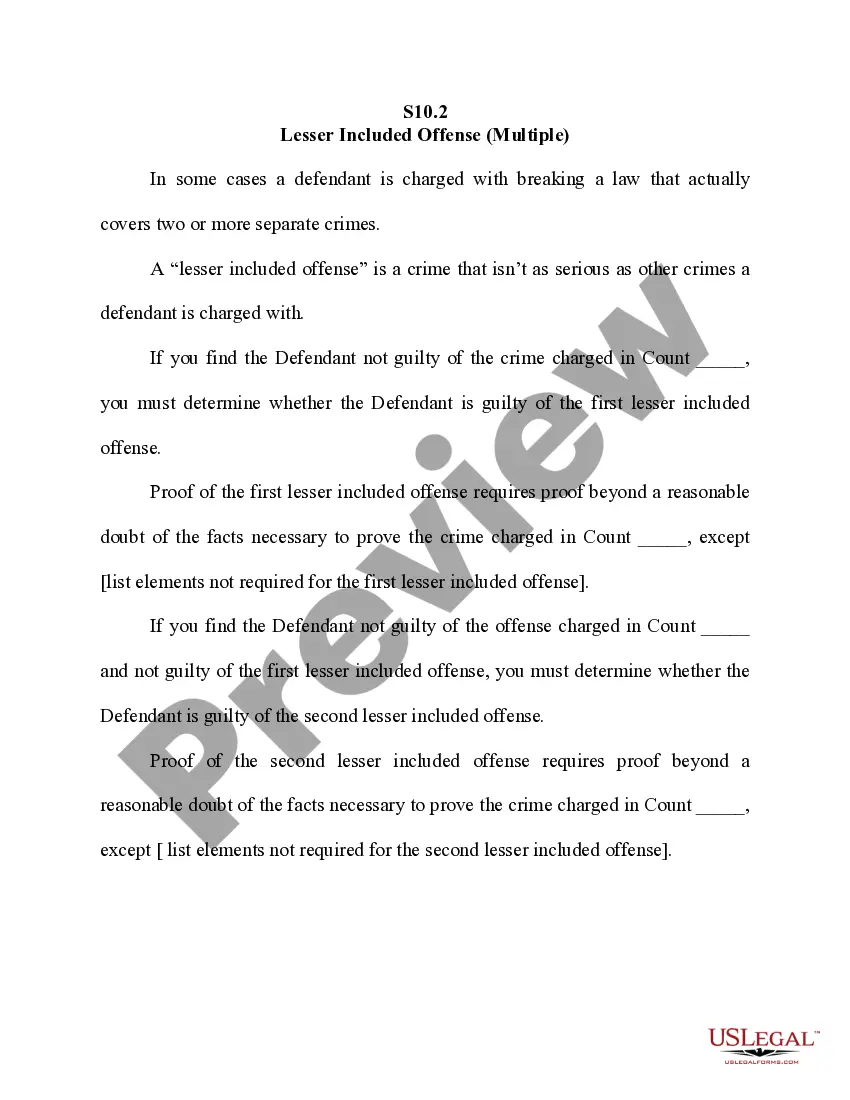
Lesser Included Offense (Multiple)
About this form
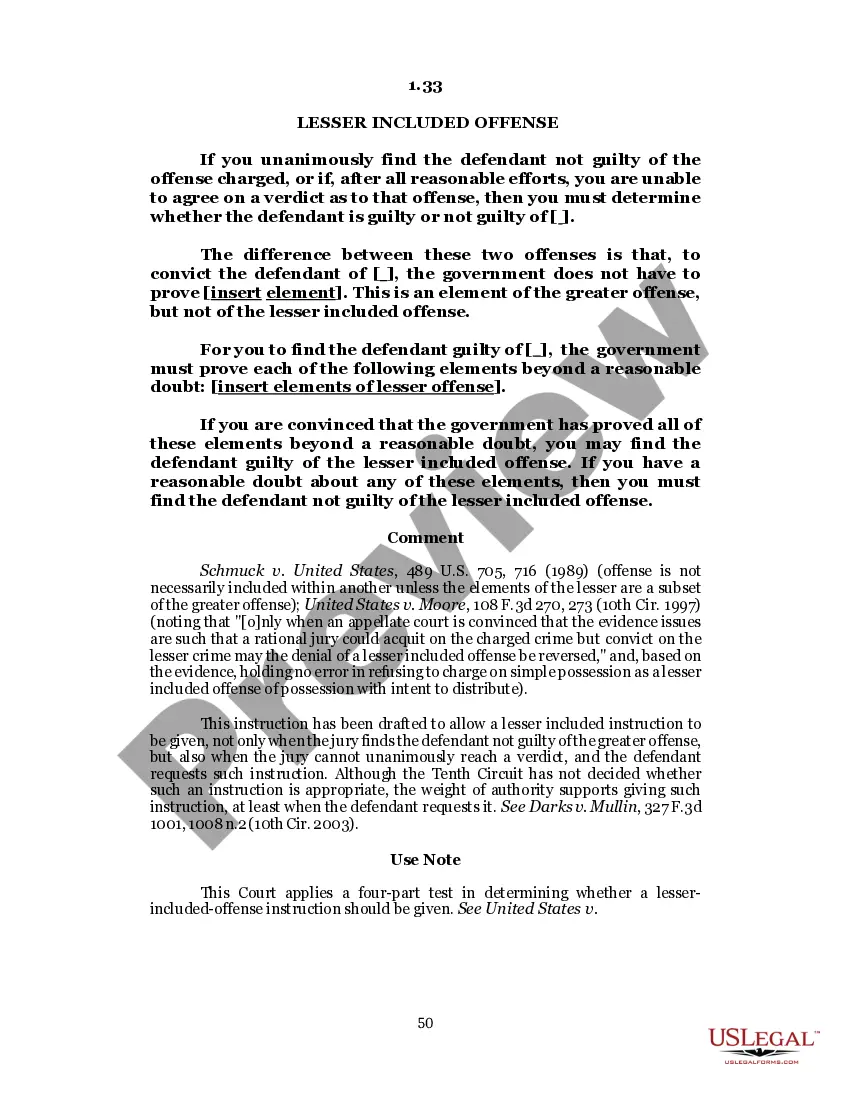
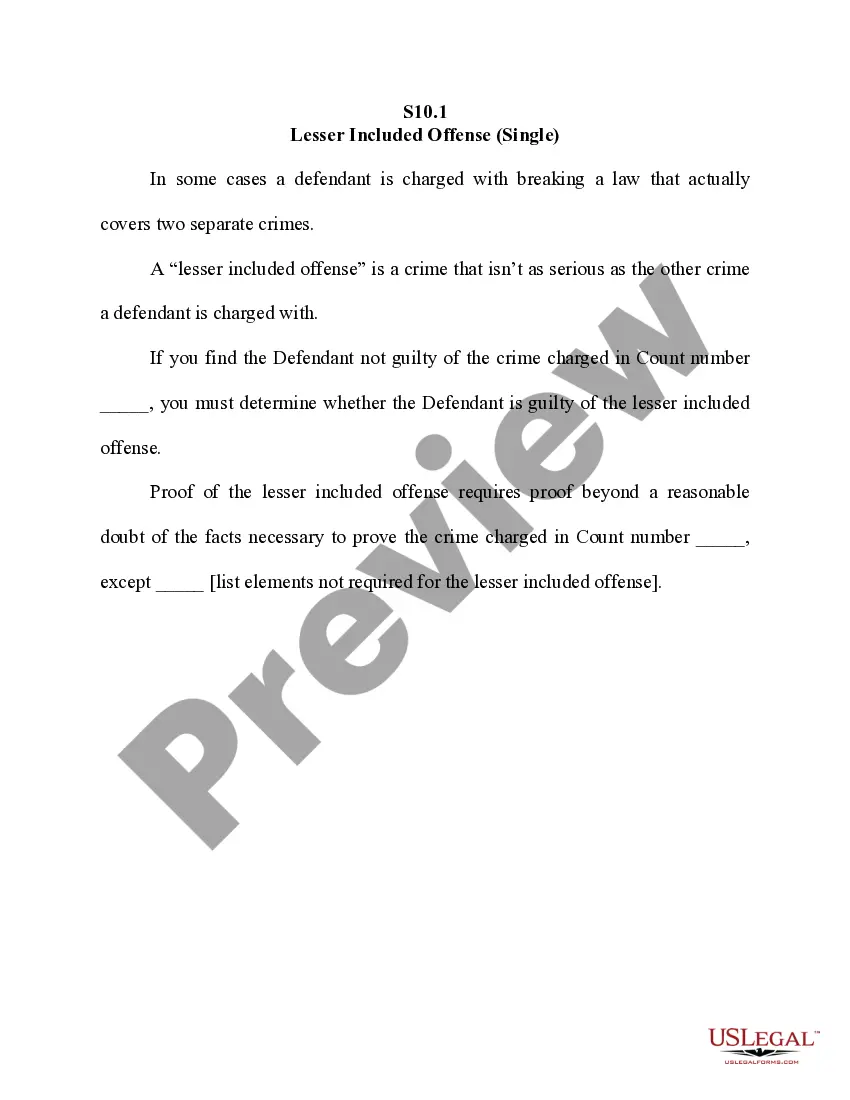
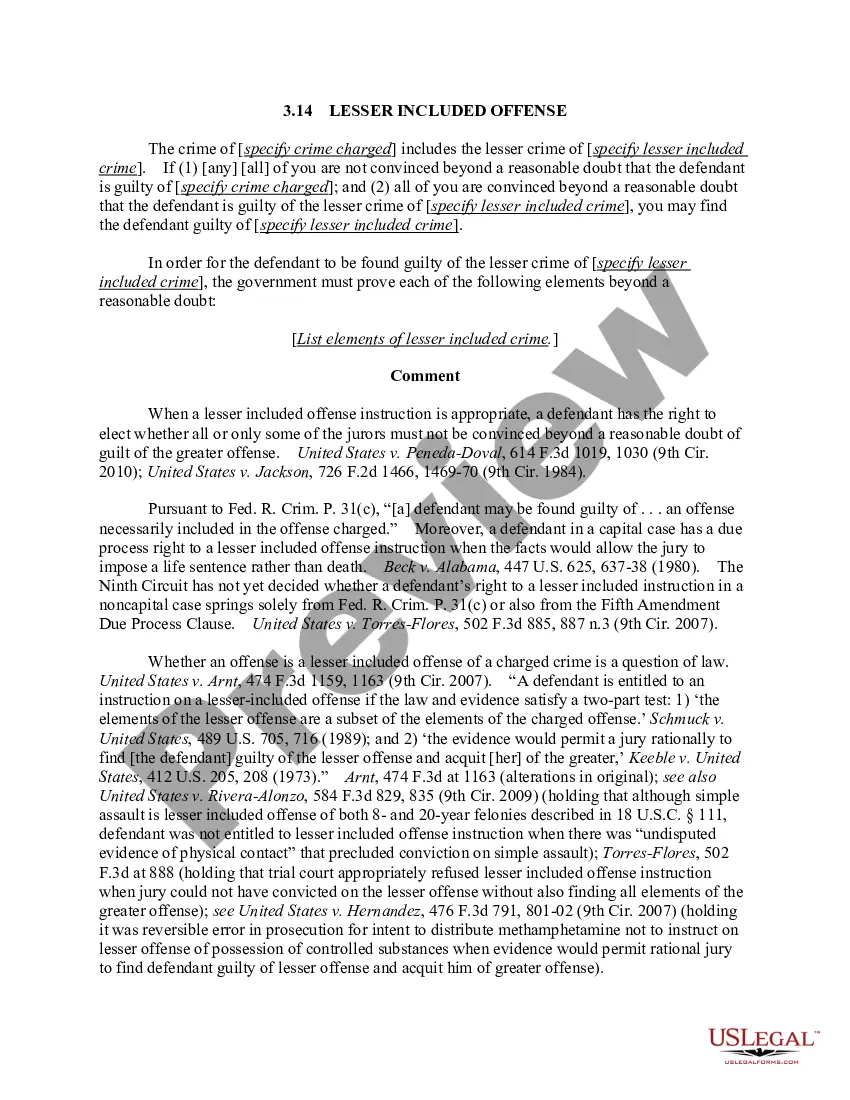
The Lesser Included Offense (Multiple) form provides jury instructions used in cases where a defendant may be charged with more than one offense that overlaps in legal elements. These instructions guide jurors on how to evaluate lesser included offenses, enabling them to consider less serious charges if they find the defendant not guilty of the primary charge. This form is essential for ensuring that jurors understand their responsibilities in evaluating different layers of criminal behavior, distinguishing it from other legal forms focused solely on single offenses.
Key components of this form
- Definition of "lesser included offense" for jurors.
- Specific instructions for jurors on evaluating the defendant's guilt for multiple charges.
- Clear presentation of proof standards required for each lesser included offense.
- Sequential instructions for deliberation in case of multiple charges.
When to use this document
This form is used in criminal trials where a defendant faces charges that can include both a serious crime and one or more lesser included offenses. It is applicable in scenarios where the evidence may support a conviction for a lesser crime even if the jury does not find sufficient grounds for the primary charge. Legal professionals often reference this form during jury selection or the trial process to clarify the considerations jurors must address.
Intended users of this form
- Judges overseeing jury trials in criminal cases.
- Attorneys representing defendants facing multiple charges.
- Legal professionals preparing jury instructions.
- Jurors who need guidance on their decision-making responsibilities.
Steps to complete this form
- Identify the charges against the defendant.
- Provide definitions for each lesser included offense relevant to the case.
- Outline the proof required to establish the first lesser included offense.
- Detail what is necessary to prove the second lesser included offense.
- Frame the instructions clearly for jurors to follow during deliberation.
Notarization requirements for this form
Notarization is not commonly needed for this form. However, certain documents or local rules may make it necessary. Our notarization service, powered by Notarize, allows you to finalize it securely online anytime, day or night.
Get your form ready online
Our built-in tools help you complete, sign, share, and store your documents in one place.
Make edits, fill in missing information, and update formatting in US Legal Forms—just like you would in MS Word.
Download a copy, print it, send it by email, or mail it via USPS—whatever works best for your next step.
Sign and collect signatures with our SignNow integration. Send to multiple recipients, set reminders, and more. Go Premium to unlock E-Sign.
If this form requires notarization, complete it online through a secure video call—no need to meet a notary in person or wait for an appointment.
We protect your documents and personal data by following strict security and privacy standards.

Make edits, fill in missing information, and update formatting in US Legal Forms—just like you would in MS Word.

Download a copy, print it, send it by email, or mail it via USPS—whatever works best for your next step.

Sign and collect signatures with our SignNow integration. Send to multiple recipients, set reminders, and more. Go Premium to unlock E-Sign.

If this form requires notarization, complete it online through a secure video call—no need to meet a notary in person or wait for an appointment.

We protect your documents and personal data by following strict security and privacy standards.
Common mistakes to avoid
- Failing to clearly define each lesser included offense for jurors.
- Not including all elements of proof required for lesser offenses.
- Assuming jurors understand the implications of multiple charges without detailed instructions.
Benefits of completing this form online
- Immediate access to legally compliant jury instructions.
- Easy customization to fit specific cases.
- Reliability, having been drafted by licensed attorneys.
Quick recap
- The Lesser Included Offense (Multiple) form is crucial in helping jurors navigate multiple charges.
- Understanding lesser included offenses can lead to fairer trial outcomes.
- Legal professionals benefit from using standardized instructions to ensure clarity in trials.
Looking for another form?

Form popularity
FAQ
United States v. Roderick, 62 M.J. 425 (if a court, contrary to the intent of Congress, imposes multiple convictions and punishments under different statutes for the same act or course of conduct, the court violates the Double Jeopardy Clause of the Constitution).
U.S. , the U.S. Supreme Court rules that the double jeopardy clause is not violated when a defendant is convicted of two different crimes arising from a single act.
A less serious crime that is necessarily committed during the perpetration of a greater crime because the lesser crime contains some of the same elements of the greater crime. The greater crime cannot be proven unless all of the elements of the lesser crime are proven.
Also, double jeopardy does not apply to prosecutions for lesser included offenses if the defendant already has defeated the charge of the more serious offense. However, if a jury convicts a defendant of multiple charges based on the same conduct, the judge can impose a sentence only for the greater crime.
Simply put, lesser included offenses are crimes included within greater criminal charges. The laws dealing with lesser included offenses vary by state. A typical example is trespassing or unlawful entry being a less serious charge when someone commits burglary.
(multiplicity is grounded in the Double Jeopardy Clause of the Fifth Amendment, which prohibits multiple punishments for the same offense; therefore, the Fifth Amendment protection against double jeopardy provides that an accused cannot be convicted of both an offense and a lesser-included offense).
Criminal. Double Jeopardy does not apply when the different actions are both in criminal and civil court. Civil actions address different areas of the law than criminal actions and require a lower standard of proof called preponderance of the evidence campared to the criminal standard of beyond a reasonable doubt.
People need to understand, however, that double jeopardy protections do not apply to all criminal charges, and the charges have to be criminal. Examples of circumstances under which double jeopardy protections would not apply may include: An alleged offender may be charged with two identical but separate crimes.