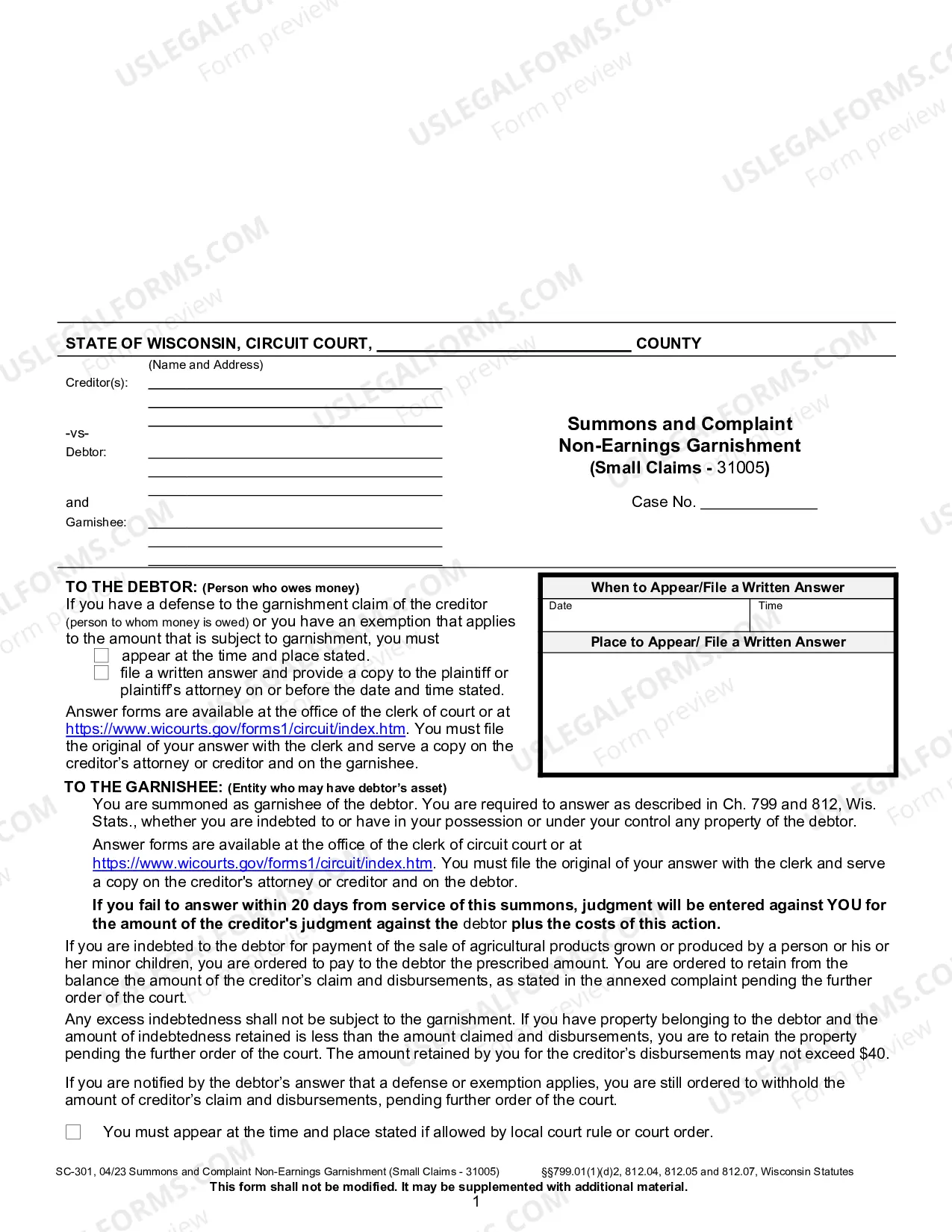
LESSER INCLUDED OFFENSE
What is this form?
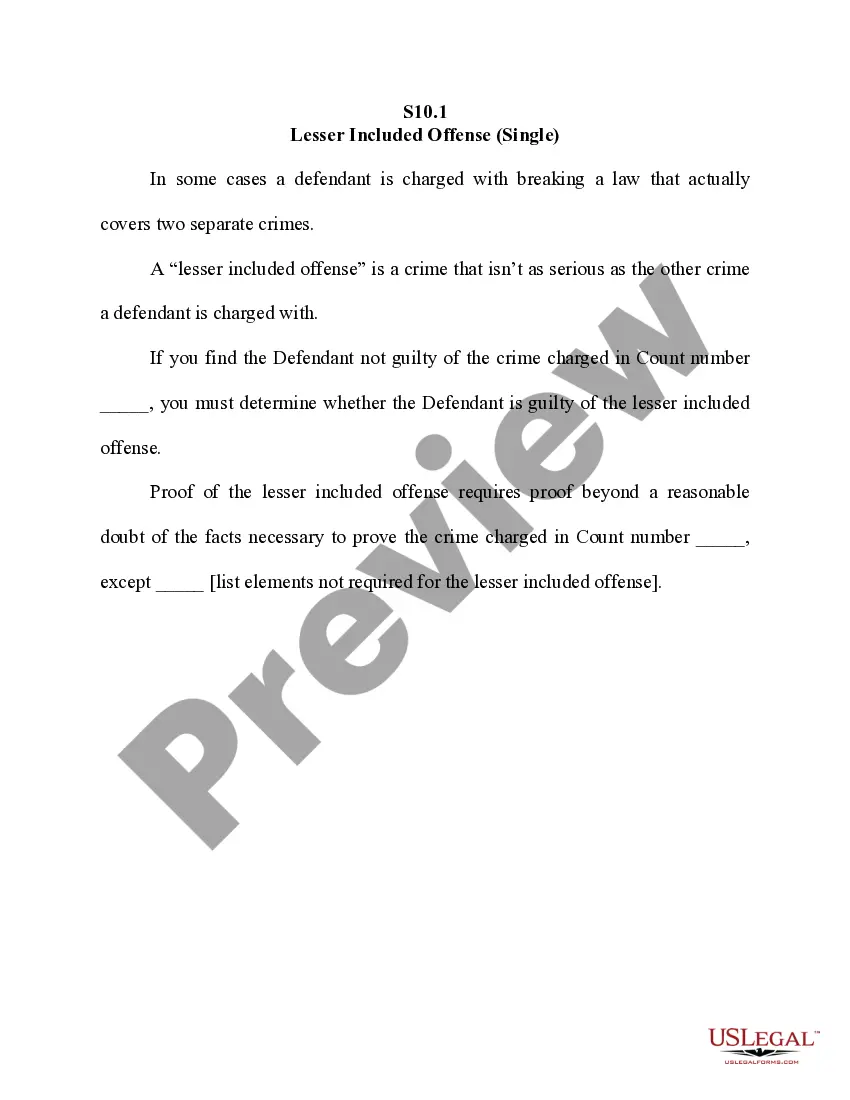
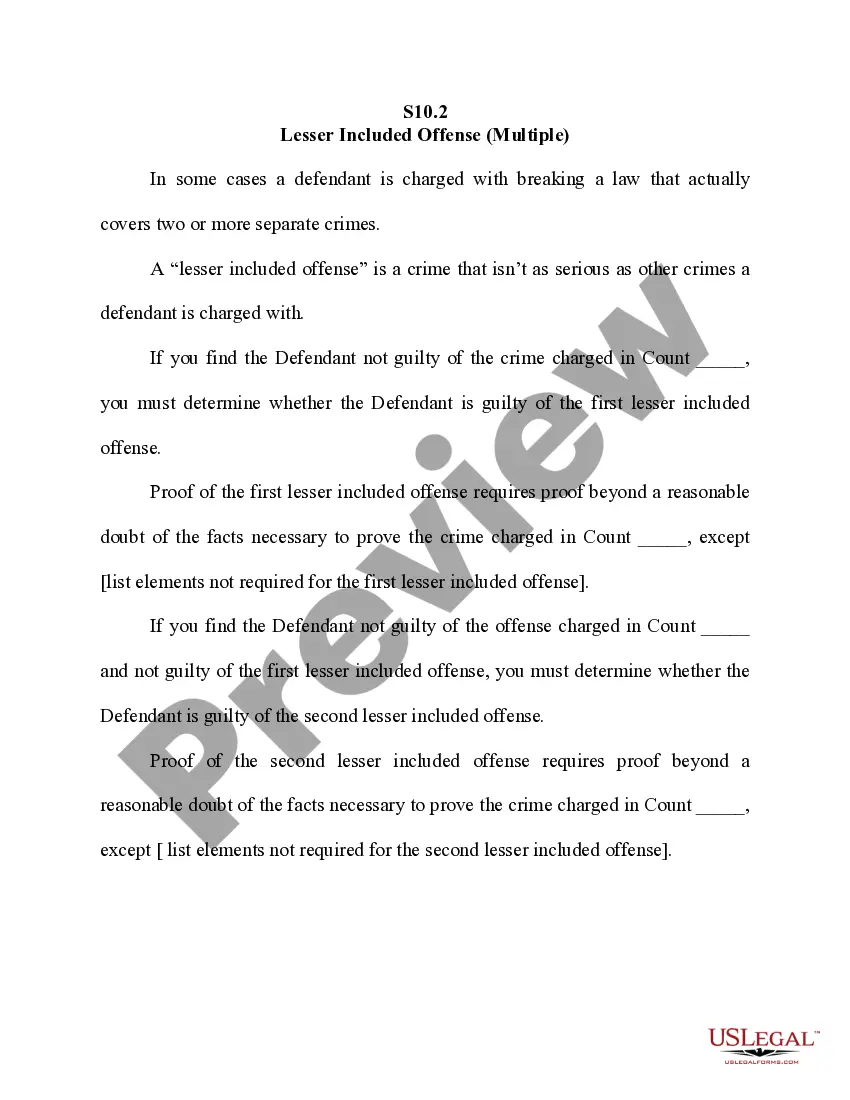
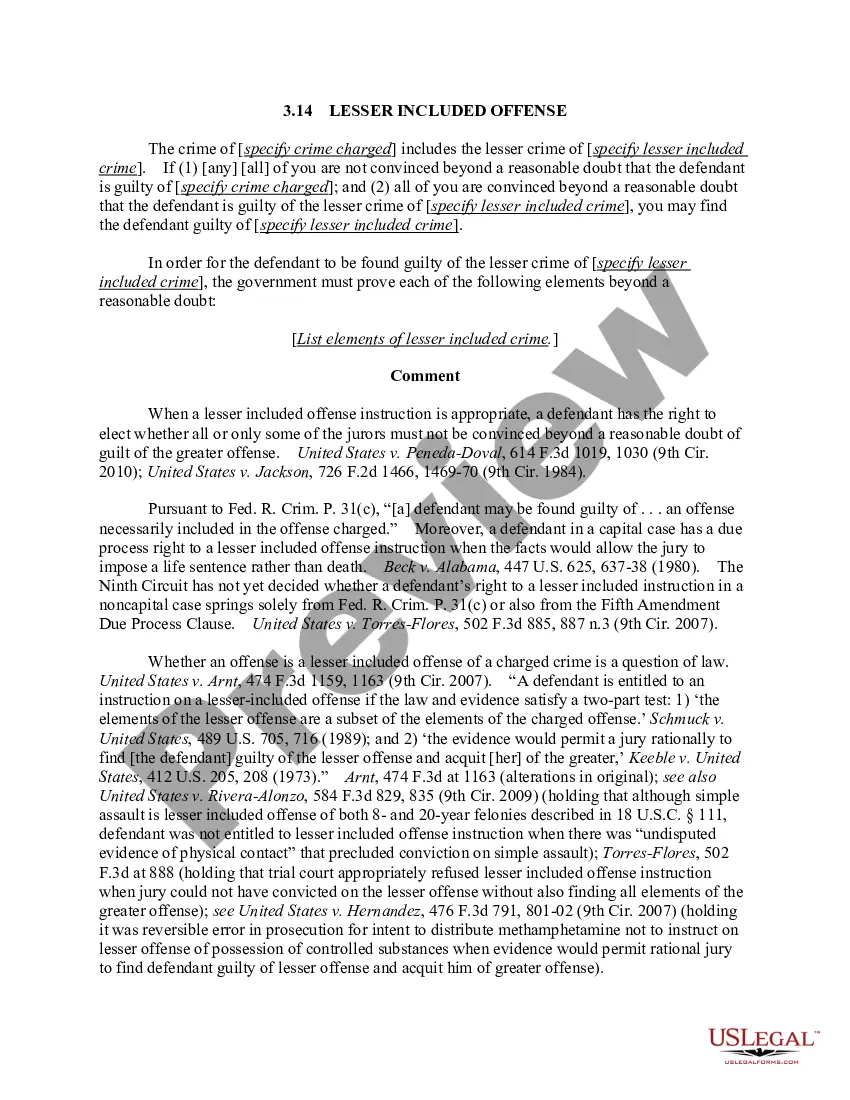
The Lesser Included Offense form is a legal instruction used in court proceedings to guide juries on how to consider lesser charges when the evidence does not support a conviction for the primary offense. This form differentiates between the primary charge and the lesser offense, emphasizing that the government must prove specific elements beyond a reasonable doubt for conviction on the lesser charge. It is essential for ensuring fair trial rights and clarifying jury instructions when defendants may not be guilty of the higher offense but could be guilty of a lesser included offense.
Key components of this form
- Unanimous decision requirement for not guilty verdict
- Definition of lesser included offense and its elements
- Conditions under which the jury must consider the lesser offense
- Emphasis on the burden of proof beyond a reasonable doubt
- Legal precedents supporting the use of this instruction

Situations where this form applies
This form is used in criminal trials when the jury is unable to reach a unanimous decision regarding the primary offense or when the defendant has been found not guilty of the charged offense. It is applicable in situations where the evidence suggests that although the defendant may not be guilty of the primary charge, there is enough evidence to consider a lesser included offense. This form helps jurors evaluate all potential outcomes based on the evidence presented during the trial.
Who can use this document
The following individuals or groups should consider using this form:
- Defendants facing serious charges in a criminal trial.
- Legal counsel representing defendants in criminal cases.
- Judges instructing juries on verdict options during trials.
- Prosecutors seeking to clarify charges during the legal proceedings.
Completing this form step by step
- Determine the primary offense and the potential lesser included offense.
- Insert the relevant elements of the lesser offense as required by the case.
- Ensure that the jury understands the specific elements they must deliberate on.
- Include the necessary legal precedents and rationale for allowing the instruction.
- Review the documentation to confirm clarity and adherence to legal standards.
Does this document require notarization?
Notarization is generally not required for this form. However, certain states or situations might demand it. You can complete notarization online through US Legal Forms, powered by Notarize, using a verified video call available anytime.
Get your form ready online
Our built-in tools help you complete, sign, share, and store your documents in one place.
Make edits, fill in missing information, and update formatting in US Legal Forms—just like you would in MS Word.
Download a copy, print it, send it by email, or mail it via USPS—whatever works best for your next step.
Sign and collect signatures with our SignNow integration. Send to multiple recipients, set reminders, and more. Go Premium to unlock E-Sign.
If this form requires notarization, complete it online through a secure video call—no need to meet a notary in person or wait for an appointment.
We protect your documents and personal data by following strict security and privacy standards.

Make edits, fill in missing information, and update formatting in US Legal Forms—just like you would in MS Word.

Download a copy, print it, send it by email, or mail it via USPS—whatever works best for your next step.

Sign and collect signatures with our SignNow integration. Send to multiple recipients, set reminders, and more. Go Premium to unlock E-Sign.

If this form requires notarization, complete it online through a secure video call—no need to meet a notary in person or wait for an appointment.

We protect your documents and personal data by following strict security and privacy standards.
Avoid these common issues
- Failing to properly define the elements of the lesser included offense.
- Not ensuring that the jury understands the burden of proof required.
- Overlooking state-specific legal requirements for the instruction.
- Using vague language that could confuse jurors.
Benefits of completing this form online
- Immediate access to legal forms drafted by licensed attorneys.
- Easy customization to align with case specifics and local laws.
- Secure and reliable download options for safeguarding legal documents.
- Convenient online access that allows for efficient preparation for court.
Legal use & context
- The instruction allows jurors to consider all evidence and charges appropriately.
- Used to ensure that defendants receive fair consideration for less serious charges.
- This form is backed by legal precedents that establish its necessity in trials.
Main things to remember
- The Lesser Included Offense form aids jurors in making fair decisions regarding charges.
- Understanding the differences between the primary and lesser offenses is crucial for trials.
- Legal representation should ensure the form is accurately completed to uphold trial rights.
Looking for another form?

Form popularity
FAQ
(an appellate court applies the elements test to determine whether one offense is an LIO of another; applying normal rules of statutory interpretation and construction, an appellate court will determine whether the elements of the LIO would necessarily be proven by proving the elements of the greater offense).
A lesser included charge is a criminal offense that was not originally charged but fits within the elements of a higher offense that was charged.
Work- man,6 a lesser offense is a lesser included offense if two conditions are met. First, each element of the lesser offense must be a necessary element of the greater offense. Second, the evidence in the case must support an inference that the lesser crime was committed.
Simply put, lesser included offenses are crimes included within greater criminal charges. The laws dealing with lesser included offenses vary by state. A typical example is trespassing or unlawful entry being a less serious charge when someone commits burglary.
Also, double jeopardy does not apply to prosecutions for lesser included offenses if the defendant already has defeated the charge of the more serious offense. However, if a jury convicts a defendant of multiple charges based on the same conduct, the judge can impose a sentence only for the greater crime.
The greater crime cannot be proven unless all of the elements of the lesser crime are proven. For example, trespassing is a lesser included offense of the crime of burglary.
A less serious crime that is necessarily committed during the perpetration of a greater crime because the lesser crime contains some of the same elements of the greater crime. The greater crime cannot be proven unless all of the elements of the lesser crime are proven.
Lesser Included Offense Under Texas Law Can be proved by the same facts, or less than all of the same facts, that would prove the crime actually charged by the prosecution; Is only different from the crime charged, in that it involves a less serious injury or risk of injury to the person, property, or public interest.