Attorney Fee Letter - Contingency Agreement
About this form
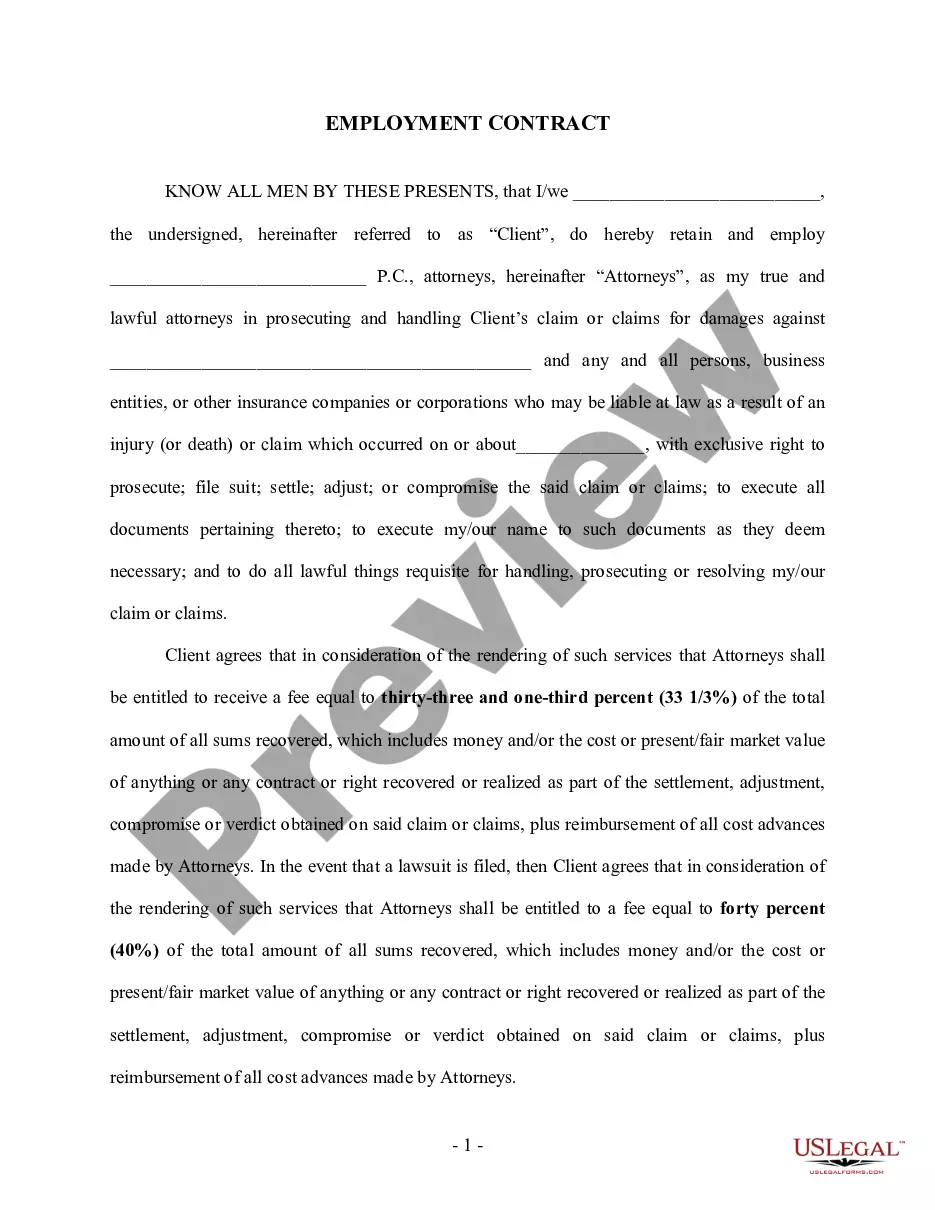
The Attorney Fee Letter - Contingency Agreement is a legal document outlining the terms under which a client agrees to pay a law firm a contingency fee for legal services rendered. This type of agreement ensures that the client understands the percentage of recovery the attorney will receive based on the outcome of their case, differentiating it from standard fee agreements where upfront payments may be required.
Main sections of this form
- Details of the law firm and client, including names and contact information.
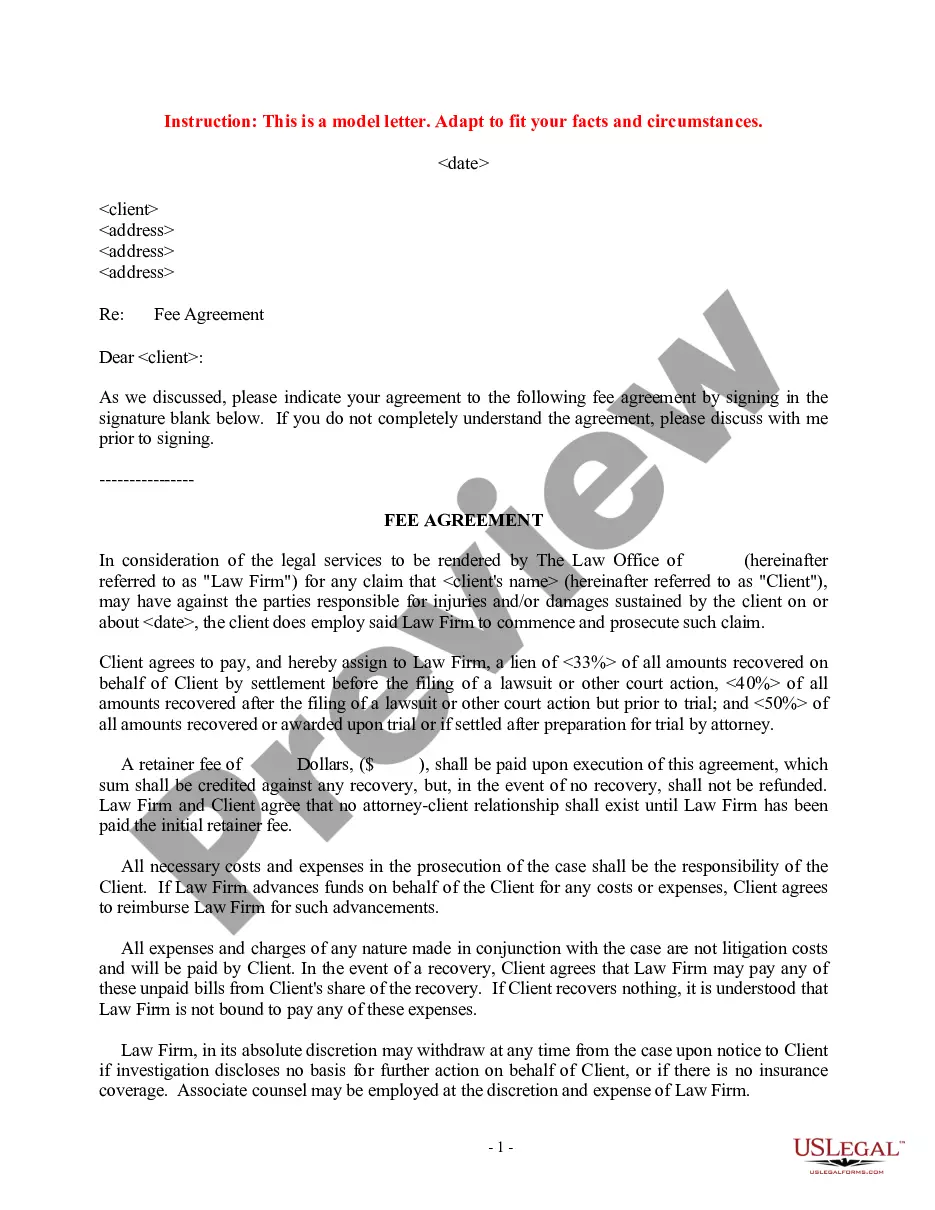
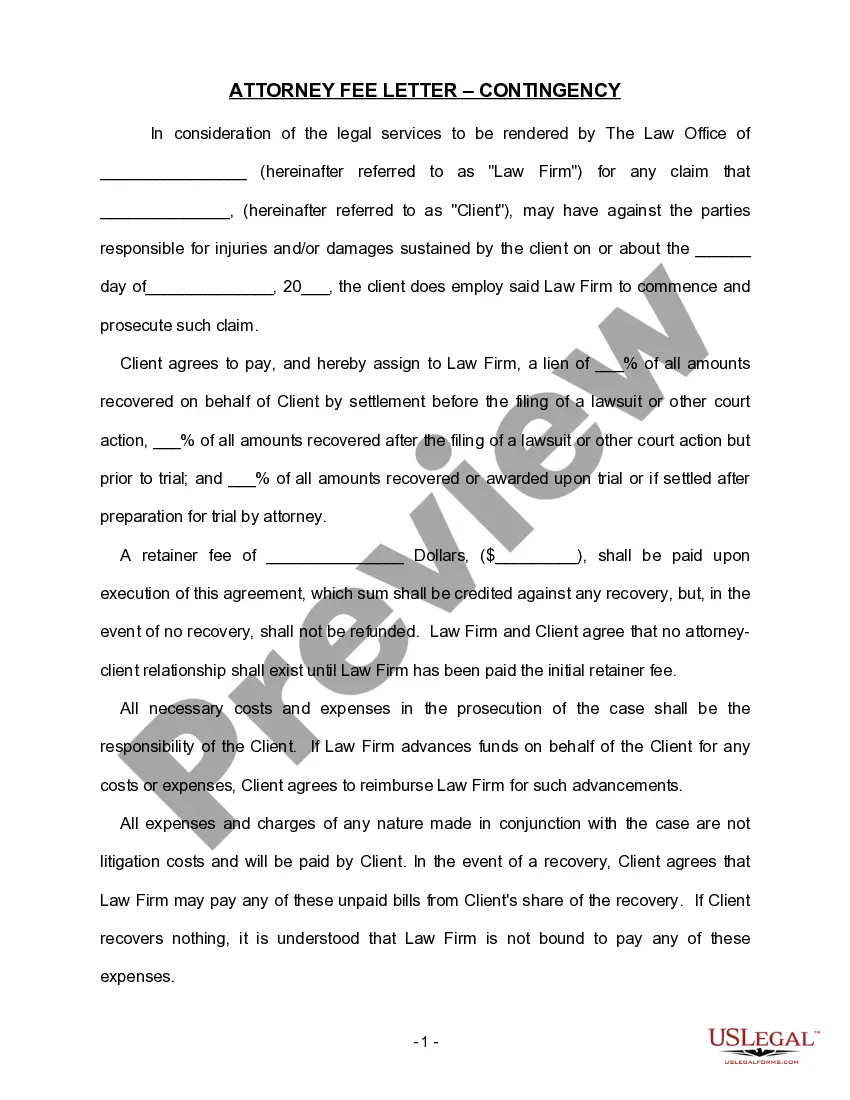
- Specific percentages allocated to the law firm based on the timing of recovery (33% pre-lawsuit, 40% post-lawsuit but pre-trial, and 50% after trial).
- Retainer fee amount and conditions related to its payment.
- Client responsibilities for costs and potential reimbursements to the law firm.
- Clauses concerning withdrawal of the law firm and the handling of appeals.
- Client obligations to cooperate with the law firm throughout the process.



When to use this form
This form is essential when a client wishes to engage a law firm on a contingency fee basis for legal services related to claims for injuries or damages. It is particularly useful in personal injury cases, where the client may not have the funds to pay upfront legal fees and instead agrees to pay the attorney a percentage of any settlement or award.
Who should use this form
- Individuals seeking legal representation for injury or damage claims without upfront costs.
- Clients looking to establish a clear understanding of legal fees and obligations.
- Those who may have concerns regarding attorney-client relationships and wish to formalize the agreement.
How to prepare this document
- Identify the parties involved: fill in the names of the client and law firm.
- Specify the claim details, including the nature of the injuries or damages and the date they occurred.
- Enter the retainer fee amount, noting its implications for the agreement.
- Review the percentage fees applicable based on the recovery timeline and ensure understanding of these terms.
- Both parties should sign and date the document, confirming their agreement to the terms outlined.
Notarization guidance
This form does not typically require notarization unless specified by local law.
Get your form ready online
Our built-in tools help you complete, sign, share, and store your documents in one place.
Make edits, fill in missing information, and update formatting in US Legal Forms—just like you would in MS Word.
Download a copy, print it, send it by email, or mail it via USPS—whatever works best for your next step.
Sign and collect signatures with our SignNow integration. Send to multiple recipients, set reminders, and more. Go Premium to unlock E-Sign.
If this form requires notarization, complete it online through a secure video call—no need to meet a notary in person or wait for an appointment.
We protect your documents and personal data by following strict security and privacy standards.

Make edits, fill in missing information, and update formatting in US Legal Forms—just like you would in MS Word.

Download a copy, print it, send it by email, or mail it via USPS—whatever works best for your next step.

Sign and collect signatures with our SignNow integration. Send to multiple recipients, set reminders, and more. Go Premium to unlock E-Sign.

If this form requires notarization, complete it online through a secure video call—no need to meet a notary in person or wait for an appointment.

We protect your documents and personal data by following strict security and privacy standards.
Typical mistakes to avoid
- Failing to specify all parties involved can create confusion.
- Not understanding the implications of the fee percentages can lead to disputes later on.
- Neglecting to clarify the retainer fee terms and its impact on potential recovery.
- Signing the document without thoroughly reviewing its terms.
Why use this form online
- Convenience of accessing and completing the form from home or anywhere with internet access.
- Editability allows clients to fill in their specific details as needed.
- Access to professionally drafted legal content ensures that users are following best practices.
- Immediate download options provide instant access to the completed form.
Looking for another form?

Form popularity
FAQ
To put it another way, with a contingency fee, payment for your attorney's services is "contingent upon" your receiving some amount of compensation. Your attorney will take an agreed-upon percentage of your recovery. This percentage is often around 1/3 or 33%.
The contract becomes void if the condition is not met. Thus, contingent contracts are meant to be performed only under specific circumstances. All types of insurance, indemnity, and guarantee contracts are considered as contingent contracts.
In simple words, contingent contracts, are the ones where the promisor perform his obligation only when certain conditions are met. The contracts of insurance, indemnity, and guarantee are some examples of contingent contracts. Illustration:- A contracts to pay to B Rs. 20,000 if B's house is burnt.
1 : a contingent event or condition: such as. a : an event (such as an emergency) that may but is not certain to occur trying to provide for every contingency. b : something liable to happen as an adjunct to or result of something else the contingencies of war.
The standard contingency fee for an attorney is a percentage amount rather than a fixed amount. Most personal injury lawyers charge 33 1/3 percent if the case settles without filing a lawsuit and 40% if a lawsuit is filed. Most employment lawyers charge a 40% fee.
A client pays a contingent fees to a lawyer only if the lawyer handles a case successfully.In a contingent fee arrangement, the lawyer agrees to accept a fixed percentage (often one third) of the recovery, which is the amount finally paid to the client.
A contingency agreement is an arrangement between a plaintiff and a lawyer, stating that the lawyer will represent the plaintiff without money to pay up front. In these situations, the plaintiff pays the lawyer only if the lawyer wins the case.
For example, a contingency fee agreement -- most common in personal injury lawsuits -- may state that the attorney's fee will be 30 percent of all funds recovered or, alternatively, 33 percent after all expenses of the case are paid.