Amendment to Right of Way Description (Pipeline)
Overview of this form
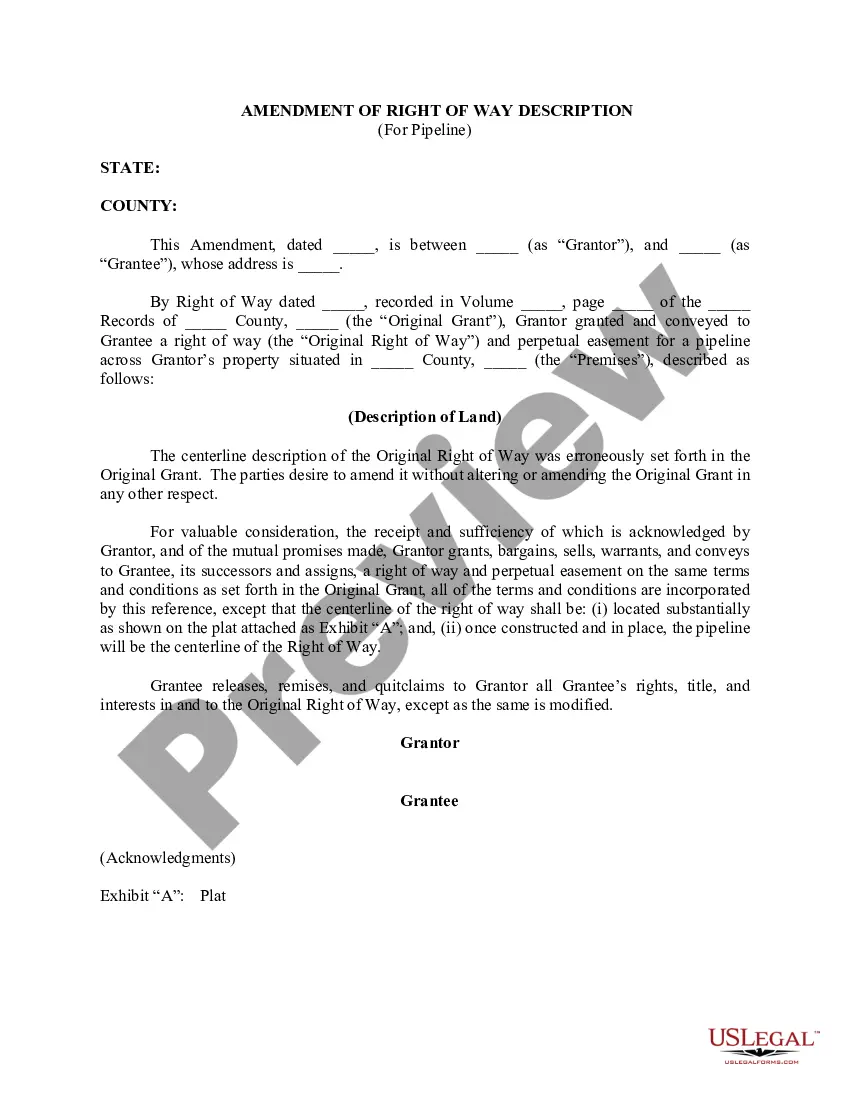
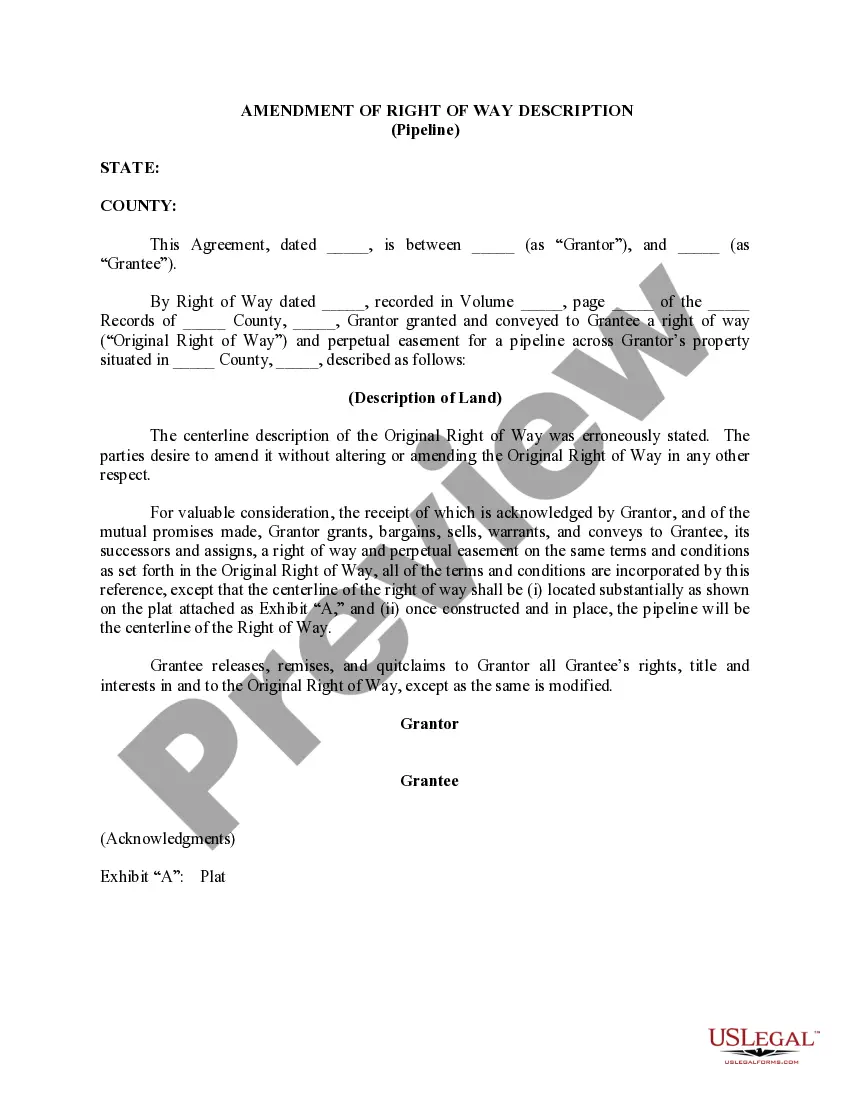
The Amendment to Right of Way Description (Pipeline) is a legal document used to modify an existing right of way description for a pipeline. This form specifically addresses instances where the original centerline description of the right of way was inaccurately recorded. By utilizing this amendment, parties can ensure the accurate representation of the pipeline's location while maintaining the original grant's terms and conditions.
What’s included in this form
- Date of amendment
- Identities of the grantor and grantee
- Description of the original right of way
- Details about the erroneous centerline description
- Terms of the amended right of way
- Release of rights by the grantee on the original right of way
- Attachment of Exhibit A (plat indicating the new centerline)
When to use this form
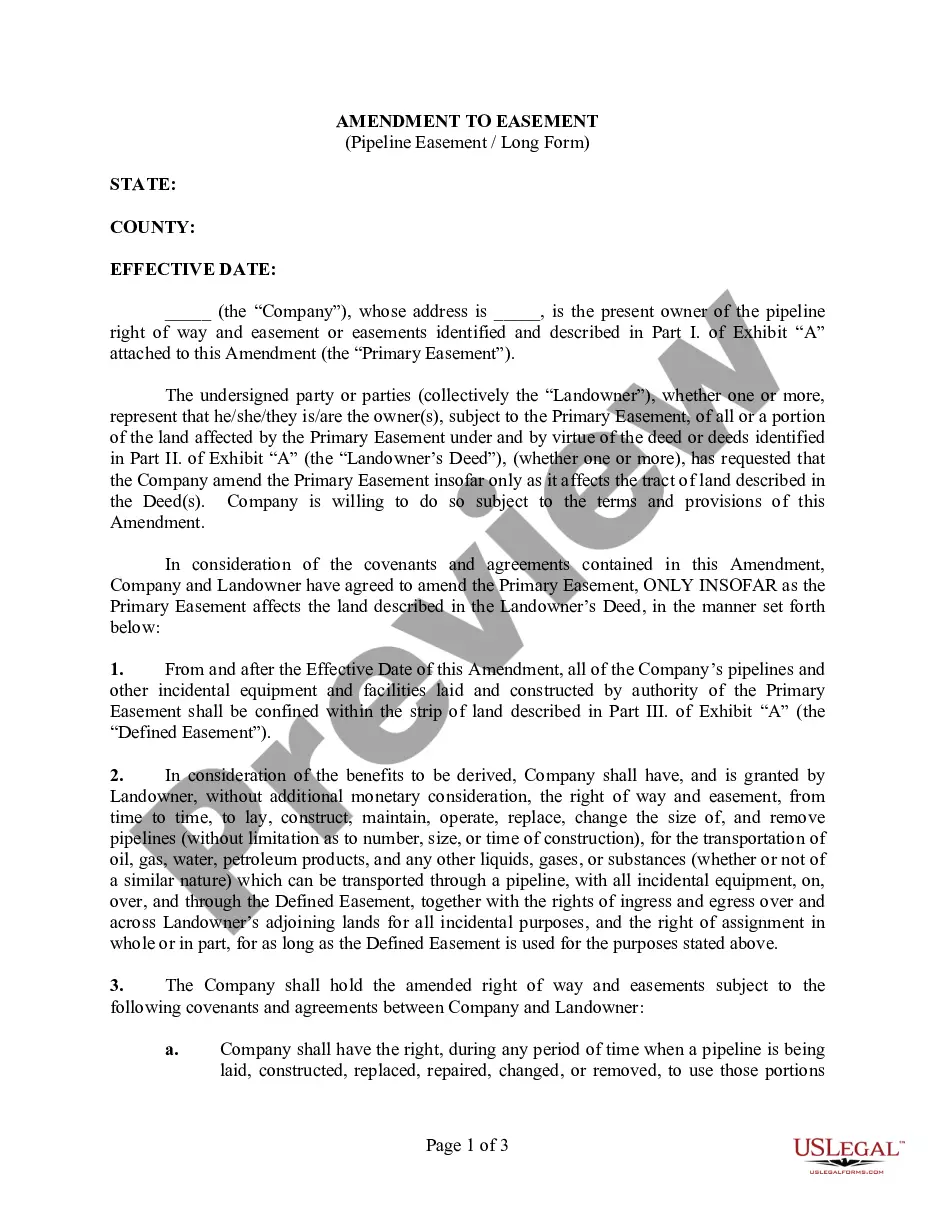
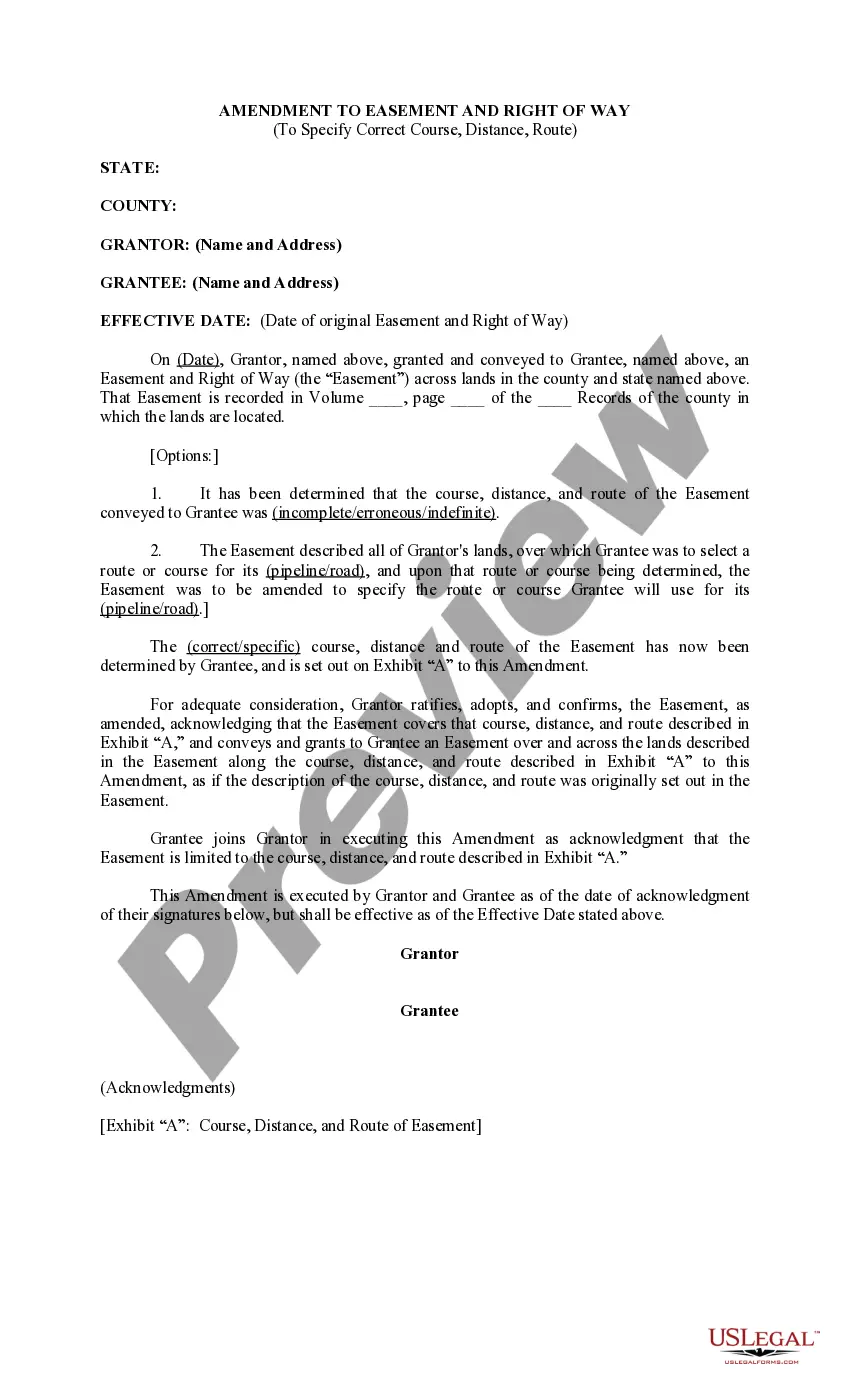
This form should be used when there is a need to correct or modify the description of a pipeline right of way after it has been previously granted. This typically occurs when the original description has inaccuracies regarding the centerline, requiring formal documentation to amend the grant without altering other terms. It is essential for maintaining clear legal standing regarding the easement's location.
Who this form is for
This form is intended for the following individuals or entities:
- Property owners (grantors) who have previously granted a right of way for pipeline installation
- Companies or individuals (grantees) seeking to amend the existing right of way descriptions for pipelines
- Legal representatives handling property easements related to pipelines
Completing this form step by step
- Identify and enter the names of the grantor and grantee, along with their addresses.
- Record the date of the original right of way grant, including the volume and page number from the county records.
- Provide a clear description of the property where the right of way applies.
- Specify the accurate centerline location for the pipeline as indicated in Exhibit A.
- Ensure both parties acknowledge the amendment by signing the form.
Notarization requirements for this form
This form needs to be notarized to ensure legal validity. US Legal Forms provides secure online notarization powered by Notarize, allowing you to complete the process through a verified video call, available anytime.
Get your form ready online
Our built-in tools help you complete, sign, share, and store your documents in one place.
Make edits, fill in missing information, and update formatting in US Legal Forms—just like you would in MS Word.
Download a copy, print it, send it by email, or mail it via USPS—whatever works best for your next step.
Sign and collect signatures with our SignNow integration. Send to multiple recipients, set reminders, and more. Go Premium to unlock E-Sign.
If this form requires notarization, complete it online through a secure video call—no need to meet a notary in person or wait for an appointment.
We protect your documents and personal data by following strict security and privacy standards.

Make edits, fill in missing information, and update formatting in US Legal Forms—just like you would in MS Word.

Download a copy, print it, send it by email, or mail it via USPS—whatever works best for your next step.

Sign and collect signatures with our SignNow integration. Send to multiple recipients, set reminders, and more. Go Premium to unlock E-Sign.

If this form requires notarization, complete it online through a secure video call—no need to meet a notary in person or wait for an appointment.

We protect your documents and personal data by following strict security and privacy standards.
Common mistakes
- Failing to accurately describe the errors in the original right of way.
- Omitting required signatures from both the grantor and grantee.
- Not including a clear description of the property involved.
- Neglecting to attach Exhibit A, which illustrates the new centerline.
Why use this form online
- Convenience of downloading and completing the form from anywhere.
- Ease of editing to ensure accuracy in descriptions and details.
- Access to forms drafted by licensed attorneys ensures reliability and legal compliance.
Looking for another form?

Form popularity
FAQ
A right-of-way is a strip of land typically about 50 feet wide (depending on location) containing a pipeline or other utility. Many rights-of-way contain more than one underground pipeline or utility and can be wider depending on the number of infrastructure assets within.
Oil pipelines are made from steel or plastic tubes with inner diameter typically from 4 to 48 inches (100 to 1,220 mm). Most pipelines are typically buried at a depth of about 3 to 6 feet (0.91 to 1.83 m). To protect pipes from impact, abrasion, and corrosion, a variety of methods are used.
An easement, right of way or profit can be expressly released by deed. Once this has been done then it is extinguished and cannot be revived. An easement, right of way or profit can be sometimes impliedly released by the owner's actions or in rare cases by the owner's inaction.
API recommends setbacks of 50 feet from petroleum and hazardous liquids lines for new homes, businesses, and places of public assembly (API 2003). It also recommends 25 feet for garden sheds, septic tanks, and water wells and 10 feet for mailboxes and yard lights.
A pipeline easement specifically gives the easement holder the right to build and maintain a pipeline on a landowner's property. It doesn't grant the easement holder actual ownership of the land, just a right to use the land for pipeline purposes.
A pipeline right-of-way is a strip of land over and around natural gas pipelines, with some of the property owner's legal rights have been granted to a pipeline operator.These easements can be both permanent and temporary, with temporary easements granting the pipeline company additional space during construction.
API recommends setbacks of 50 feet from petroleum and hazardous liquids lines for new homes, businesses, and places of public assembly (API 2003). It also recommends 25 feet for garden sheds, septic tanks, and water wells and 10 feet for mailboxes and yard lights.
API recommends setbacks of 50 feet from petroleum and hazardous liquids lines for new homes, businesses, and places of public assembly (API 2003). It also recommends 25 feet for garden sheds, septic tanks, and water wells and 10 feet for mailboxes and yard lights.
More simply, an easement is the right to use another's property for a specific purpose. Rights-of-way are easements that specifically grant the holder the right to travel over another's property.