Amendment to Easement and Right of Way (To Specifiy Course of Pipeline/Road)
About this form
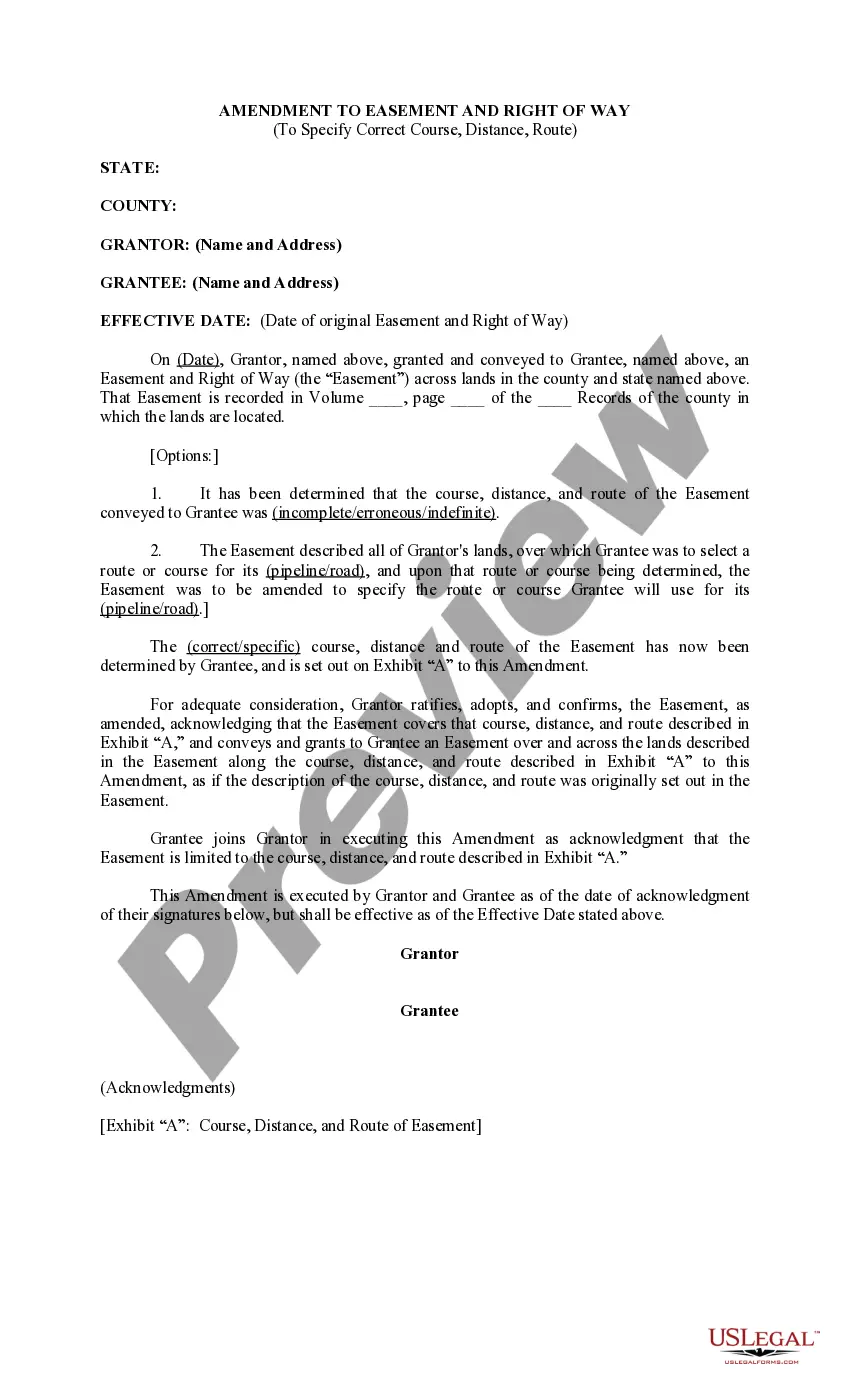
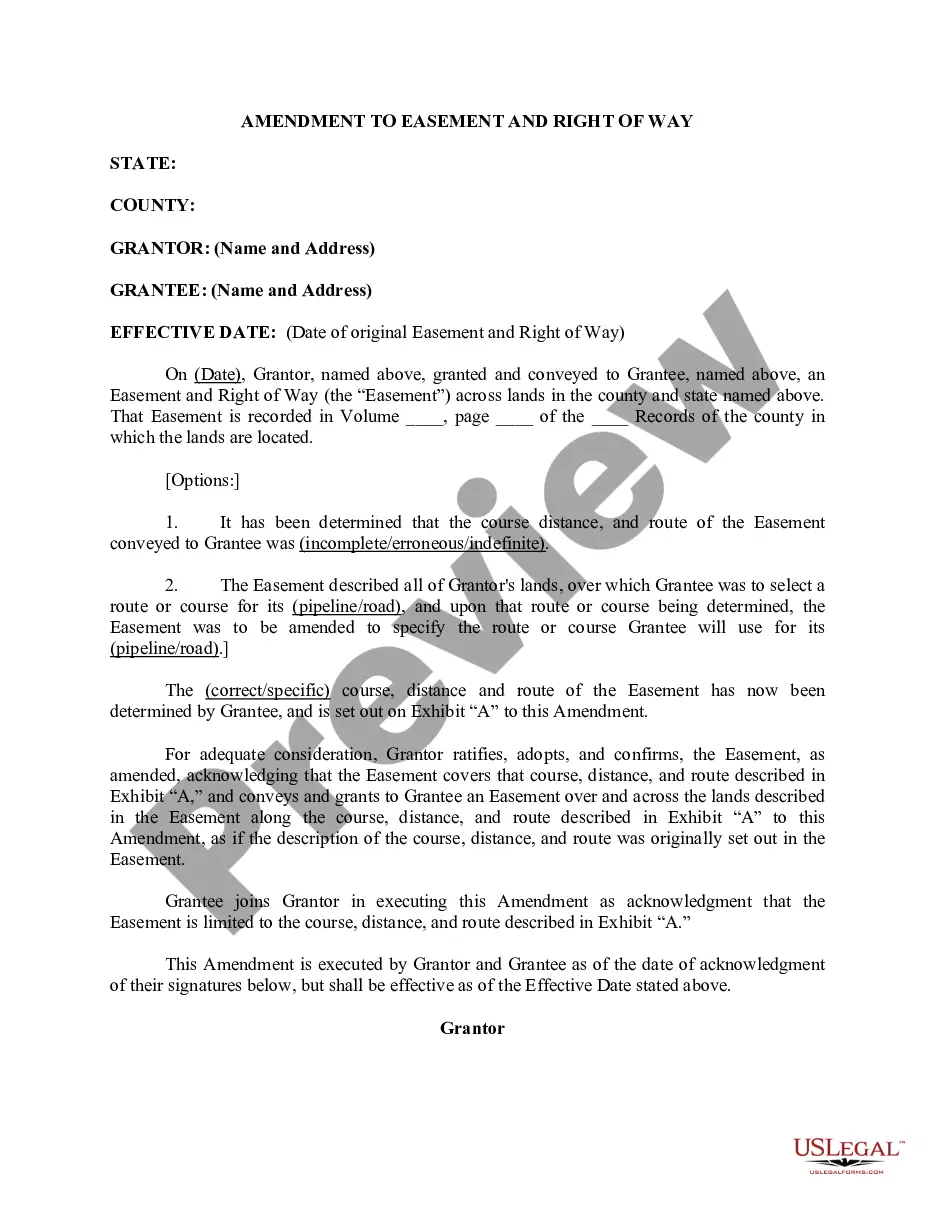
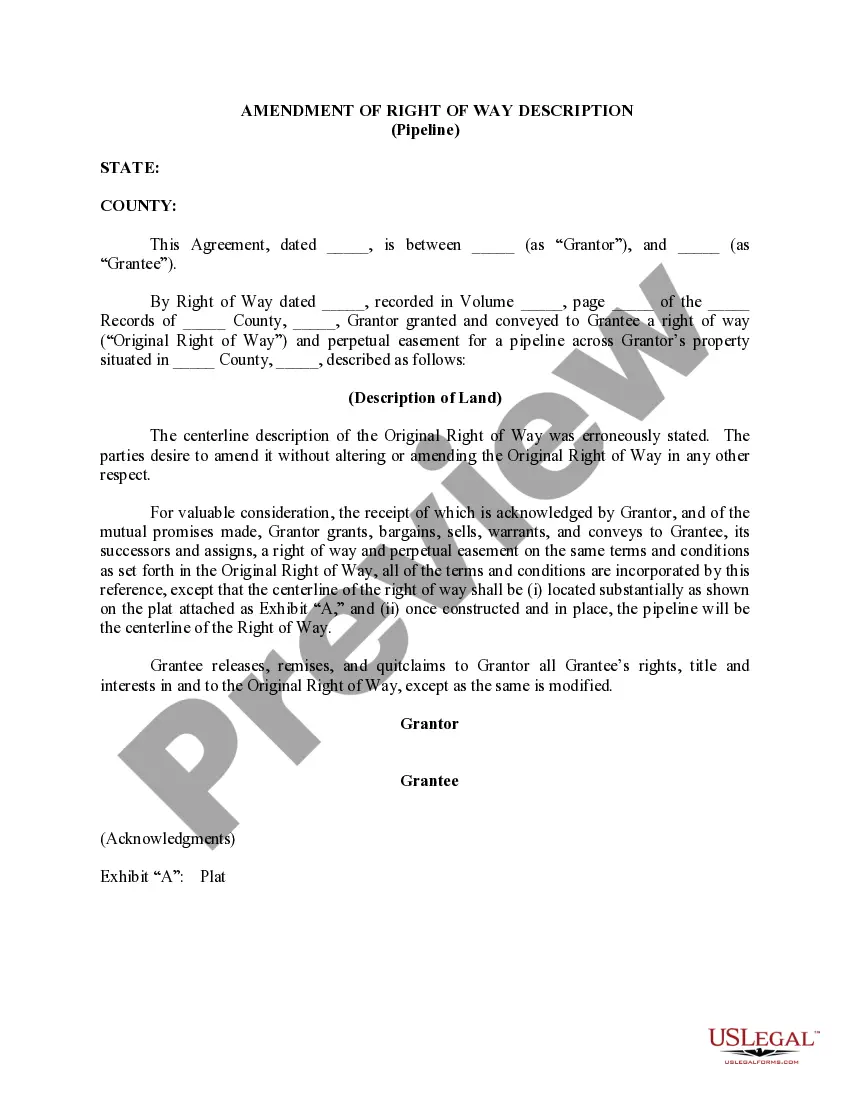
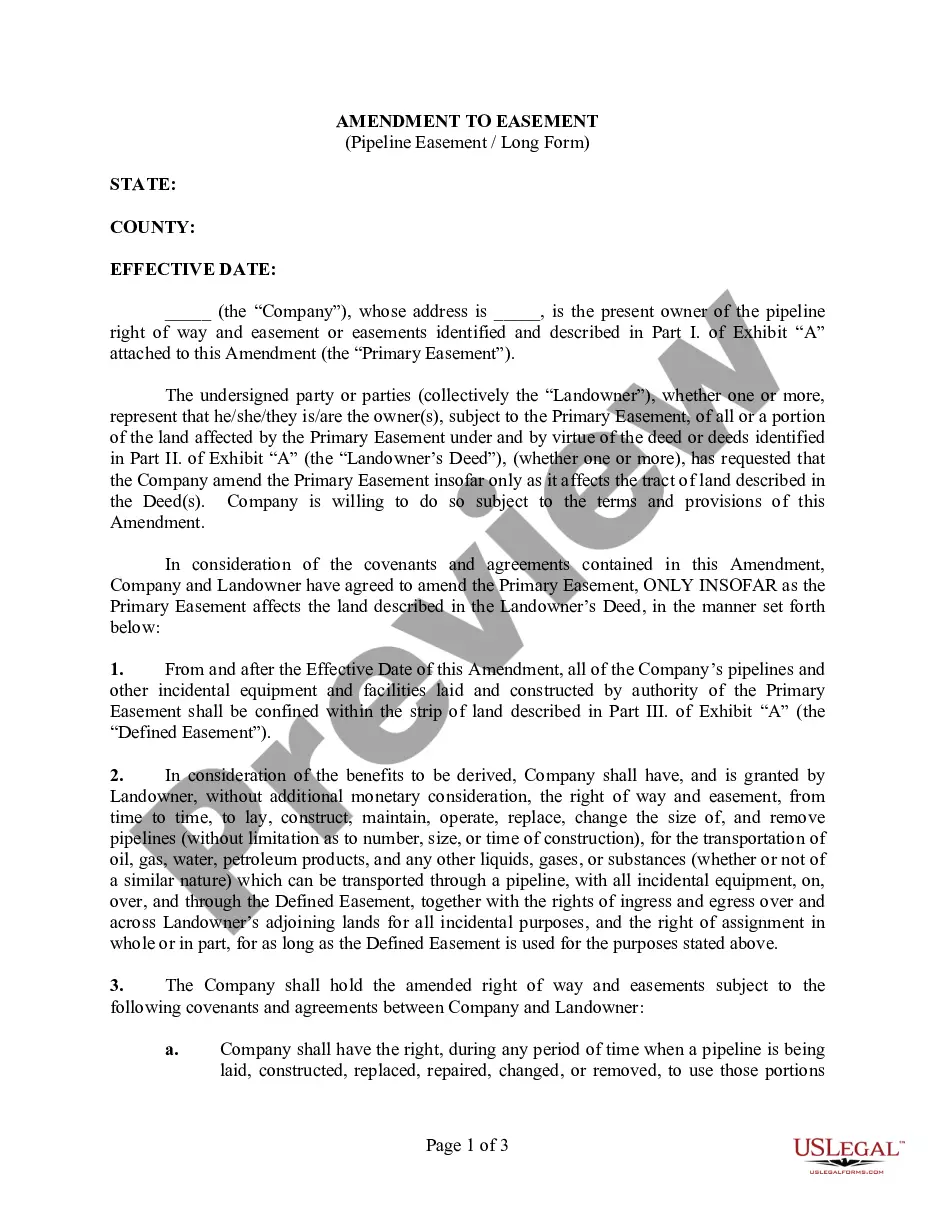
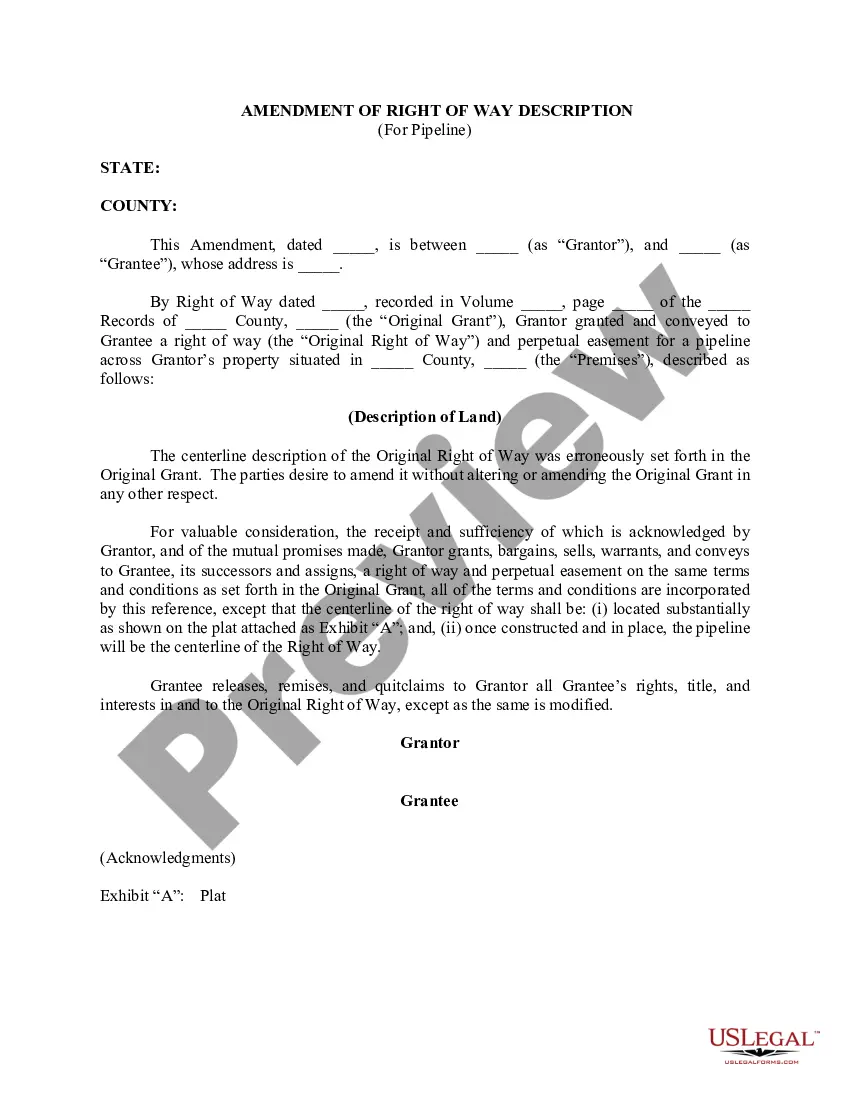
The Amendment to Easement and Right of Way is a legal document used to officially modify an existing easement agreement. This form specifies the correct course, distance, and route for utilities such as pipelines or roads across a property. Unlike a standard easement form, this amendment addresses discrepancies by detailing the precise path the grantee can utilize, ensuring clarity and legal enforcement of the easement rights moving forward.
What’s included in this form
- Identification of the grantor and grantee, including names and addresses.
- Effective date of the original easement.
- Specification of the recorded easement details, including volume and page number.
- Clear determination indicating if the previous easement description was incomplete or erroneous.
- Exhibit A detailing the correct course, distance, and route for the easement.
- Signatures of both grantor and grantee, affirming the amendment.
Common use cases
This form is essential when the original easement agreement does not accurately describe the physical path for the intended pipeline or road. Use this amendment to correct such discrepancies when the route has been defined, ensuring that both parties agree to the revised terms and that the easement remains enforceable.
Who can use this document
- Property owners (grantors) granting easement rights.
- Entities or individuals (grantees) seeking to utilize the easement for installation or access of infrastructure such as pipelines or roads.
- Legal representatives assisting clients in amending easement agreements.
How to prepare this document
- Identify the parties involved by entering the names and addresses of the grantor and grantee.
- State the effective date of the original easement agreement.
- Provide details of the recorded easement, including volume and page information.
- Clearly indicate if the previous easement description was incomplete or erroneous.
- Attach Exhibit A detailing the correct course, distance, and route.
- Ensure both parties sign and date the amendment to finalize the changes.
Notarization guidance
To make this form legally binding, it must be notarized. Our online notarization service, powered by Notarize, lets you verify and sign documents remotely through an encrypted video session.
Get your form ready online
Our built-in tools help you complete, sign, share, and store your documents in one place.
Make edits, fill in missing information, and update formatting in US Legal Forms—just like you would in MS Word.
Download a copy, print it, send it by email, or mail it via USPS—whatever works best for your next step.
Sign and collect signatures with our SignNow integration. Send to multiple recipients, set reminders, and more. Go Premium to unlock E-Sign.
If this form requires notarization, complete it online through a secure video call—no need to meet a notary in person or wait for an appointment.
We protect your documents and personal data by following strict security and privacy standards.

Make edits, fill in missing information, and update formatting in US Legal Forms—just like you would in MS Word.

Download a copy, print it, send it by email, or mail it via USPS—whatever works best for your next step.

Sign and collect signatures with our SignNow integration. Send to multiple recipients, set reminders, and more. Go Premium to unlock E-Sign.

If this form requires notarization, complete it online through a secure video call—no need to meet a notary in person or wait for an appointment.

We protect your documents and personal data by following strict security and privacy standards.
Mistakes to watch out for
- Failing to include the specific details of Exhibit A.
- Not providing accurate identification of the grantor and grantee.
- Overlooking the effective date of the original easement.
- Missing signatures from either the grantor or grantee.
Advantages of online completion
- Convenience of downloading and filling out the form at your own pace.
- Editability, allowing for modifications as needed before printing.
- Access to reliable templates drafted by licensed attorneys, ensuring legal accuracy.
Quick recap
- The form is essential for correcting existing easements to ensure clarity in property use.
- Key details include identification of parties, effective dates, and specific route information.
- Completion requires careful attention to detail to avoid common errors.
Looking for another form?
Form popularity
FAQ
An easement deed allows a party that is not the owner to use a portion of the land. It is a written agreement between two parties that spells out what part of the property is available for access and how it may be used. Since you are granting an easement to your land, you can set any terms and conditions you like.
Generally speaking, an easement is a more serious property right; it is the legal right to use someone else's land for a particular purpose. Easements are often recorded at the county clerk's office and encumber your property's title.Here, however, you probably do not need to take the step of granting an easement.
An easement is a nonpossessory right to use and/or enter onto the real property of another without possessing it. It is "best typified in the right of way which one landowner, A, may enjoy over the land of another, B".
An easement is a limited right to use another person's land for a stated purpose. Examples of easements include the use of private roads and paths, or the use of a landowner's property to lay railroad tracks or electrical wires.
You are willing to either share in or bear the cost of land maintenance and are now ready to negotiate. Reducing the impact the easement has on the neighbor will help convince him to say yes. Include in the negotiations elements that include his continued use and rights to share that parcel of land with you.
What is a Pipeline Easement? Generally, an easement is a legal interest that allows someone the right to use another's property for a certain purpose. A pipeline easement specifically gives the easement holder the right to build and maintain a pipeline on a landowner's property.
What are Easements and Rights-of-Way? Easements are nonpossessory interests in real property. More simply, an easement is the right to use another's property for a specific purpose. Rights-of-way are easements that specifically grant the holder the right to travel over another's property.
A Right of Way Easement is a form of Easement annexed to land which grants a right to travel over a part of the landowner's property. This right of way is usually granted to neighbouring landowners. The legal rights of the attached landowners to use and maintain the right of way may not always be clear.
Give the document a simple title: Grant of Easement is sufficient. Identify the parties. You need to explain who the parties are to the agreement. The person granting the easement to his property is the Grantor and the person gaining access to the property is the Grantee.