Release of Surface Damages For Pipeline Easement
Understanding this form
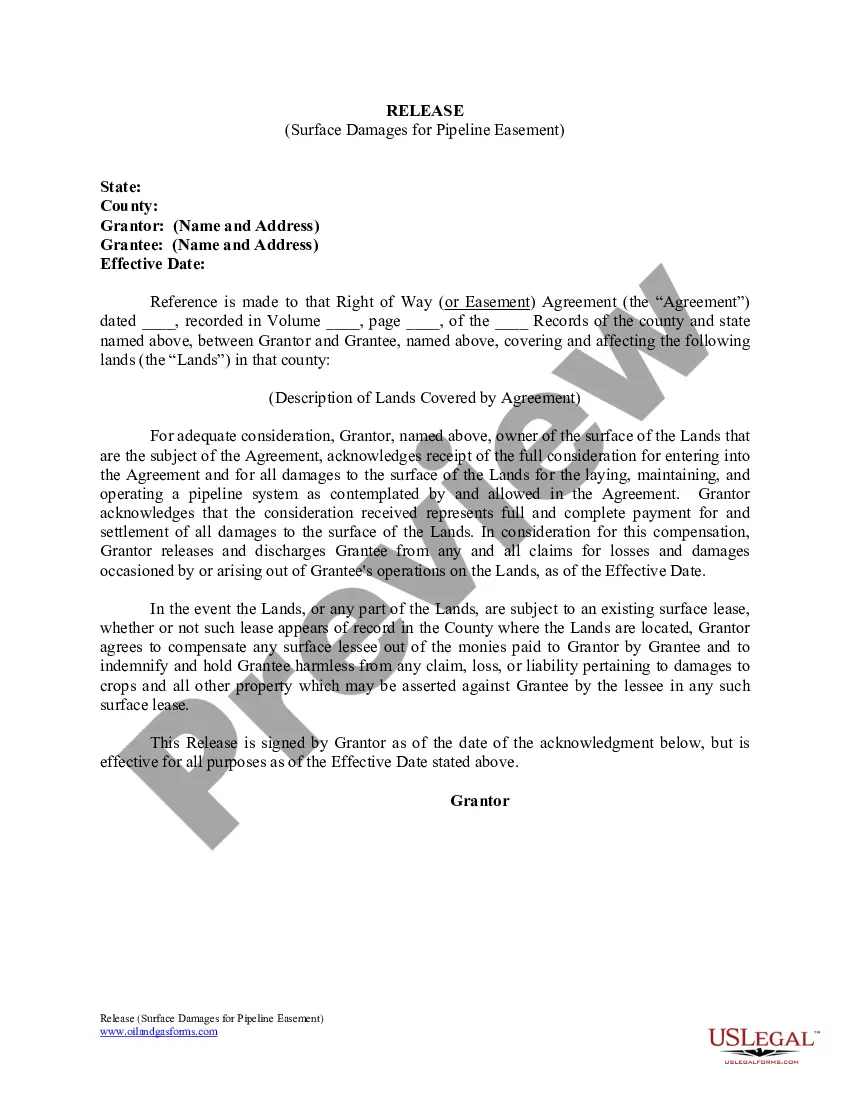
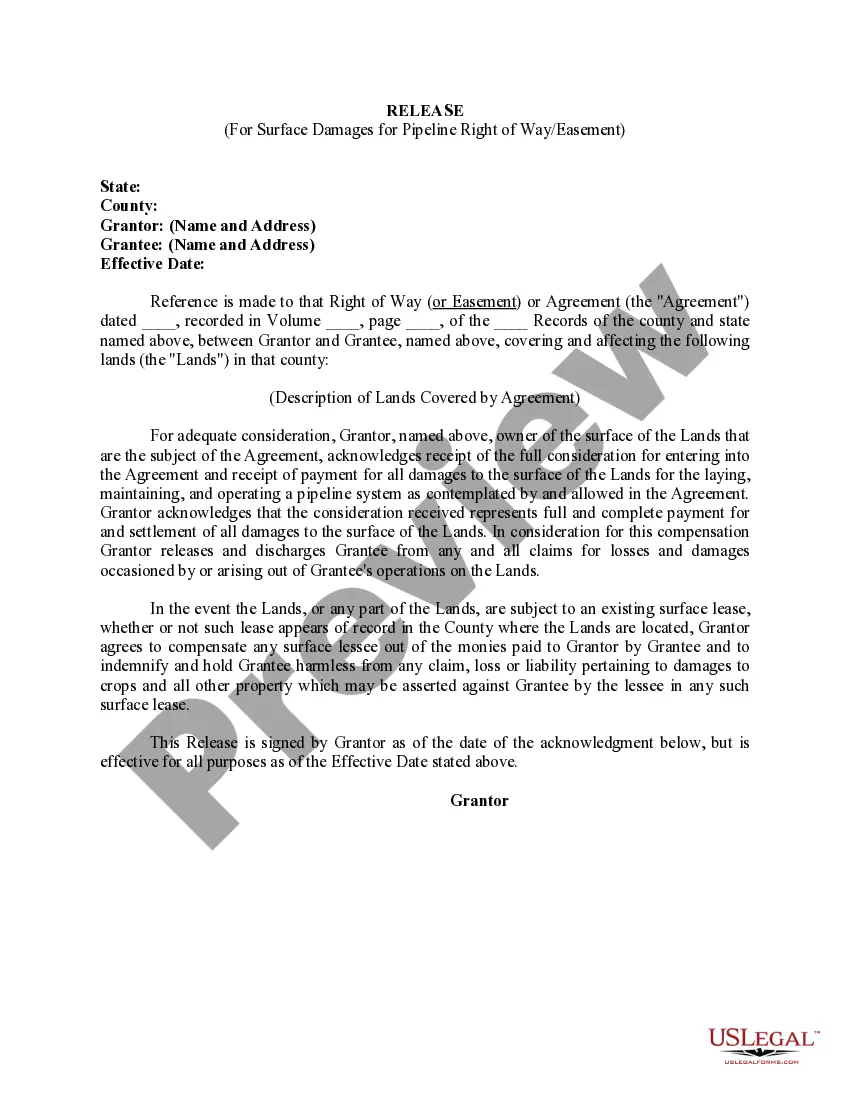
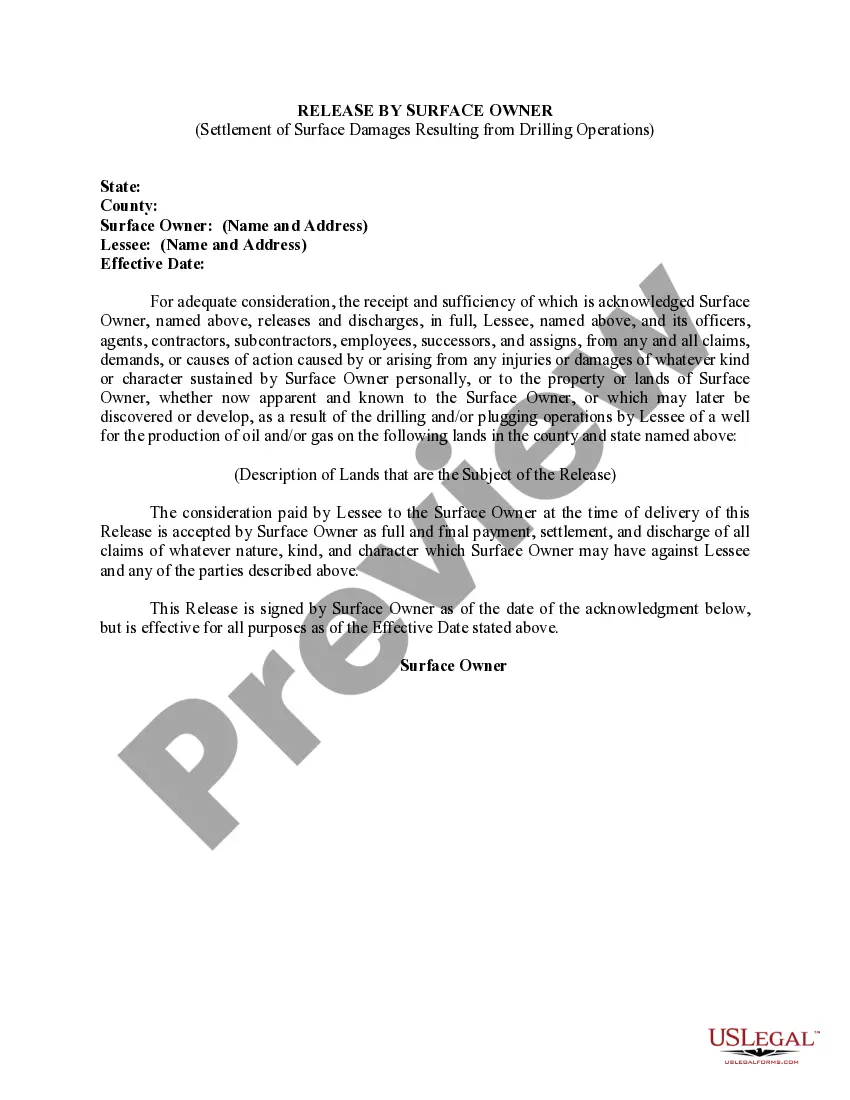
The Release of Surface Damages for Pipeline Easement is a legal document that allows a landowner (the Grantor) to formally release any claims for damages to the surface of their property as a result of pipeline installation, maintenance, or operation. This release is significant as it verifies that the Grantor has received full compensation for any damages occurring from the pipeline's operations, distinguishing it from other easement-related forms, which may not include this specific release of claims.
What’s included in this form
- Identification of parties: Includes names and addresses of the Grantor and Grantee.
- Effective date: Specifies the date when the release becomes effective.
- Reference to the easement agreement: Links to the original right of way or easement agreement.
- Description of lands: Details the property affected by the pipeline activities.
- Acknowledgment of receipt of consideration: Confirms that the Grantor has received payment for surface damages.
- Release of claims: Grants the Grantee immunity from any further claims related to surface damages.


Common use cases
This form should be used when a landowner has entered into a right of way agreement with a company to install, maintain, or operate a pipeline on their property. It is essential when the landowner wants to confirm that they have received adequate compensation and want to release the company from future claims regarding surface damages that may occur as a result of the pipeline's presence or operations.
Who this form is for
The following individuals or entities should consider using this form:
- Landowners (Grantors) who have granted a pipeline easement on their property.
- Pipelines companies or Grantees who require legal assurances to operate without further claims.
- Legal representatives or attorneys managing property agreements concerning pipeline installations.
Steps to complete this form
- Identify the parties involved by providing the names and addresses of both the Grantor and Grantee.
- Enter the effective date of the release to specify when it will take effect.
- Reference the original easement agreement by including the date and recording details.
- Describe the land affected by attaching or clearly stating the property description.
- Ensure the Grantor acknowledges receipt of payment for any surface damages and signs the document.
Notarization guidance
This form usually doesn’t need to be notarized. However, local laws or specific transactions may require it. Our online notarization service, powered by Notarize, lets you complete it remotely through a secure video session, available 24/7.
Get your form ready online
Our built-in tools help you complete, sign, share, and store your documents in one place.
Make edits, fill in missing information, and update formatting in US Legal Forms—just like you would in MS Word.
Download a copy, print it, send it by email, or mail it via USPS—whatever works best for your next step.
Sign and collect signatures with our SignNow integration. Send to multiple recipients, set reminders, and more. Go Premium to unlock E-Sign.
If this form requires notarization, complete it online through a secure video call—no need to meet a notary in person or wait for an appointment.
We protect your documents and personal data by following strict security and privacy standards.

Make edits, fill in missing information, and update formatting in US Legal Forms—just like you would in MS Word.

Download a copy, print it, send it by email, or mail it via USPS—whatever works best for your next step.

Sign and collect signatures with our SignNow integration. Send to multiple recipients, set reminders, and more. Go Premium to unlock E-Sign.

If this form requires notarization, complete it online through a secure video call—no need to meet a notary in person or wait for an appointment.

We protect your documents and personal data by following strict security and privacy standards.
Common mistakes
- Failing to provide accurate and complete party information.
- Not including the correct effective date, which can lead to disputes.
- Omitting a clear and complete description of the lands involved.
- Neglecting to ensure that the Grantor signs the document, potentially rendering it invalid.
Advantages of online completion
- Convenience of downloading and completing the form at their own pace.
- Editability allows users to tailor the document to their specific needs before printing.
- Access to professionally drafted legal forms ensures reliability and accuracy.
Looking for another form?

Form popularity
FAQ
Background on perpetual easementsEasements are treated as a recovery of the basis of the property first, with any excess proceeds treated as capital gain, which is taxed at a lower rate than ordinary income. The basis of property that offsets an easement is limited to the basis of the affected acres or square footage.
You don't usually report payment for an easement or damages. You only reduce your cost basis in the remaining property, by the amount you received, for when the property is sold in the future. But,if you got the 1099-S, it must be reported on your tax return, but it is most likely not taxable.
Easements and right-of-way payments, even if they are labeled as a lease, do receive sales treatment. Keep in mind: Easements are treated as a recovery of the basis of the property first, with any excess proceeds treated as capital gain, which is taxed at a lower rate than ordinary income.
How much money should landowners get when an oil or gas pipeline crosses their land? As it stands, landowners receive a one-time payment roughly based on the length of the pipeline, with rates varying from $5 to $50 per foot or more for a Marcellus or Utica shale pipeline right-of-way agreement.
How much money should landowners get when an oil or gas pipeline crosses their land? As it stands, landowners receive a one-time payment roughly based on the length of the pipeline, with rates varying from $5 to $50 per foot or more for a Marcellus or Utica shale pipeline right-of-way agreement.
Pipelines can reduce property values by 5 to 40 percent, according to Realtors.Pipelines can reduce property values by 5 to 40 percent by making them less attractive to potential buyers, according to local Realtors.
No, your compensation and damages settlement payment or award is not taxable.
If an easement is 50 rods long, that is almost an acre. In a recent case, a pipeline company paid some owners $180 per rod and others $767 per rod for the same project.