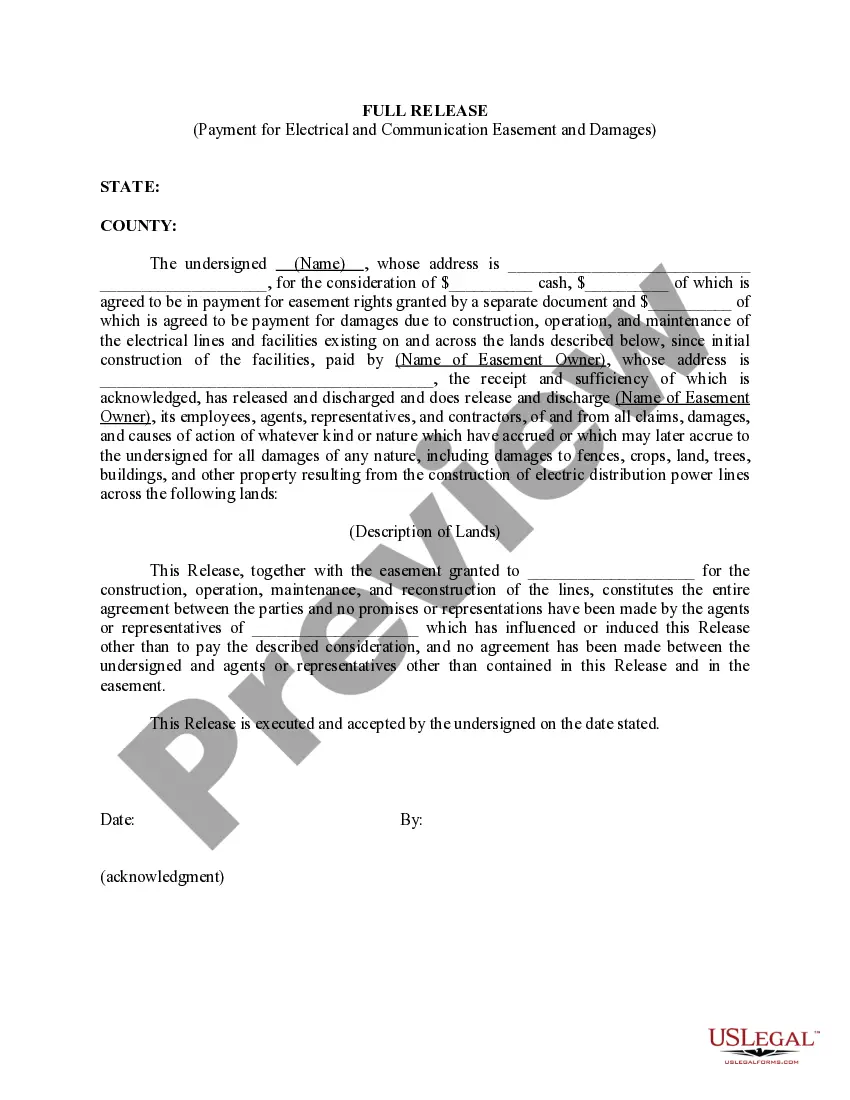
Full Release of Payment For Electrical and Communication Easement and Damages
What is this form?
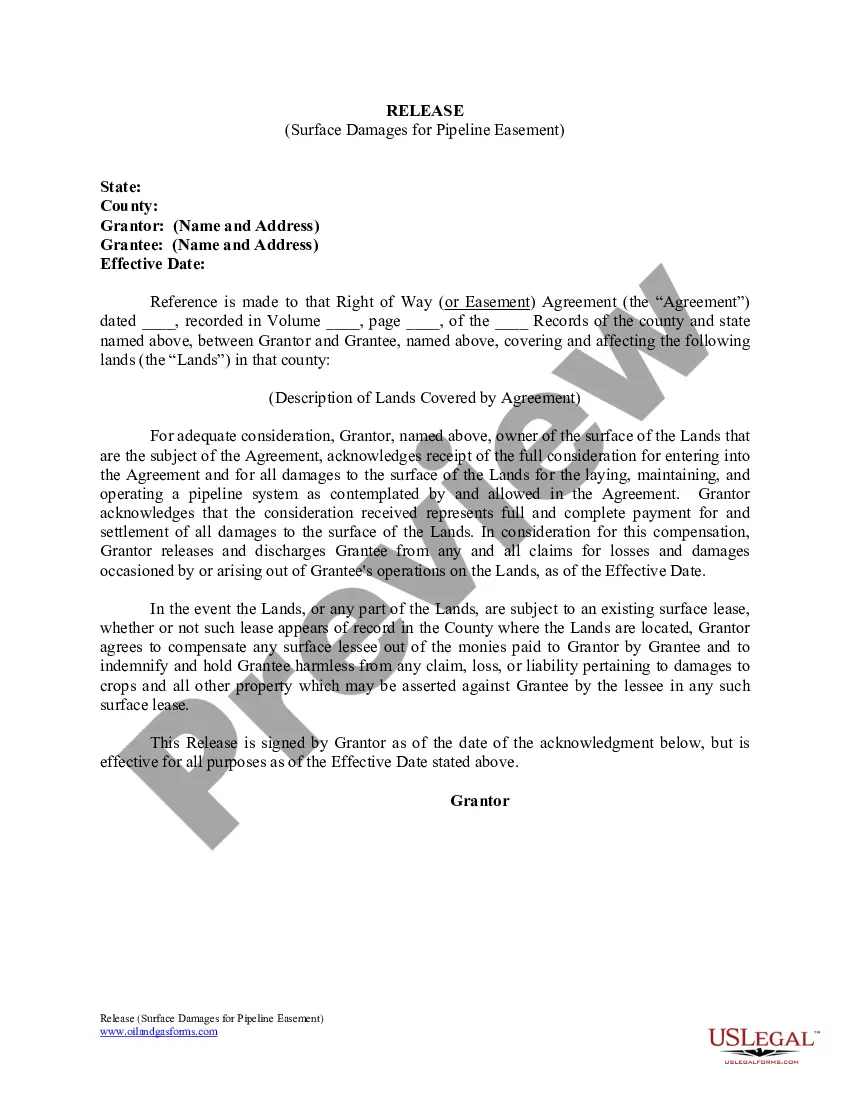
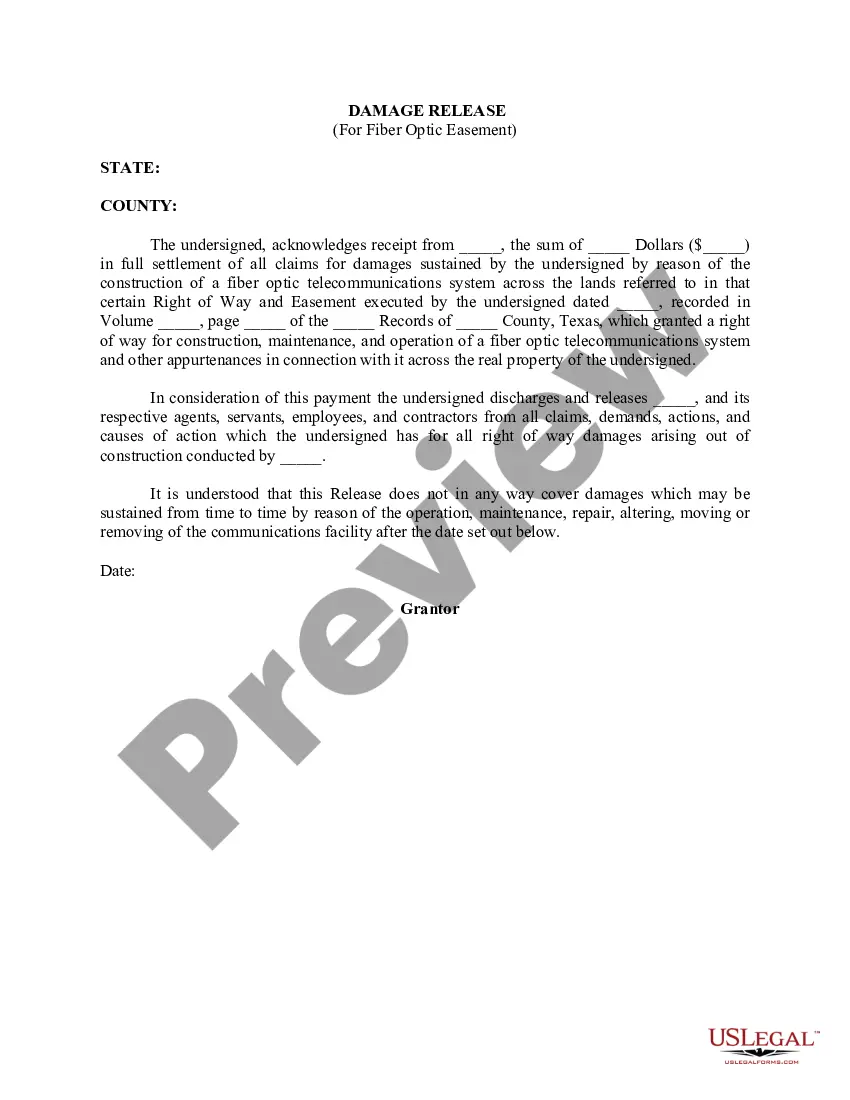
The Full Release of Payment for Electrical and Communication Easement and Damages is a legal document that formally releases the easement owner from future claims related to damages caused by the construction, operation, or maintenance of electrical lines on a property. This form is used to ensure that the paying party accepts compensation in exchange for waiving any claims for property damage, distinguishing it from other easement agreements that may not address damages in detail.
Form components explained
- Identification of the parties involved, including names and addresses.
- A detailed description of the easement rights being compensated.
- Specification of the total payment amount and its breakdown.
- A section releasing the easement owner from all future claims related to damages.
- Confirmation that no additional promises were made outside the form.
Common use cases
This form should be used when a property owner has accepted payment for an easement, allowing electrical lines or communication facilities to be installed on their land. It is applicable after the construction of the utilities when the landowner wishes to release the easement owner from any liability regarding damages incurred during the installation or maintenance of the facilities.
Intended users of this form
- Property owners who have granted easements for electrical or communication lines.
- Easement owners who need to formalize a release from liability regarding property damage.
- Individuals or entities involved in land development or utility installation who need to ensure legal protection against future claims.
How to complete this form
- Identify the parties by entering the names and addresses of the property owner and the easement owner.
- Specify the total payment amount and break it down into compensation for easement rights and damages.
- Detail the property description where the easement is located.
- Include the date of execution at the end of the form.
- Have all parties sign the form to acknowledge their agreement and understanding.
Notarization requirements for this form
Notarization is not commonly needed for this form. However, certain documents or local rules may make it necessary. Our notarization service, powered by Notarize, allows you to finalize it securely online anytime, day or night.
Get your form ready online
Our built-in tools help you complete, sign, share, and store your documents in one place.
Make edits, fill in missing information, and update formatting in US Legal Forms—just like you would in MS Word.
Download a copy, print it, send it by email, or mail it via USPS—whatever works best for your next step.
Sign and collect signatures with our SignNow integration. Send to multiple recipients, set reminders, and more. Go Premium to unlock E-Sign.
If this form requires notarization, complete it online through a secure video call—no need to meet a notary in person or wait for an appointment.
We protect your documents and personal data by following strict security and privacy standards.

Make edits, fill in missing information, and update formatting in US Legal Forms—just like you would in MS Word.

Download a copy, print it, send it by email, or mail it via USPS—whatever works best for your next step.

Sign and collect signatures with our SignNow integration. Send to multiple recipients, set reminders, and more. Go Premium to unlock E-Sign.

If this form requires notarization, complete it online through a secure video call—no need to meet a notary in person or wait for an appointment.

We protect your documents and personal data by following strict security and privacy standards.
Common mistakes to avoid
- Failing to clearly define the payment breakdown can lead to misunderstandings.
- Not including specific descriptions of the affected property can make the release unclear.
- Forgetting to obtain all necessary signatures may invalidate the release.
- Leaving out the date of execution can cause issues with enforceability.
Why complete this form online
- Convenient access allows for easy completion and download at any time.
- Editable templates enable users to customize the form to their specific situation.
- Reliability comes from forms drafted by licensed attorneys, ensuring legal accuracy.
Key takeaways
- The form releases an easement owner from future claims once payment is acknowledged.
- It is essential for landowners who wish to settle any disputes related to easements effectively.
- Be thorough in completing the document to avoid common errors that can affect its validity.
Looking for another form?
Form popularity
FAQ
You are willing to either share in or bear the cost of land maintenance and are now ready to negotiate. Reducing the impact the easement has on the neighbor will help convince him to say yes. Include in the negotiations elements that include his continued use and rights to share that parcel of land with you.
Easements are treated as a recovery of the basis of the property first, with any excess proceeds treated as capital gain, which is taxed at a lower rate than ordinary income. The basis of property that offsets an easement is limited to the basis of the affected acres or square footage.
How much money should landowners get when an oil or gas pipeline crosses their land? As it stands, landowners receive a one-time payment roughly based on the length of the pipeline, with rates varying from $5 to $50 per foot or more for a Marcellus or Utica shale pipeline right-of-way agreement.
Easements are treated as a recovery of the basis of the property first, with any excess proceeds treated as capital gain, which is taxed at a lower rate than ordinary income. The basis of property that offsets an easement is limited to the basis of the affected acres or square footage.
They are treated as rent or lease income. Permanent easements are perpetual or don't have a specified end date. They are treated as a property sale.Generally, the income will be taxed at favorable capital gains tax rates.
What is a Pipeline Easement? Generally, an easement is a legal interest that allows someone the right to use another's property for a certain purpose. A pipeline easement specifically gives the easement holder the right to build and maintain a pipeline on a landowner's property.
Tax Reporting Whoever is paying for the easement will send you a Form 1099 at the end of the year. If you get a 1099-MISC for rental payments, you report the income on Schedule E. For a permanent easement, you get a 1099-S and use Schedule D to report capital gains.
Pipelines can reduce property values by 5 to 40 percent by making them less attractive to potential buyers, according to local Realtors.