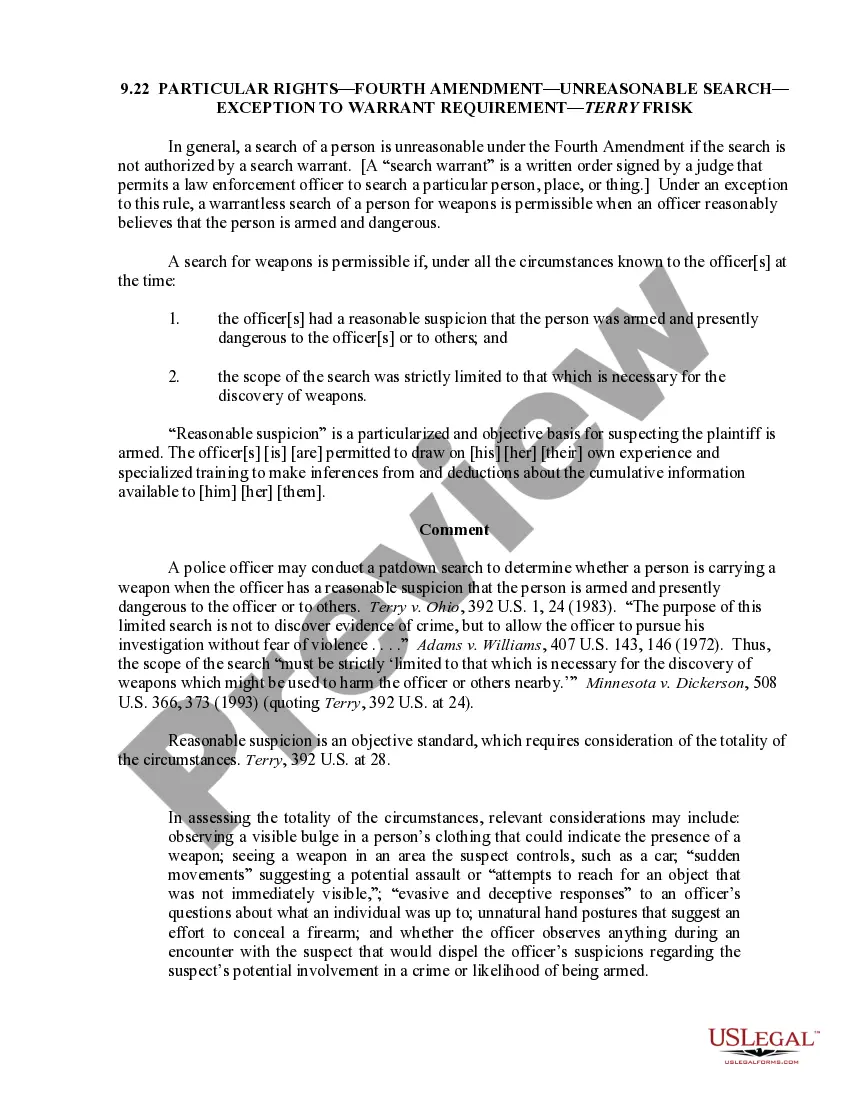
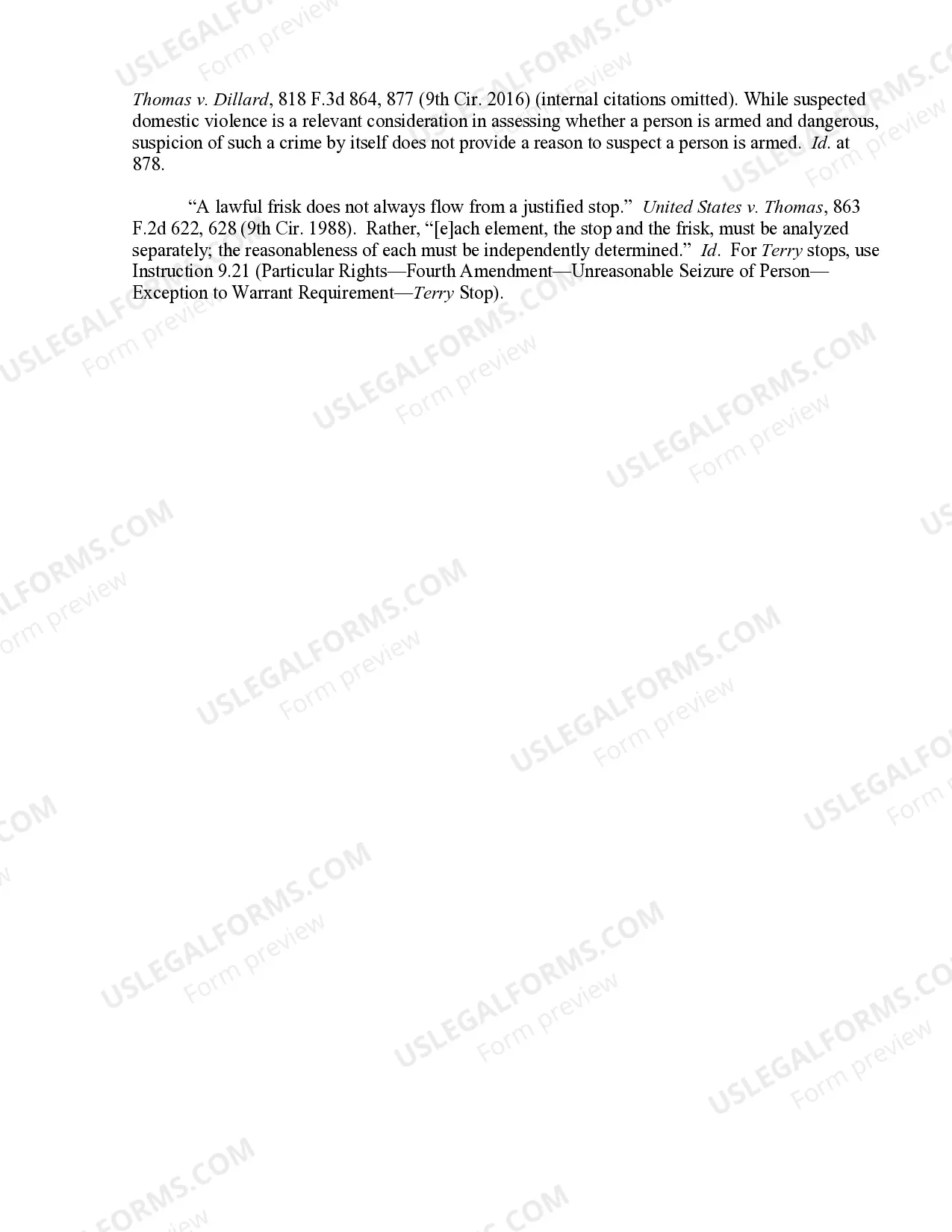
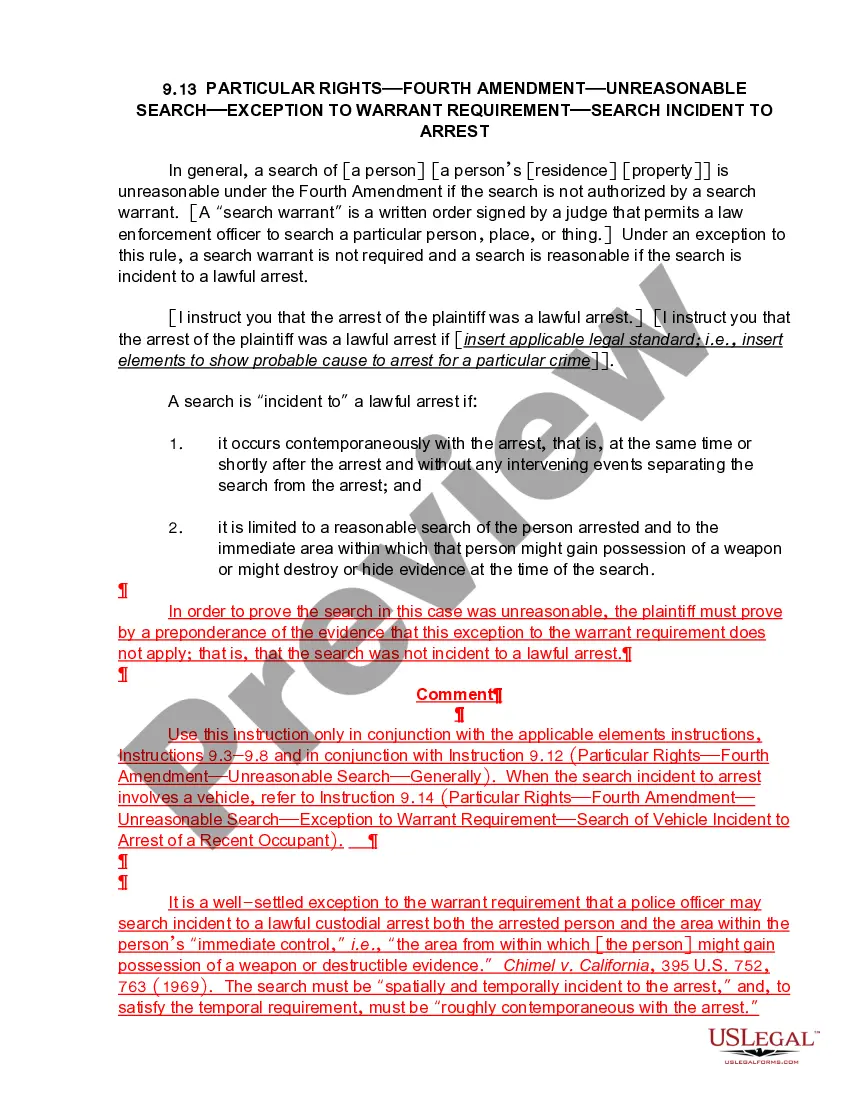
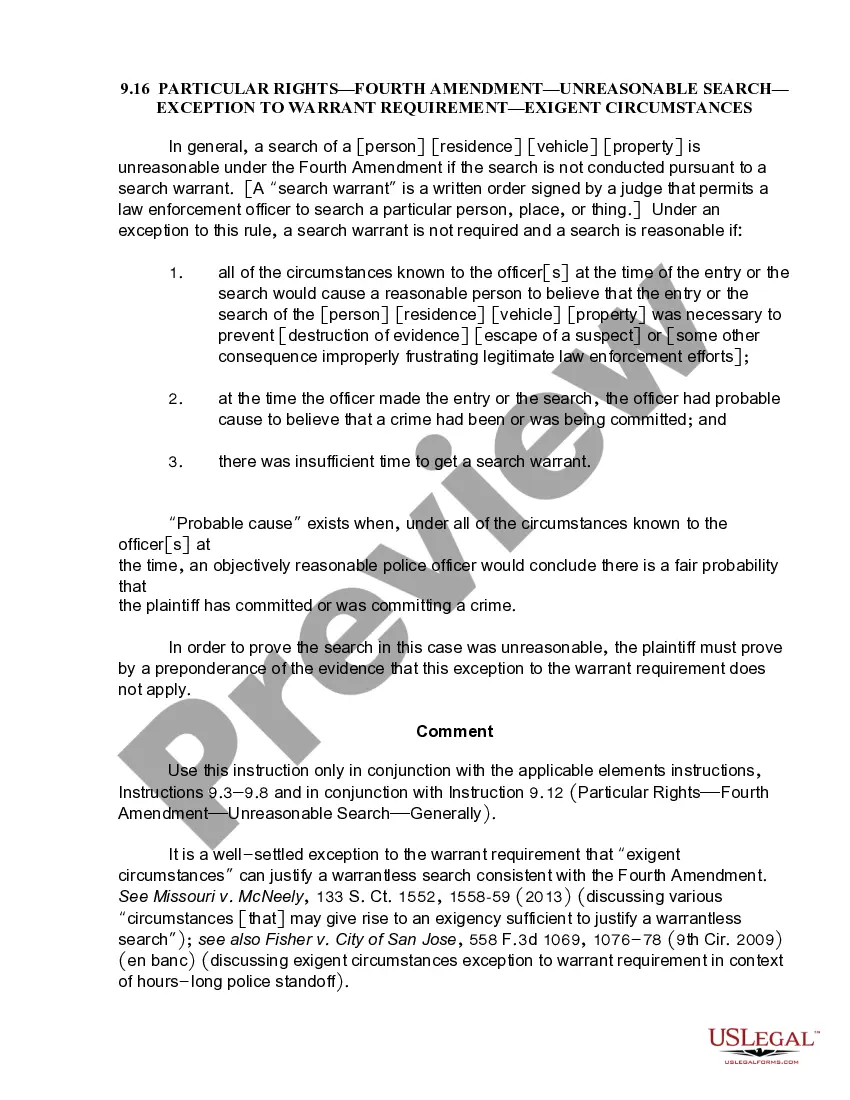
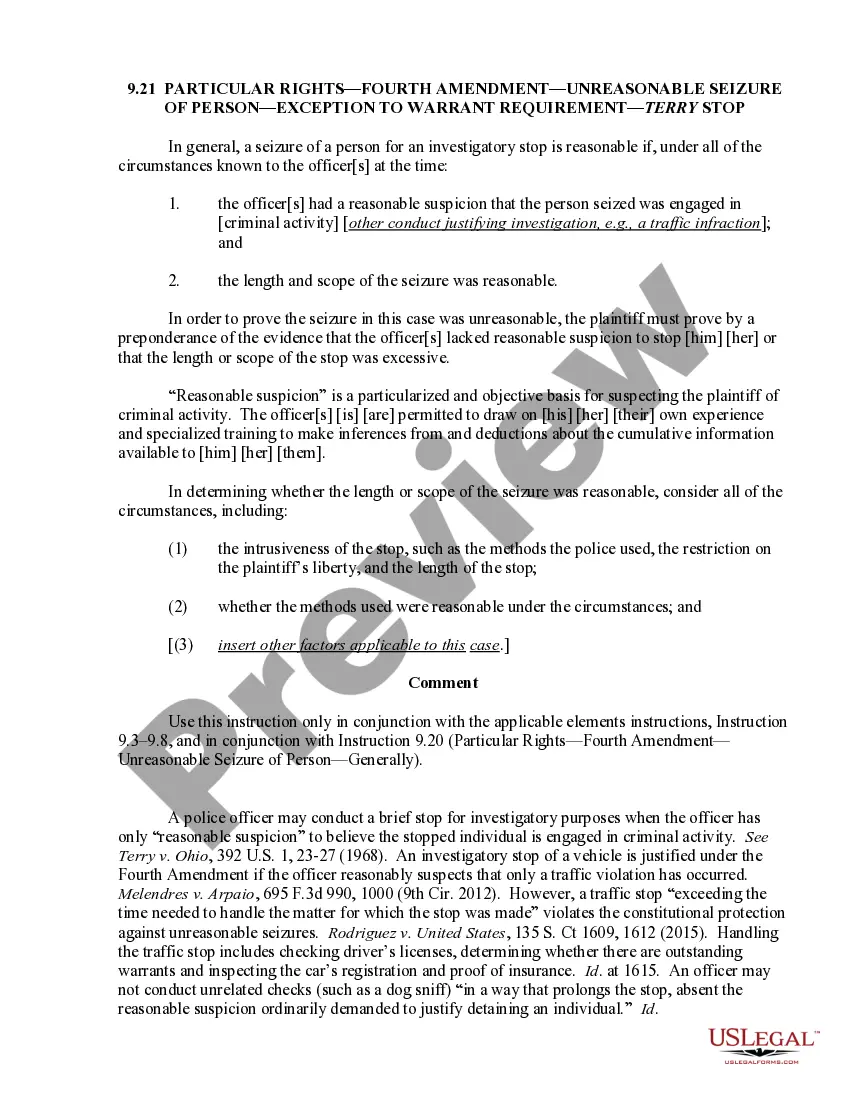
9.22 Particular Rights-Fourth Amendment-Unreasonable Search-Exception to Warrant Requirement-Terry Frisk
Does this document require notarization?
This form does not typically require notarization to be legally valid. However, some jurisdictions or document types may still require it. US Legal Forms provides secure online notarization powered by Notarize, available 24/7 for added convenience.
Get your form ready online
Our built-in tools help you complete, sign, share, and store your documents in one place.
Make edits, fill in missing information, and update formatting in US Legal Forms—just like you would in MS Word.
Download a copy, print it, send it by email, or mail it via USPS—whatever works best for your next step.
Sign and collect signatures with our SignNow integration. Send to multiple recipients, set reminders, and more. Go Premium to unlock E-Sign.
If this form requires notarization, complete it online through a secure video call—no need to meet a notary in person or wait for an appointment.
We protect your documents and personal data by following strict security and privacy standards.

Make edits, fill in missing information, and update formatting in US Legal Forms—just like you would in MS Word.

Download a copy, print it, send it by email, or mail it via USPS—whatever works best for your next step.

Sign and collect signatures with our SignNow integration. Send to multiple recipients, set reminders, and more. Go Premium to unlock E-Sign.

If this form requires notarization, complete it online through a secure video call—no need to meet a notary in person or wait for an appointment.

We protect your documents and personal data by following strict security and privacy standards.
Looking for another form?
Form popularity
FAQ
A seizure of a person, within the meaning of the Fourth Amendment, occurs when the police's conduct would communicate to a reasonable person, taking into account the circumstances surrounding the encounter, that the person is not free to ignore the police presence and leave at his will.
In Terry v. Ohio, the Supreme Court rules that 'stop and frisk' fell under the fourth amendment decrees in that citizens have a right to walk freely without being stopped by the police.
Stop and frisk law must be based on more than whimsy but less than probable cause; it must be based on (1) reasonable suspicion, (2) good cause to believe, and (3) articulable suspicion. In Terry v.
Overview. A stop-and-frisk refers to a brief non-intrusive police stop of a suspect. The Fourth Amendment requires that before stopping the suspect, the police must have a reasonable suspicion that a crime has been, is being, or is about to be committed by the suspect.
The case of Terry v. Ohio is the seminal case handed down by the U.S. Supreme Court, which permits police to stop and question persons upon reasonable suspicion that the suspects might be engaged or about to be engaged in the commission of crime.
Like we wrote about previously, a search and seizure allows police officers to examine your vehicle or residence for evidence, illegal weapons, or controlled substances. In comparison, a frisk only lets officers pat down someone in order to detect weapons like guns or knives.
Field Example: An officer / agent has valid reasonable suspicion to conduct a stop and frisk. The officer pats the suspect down and feels a small box like item in a pocket. The officer / agent seizes the box which turns out to be a cardboard flip-top box of cigarettes.