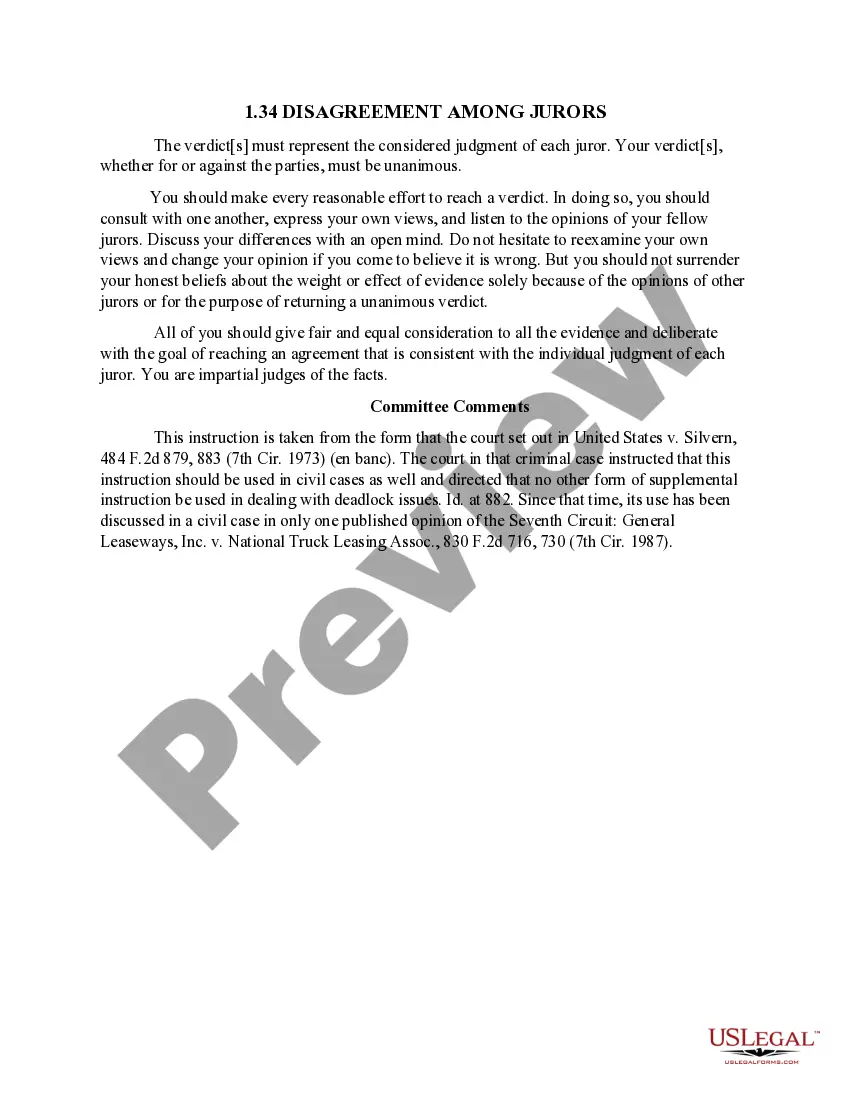
1.34 Disagreement Among Jurors.
About this form
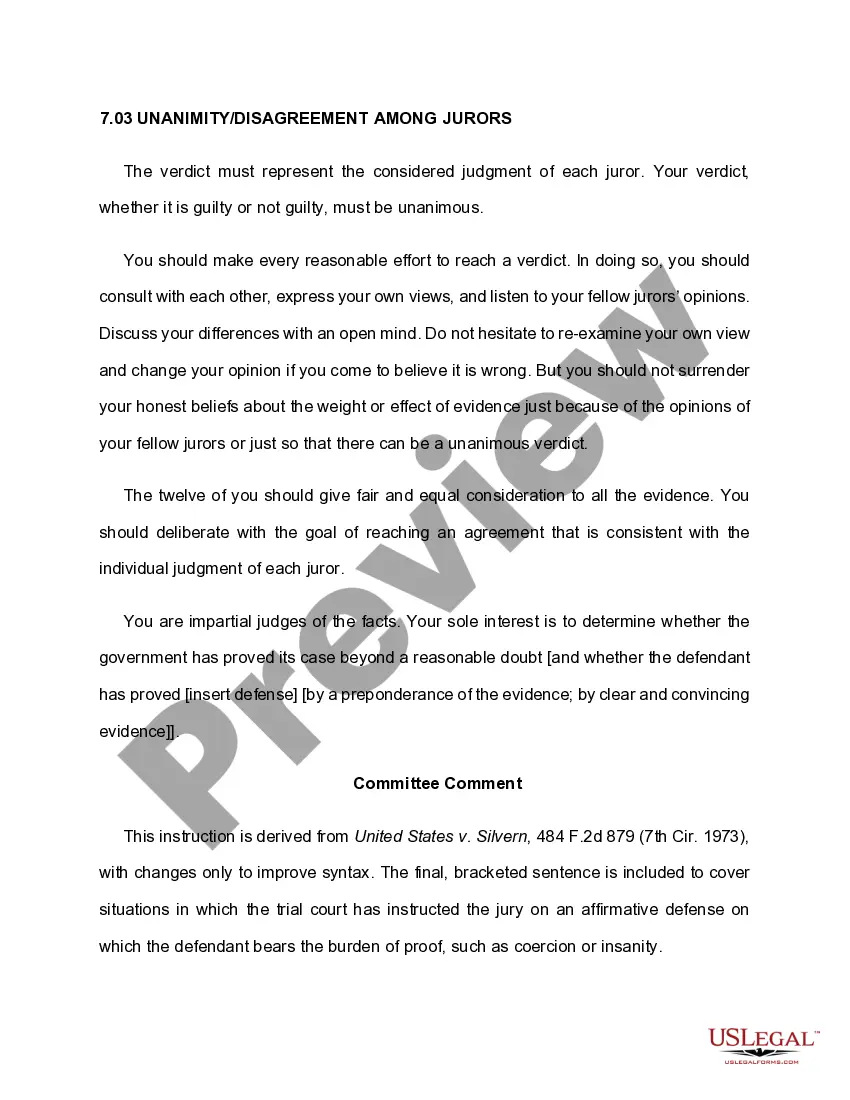
The Disagreement Among Jurors form provides official jury instructions for jurors who are unable to reach a unanimous verdict during deliberations. This form, adopted as part of the Federal 7th Circuit Court's official pattern jury instructions, emphasizes the importance of thorough discussion and consideration of differing opinions among jurors. Unlike other forms, this instruction specifically addresses how jurors should handle disagreements to ensure a fair and impartial verdict is reached.
Key parts of this document
- Instructions on the need for a unanimous verdict.
- Guidance on engaging in open discussions and weighing differing opinions.
- Encouragement to reassess personal viewpoints based on discussion.
- Emphasis on fair consideration of all evidence presented during the trial.
- Clarification that jurors are impartial judges of the facts.
When to use this form
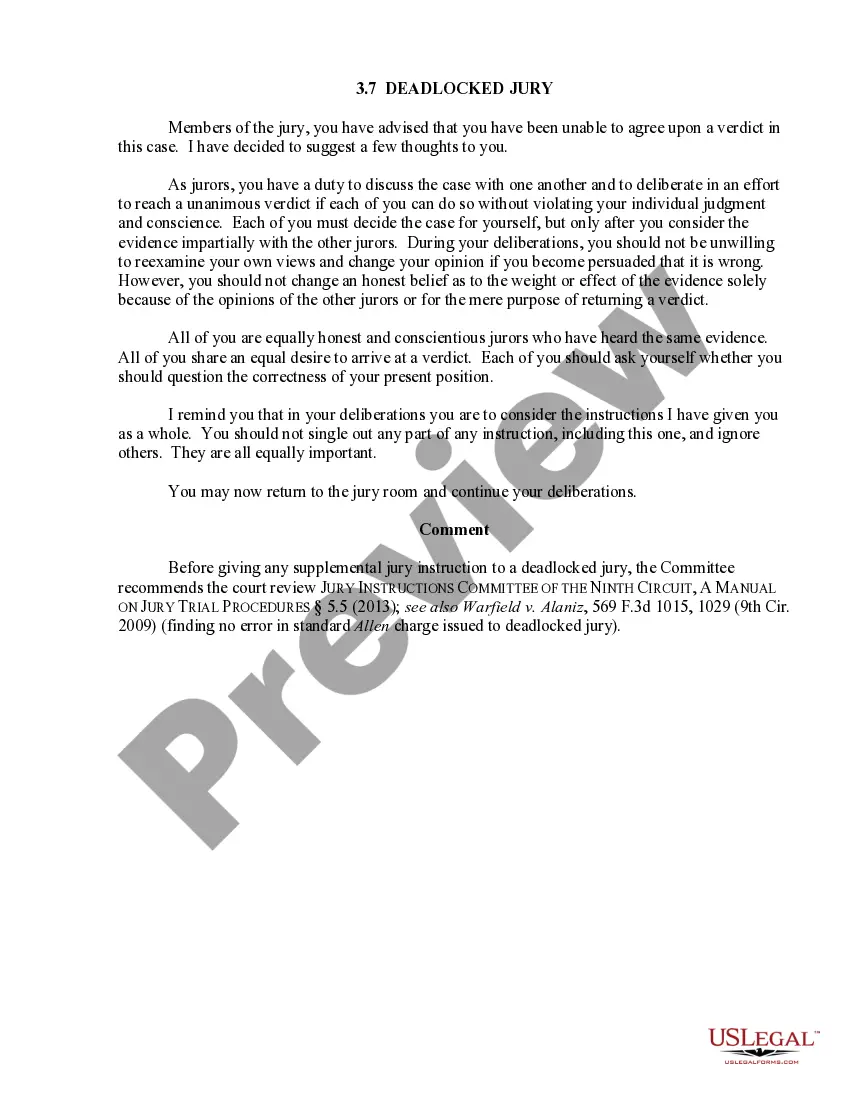
This form is used when jurors find themselves in a deadlock and cannot come to a unanimous decision on a verdict. It serves as a guide during the deliberation process to encourage jurors to communicate and work towards agreement. The instruction aims to remind jurors of their responsibility to consult one another and to convey their individual assessments of the case.
Who can use this document
- Jury members involved in civil or criminal cases within the jurisdiction of the Federal 7th Circuit Court.
- Court officials seeking to provide clear instructions to juries tackling disagreement.
- Legal representatives and attorneys involved in cases where jury instructions are required.
Instructions for completing this form
- Read the instructions thoroughly to understand the requirements for reaching a verdict.
- Discuss differences in opinions openly with fellow jurors.
- Reexamine your own views based on evidence and group discussions.
- Aim for a consensus while maintaining personal integrity regarding the evidence.
- Ensure that all jurors participate in deliberation to uphold a fair judgment.
Does this document require notarization?
This form does not typically require notarization unless specified by local law. Always check the specific regulations in your jurisdiction if there are any special requirements regarding jury instructions.
Get your form ready online
Our built-in tools help you complete, sign, share, and store your documents in one place.
Make edits, fill in missing information, and update formatting in US Legal Forms—just like you would in MS Word.
Download a copy, print it, send it by email, or mail it via USPS—whatever works best for your next step.
Sign and collect signatures with our SignNow integration. Send to multiple recipients, set reminders, and more. Go Premium to unlock E-Sign.
If this form requires notarization, complete it online through a secure video call—no need to meet a notary in person or wait for an appointment.
We protect your documents and personal data by following strict security and privacy standards.

Make edits, fill in missing information, and update formatting in US Legal Forms—just like you would in MS Word.

Download a copy, print it, send it by email, or mail it via USPS—whatever works best for your next step.

Sign and collect signatures with our SignNow integration. Send to multiple recipients, set reminders, and more. Go Premium to unlock E-Sign.

If this form requires notarization, complete it online through a secure video call—no need to meet a notary in person or wait for an appointment.

We protect your documents and personal data by following strict security and privacy standards.
Avoid these common issues
- Failing to communicate differences in opinions, which can prolong deadlock.
- Rushing to a decision without thorough discussion of the evidence.
- Ignoring the importance of each juror's individual judgment.
Advantages of online completion
- Easy access to the official jury instructions at any time.
- Convenient download options for immediate use in court settings.
- Instructions are formatted for clarity and comprehensibility.
Legal use & context
- This form is specifically designed to aid jurors in their deliberations when facing disagreements.
- It ensures that all jurors are aware of their responsibilities and the importance of thorough discussion.
- The instructions provided are meant to promote fairness and reduce the chances of a mistrial due to deadlock.
Summary of main points
- The Disagreement Among Jurors form is essential for guiding jurors during the deliberation process.
- Unanimous verdicts require effective communication and consideration among jurors.
- Understanding and using this form can help juries reach fair and just outcomes in trials.
Looking for another form?
Form popularity
FAQ
For criminal trials, nearly every state requires the jury to produce a unanimous verdict. For civil trials, almost one-third of states only require a majority for a verdict. Some states require a majority if the money at issue in the trial is below a certain amount, and a unanimous verdict all other times.
In a criminal offense trial, all 12 jurors must agree on a judgment, whether it is a guilty verdict or otherwise, to reach a unanimous decision. If the jurors are unable to reach a unanimous verdict, the trial may result in a hung jury. Even if only one juror disagrees, a hung jury may occur.
Some jurisdictions also permit a verdict to be returned despite the dissent of one, two, or three jurors. Federal Rule of Civil Procedure 48 states that a federal civil jury must begin with at least 6 and no more than 12 members, and that the verdict must be unanimous unless the parties stipulate otherwise.
2.6. If even one member of the jury panel disagrees with the rest, the jury is hung, and the defendant retains the presumption of innocence. A ?hung jury? results in either: a mistrial (which means there may be a retrial with a new jury), a plea bargain to a reduced charge that carries a lesser sentence, or.
2.6. If even one member of the jury panel disagrees with the rest, the jury is hung, and the defendant retains the presumption of innocence. A ?hung jury? results in either: a mistrial (which means there may be a retrial with a new jury), a plea bargain to a reduced charge that carries a lesser sentence, or.
This is called "challenging a juror". There are two types of challenges: a challenge for cause and a peremptory challenge.
United States, 333 U.S. 740, 748 (1948) ( Unanimity in jury verdicts is required where the Sixth and Seventh Amendments apply. In criminal cases this requirement of unanimity extends to all issues?character or degree of the crime, guilt and punishment?which are left to the jury. ); Maxwell v.
How many jurors must vote for conviction in a criminal trial? In criminal cases, most courts (state and federal) require a unanimous vote by the jury to find the defendant guilty.