Work Made for Hire Agreement
What this document covers
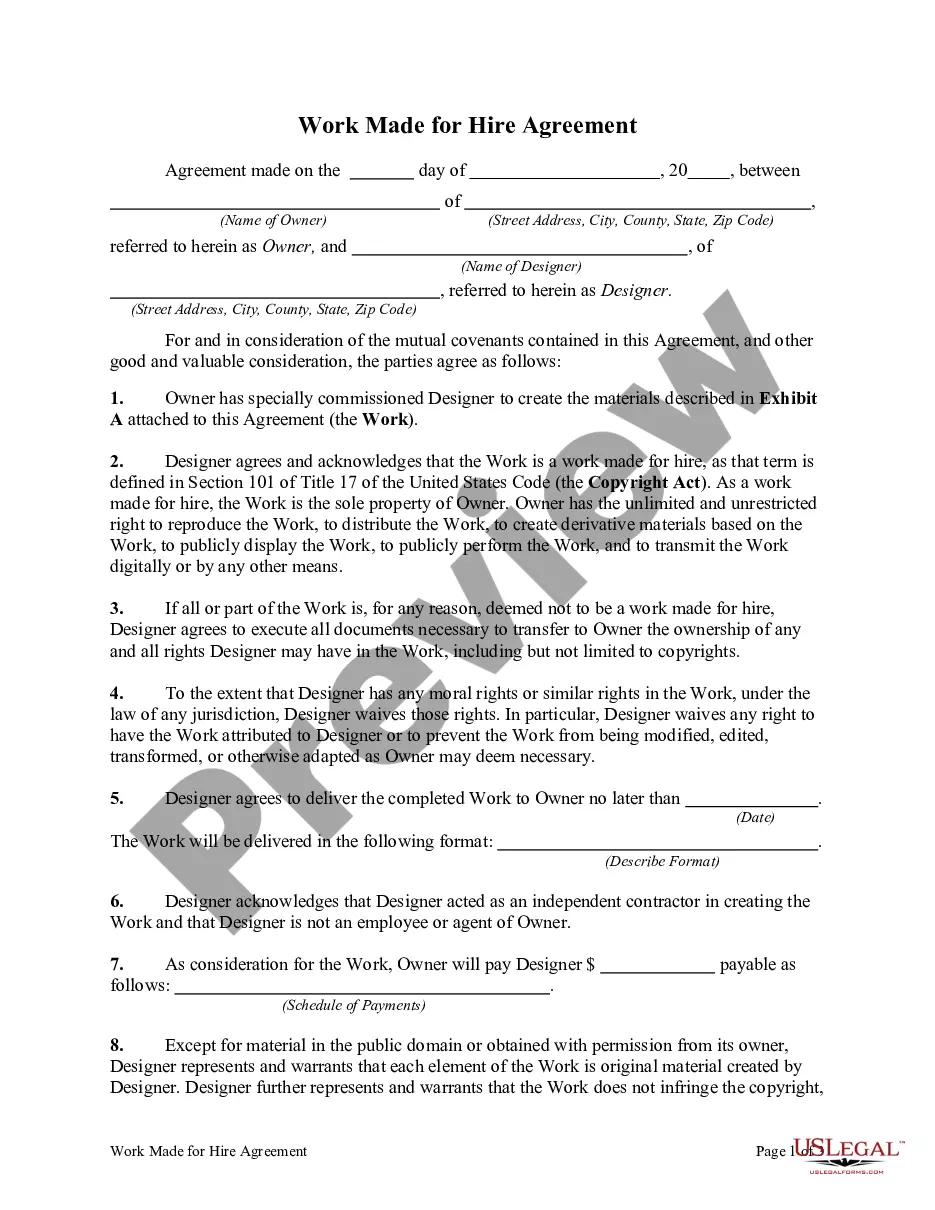
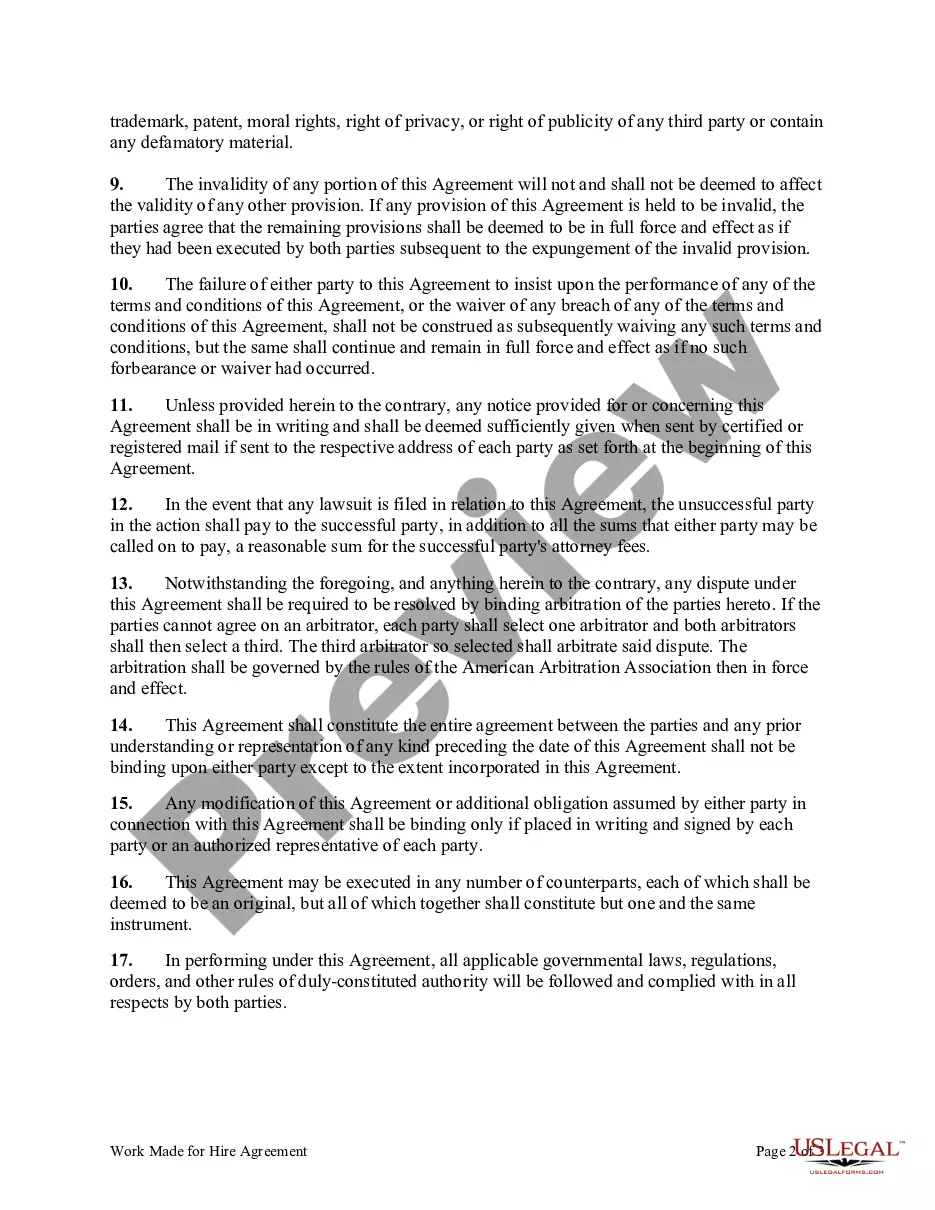
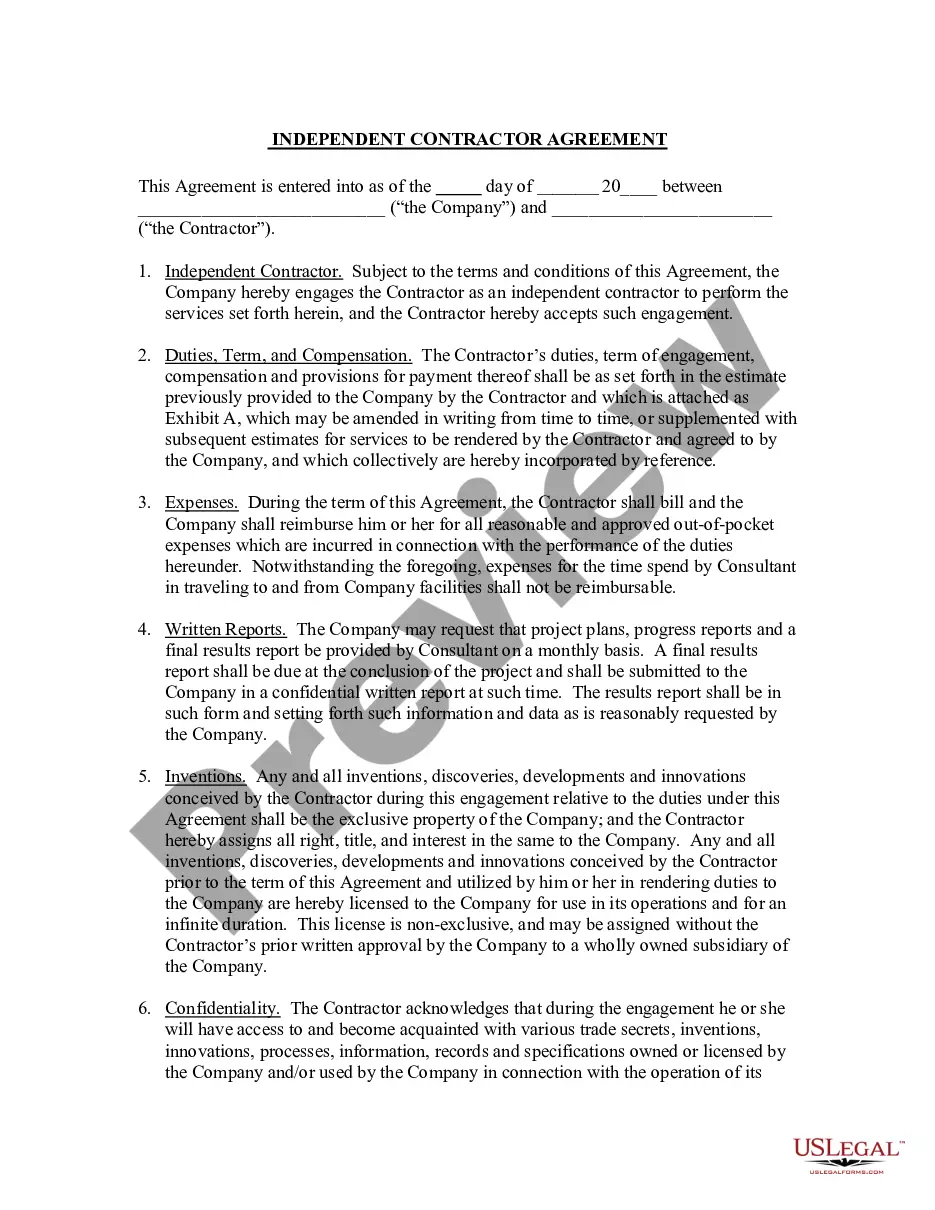
The Work Made for Hire Agreement is a legal document that establishes the terms between an owner and a designer when hiring an independent contractor for temporary work. This agreement clarifies the expectations, ownership, and rights related to the completed work, differentiating it from standard contracts by specifically designating the work as a "work made for hire," which allows the owner to retain full control and rights over the created materials.
Key parts of this document
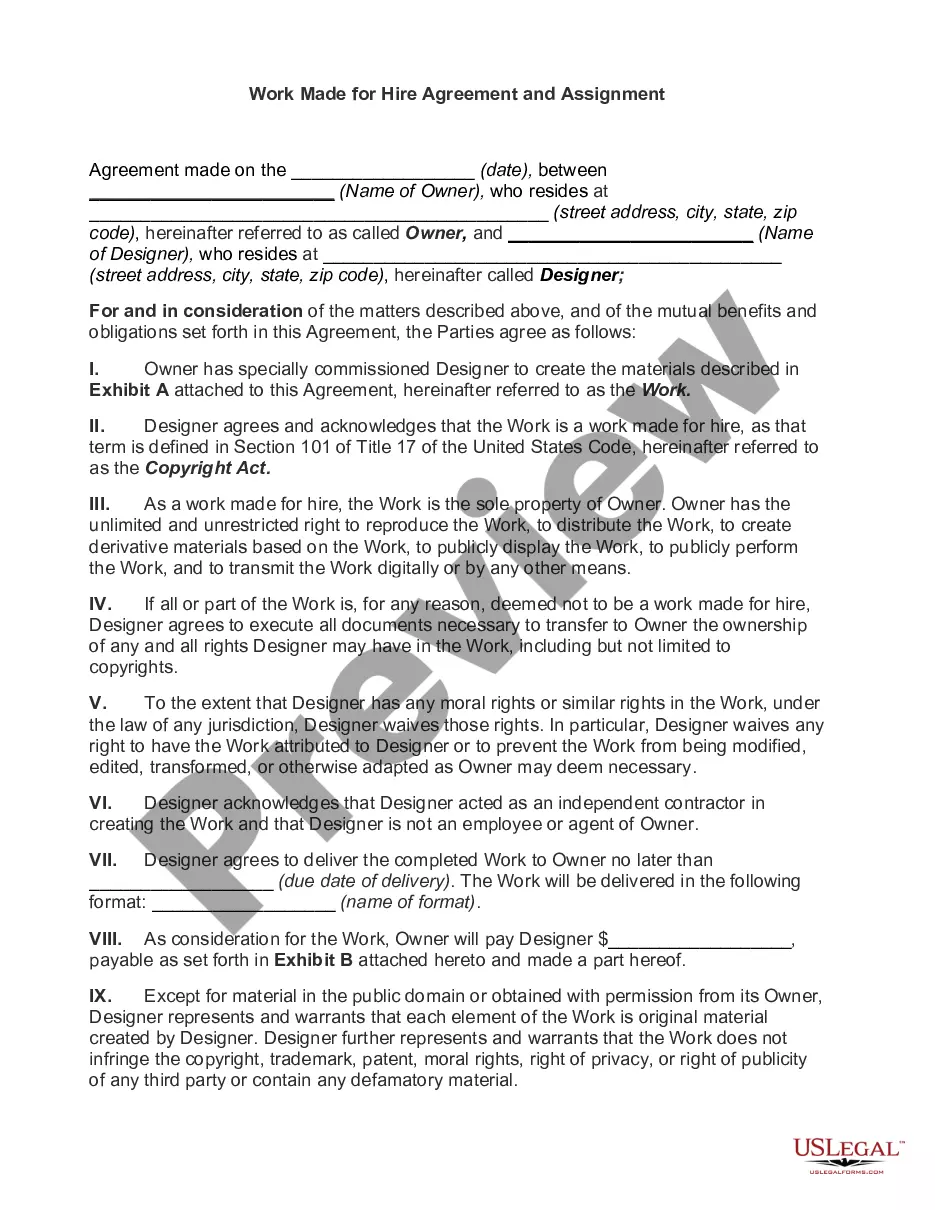
- Identification of the owner and designer, including their roles.
- Description of the work to be created, detailed in an attached exhibit.
- Declaration of ownership rights, stating the work is a work made for hire.
- Transfer of rights, in case the work is not classified as a work made for hire.
- Moral rights waiver by the designer regarding the created work.
- Procedures for dispute resolution, including arbitration requirements.
- Conditions for notice and communication between parties.
When this form is needed
Use the Work Made for Hire Agreement when hiring an independent contractor to create specific work products, such as artworks, written materials, software, or other creative outputs. This agreement ensures that the owner has exclusive rights to the finished work and prevents potential disputes over ownership in the future.
Intended users of this form
- Business owners hiring independent contractors for creative projects.
- Freelancers entering agreements with clients for specific work tasks.
- Individuals commissioning works that require clear ownership rights.
- Designers or contractors seeking to clarify the terms of their work agreements.
How to prepare this document
- Identify the parties involved, specifying the owner and the designer.
- Describe the work clearly in Exhibit A, ensuring all specifications are included.
- Agree upon the payment terms, timeline, and milestones for project completion.
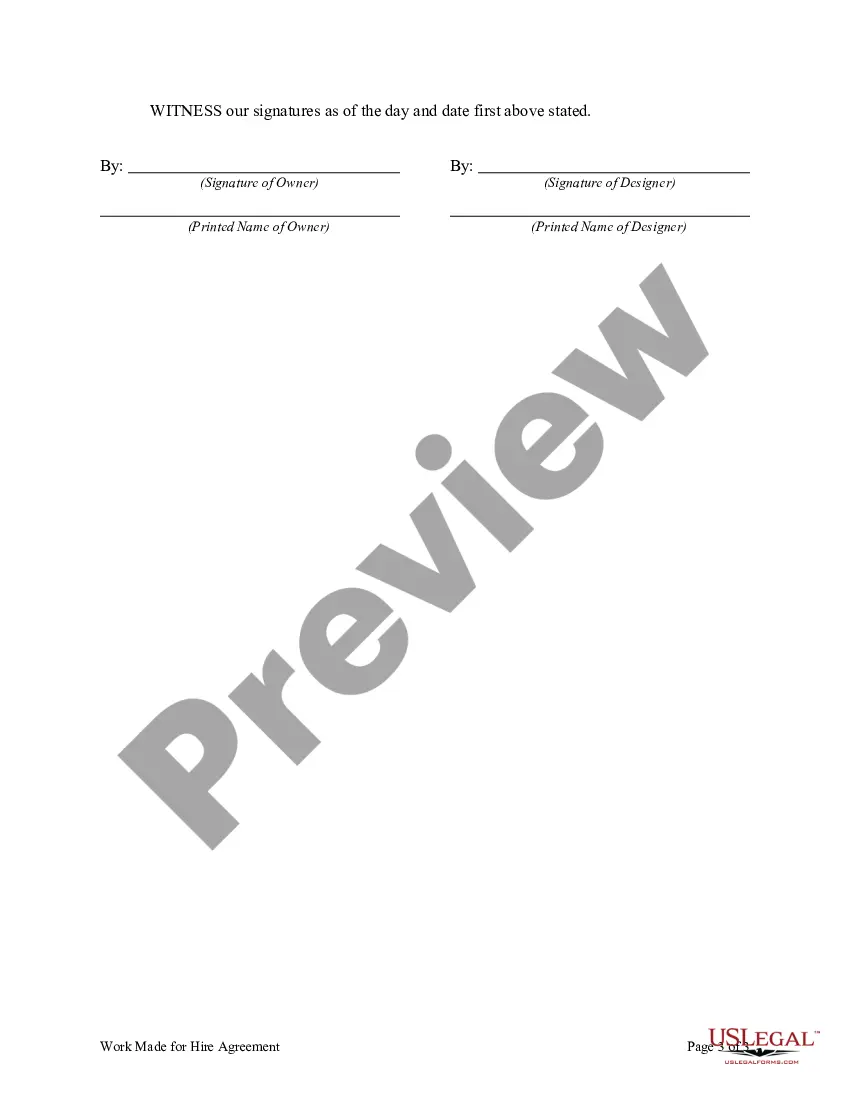
- Include signatures of both parties to validate the agreement.
- Review and retain a copy for records, ensuring both parties have access to the signed document.
Does this document require notarization?
This form usually doesn’t need to be notarized. However, local laws or specific transactions may require it. Our online notarization service, powered by Notarize, lets you complete it remotely through a secure video session, available 24/7.
Get your form ready online
Our built-in tools help you complete, sign, share, and store your documents in one place.
Make edits, fill in missing information, and update formatting in US Legal Forms—just like you would in MS Word.
Download a copy, print it, send it by email, or mail it via USPS—whatever works best for your next step.
Sign and collect signatures with our SignNow integration. Send to multiple recipients, set reminders, and more. Go Premium to unlock E-Sign.
If this form requires notarization, complete it online through a secure video call—no need to meet a notary in person or wait for an appointment.
We protect your documents and personal data by following strict security and privacy standards.

Make edits, fill in missing information, and update formatting in US Legal Forms—just like you would in MS Word.

Download a copy, print it, send it by email, or mail it via USPS—whatever works best for your next step.

Sign and collect signatures with our SignNow integration. Send to multiple recipients, set reminders, and more. Go Premium to unlock E-Sign.

If this form requires notarization, complete it online through a secure video call—no need to meet a notary in person or wait for an appointment.

We protect your documents and personal data by following strict security and privacy standards.
Avoid these common issues
- Failing to define the work clearly, which can lead to misunderstandings.
- Not having both parties sign the agreement, making it unenforceable.
- Neglecting to include payment terms or timelines, creating ambiguity.
- Overlooking the need for a waiver of moral rights, limiting the designer's future claims.
Advantages of online completion
- Convenience of downloading and editing the document as needed.
- Accessibility to templates drafted by licensed attorneys, ensuring legal compliance.
- Time-saving compared to creating a legal document from scratch.
- Ability to customize the agreement to fit specific project requirements easily.
Legal use & context
- The Work Made for Hire Agreement is legally binding and establishes clear ownership rights.
- It protects the interests of the Owner by ensuring that all rights to the work created are retained.
- Including arbitration clauses ensures that disputes can be resolved effectively without lengthy court procedures.
Summary of main points
- The Work Made for Hire Agreement is essential for establishing ownership rights in creative work.
- Clear specification of terms protects both parties' interests and prevents future disputes.
- Ensure all terms, including payment and deadlines, are explicitly detailed in the agreement.
Looking for another form?
Form popularity
FAQ
In the copyright law of the United States, a work made for hire (work for hire or WFH) is a work subject to copyright that is created by an employee as part of his or her job, or some limited types of works for which all parties agree in writing to the WFH designation.
Generally, the person who creates a work is considered its author and the automatic owner of copyright in that work. However, under the work made for hire doctrine, your employer or the company that has commissioned your work, not you, is considered the author and automatic copyright owner of your work.
2. There must be a written agreement between the party that ordered or commissioned the work and individual(s) who actually created the work. 3. In the written agreement, the parties must expressly agree that the work is to be considered a work made for hire.
The term of copyright protection of a work made for hire is 95 years from the date of publication or 120 years from the date of creation, whichever expires first. (A work not made for hire is ordinarily protected by copyright for the life of the author plus 70 years.)
In the copyright law of the United States, a work made for hire (work for hire or WFH) is a work subject to copyright that is created by an employee as part of his or her job, or some limited types of works for which all parties agree in writing to the WFH designation.
A work for hire agreement is when you give up all ownership and administration rights for the life of a work's copyright in exchange for a flat fee. It is an exception to the prevailing rule that the person who creates a work is its legally recognized author.
Work agreement means a written agreement between the employer and employee that details the terms and conditions of an employee's work away from his central workplace.
1 For legal purposes, when a work is a work made for hire, the author is not the individual who actually created the work. Instead, the party that hired the individual is considered both the author and the copyright owner of the work.
Generally, the person who creates a work is considered its author and the automatic owner of copyright in that work. However, under the work made for hire doctrine, your employer or the company that has commissioned your work, not you, is considered the author and automatic copyright owner of your work.