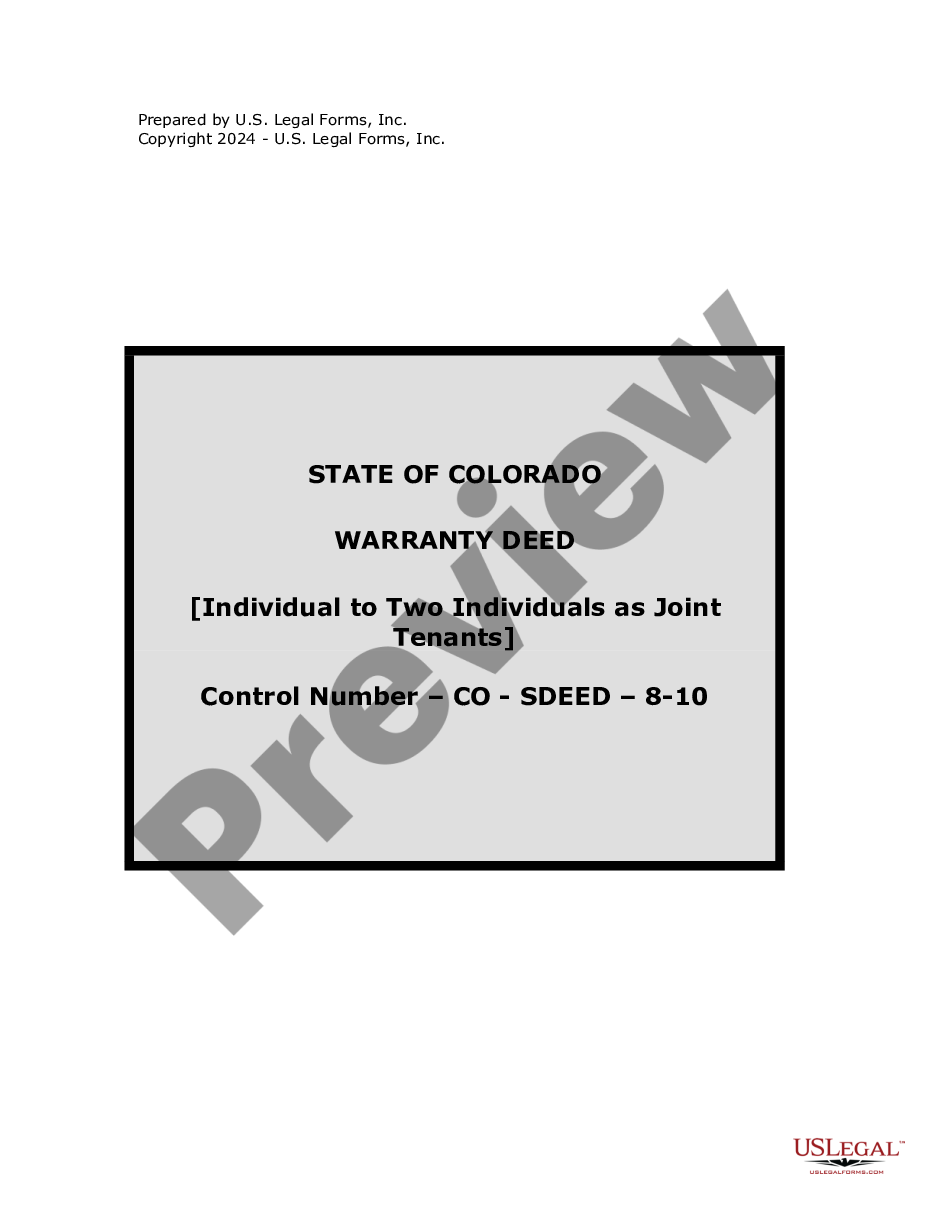
Colorado Warranty Deed from Individual to Two Individuals as Joint Tenants
About this form
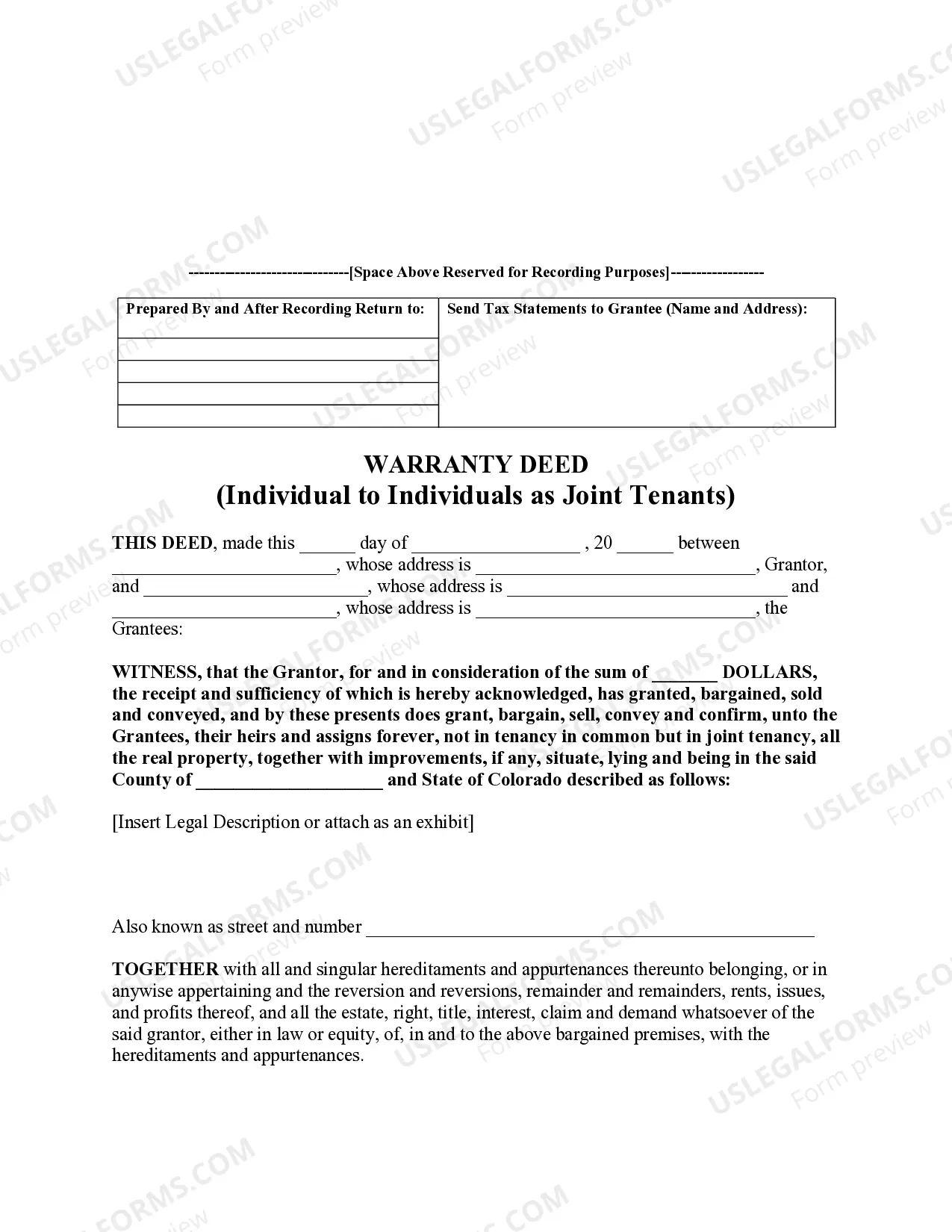
The Warranty Deed from Individual to Two Individuals as Joint Tenants is a legal document that facilitates the transfer of real property ownership from one individual (the grantor) to two individuals (the grantees) who will hold the title as joint tenants. Unlike other types of deeds, this warranty deed guarantees that the grantor holds a clear title to the property, free from any claims, enabling the grantees to maintain equal ownership and rights to the property upon the death of one of them.
Form components explained
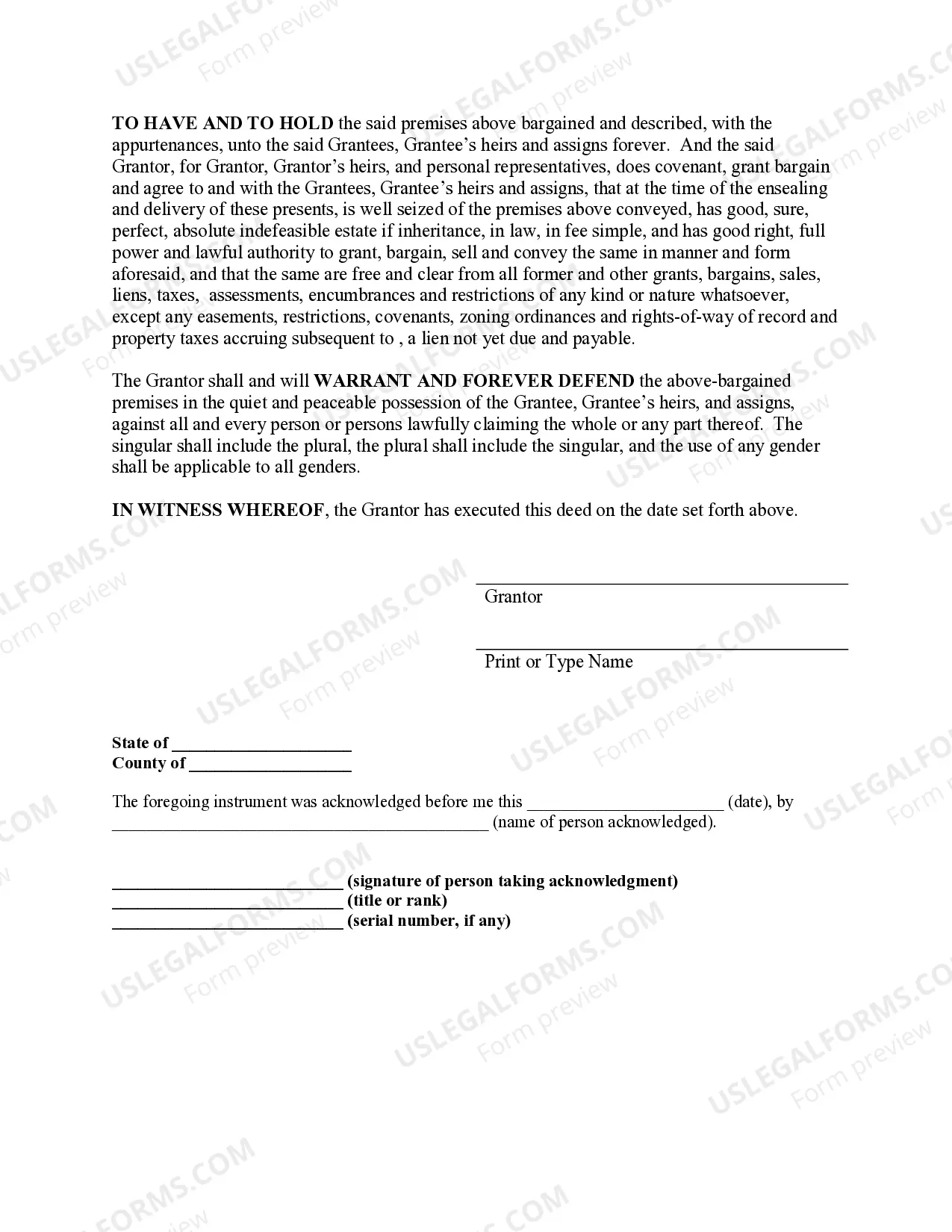
- Grantor's name and signature: Identifies the individual transferring the property.
- Grantees' names: Lists the two individuals receiving the property title as joint tenants.
- Property legal description: Specifies the exact location and boundaries of the property being transferred.
- Consideration amount: States the amount recognized in the transaction, typically expressed in dollars.
- Covenant of warranty: Ensures that the grantor guarantees a clear title and freedom from encumbrances.
- Notarization section: Confirms the identity of the grantor with a notary public's acknowledgment.




Situations where this form applies
This form is used when an individual wishes to transfer ownership of real property to two individuals who intend to hold it together as joint tenants. This is appropriate in various situations, such as when family members, partners, or friends wish to purchase a property together or when a property owner wants to ensure a smooth transition of ownership in the event of their death.
Who can use this document
This form is suitable for:
- Individuals looking to convey real estate to two other individuals as joint tenants.
- Couples who are interested in jointly owning real property.
- Family members wanting to simplify property transfer and inheritance.
- Anyone seeking a warranty deed to secure their real estate transaction.
How to prepare this document
- Identify the grantor: Enter the name of the individual transferring the property.
- List the grantees: Provide the names of the two individuals who will be the new owners.
- Specify the property: Insert the legal description of the property along with its common address.
- Enter the consideration: Fill in the amount for which the property is being sold or transferred.
- Sign in front of a notary: Ensure the grantor signs the deed before a notary public to validate the transfer.
Does this form need to be notarized?
Yes, this form must be notarized to be legally valid. The notary public will verify the grantor's identity and witness their signature, ensuring the transaction is secure. US Legal Forms offers an integrated online notarization service that is available 24/7 via secure video call, providing legal equivalence without requiring travel.
Get your form ready online
Our built-in tools help you complete, sign, share, and store your documents in one place.
Make edits, fill in missing information, and update formatting in US Legal Forms—just like you would in MS Word.
Download a copy, print it, send it by email, or mail it via USPS—whatever works best for your next step.
Sign and collect signatures with our SignNow integration. Send to multiple recipients, set reminders, and more. Go Premium to unlock E-Sign.
If this form requires notarization, complete it online through a secure video call—no need to meet a notary in person or wait for an appointment.
We protect your documents and personal data by following strict security and privacy standards.

Make edits, fill in missing information, and update formatting in US Legal Forms—just like you would in MS Word.

Download a copy, print it, send it by email, or mail it via USPS—whatever works best for your next step.

Sign and collect signatures with our SignNow integration. Send to multiple recipients, set reminders, and more. Go Premium to unlock E-Sign.

If this form requires notarization, complete it online through a secure video call—no need to meet a notary in person or wait for an appointment.

We protect your documents and personal data by following strict security and privacy standards.
Common mistakes
- Missing notarization: Not having the document properly notarized may invalidate the deed.
- Incorrect property description: Failure to accurately describe the property can lead to legal issues.
- Not specifying joint tenancy: Failing to clearly state that the grantees are joint tenants can create ownership disputes.
Benefits of using this form online
- Convenience: Download and complete the form from your own location at any time.
- Editability: Allow for easy updates or corrections to the information before finalizing.
- Reliability: Ensure the document meets legal requirements established by licensed attorneys.
What to keep in mind
- This Warranty Deed facilitates property transfer to two individuals as joint tenants.
- Proper identification and legal description of the property are critical components.
- Notarization is required for the deed to be legally enforceable.
Looking for another form?
Form popularity
FAQ
Joint tenancy in Colorado allows two or more individuals to own property together with equal rights. When using a Colorado Warranty Deed from Individual to Two Individuals as Joint Tenants, each person has an equal share of the property. One key feature of joint tenancy is the right of survivorship, meaning if one owner passes away, the surviving owner automatically inherits the deceased owner’s share. This arrangement simplifies the transfer of property and can provide certain benefits in estate planning.
To add someone to a deed in Colorado, you will typically need to create a new Colorado Warranty Deed from Individual to Two Individuals as Joint Tenants. First, gather details about the property and the new co-owner. Next, fill out the warranty deed form accurately, listing both individuals as joint tenants. Finally, file the completed deed with the county clerk and recorder to ensure the change is legally recognized.
When a warranty deed specifies joint tenants, it indicates that two or more people own equal shares of the property with right of survivorship. This feature of a Colorado Warranty Deed from Individual to Two Individuals as Joint Tenants allows one owner to inherit the other's share without going through probate. Essentially, it provides a straightforward and efficient transfer of ownership upon the death of one owner.
Co-ownership and joint ownership are similar but not identical. In joint ownership, such as a Colorado Warranty Deed from Individual to Two Individuals as Joint Tenants, both parties have equal shares and rights to the property. In contrast, co-ownership can include various arrangements, such as tenants in common, where owners may have unequal shares or different rights upon the death of an owner.
To transfer a property title to a family member in Colorado, you typically need to complete a warranty deed. This deed will reflect the transfer, such as a Colorado Warranty Deed from Individual to Two Individuals as Joint Tenants if you're adding another owner. It's essential to ensure that the deed is properly signed, notarized, and filed with the appropriate county office to make the transfer official.
Yes, two people can be on a warranty deed, and they can hold ownership in various ways. In the case of a Colorado Warranty Deed from Individual to Two Individuals as Joint Tenants, both individuals share equal rights to the property. This means that if one owner passes away, the other automatically inherits their share of the property, ensuring a seamless transfer of ownership.
If you've recently married and already own a home or other real estate, you may want to add your new spouse to the deed for your property so the two of you own it jointly. To add a spouse to a deed, all you have to do is literally fill out, sign and record a new deed in your county recorder's office.
Typically, the lender will provide you with a copy of the deed of trust after the closing. The original warranty deeds are often mailed to the grantee after they are recorded. These are your original copies and should be kept in a safe place, such as a fireproof lockbox or a safe deposit box at a financial institution.
A special warranty deed to real estate offers protection to the buyer through the seller's guarantee that the title has been free and clear of encumbrances during their ownership of the property. It does not guarantee clear title beyond their ownership.
A warranty deed guarantees that: The grantor is the rightful owner of the property and has the legal right to transfer the title.The title would withstand third-party claims to ownership of the property. The grantor will do anything to ensure the grantee's title to the property.