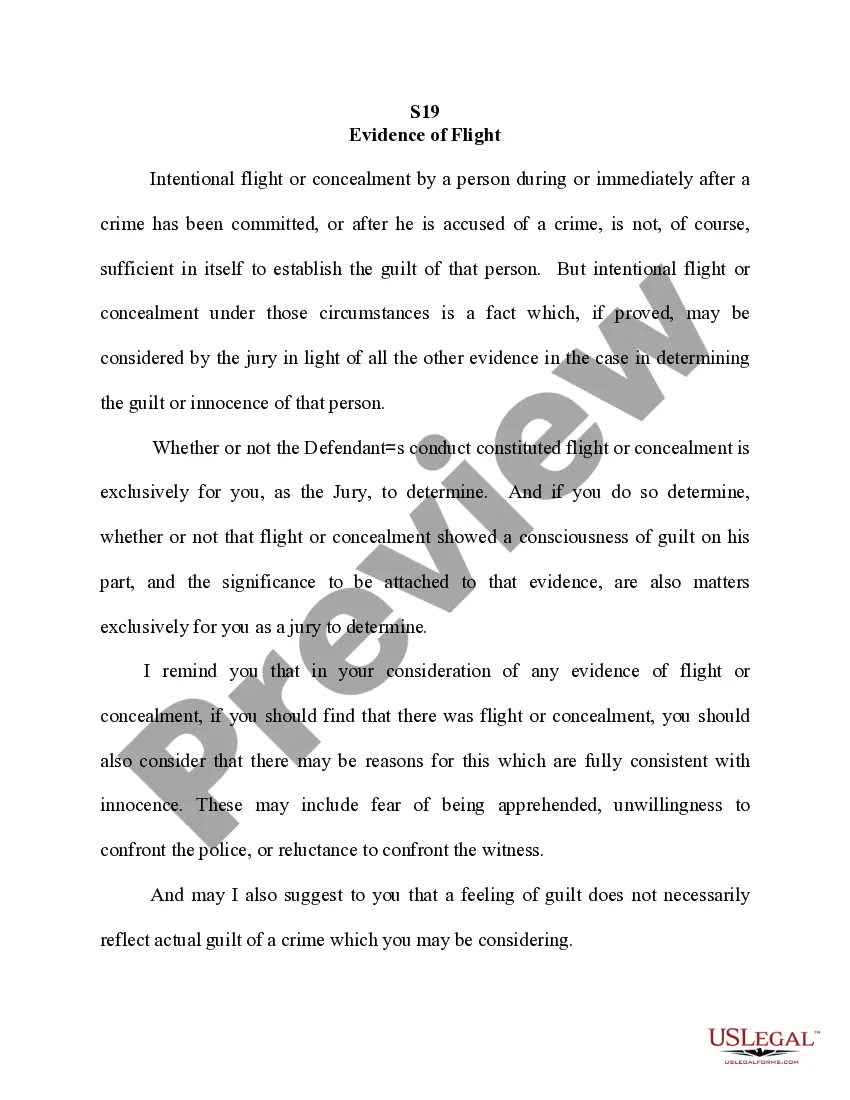
Evidence of Flight
What this document covers
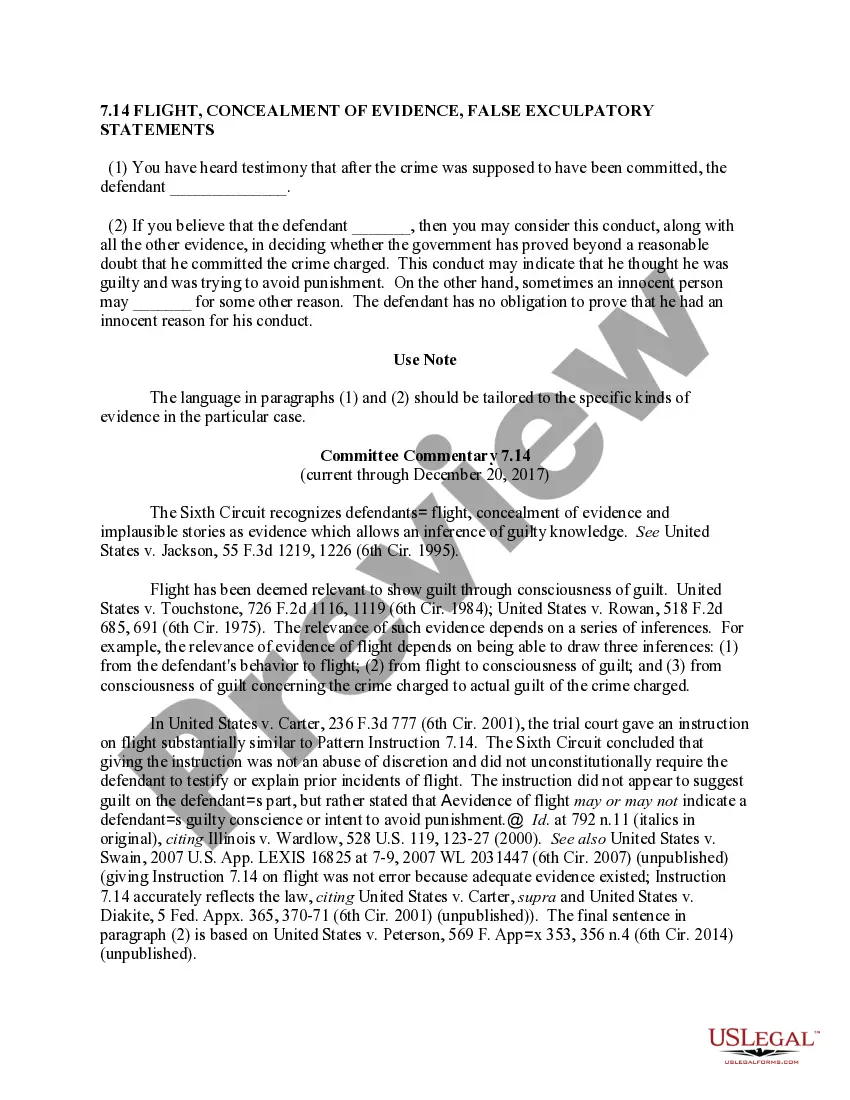
The Evidence of Flight form is a legal document used in court cases to provide instructions to a jury regarding the implications of a defendant's flight or concealment following a crime. This form clarifies that while fleeing may be considered, it is not in itself proof of guilt; juries must weigh this evidence alongside other information presented in the case. Unlike other legal forms that may address aspects of a trial, this specific form focuses on the complex psychological implications of flight as a factor in determining guilt or innocence.
Form components explained
- Definition of flight or concealment: Explains what constitutes intentional flight or concealment in relation to a crime.
- Jury's determination: Affirms that it is solely up to the jury to decide whether a defendant's actions indicate flight or concealment.
- Consciousness of guilt: Discusses how the jury should interpret flight concerning possible guilt, emphasizing that feelings of guilt do not equate to actual guilt.
- Potential innocence: Highlights alternative reasons for flight that may indicate innocence, such as fear of apprehension or unwillingness to confront authorities.
When to use this document
This form is used in legal proceedings where the defendant's actions of fleeing or concealing themselves could be presented as evidence. It is particularly relevant in criminal cases where such behavior may arise either during the commission of a crime or shortly thereafter. This form guides juries in understanding how to correctly interpret and evaluate evidence of flight in the context of overall culpability.
Who this form is for
- Jurors involved in a criminal trial where evidence of flight is relevant.
- Judges presiding over cases that require specific jury instructions regarding flight.
- Attorneys representing defendants or the prosecution, who need clarity on how to frame arguments related to a defendant's actions.
Steps to complete this form
- Review the case details: Understand the context related to the defendant's alleged flight.
- Consider the instructions: Note the significance of flight as evidence and how it should be evaluated.
- Evaluate potential reasons for flight: Deliberate on alternative explanations that may indicate innocence.
- Deliberate as a jury: Discuss collectively how the evidence of flight aligns with other pieces of evidence in the case.
- Reach a verdict: Decide if the evidence of flight establishes guilt or innocence based on the instructions provided.
Notarization guidance
This form does not typically require notarization to be legally valid. However, some jurisdictions or document types may still require it. US Legal Forms provides secure online notarization powered by Notarize, available 24/7 for added convenience.
Get your form ready online
Our built-in tools help you complete, sign, share, and store your documents in one place.
Make edits, fill in missing information, and update formatting in US Legal Forms—just like you would in MS Word.
Download a copy, print it, send it by email, or mail it via USPS—whatever works best for your next step.
Sign and collect signatures with our SignNow integration. Send to multiple recipients, set reminders, and more. Go Premium to unlock E-Sign.
If this form requires notarization, complete it online through a secure video call—no need to meet a notary in person or wait for an appointment.
We protect your documents and personal data by following strict security and privacy standards.

Make edits, fill in missing information, and update formatting in US Legal Forms—just like you would in MS Word.

Download a copy, print it, send it by email, or mail it via USPS—whatever works best for your next step.

Sign and collect signatures with our SignNow integration. Send to multiple recipients, set reminders, and more. Go Premium to unlock E-Sign.

If this form requires notarization, complete it online through a secure video call—no need to meet a notary in person or wait for an appointment.

We protect your documents and personal data by following strict security and privacy standards.
Common mistakes to avoid
- Assuming flight alone proves guilt without considering the context and other evidence.
- Overlooking alternative explanations that may justify a defendant's actions.
- Failing to discuss the implications of flight during jury deliberations.
Advantages of online completion
- Convenience of accessing legal standards and instructions quickly from any location.
- Ability to customize instructions based on specific case circumstances.
- Reliability as the form is drafted by licensed attorneys ensuring accuracy in legal guidance.
Looking for another form?
Form popularity
FAQ
"Evidence of an accused's flight may be admitted at trial as indicative of a guilty mind, so long as there is an adequate factual predicate creating an inference of guilt of the crime charged." Hernandez-Bermudez, 857 F. 2d at 52; see also United States v. Zanghi, 189 F. 3d 71, 83 (1st Cir.
An example of relevant evidence in a murder trial could be the DNA evidence that defendant possessed the murder weapon and testimony from a witness who saw him at the scene around the time of the murder.
Example: Ruby Ridge is charged with stealing costume makeup from a drugstore the night before Halloween. The prosecution wants to offer evidence that Ruby's mom had refused to buy her a Halloween costume. The evidence is relevant to prove that Ruby had a motive for stealing the makeup.
Evidence an item or information proffered to make the existence of a fact more or less probable. Evidence can take the form of testimony, documents, photographs, videos, voice recordings, DNA testing, or other tangible objects.
Flight, in the context of criminal law, means when a person accused of a crime runs away or hides to avoid arrest or prosecution.
"Relevant evidence" means evidence having any tendency to make the existence of any fact that is of consequence to the determination of the action more probable or less probable than it would be without the evidence. Advisory Commission Comments.
(a) A is accused of the murder of B by beating him. Whatever was said or done by A or B or the by-standers at the beating, or so shortly before or after it as to form part of the transaction, is a relevant fact.
Evidence is relevant if: (a) it has any tendency to make a fact more or less probable than it would be without the evidence; and (b) the fact is of consequence in determining the action.