Multiple Conspiracies - for use with General Conspiracy Charge
Understanding this form
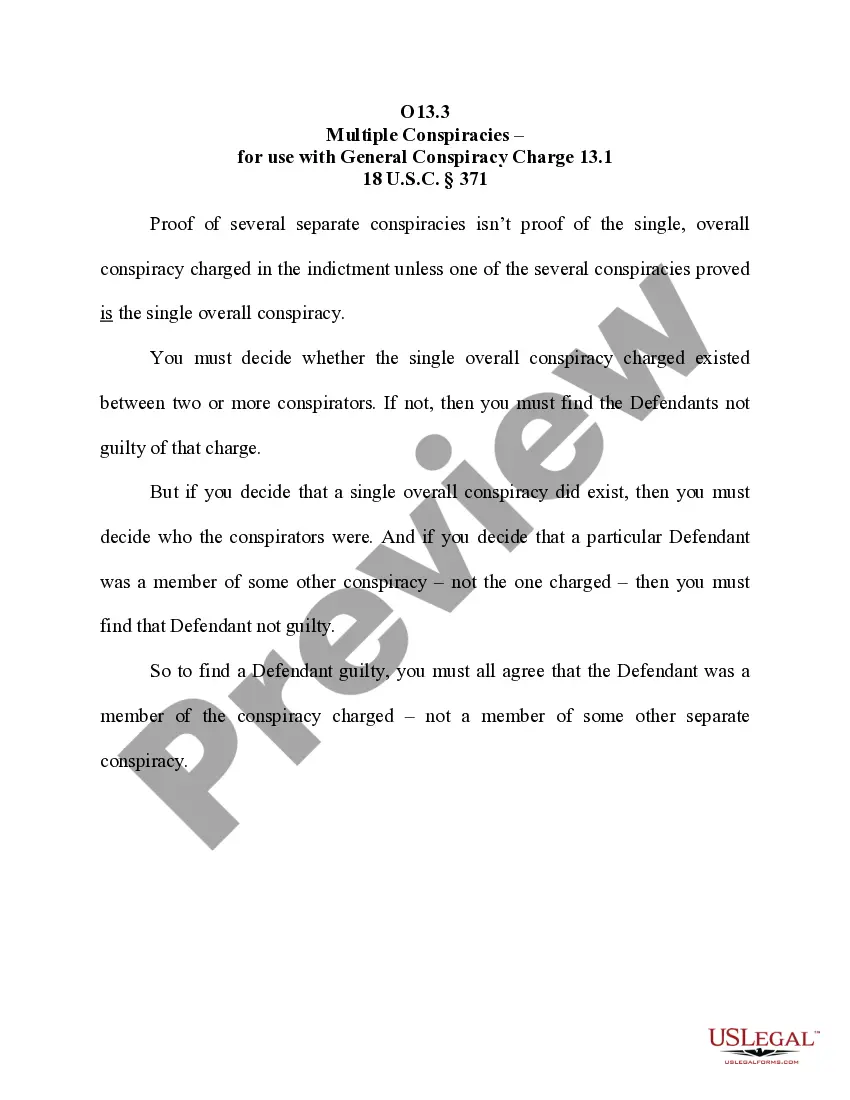
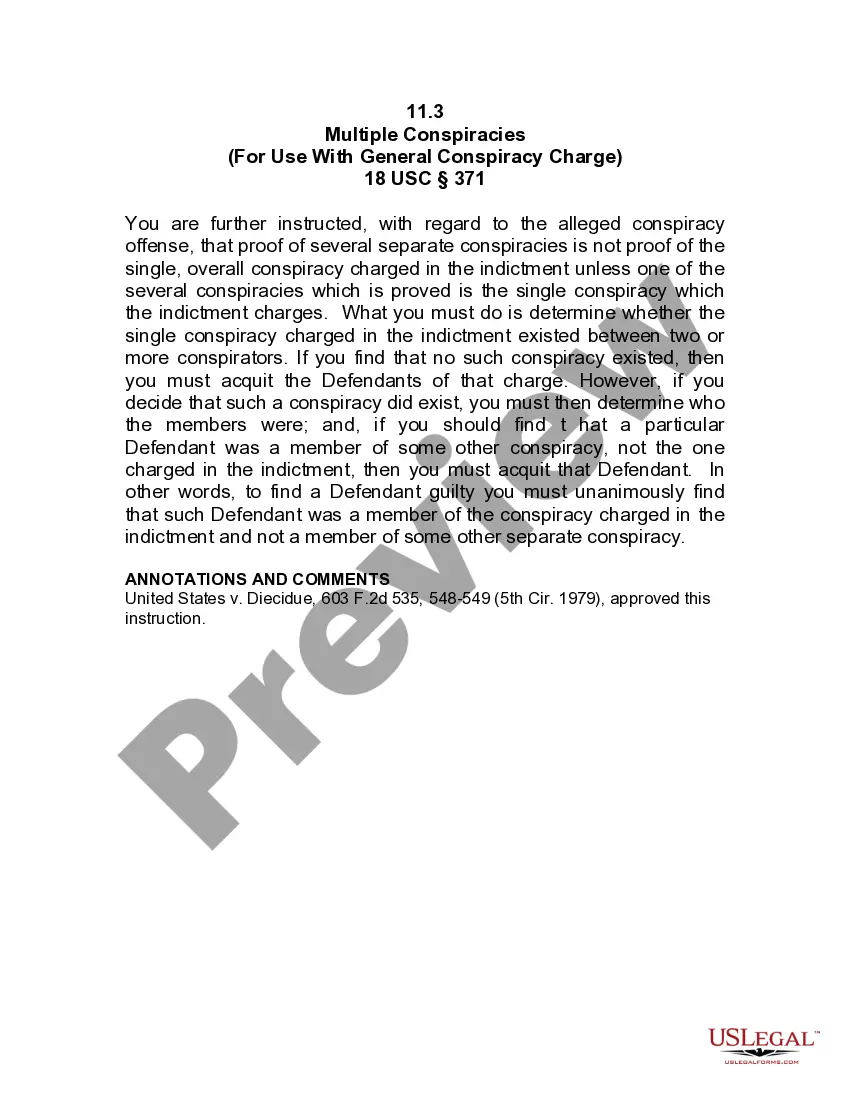
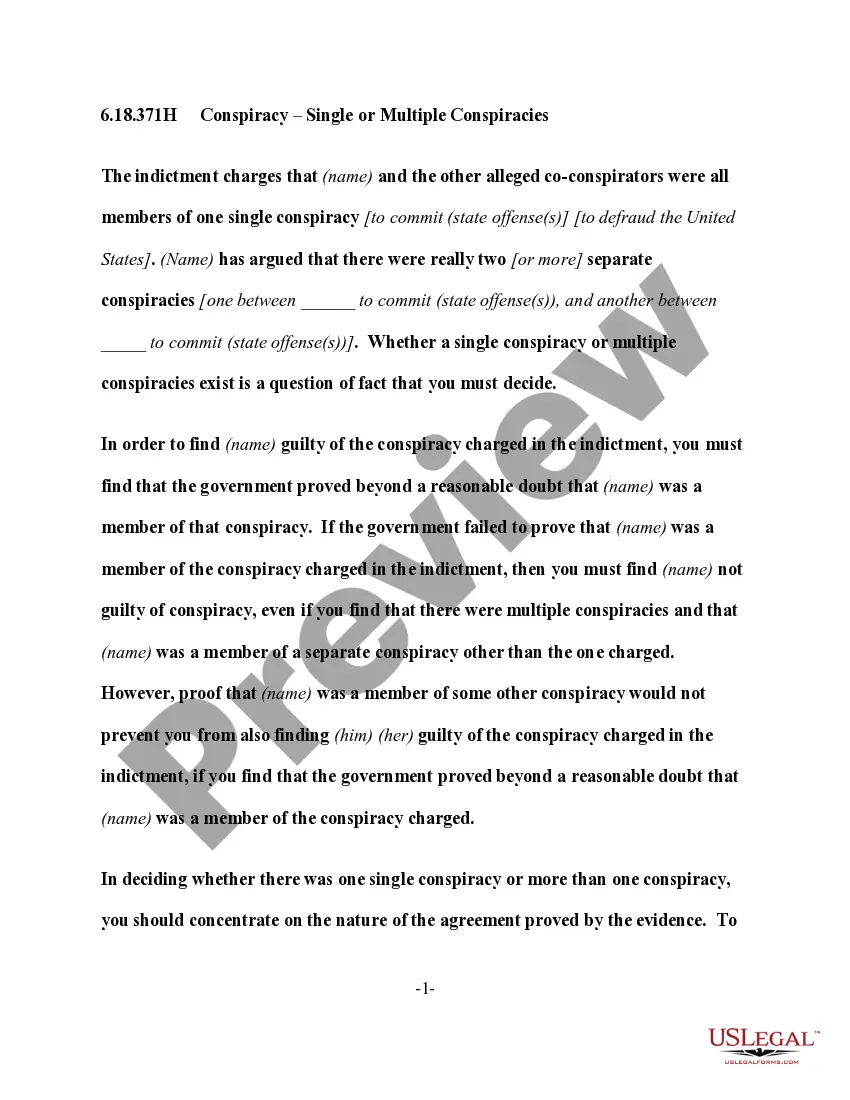
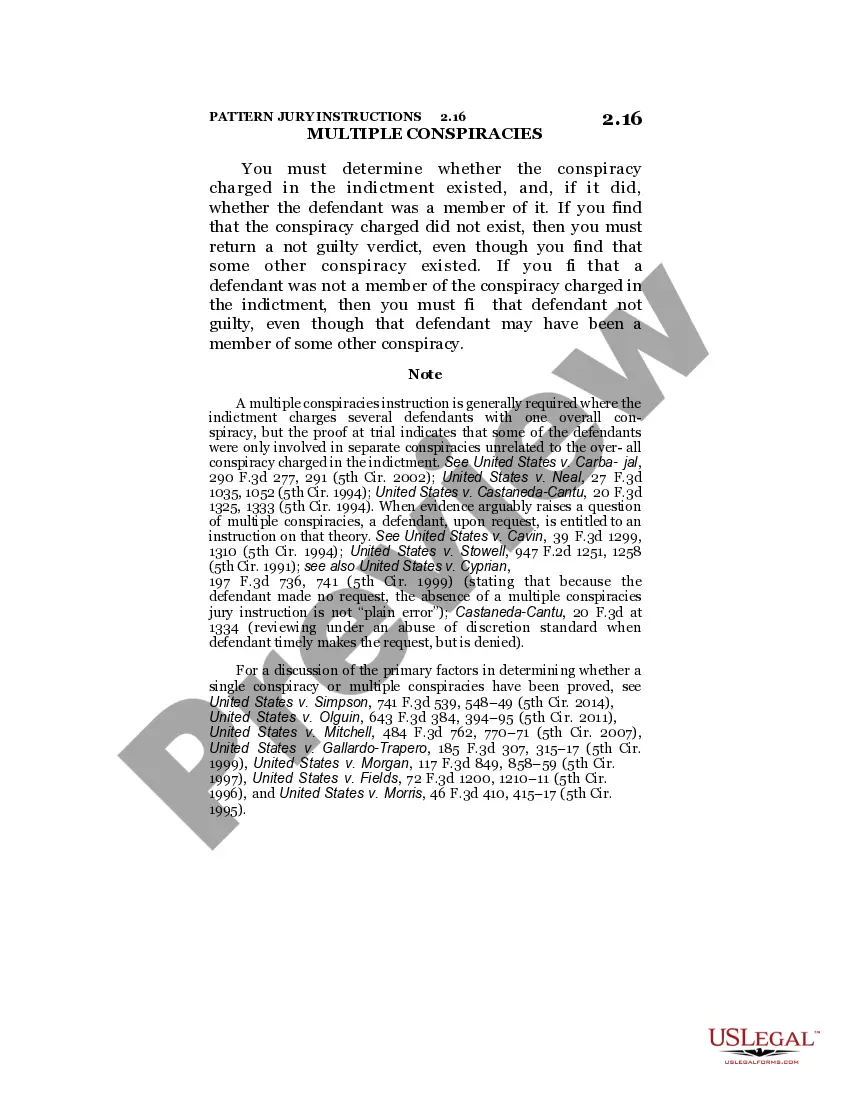
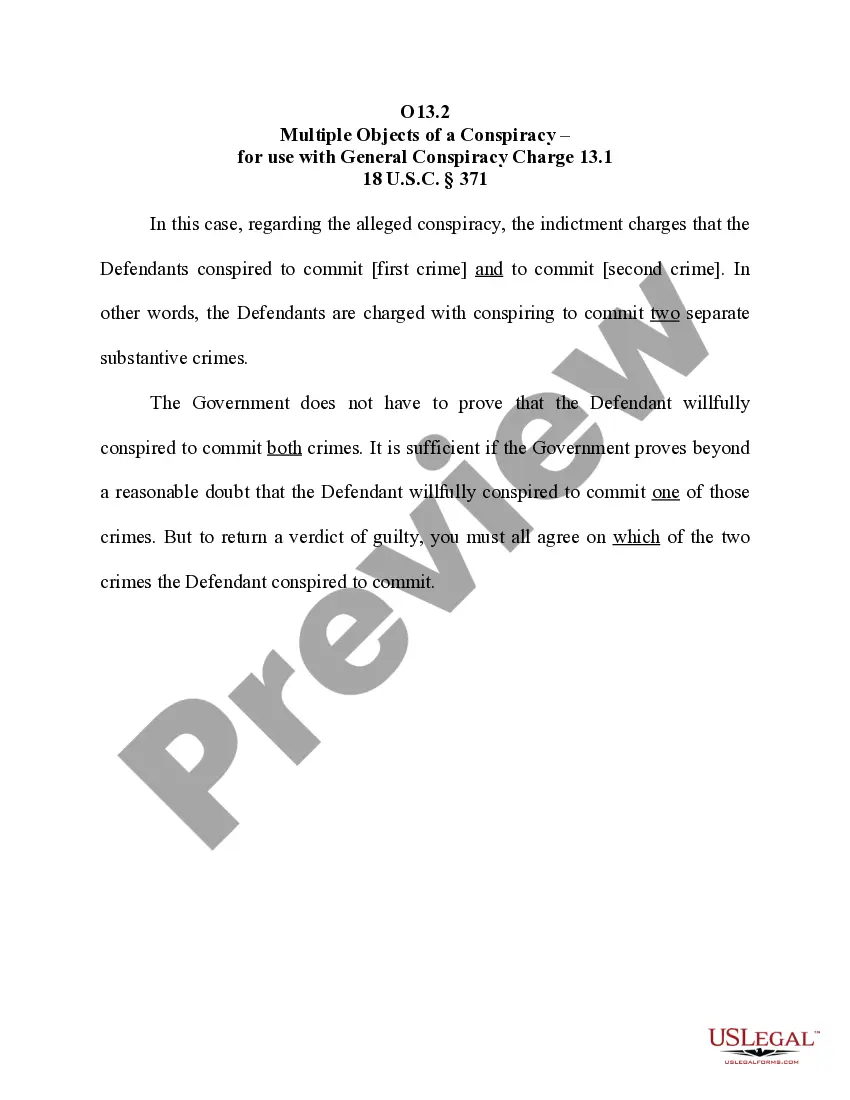
The Multiple Conspiracies form is designed for use with a General Conspiracy Charge under 18 U.S.C. § 371. This form helps clarify the distinction between separate conspiracies and a single, overarching conspiracy charged in an indictment. It enables jurors to determine whether the separate conspiracies presented constitute the overall conspiracy accused in the case. This legal form, based on Pattern Jury Instructions from the 11th Circuit Federal Court of Appeals, is crucial for accurate legal proceedings involving conspiracy allegations, ensuring defendants' rights are upheld during trial.
What’s included in this form
- Definition of a single overall conspiracy and its relationship to multiple conspiracies.
- Instructions for jurors on how to assess whether a single overall conspiracy existed.
- Guidelines for distinguishing between conspirators in the case.
- Criteria for finding a defendant guilty based on conspiracy membership.
Common use cases
This form is necessary when there are allegations of conspiracy involving multiple parties. It should be used in cases where jurors must determine if there is an overall conspiracy beyond separate, individual actions. Situations involving numerous defendants, each possibly involved in different conspiracies, warrant this instruction to ensure that all parties receive a fair assessment under the law.
Who should use this form
This form is intended for:
- Defense attorneys representing clients charged with conspiracy.
- Prosecutors who need to present their case effectively in conspiracy trials.
- Judges overseeing trials with conspiracy charges to guide jury instructions.
- Legal professionals involved in the preparation of defense strategies or jury instructions in conspiracy cases.
How to prepare this document
Follow these steps to complete the Multiple Conspiracies form:
- Review the indictment to understand the overall conspiracy charged.
- Identify any separate conspiracies that have been proven during the trial.
- Determine the list of conspirators involved in the overall conspiracy.
- Evaluate evidence to ascertain whether any defendant belongs to a separate conspiracy.
- Convene the jury to ensure all members agree on the conspiracy charge against each defendant.
Does this form need to be notarized?
This form does not typically require notarization unless specified by local law. Ensure that any jurisdiction-specific rules are reviewed to confirm the requirements for submission and usage.
Get your form ready online
Our built-in tools help you complete, sign, share, and store your documents in one place.
Make edits, fill in missing information, and update formatting in US Legal Forms—just like you would in MS Word.
Download a copy, print it, send it by email, or mail it via USPS—whatever works best for your next step.
Sign and collect signatures with our SignNow integration. Send to multiple recipients, set reminders, and more. Go Premium to unlock E-Sign.
If this form requires notarization, complete it online through a secure video call—no need to meet a notary in person or wait for an appointment.
We protect your documents and personal data by following strict security and privacy standards.

Make edits, fill in missing information, and update formatting in US Legal Forms—just like you would in MS Word.

Download a copy, print it, send it by email, or mail it via USPS—whatever works best for your next step.

Sign and collect signatures with our SignNow integration. Send to multiple recipients, set reminders, and more. Go Premium to unlock E-Sign.

If this form requires notarization, complete it online through a secure video call—no need to meet a notary in person or wait for an appointment.

We protect your documents and personal data by following strict security and privacy standards.
Mistakes to watch out for
- Failing to differentiate between separate conspiracies and the overarching conspiracy.
- Not adequately supporting claims of membership in a conspiracy with evidence.
- Assuming all defendants are part of a single conspiracy without thorough examination of the evidence.
Why use this form online
- Convenience of accessing and downloading the form at any time.
- Editability allows for customization based on case specifics.
- Reliability of using a form drafted by licensed attorneys enhances legal accuracy.
Legal use & context
- The form provides a legal framework for jurors to understand their duties when faced with conspiracy charges.
- It supports ensuring fair judgment by clarifying definitions and evidence requirements.
- Using the form helps avoid potential misinterpretations of conspiracy laws and charges.
Quick recap
- The Multiple Conspiracies form is essential for guiding jurors in conspiracy cases.
- It helps clearly distinguish between single and multiple conspiracy charges.
- Understanding and utilizing the form ensures fair trials and accurate verdicts.
Looking for another form?


Form popularity
FAQ
You must have 2 or more persons who 2. Intentionally 3. make an agreement 4. to violate federal law or defraud the United states, and then 5. Commit some overt act in furtherance of the agreement.
The current edition of Wharton's treatise states the Rule more simply: "An agreement by two persons to commit a particular crime cannot be prosecuted as a conspiracy when the crime is of such a nature as to necessarily require the participation of two persons for its commission."
Those elements are: 1. You must have 2 or more persons who 2. Intentionally 3. make an agreement 4. to violate federal law or defraud the United states, and then 5.
The conspirators must have the intent to actually commit the crime. The punishment for being convicted of conspiracy will be based on the severity of the crime the conspirators intended to commit.
All that is required is that the parties had a mutual understanding to undertake an unlawful plan. Second, all conspirators must have the specific intent to commit the objective of the conspiracy.
Many federal conspiracy charges carry a 5, 10 or 20-year mandatory minimum prison sentence. However, the important thing to remember is that these sentences can be negotiated based on the information you have to give.
Only one overt act has to be proven. The government is not required to prove that defendant personally committed or knew about the overt act. It is sufficient if one conspirator committed one overt act at some time during the period of the conspiracy.
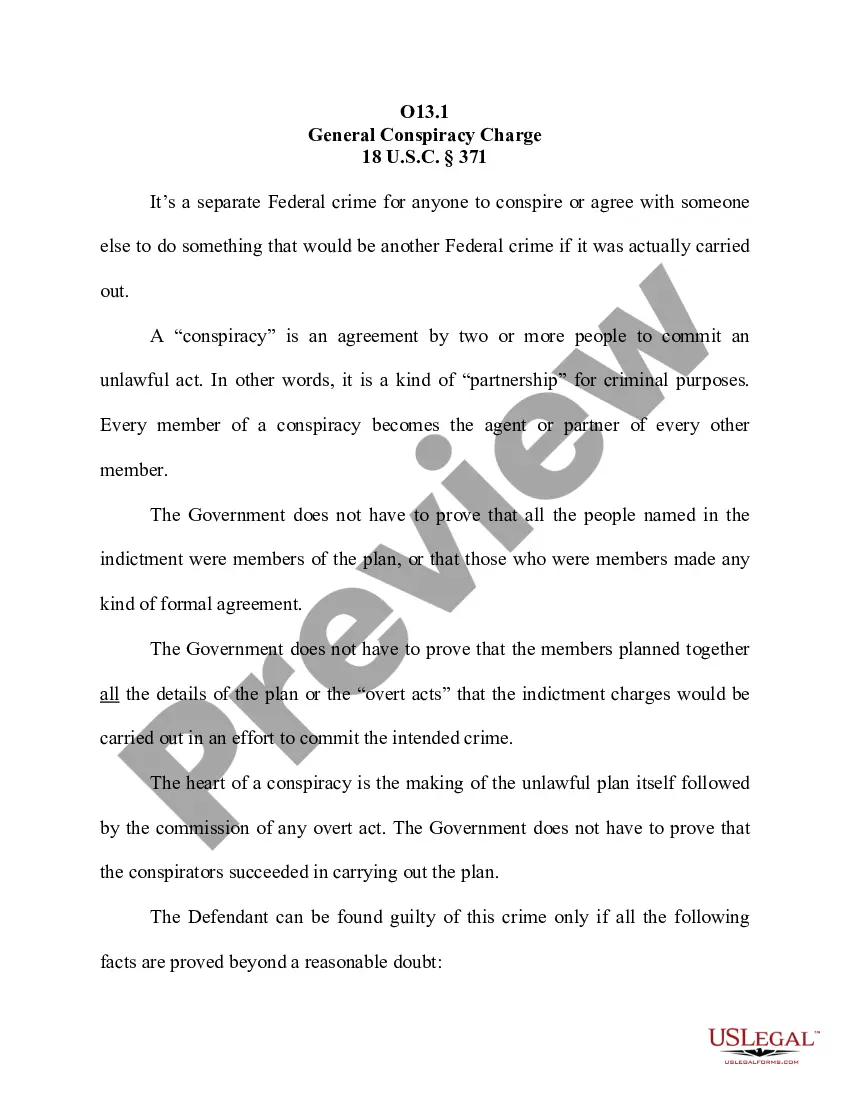
Conspiracy is an agreement between two or more people to commit an illegal act, along with an intent to achieve the agreement's goal. Most U.S. jurisdictions also require an overt act toward furthering the agreement. An overt act is a statutory requirement, not a constitutional one.