New Mexico Judgment Quieting Title
Overview of this form
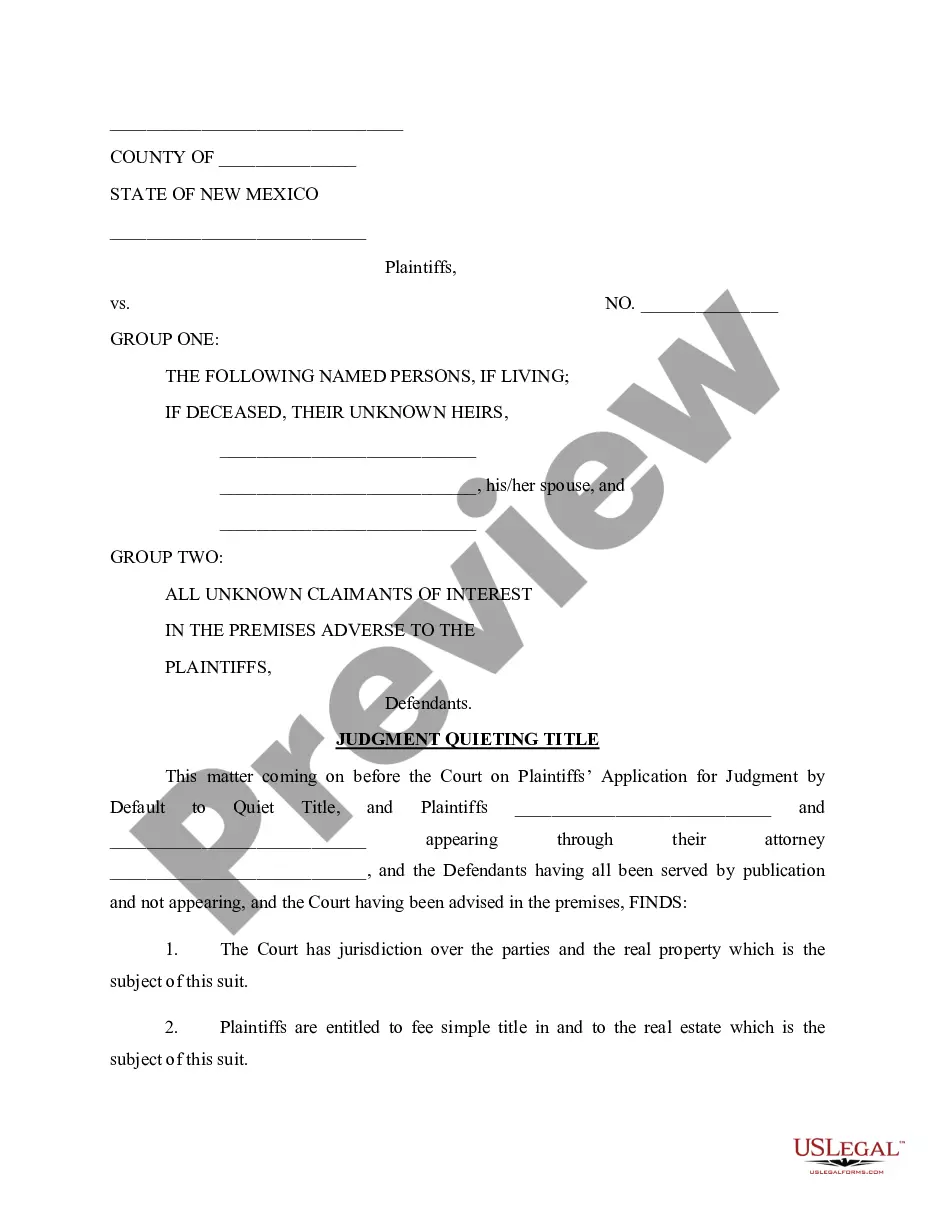
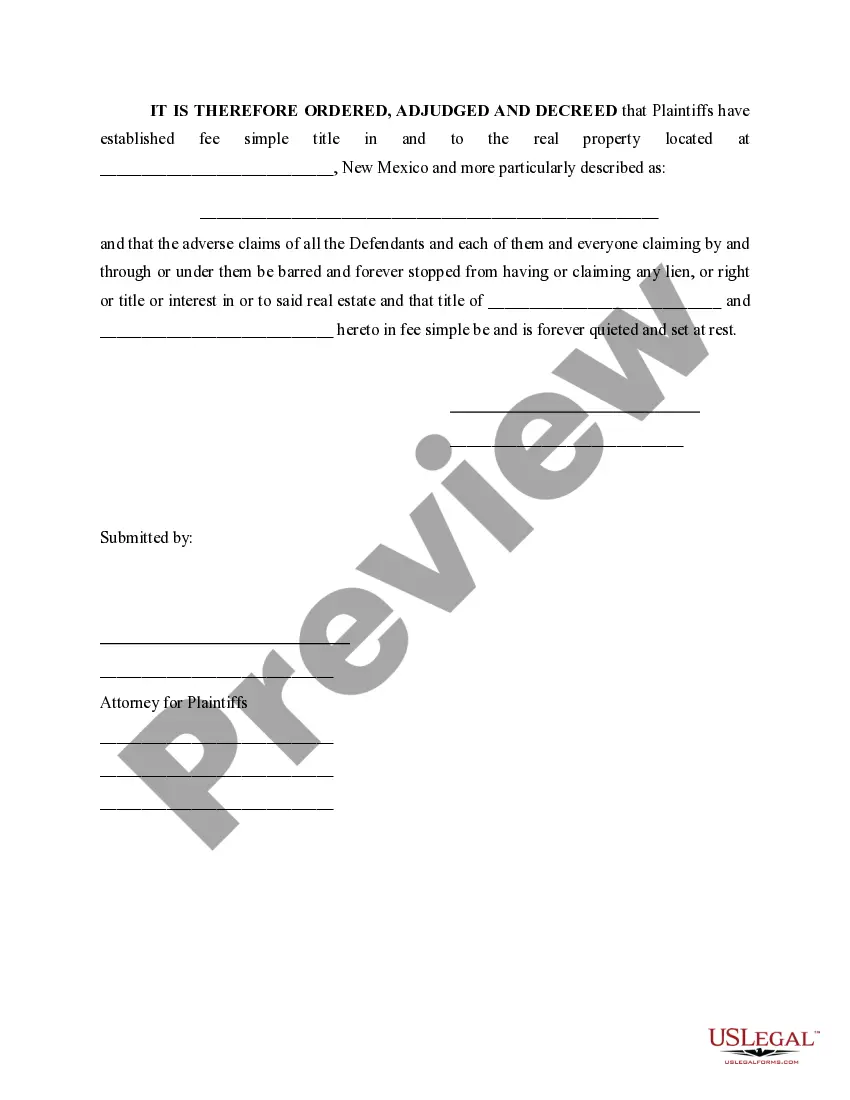
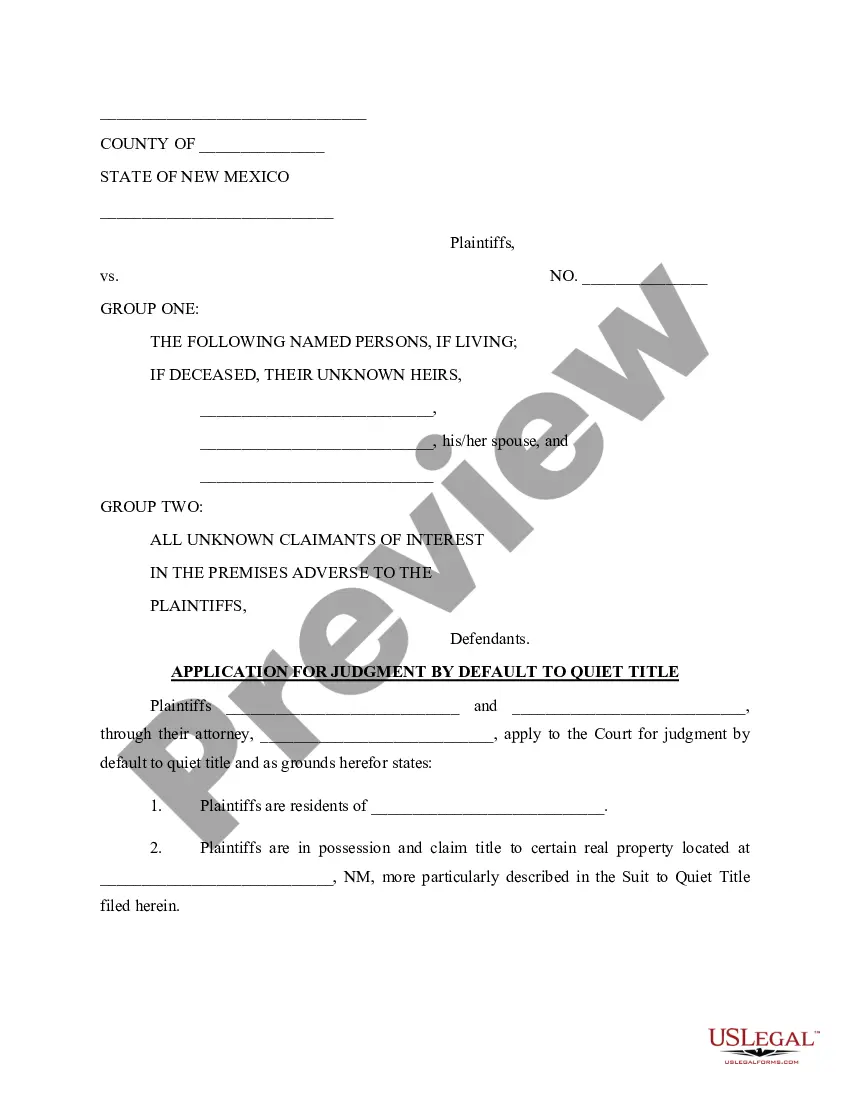
The Judgment Quieting Title form allows plaintiffs to obtain a court judgment that establishes clear ownership of real property. This legal document is vital when previous claimants or unknown parties assert rights to the property but do not respond to legal proceedings. Unlike other property-related forms, this form specifically resolves disputes over title by confirming that the plaintiffs hold fee simple title, eliminating any adverse claims.
Form components explained
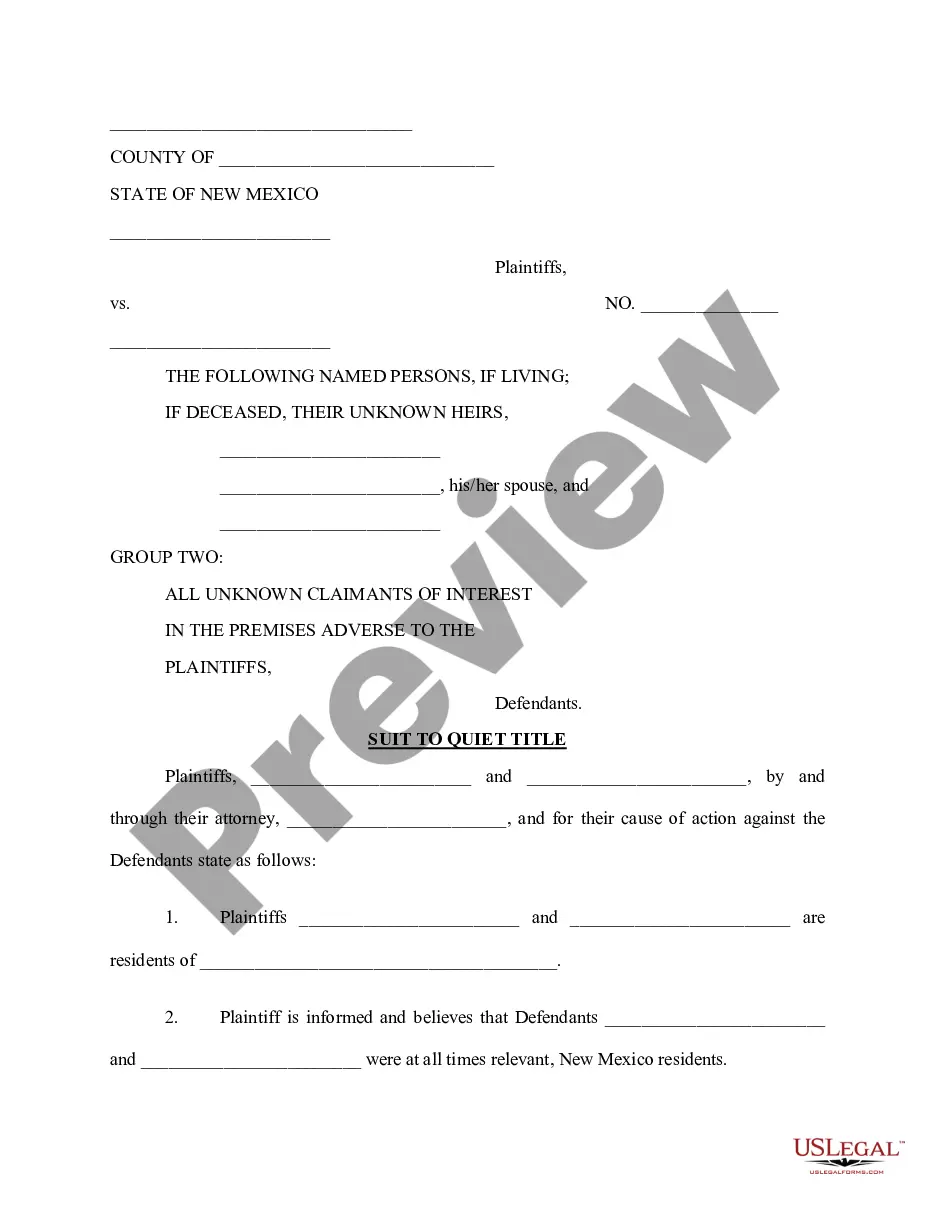
- Parties involved: Identification of plaintiffs and defendants, including any unknown heirs or claimants.
- Jurisdiction statement: A declaration confirming the court's authority over the parties and property.
- Title determination: A finding that the plaintiffs are entitled to fee simple title.
- Order of quiet title: An official decree barring future claims against the title by defendants.
- Property description: Detailed identification of the real estate in question.
Situations where this form applies
This form is typically used when you need to clarify ownership of a property and eliminate any disputes over title. It is particularly applicable in situations where defendants have been formally notified of the claim but fail to respond, allowing you to finalize your ownership rights in court. This is essential in real estate transactions, inheritance situations, or when resolving disputes over property ownership.
Intended users of this form
- Property owners seeking to secure legal title against unknown claims.
- Individuals involved in real estate transactions or disputes.
- Heirs of deceased property owners aiming to confirm their title.
- Legal representatives of plaintiffs in such cases.
Steps to complete this form
- Identify the parties involved: Enter the names of the plaintiffs and defendants, including any unknown claimants.
- Specify the jurisdiction: Include the county and state where the court has authority.
- Describe the property: Clearly outline the location and physical description of the real estate.
- Fill in the court case number: Reference valid case information to ensure court recognition.
- Have the submission reviewed: Ensure accuracy and completeness before filing with the court.
Notarization requirements for this form
This form does not typically require notarization unless specified by local law. However, having it notarized can enhance its credibility and acceptance during legal proceedings.
Get your form ready online
Our built-in tools help you complete, sign, share, and store your documents in one place.
Make edits, fill in missing information, and update formatting in US Legal Forms—just like you would in MS Word.
Download a copy, print it, send it by email, or mail it via USPS—whatever works best for your next step.
Sign and collect signatures with our SignNow integration. Send to multiple recipients, set reminders, and more. Go Premium to unlock E-Sign.
If this form requires notarization, complete it online through a secure video call—no need to meet a notary in person or wait for an appointment.
We protect your documents and personal data by following strict security and privacy standards.

Make edits, fill in missing information, and update formatting in US Legal Forms—just like you would in MS Word.

Download a copy, print it, send it by email, or mail it via USPS—whatever works best for your next step.

Sign and collect signatures with our SignNow integration. Send to multiple recipients, set reminders, and more. Go Premium to unlock E-Sign.

If this form requires notarization, complete it online through a secure video call—no need to meet a notary in person or wait for an appointment.

We protect your documents and personal data by following strict security and privacy standards.
Common mistakes
- Failing to properly identify all parties, especially unknown claimants.
- Omitting critical information about the property description.
- Not adhering to court format requirements for submission.
- Submitting the form without all necessary signatures or verifications.
Benefits of using this form online
- Convenient access: Download and complete your form at any time.
- Editability: Easily modify the form to suit your specific situation.
- Expertly drafted: Forms are provided by licensed attorneys, ensuring reliability.
- Guidance available: Clear instructions for completing the forms effectively.
Looking for another form?
Form popularity
FAQ
A lawsuit for quiet title must be brought in local Superior Court. To begin the lawsuit, the plaintiff (the lender or homeowner) files a complaint with the court followed by a Notice of Pendency of Action (a Lis Pendens) that is recorded with the county recorder and filed with the court.
When two or more persons have adverse claims to the same property, any of them may file a quiet title action. The purpose of the quiet title action is to eliminate an adverse claim to a legal interest in the property and to establish, perfect, or quiet the title in the property in one or more of the claimants.
Why would a property owner file a quiet title suit?the owner against liabilities and losses resulting from title defects. A lender's title insurance policy generally protects. the lender against the possibility that the lender's lien cannot be enforced.
If the parties are easily found the action can be complete within sixty days. However, if service through newspaper is required, this can add an additional month.
What Is a Quiet Title Action? A quiet title action, also known as an action of quiet title, is a circuit court actionor lawsuitthat is filed with the intended purpose to establish or settle the title to a property.
Understanding a Quiet Title Action A quiet title action occurs when one property claimant challenges one or more other people in a court of law for the purpose of determining who is the rightful legal owner of the property in question.
If the court deems the claim to meet the standards set by the local jurisdiction, the claimant is granted what is known as an action to quiet title. This decree essentially is a formal announcement that the court recognizes the claim and believes it supersedes any other possible claims against the property.
A failure to record an instrument may render title un-marketable if a subsequent bona fide purchaser or creditor takes an interest in the property without notice of the instrument, by virtue of New Mexico's recording statutes which creates a race-notice regime.
Definition. A special legal proceeding to determine ownership of real property. A party with a claim of ownership to land can file an action to quiet title, which serves as a sort of lawsuit against anyone and everyone else who has a claim to the land.