Jury Instruction - Multiple Conspiracies - For Use With General Conspiracy Charge
Understanding this form
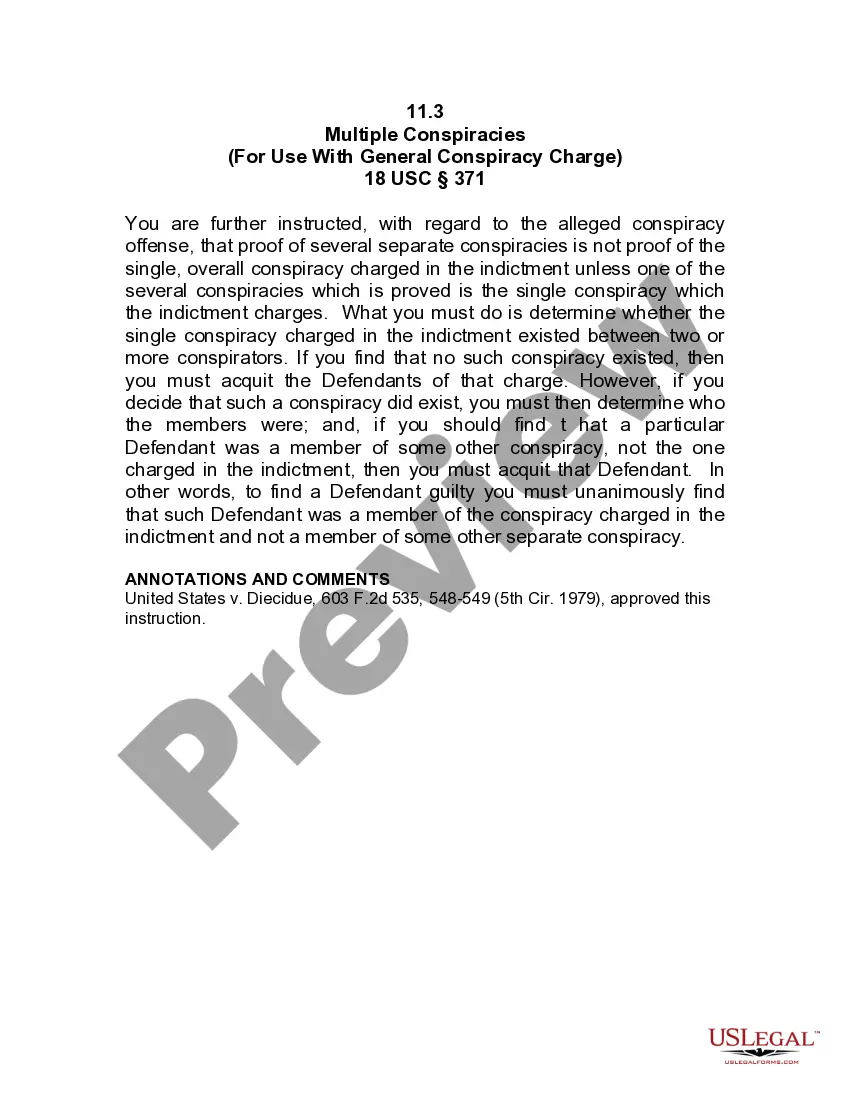
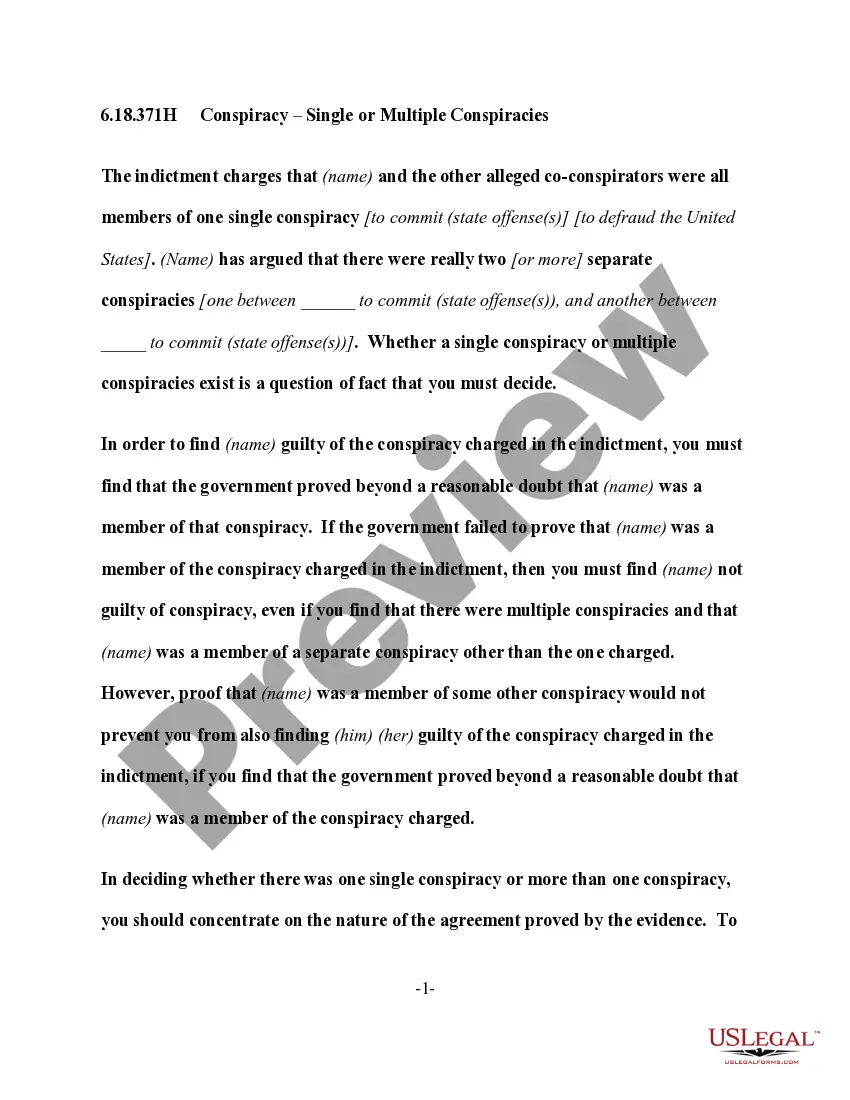
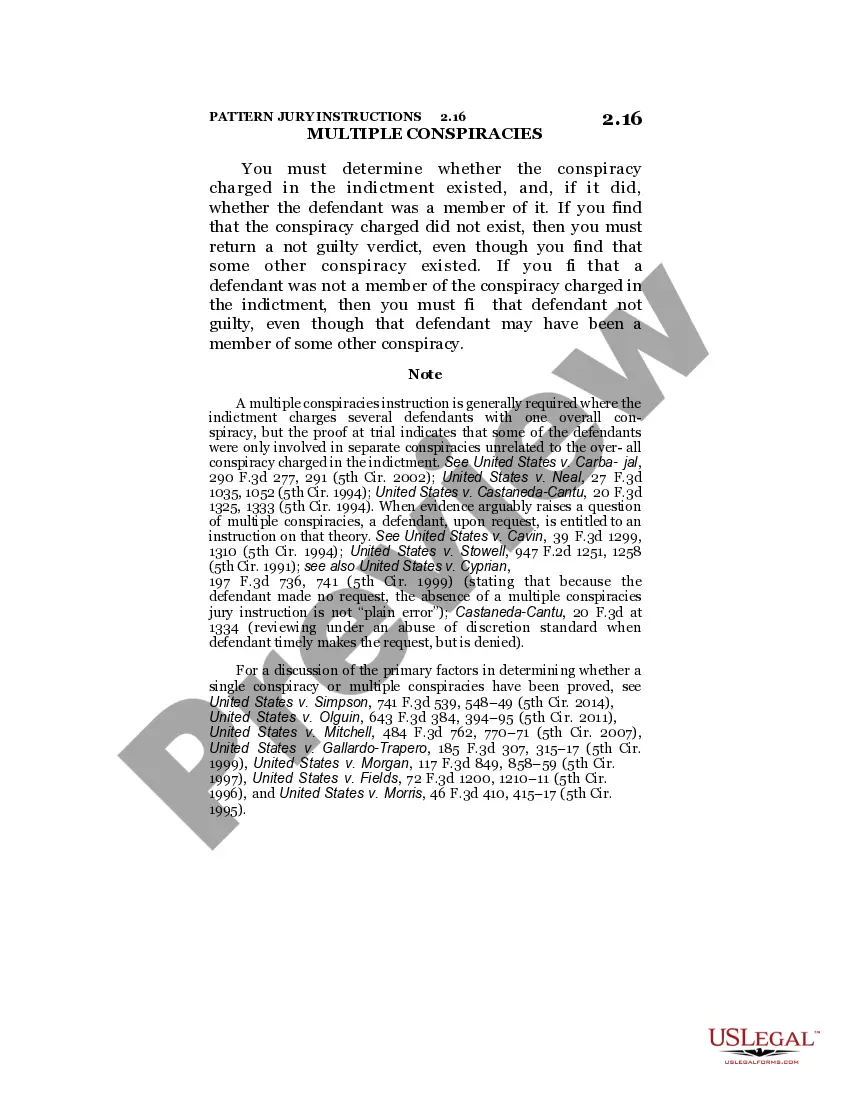
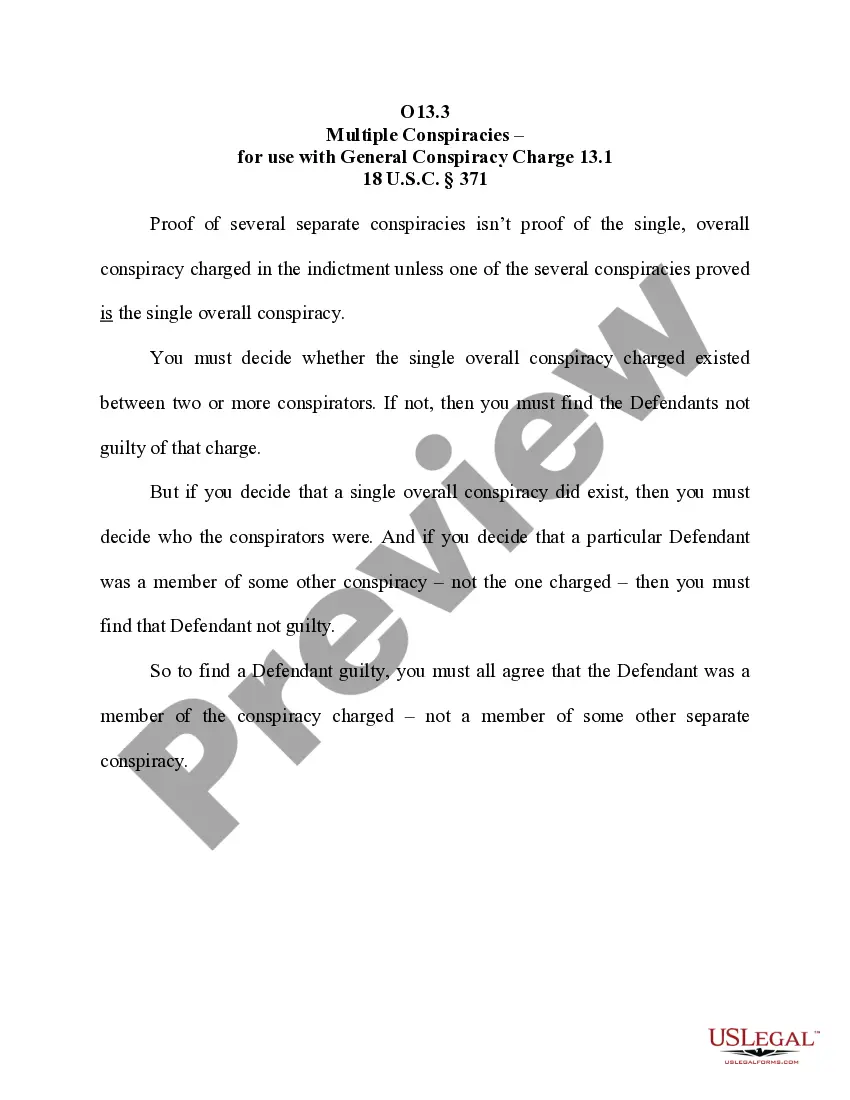
This form provides jury instructions related to multiple conspiracies, specifically for use with a general conspiracy charge under 18 USC 371. It serves as a guide for jurors to differentiate between separate conspiracies and the single conspiracy alleged in an indictment. By using this form, legal professionals can ensure clarity in jury deliberations regarding complex conspiracy cases.
Key components of this form
- Definitions and explanations of conspiracy based on United States law.
- Guidance on determining the existence of the single conspiracy charged.
- Instructions on evaluating the membership of defendants in the charged conspiracy.
- Clarification on the need for unanimous jury agreement for a guilty verdict.
When to use this document
This form is used in criminal trials involving conspiracy charges. It is particularly relevant in cases where multiple conspiracies are alleged, and the jury needs clear direction on how to assess these claims. Legal practitioners should employ this form when preparing jury instructions to ensure that jurors understand the fundamental principles of conspiracy law and their specific role in the case.
Who can use this document
- Attorneys representing defendants in conspiracy cases.
- Judges instructing juries on conspiracy charges.
- Legal educators teaching principles of conspiracy law.
- Legal professionals involved in jury selection and trial preparation.
How to prepare this document
- Review the allegations stated in the indictment.
- Determine if there is evidence supporting the existence of a single conspiracy.
- Evaluate the roles of each defendant and identify their participation in conspiracies.
- Ensure jurors understand the requirement for unanimous agreement in their verdict.
- Modify the instructions as needed to fit the specifics of the case at hand.
Notarization requirements for this form
This form does not typically require notarization to be legally valid. However, some jurisdictions or document types may still require it. US Legal Forms provides secure online notarization powered by Notarize, available 24/7 for added convenience.
Get your form ready online
Our built-in tools help you complete, sign, share, and store your documents in one place.
Make edits, fill in missing information, and update formatting in US Legal Forms—just like you would in MS Word.
Download a copy, print it, send it by email, or mail it via USPS—whatever works best for your next step.
Sign and collect signatures with our SignNow integration. Send to multiple recipients, set reminders, and more. Go Premium to unlock E-Sign.
If this form requires notarization, complete it online through a secure video call—no need to meet a notary in person or wait for an appointment.
We protect your documents and personal data by following strict security and privacy standards.

Make edits, fill in missing information, and update formatting in US Legal Forms—just like you would in MS Word.

Download a copy, print it, send it by email, or mail it via USPS—whatever works best for your next step.

Sign and collect signatures with our SignNow integration. Send to multiple recipients, set reminders, and more. Go Premium to unlock E-Sign.

If this form requires notarization, complete it online through a secure video call—no need to meet a notary in person or wait for an appointment.

We protect your documents and personal data by following strict security and privacy standards.
Typical mistakes to avoid
- Failing to explain the difference between multiple conspiracies and a single conspiracy clearly.
- Omitting the importance of unanimous agreement among jurors.
- Not tailoring the instructions to the specific facts of the case.
Benefits of completing this form online
- Convenient access to standardized jury instructions at any time.
- Editability allows for customization to fit unique case details.
- Reliability from templates drafted by licensed attorneys ensures legal accuracy.
Looking for another form?




Form popularity
FAQ
Penalties. Under the federal conspiracy statute, the offense is punishable by up to five years imprisonment, plus fines.
In most U.S. jurisdictions, for a person to be convicted of conspiracy, not only must he or she agree to commit a crime, but at least one of the conspirators must commit an overt act (the actus reus) in furtherance of the crime.
Federal conspiracies are punishable by up to five years in jail plus fines. Some of the most common conspiracies charged at the federal level include money laundering or the manufacturing of drugs or weapons. Misdemeanor conspiracies typically carry whatever sentence is the maximum for that misdemeanor.
(2) an act which is not illegal by illegal means, such an agreement is designated a criminal conspiracy: Provided that no agreement except an agreement to commit an offence shall amount to a criminal conspiracy unless some act besides the agreement is done by one or more parties to such agreement in pursuance thereof.
In some respects, conspiracy is similar to attempt, to solicitation, and to aiding and abetting. Unlike aiding and abetting, however, it does not require commission of the underlying offense. Unlike attempt and solicitation, conspiracy does not merge with the substantive offense; a conspirator may be punished for both.
Put simply, a criminal conspiracy is an agreement to commit an unlawful act. The agreement itself is the crime, but at least one co-conspirator must take an overt act in furtherance of the conspiracy. Under the federal conspiracy statute: The agreement by two or more persons is the essence of the crime.
It is fairly difficult for a defendant to withdraw from a criminal conspiracy; the defendant must prove that he, in fact, walked away; and. withdrawal is a complete defense only if it occurred more than five years before the indictment.
Unlike conspiracy or attempt, which require an additional act in furtherance of the crime itself, solicitation does not require that the solicited party actually take any action to commit the crime. Simply asking a person to commit a crime is enough.