Multiple Conspiracies
What is this form?
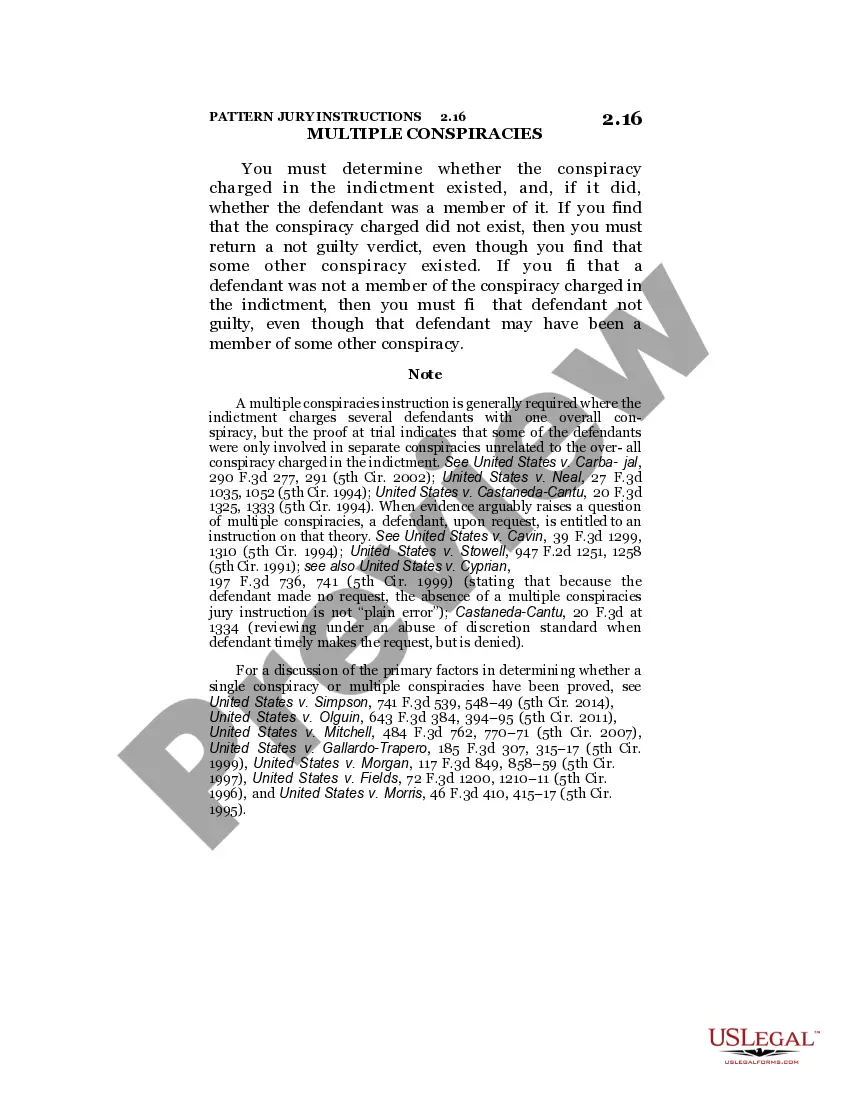
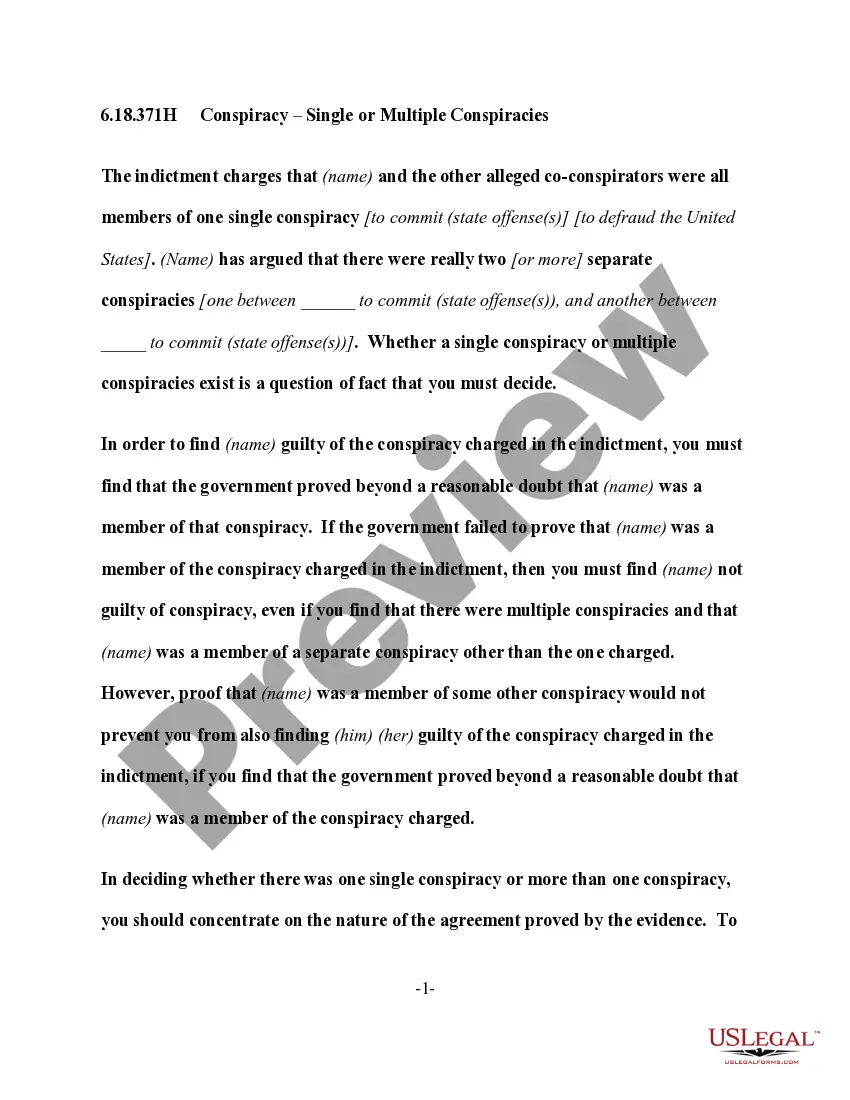
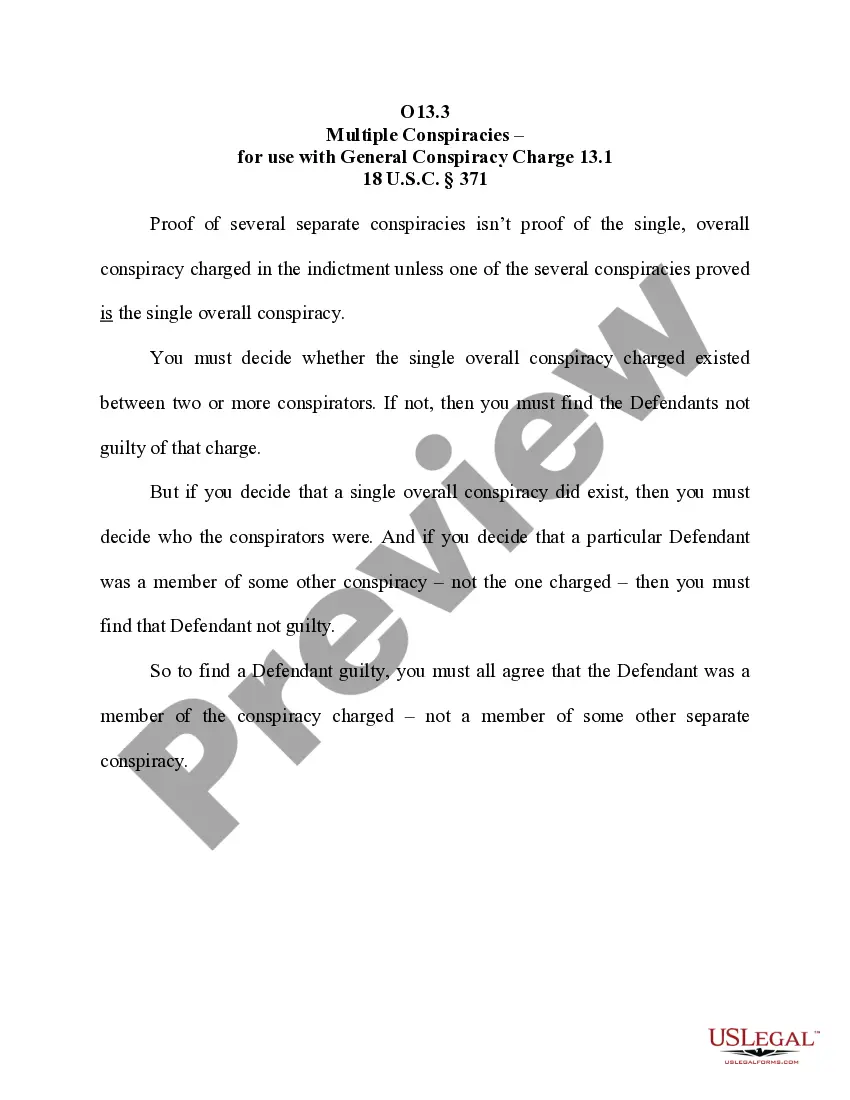
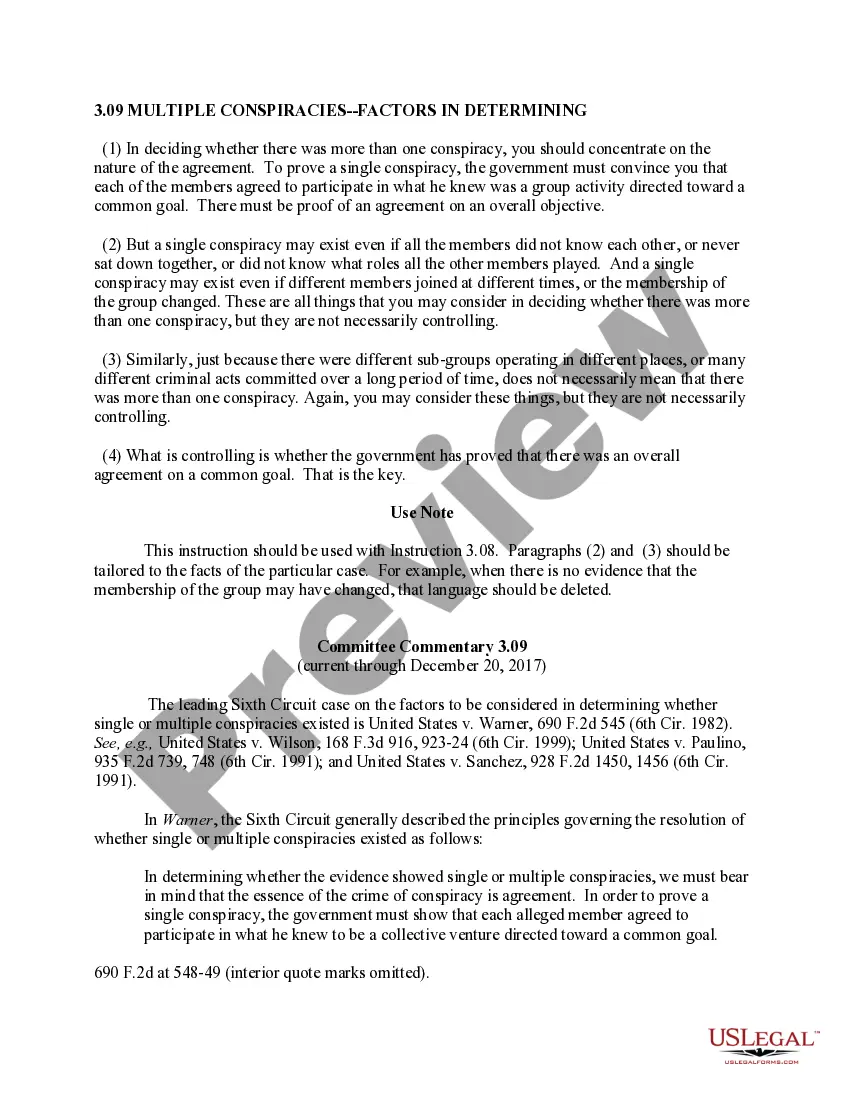
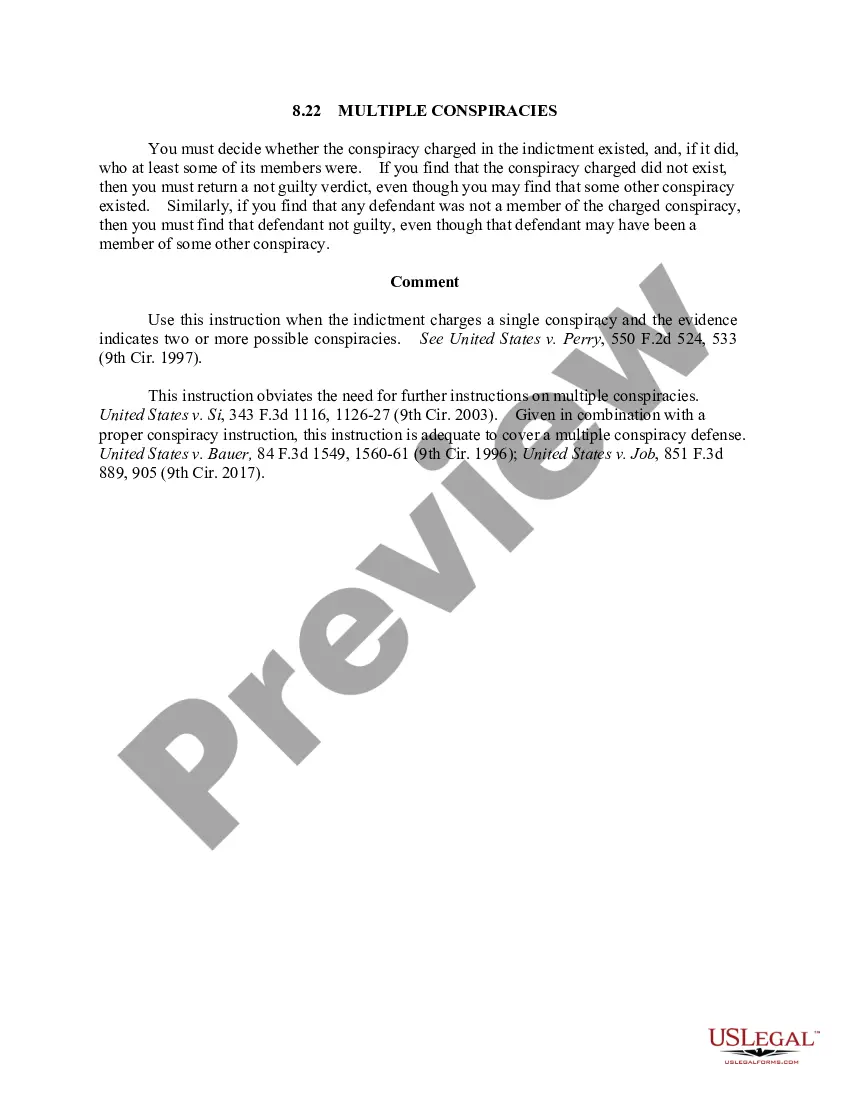
The Multiple Conspiracies form is a legal document used in criminal law to address situations where a defendant is alleged to be part of multiple separate conspiracies. This form helps clarify the evidence presented in court, distinguishing between different conspiracies and ensuring that each defendant is evaluated based solely on the specific conspiracy charged. It is distinct from other conspiracy forms because it focuses on the need to determine member participation in a particular conspiracy, rather than addressing conspiracy as a general concept.
Key components of this form
- Determination of whether the charged conspiracy exists.
- Assessment of the defendant's involvement in only the charged conspiracy.
- Instruction requirements based on evidence suggesting multiple conspiracies.
- Associated legal precedents that support the need for this instruction.
- Clarification on jury unanimity regarding conspiracy participation.

When to use this form
This form is necessary when a defendant is accused of participating in a conspiracy, but evidence suggests there were multiple unrelated conspiracies involved. Legal representation may request this instruction to ensure the jury understands they must only consider the conspiracy charged in the indictment, not any outside conspiracies. This is particularly relevant in complex cases with multiple defendants and differing degrees of involvement.
Who can use this document
- Criminal defense attorneys representing clients charged with conspiracy.
- Prosecutors needing to clarify the nature of the conspiracy charged.
- Judges requiring a clear understanding of how to instruct juries on conspiracy cases.
- Legal scholars studying conspiracy law within the context of multiple defendants.
Steps to complete this form
- Review the indictment to identify the conspiracy charged.
- Gather evidence to determine the existence of the alleged conspiracy.
- Evaluate the defendant's involvement in that specific conspiracy.
- Prepare the courtroom instruction based on the evidence regarding multiple conspiracies.
- Ensure the jury is aware they must focus only on the charged conspiracy when deliberating.
Does this form need to be notarized?
This form does not typically require notarization to be legally valid. However, some jurisdictions or document types may still require it. US Legal Forms provides secure online notarization powered by Notarize, available 24/7 for added convenience.
Get your form ready online
Our built-in tools help you complete, sign, share, and store your documents in one place.
Make edits, fill in missing information, and update formatting in US Legal Forms—just like you would in MS Word.
Download a copy, print it, send it by email, or mail it via USPS—whatever works best for your next step.
Sign and collect signatures with our SignNow integration. Send to multiple recipients, set reminders, and more. Go Premium to unlock E-Sign.
If this form requires notarization, complete it online through a secure video call—no need to meet a notary in person or wait for an appointment.
We protect your documents and personal data by following strict security and privacy standards.

Make edits, fill in missing information, and update formatting in US Legal Forms—just like you would in MS Word.

Download a copy, print it, send it by email, or mail it via USPS—whatever works best for your next step.

Sign and collect signatures with our SignNow integration. Send to multiple recipients, set reminders, and more. Go Premium to unlock E-Sign.

If this form requires notarization, complete it online through a secure video call—no need to meet a notary in person or wait for an appointment.

We protect your documents and personal data by following strict security and privacy standards.
Mistakes to watch out for
- Failing to properly distinguish between multiple conspiracies when presenting evidence.
- Not instructing the jury clearly on focusing only on the charged conspiracy.
- Assuming that participation in unrelated conspiracies affects the verdict on the charged conspiracy.
- Neglecting to request a multiple conspiracies instruction when evidence indicates its necessity.
Advantages of online completion
- Immediate access to the latest legal standards and jury instructions.
- Convenience of downloading and completing forms from any location.
- Editable templates that allow for customization based on specific cases.
- Reliability, as the forms are drafted with input from licensed attorneys.
Legal use & context
- This form reinforces the legal principle that each conspiracy must be judged based on its specific charges.
- Using this form helps uphold fair trial standards by preventing jury confusion over multiple conspiracies.
- Courts rely on clear instructions to ensure that jurors focus on the allegations directly related to the case at hand.
Looking for another form?
Form popularity
FAQ
What is an example of a conspiracy charge? An example of a conspiracy charge could be two people that make an agreement to kill someone and buy the weapons to do it. They are charged with conspiracy, even if they never fully follow through on killing the person.
As a felony, violation of 18 U.S.C. § 371 carries a fine or imprisonment for up to five years. However, if the offense which is the subject of the conspiracy is charged as a misdemeanor, the punishment for the conspiracy cannot exceed the maximum punishment for the misdemeanor.
The Crime of Conspiracy in North Carolina In North Carolina, a person can be charged with conspiracy if there is an agreement or plan by a group of people to commit a crime. In fact, you could face conspiracy charges if you are plotting to do something lawful through illegal conduct.
What is an example of a conspiracy charge? An example of a conspiracy charge could be two people that make an agreement to kill someone and buy the weapons to do it. They are charged with conspiracy, even if they never fully follow through on killing the person.
For example, if you are charged with conspiring to commit a felony, you could face a sentence of life in prison. Many federal conspiracy charges carry a 5, 10 or 20-year mandatory minimum prison sentence.
A conspiracy to commit a Class A or Class B1 felony is a Class B2 felony, a conspiracy to commit a Class B2 felony is a Class C felony, a conspiracy to commit a Class I felony is a Class 1 misdemeanor, and. a conspiracy to commit a Class 3 misdemeanor remains a Class 3 misdemeanor.
Like other inchoate crimes such as attempt, a defendant charged with conspiracy can raise the defense of abandonment or withdrawal. In order to do so, a defendant must show that he affirmatively communicated his withdrawal to his co-conspirators and took some positive action to withdraw from the conspiracy.
You could be charged with conspiracy if the agreement is to complete a lawful act, but through unlawful conduct. North Carolina provides three essential elements of conspiracy that a prosecutor must prove to convict you: You and at least one other individual created an agreement.