Self-Employed Independent Welder Services Contract
About this form
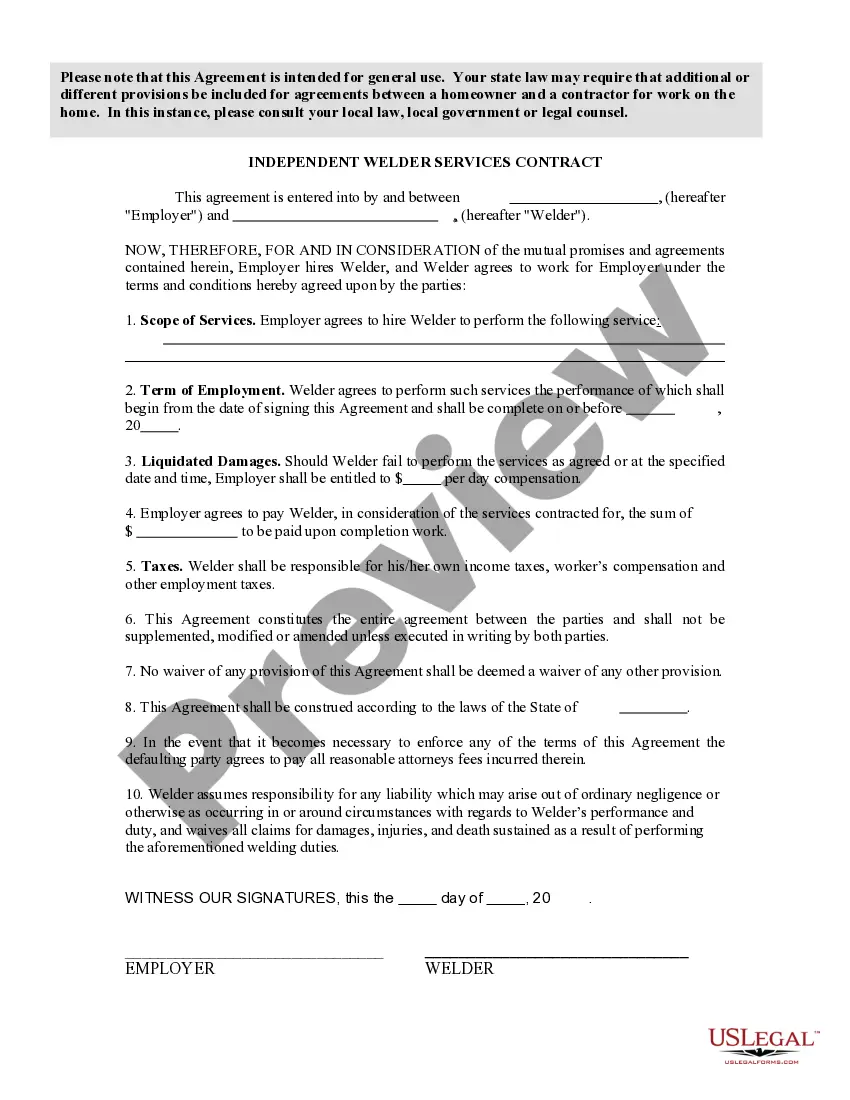
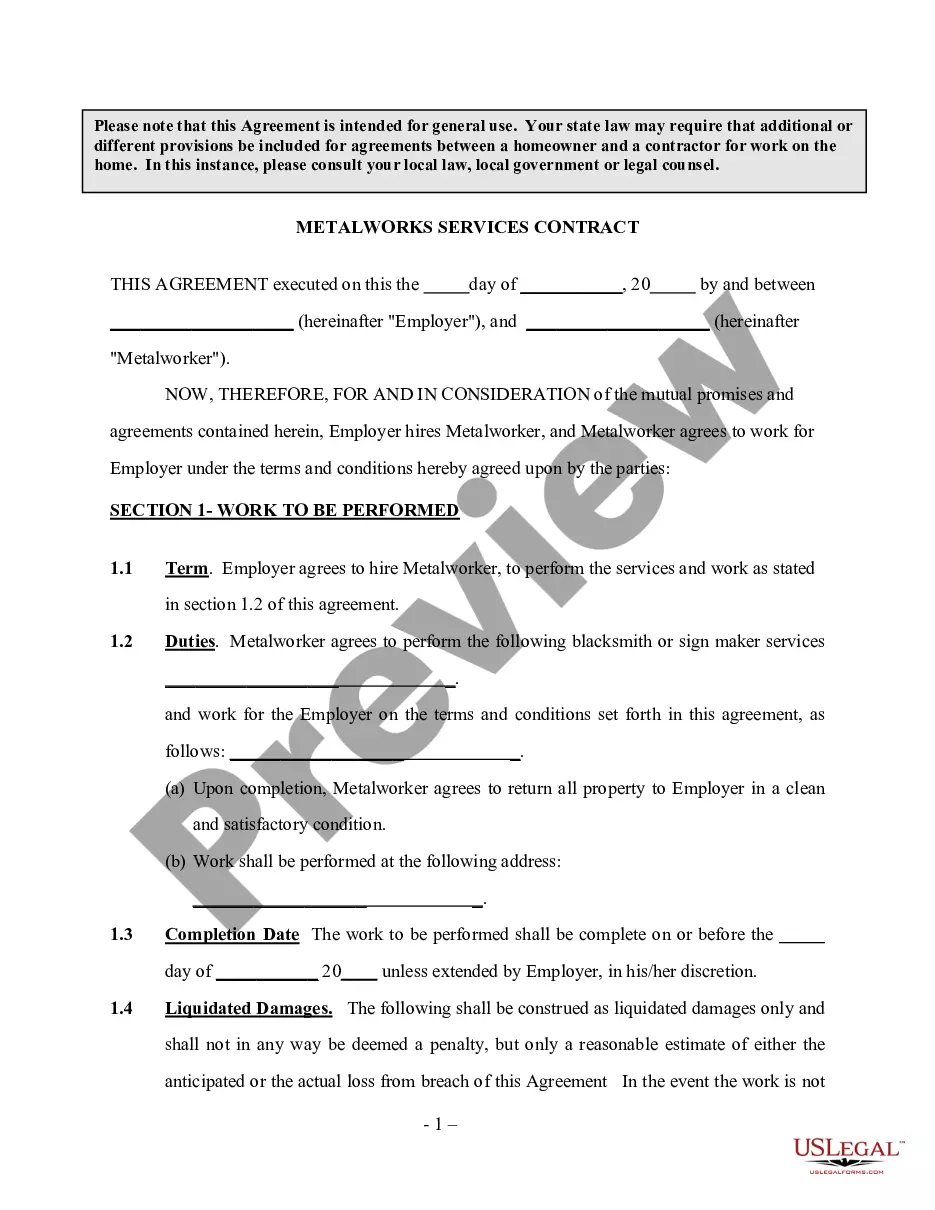
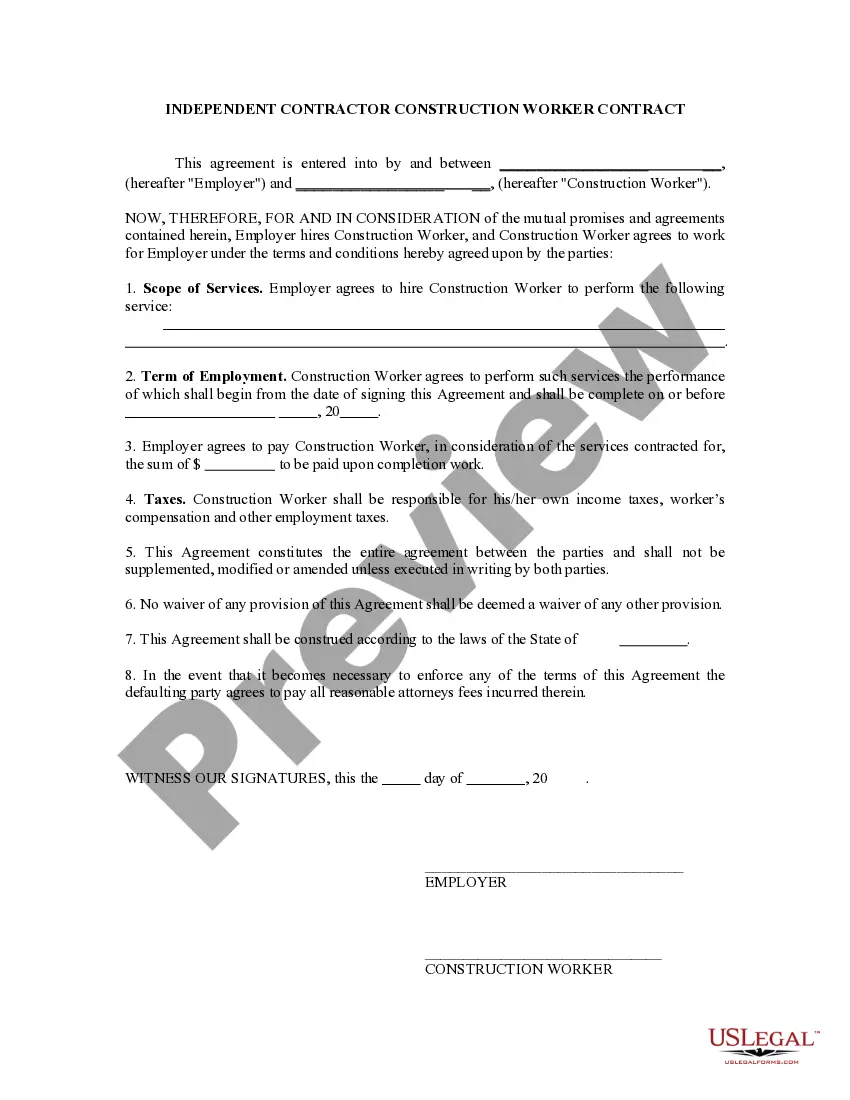
The Self-Employed Independent Welder Services Contract is a legally binding agreement between an employer and a welder who is hired as an independent contractor. This contract outlines the specific services to be performed for a particular project or time period, helping clarify the responsibilities of both parties and ensuring compliance with applicable laws. Unlike standard employment agreements, this form emphasizes the contractor's independent status and scope of work, making it ideal for freelance welders.
Form components explained
- Scope of services: Clearly defines the specific welding services the contractor will provide.
- Duration of the contract: States the timeline for the completion of services.
- Compensation details: Outlines payment terms for the work performed.
- Liability considerations: Addresses insurance and liability issues pertinent to the contract.
- Termination conditions: Specifies how either party can terminate the agreement.
When to use this form
This form should be used when an employer needs to hire a welder as an independent contractor for specific projects. It's suitable for situations where the employer does not want to engage the welder as a full-time employee but requires skilled welding services for a set period or task. Common scenarios include construction projects, fabricating metal structures, or repair work in various industries.
Who needs this form
- Employers seeking to hire independent welders for specific projects.
- Self-employed welders looking for a formal agreement to outline their services.
- Contractors in the construction or manufacturing industries who require welding expertise on a temporary basis.
How to complete this form
- Identify the parties: Clearly list the names and contact information of both the employer and the welder.
- Define the scope of services: Specify the welding services that will be provided.
- Set the duration of the contract: Indicate the start and end dates of the agreement.
- Outline compensation: Clearly state the payment details and any relevant terms regarding invoicing.
- Include termination conditions: Describe how either party can conclude the agreement if needed.
Does this form need to be notarized?
This form does not typically require notarization unless specified by local law. However, it is advisable to check if notarization is necessary for your specific jurisdiction to ensure enforceability.
Get your form ready online
Our built-in tools help you complete, sign, share, and store your documents in one place.
Make edits, fill in missing information, and update formatting in US Legal Forms—just like you would in MS Word.
Download a copy, print it, send it by email, or mail it via USPS—whatever works best for your next step.
Sign and collect signatures with our SignNow integration. Send to multiple recipients, set reminders, and more. Go Premium to unlock E-Sign.
If this form requires notarization, complete it online through a secure video call—no need to meet a notary in person or wait for an appointment.
We protect your documents and personal data by following strict security and privacy standards.

Make edits, fill in missing information, and update formatting in US Legal Forms—just like you would in MS Word.

Download a copy, print it, send it by email, or mail it via USPS—whatever works best for your next step.

Sign and collect signatures with our SignNow integration. Send to multiple recipients, set reminders, and more. Go Premium to unlock E-Sign.

If this form requires notarization, complete it online through a secure video call—no need to meet a notary in person or wait for an appointment.

We protect your documents and personal data by following strict security and privacy standards.
Avoid these common issues
- Failing to specify the exact services required, leading to misunderstandings later.
- Not including start and end dates, which can lead to ambiguity regarding the timeline of work.
- Overlooking the inclusion of payment terms, resulting in disputes over compensation.
Why complete this form online
- Easy access: Downloadable templates allow quick and convenient form completion.
- Editability: Forms can be customized to meet specific project needs.
- Reliability: Ensures legal compliance with templates drafted by licensed attorneys.
Summary of main points
- The Self-Employed Independent Welder Services Contract formalizes the relationship between the welder and the employer.
- It is crucial for defining the scope of work and payment arrangements.
- Both parties should ensure all terms are clearly laid out to avoid potential disputes.
Looking for another form?
Form popularity
FAQ
Union, licensing, regulatory, occupational and trade associations fees. Liability insurance costs. Uniform upkeep and the cost of any gear or clothing that cannot be worn outside the course of work. Tools or equipment replaceable within a year.
Occupational Operating Expenses. Supplies and Materials. Home Office. Snacks and Coffee. Business Entertainment. Travel. Child Care. Cleaning Services.
Educator Expenses. Student Loan Interest. HSA Contributions. IRA Contributions. Self-Employed Retirement Contributions. Early Withdrawal Penalties. Alimony Payments. Certain Business Expenses.
Where to Find Welding Jobs. Check with your local Chamber of Commerce to find out if they offer networking services that may help you connect with businesses that outsource welding jobs. Welding Bid Site Visits. Create a Bid Package. Pricing Your Welding Bid. Meet the Job Poster's Requirements.
The IRS requires contractors to fill out a Form W-9, request for Taxpayer Identification Number and Certification, which you should keep on file for at least four years after the hiring. This form is used to request the correct name and Taxpayer Identification Number, or TIN, of the worker or their entity.
Terms. This is the first section of any agreement or contract and states the names and locations of the parties involved. Responsibilities & Deliverables. Payment-Related Details. Confidentiality Clause. Contract Termination. Choice of Law.
For most types of projects you hire an independent contractor (IC) to do, the law does not require you to put anything in writing. You can meet with the IC, agree on the terms of your arrangement, and have an oral contract or agreement that is legally binding. Just because you can doesn't mean you should, however.
While there is no limit on the number of deductions you can claim, some deductions are limited by factors such as your income, the level of the expense or other qualifying criteria. The home mortgage interest deduction, for example, can be claimed for mortgage debt up to $1 million.
A write-off is a business expense that is deducted for tax purposes.The cost of these items is deducted from revenue in order to decrease the total taxable revenue. Examples of write-offs include vehicle expenses and rent or mortgage payments, according to the IRS.