Self-Employed Independent Contractor Construction Worker Contract
What is this form?
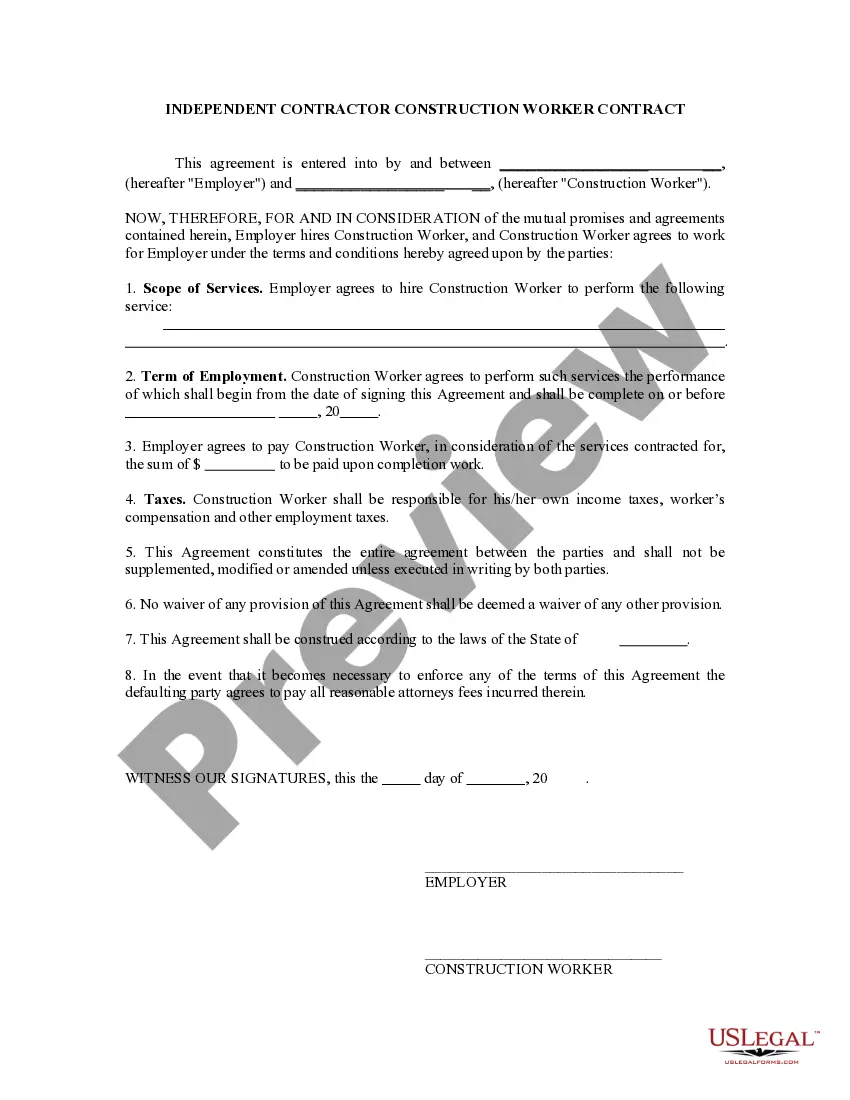
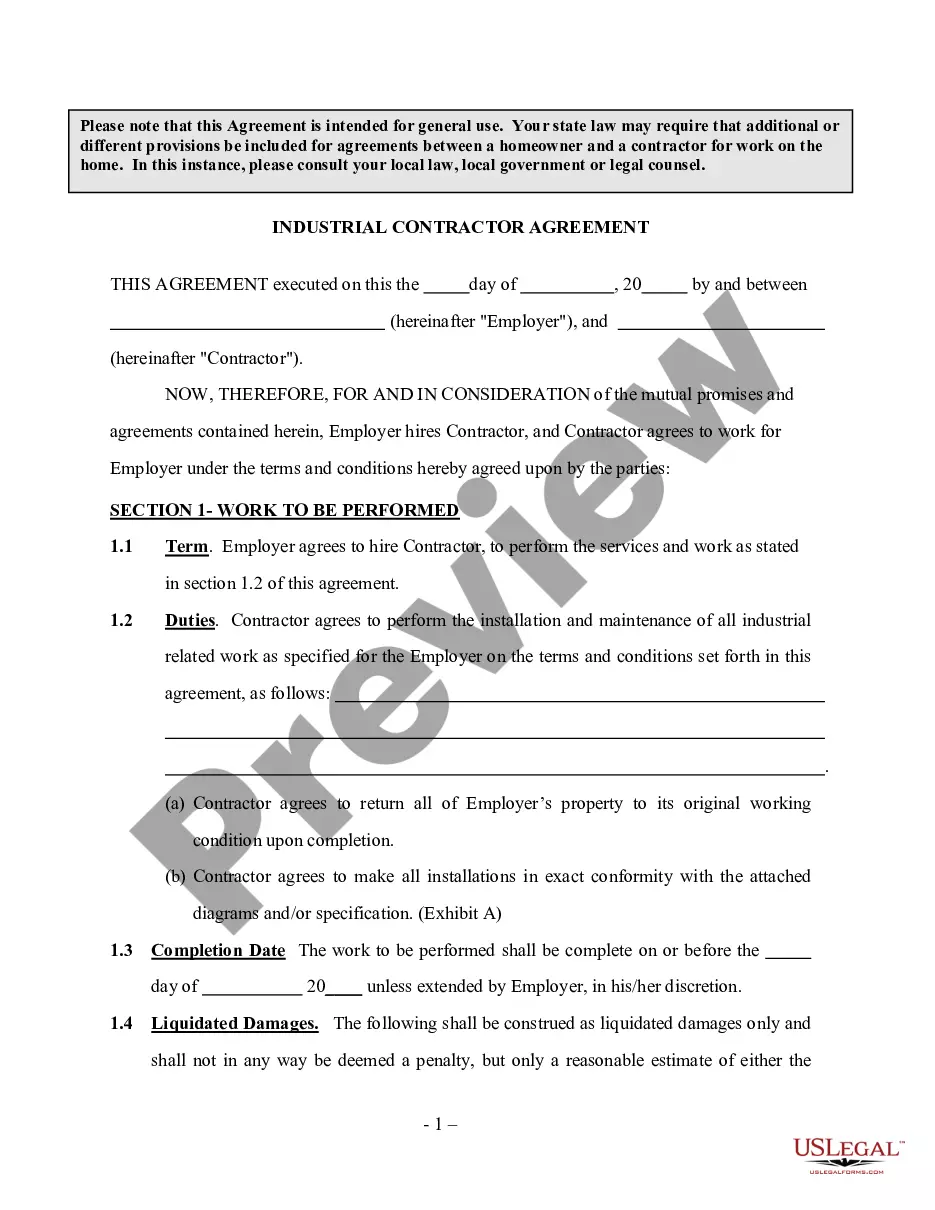
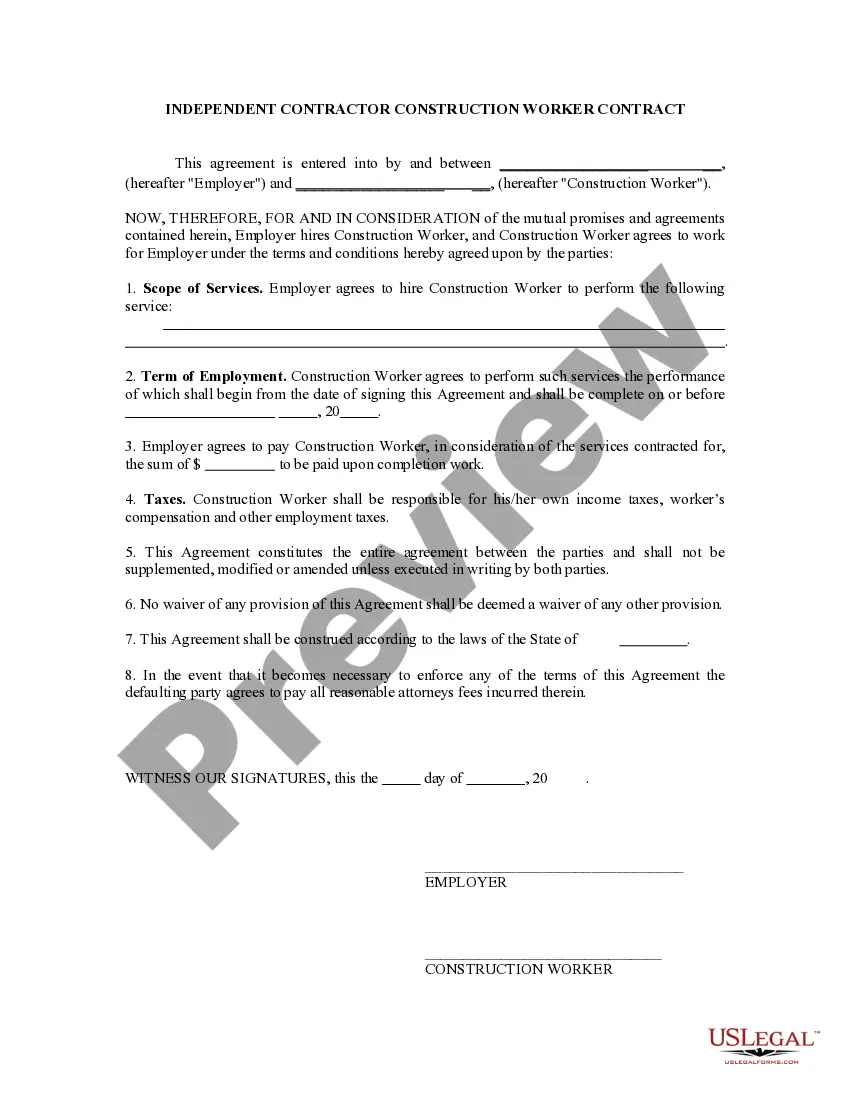
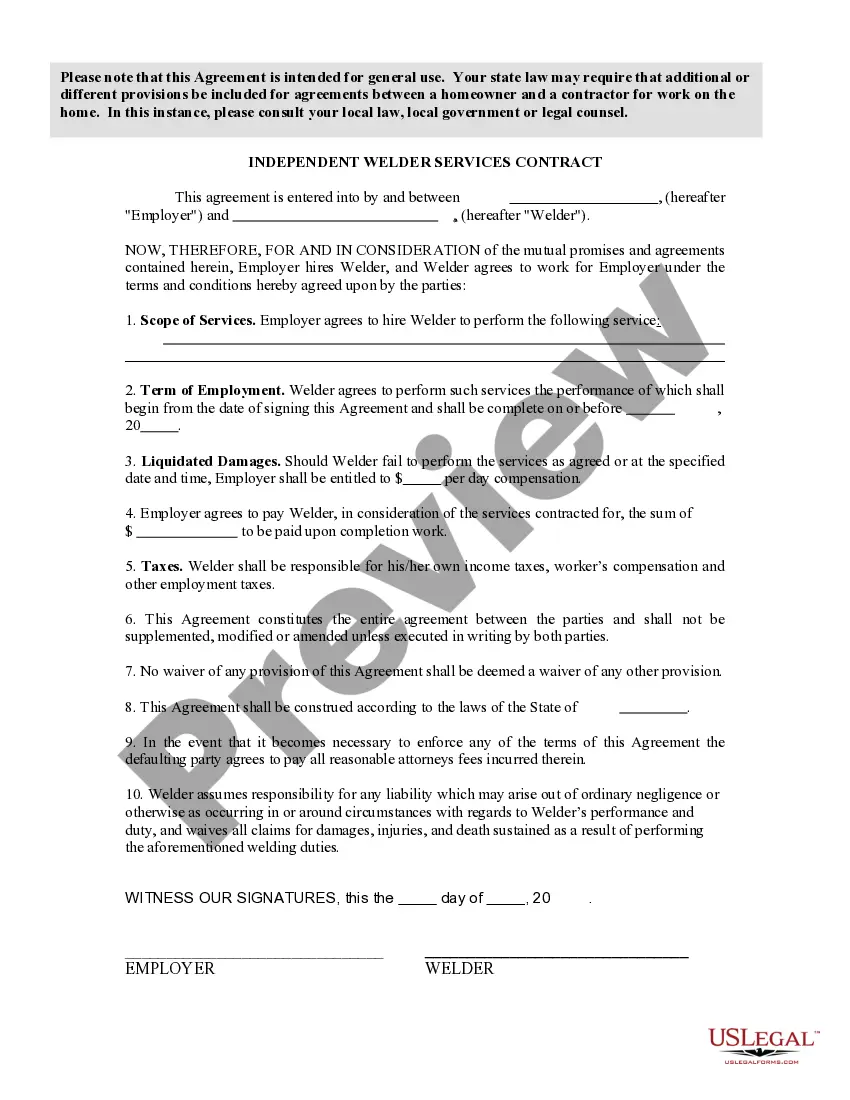
The Self-Employed Independent Contractor Construction Worker Contract is an essential legal document that formalizes the agreement between a construction worker and an employer. This contract outlines the terms for hiring the worker on a contractual basis, differentiating it from traditional employment arrangements. It clarifies the responsibilities of both parties, particularly concerning tax obligations and the nature of the work performed.
Key components of this form
- Identification of parties: Clearly states the names of the employer and the construction worker.
- Terms and conditions: Outlines specific duties and expectations for the construction worker.
- Tax responsibilities: Specifies that the worker is responsible for their own taxes, including income and workers' compensation taxes.
- Modification clause: States that any changes to the agreement must be made in writing and signed by both parties.
- Waiver clause: Clarifies that waiver of one provision does not imply waiver of other provisions.
When this form is needed
This contract is used when an employer wishes to hire a construction worker as an independent contractor rather than an employee. Scenarios include hiring labor for specific projects, repairs, or renovations where the worker operates independently and is not entitled to employee benefits. It is also beneficial when a business requires flexibility in staffing for temporary construction work.
Who should use this form
- Employers in the construction industry seeking to hire independent contractors.
- Self-employed construction workers looking to formalize contracts with employers.
- Businesses that require contractual services for construction projects.
- Engaged parties wanting to clearly outline expectations and legal obligations.
Steps to complete this form
- Identify the parties: Enter the full names of the employer and the construction worker in the designated spaces.
- Describe the work: Clearly specify the type of construction services to be provided.
- Clarify payment terms: Include information about how and when the construction worker will be compensated.
- Sign and date: Ensure both parties sign and date the agreement to make it legally binding.
- Keep a copy: Each party should retain a signed copy of the contract for their records.
Does this document require notarization?
This form does not typically require notarization to be legally valid. However, some jurisdictions or document types may still require it. US Legal Forms provides secure online notarization powered by Notarize, available 24/7 for added convenience.
Get your form ready online
Our built-in tools help you complete, sign, share, and store your documents in one place.
Make edits, fill in missing information, and update formatting in US Legal Forms—just like you would in MS Word.
Download a copy, print it, send it by email, or mail it via USPS—whatever works best for your next step.
Sign and collect signatures with our SignNow integration. Send to multiple recipients, set reminders, and more. Go Premium to unlock E-Sign.
If this form requires notarization, complete it online through a secure video call—no need to meet a notary in person or wait for an appointment.
We protect your documents and personal data by following strict security and privacy standards.

Make edits, fill in missing information, and update formatting in US Legal Forms—just like you would in MS Word.

Download a copy, print it, send it by email, or mail it via USPS—whatever works best for your next step.

Sign and collect signatures with our SignNow integration. Send to multiple recipients, set reminders, and more. Go Premium to unlock E-Sign.

If this form requires notarization, complete it online through a secure video call—no need to meet a notary in person or wait for an appointment.

We protect your documents and personal data by following strict security and privacy standards.
Typical mistakes to avoid
- Failing to clarify the scope of work can lead to disputes.
- Not specifying payment terms, which can result in confusion over compensation.
- Forgetting to include signatures, making the contract unenforceable.
- Neglecting to discuss and outline tax obligations upfront.
Why use this form online
- Easy access: Download the contract instantly and start filling it out right away.
- Editability: Customize the form with specific terms that meet your needs.
- Legality: Forms are drafted by licensed attorneys to ensure compliance with current laws.
- Convenience: No need to visit a lawyer's office; complete the process from anywhere.
What to keep in mind
- Use this contract to clearly define the working relationship between an employer and a construction worker.
- Ensure both parties understand their tax responsibilities and the scope of work.
- Always retain signed copies of the contract for administrative and legal purposes.
- Consult local laws to adhere to specific requirements that may apply in your state.
Looking for another form?



Form popularity
FAQ
Simply put, being an independent contractor is one way to be self-employed. Being self-employed means that you earn money but don't work as an employee for someone else.An independent contractor is someone who provides a service on a contractual basis.
The earnings of a person who is working as an independent contractor are subject to Self-Employment Tax. If you are an independent contractor, you are self-employed.You are not an independent contractor if you perform services that can be controlled by an employer (what will be done and how it will be done).
If you run a small business that hires 1099 contractors, also known as independent contractors, it is vital that you have them sign an independent contractor contract. This is because there is a significant gray area between who is classified as an independent contractor and who is classified as an employee.
For most types of projects you hire an independent contractor (IC) to do, the law does not require you to put anything in writing. You can meet with the IC, agree on the terms of your arrangement, and have an oral contract or agreement that is legally binding. Just because you can doesn't mean you should, however.
1. Not Having a Written Contract.The taxing, labor and employment, and insurance authorities expect a written contract that states that the worker is an independent contractor and will be paid as such with no tax withholding, no benefits, etc.
An independent contractor is not considered an employee for Form I-9 purposes and does not need to complete Form I-9.
Finally, the new stimulus bill provides independent contractors with paid sick and paid family leave benefits through March 14, 2021.Under CARES Act II, unemployed or underemployed independent contractors who have an income mix from self-employment and wages paid by an employer are still eligible for PUA.
Do employers need to complete employment verification checks for independent contractors? No.However, it is important to note that businesses and individuals may not hire independent contractors if they are aware that the independent contractor is not authorized to work in the United States.