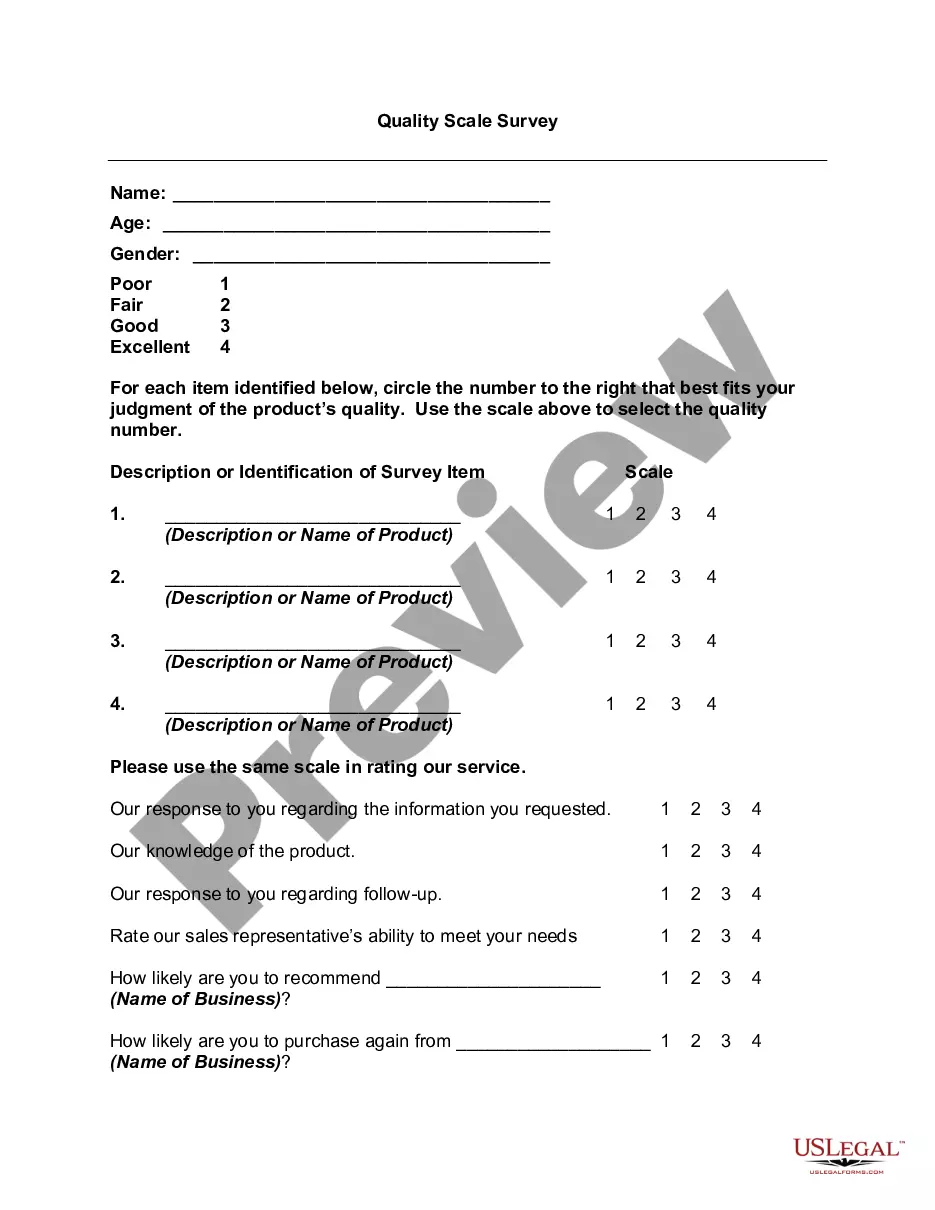
Quality Scale Survey
What is this form?
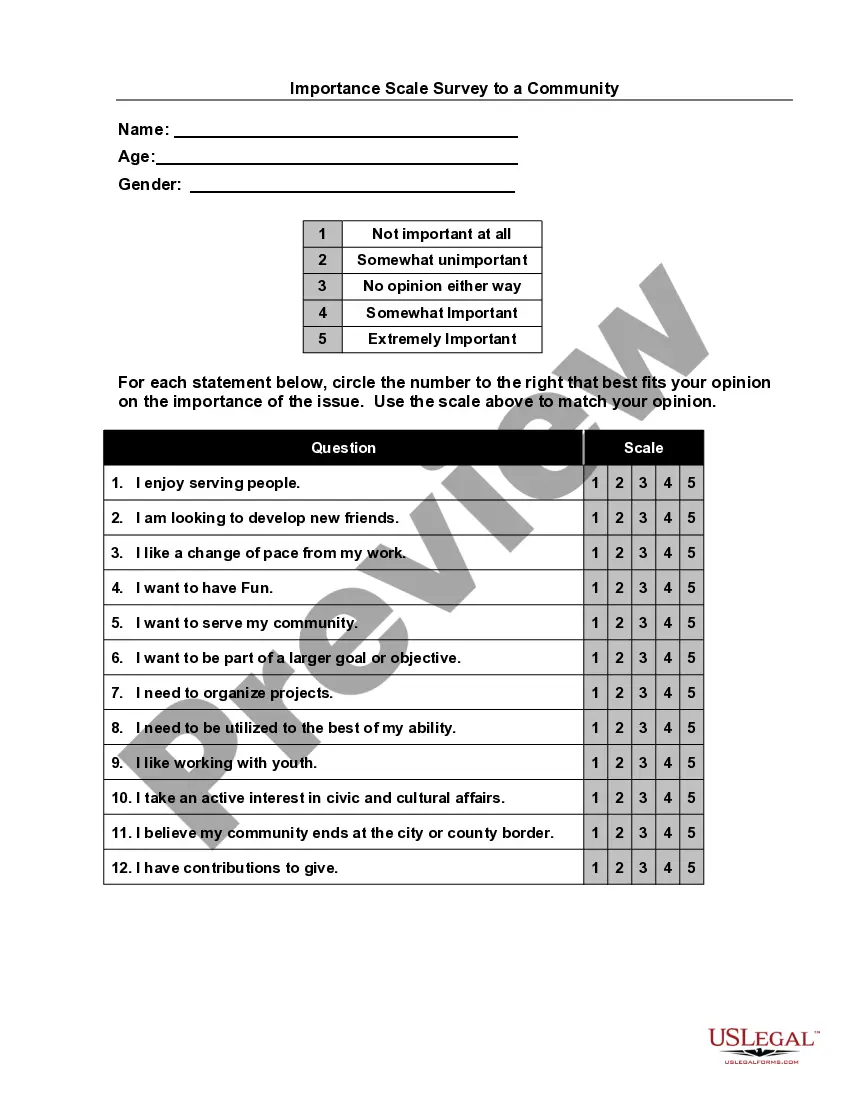
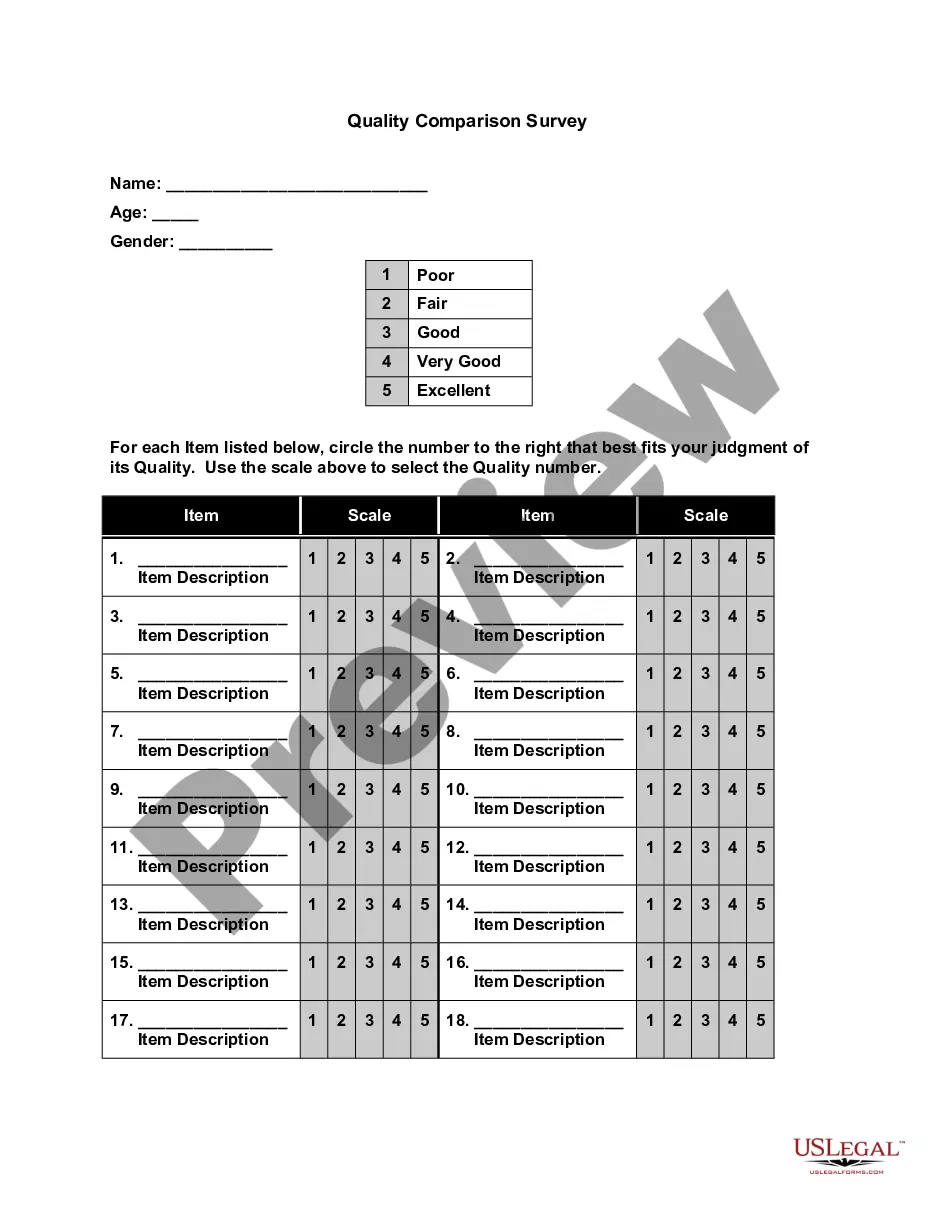
The Quality Scale Survey is a tool designed to gauge customer satisfaction regarding products and services. This form helps businesses understand their customers' experiences and identify areas for improvement, differing from generic feedback forms by using a structured rating scale. By collecting customer insights, companies can enhance their offerings and strengthen customer loyalty.
What’s included in this form
- Name and contact information of the respondent
- Demographic information such as age and gender
- Rating scale from poor to excellent for various products and services
- Specific sections for rating customer service and likelihood of recommending the business
- Space for additional comments and suggestions
When to use this form
This Quality Scale Survey should be used when businesses want to assess their customers' satisfaction levels. It is particularly useful after a product launch, following a service experience, or during regular feedback collection cycles. The insights gained from this survey can help identify trends and address any concerns that may affect customer retention.
Who needs this form
- Business owners seeking to improve customer satisfaction
- Managers looking to evaluate employee performance in terms of customer relations
- Marketing professionals interested in gathering consumer feedback on product offerings
- Service-based companies wanting to understand client experiences better
Instructions for completing this form
- Fill in your name, age, and gender at the top of the form.
- For each product or service listed, circle the number that reflects your level of satisfaction based on the provided scale.
- Rate the customer service and overall quality of your experience in the designated sections.
- Indicate your likelihood of recommending the business to others.
- Provide additional comments or suggestions if needed in the space provided.
Does this form need to be notarized?
This form does not typically require notarization to be legally valid. However, some jurisdictions or document types may still require it. US Legal Forms provides secure online notarization powered by Notarize, available 24/7 for added convenience.
Get your form ready online
Our built-in tools help you complete, sign, share, and store your documents in one place.
Make edits, fill in missing information, and update formatting in US Legal Forms—just like you would in MS Word.
Download a copy, print it, send it by email, or mail it via USPS—whatever works best for your next step.
Sign and collect signatures with our SignNow integration. Send to multiple recipients, set reminders, and more. Go Premium to unlock E-Sign.
If this form requires notarization, complete it online through a secure video call—no need to meet a notary in person or wait for an appointment.
We protect your documents and personal data by following strict security and privacy standards.

Make edits, fill in missing information, and update formatting in US Legal Forms—just like you would in MS Word.

Download a copy, print it, send it by email, or mail it via USPS—whatever works best for your next step.

Sign and collect signatures with our SignNow integration. Send to multiple recipients, set reminders, and more. Go Premium to unlock E-Sign.

If this form requires notarization, complete it online through a secure video call—no need to meet a notary in person or wait for an appointment.

We protect your documents and personal data by following strict security and privacy standards.
Common mistakes to avoid
- Leaving sections unanswered, which can limit the feedback quality.
- Not providing specific comments to clarify ratings.
- Using the scale inconsistently, making results difficult to interpret.
Why complete this form online
- Ease of distribution and completion from any device.
- Improved accuracy with standardized rating scales.
- Efficient data collection that can be analyzed quickly.
Legal use & context
- This form is a standard customer feedback mechanism and does not have legal binding implications.
- Feedback collected may be used for internal assessments and to enhance customer satisfaction strategies.
Quick recap
- The Quality Scale Survey is essential for understanding customer experiences.
- It should be used regularly to gather actionable feedback.
- Clear and specific ratings help businesses identify strengths and weaknesses.
Looking for another form?


Form popularity
FAQ
Examples include age, income, price, costs, sales revenue, sales volume and market share. More than one rating scale question is required to measure an attitude or perception due to the requirement for statistical comparisons between the categories in the polytomous Rasch model for ordered categories.
Clarify the endpoints (the labels for 1 and 5) of your scale. Include both sides of the scale in your question, as well as in the endpoint fields. 1 should always be the pain point of the scale, and 5 should always be the positive point.
Psychologists have used the balanced 6-point scale in millions of surveys over more than a hundred years, and it has proven to be extremely effective in gathering actionable, useful information from a customer survey.
5 points (Pass) Excellent. Exceptional. Mastery. Much more than acceptable.
Rating scale is defined as a closed-ended survey question used to represent respondent feedback in a comparative form for specific particular features/products/services. It is one of the most established question types for online and offline surveys where survey respondents are expected to rate an attribute or feature.
4 point Likert scale is basically a forced Likert scale. The reason it is named as such is that the user is forced to form an opinion. There is no safe 'neutral' option. Ideally a good scale for market researchers, they make use of the 4 point scale to get specific responses. Pros of a 4 Point scale.
In rating scale questions (sometimes referred to as ordinal questions), the question displays a scale of answer options from any range (0 to 100, 1 to 10, etc.). The respondent selects the number that most accurately represents their response. Net Promoter Score® questions are a good example of rating scale questions.