Quality Comparison Survey
About this form
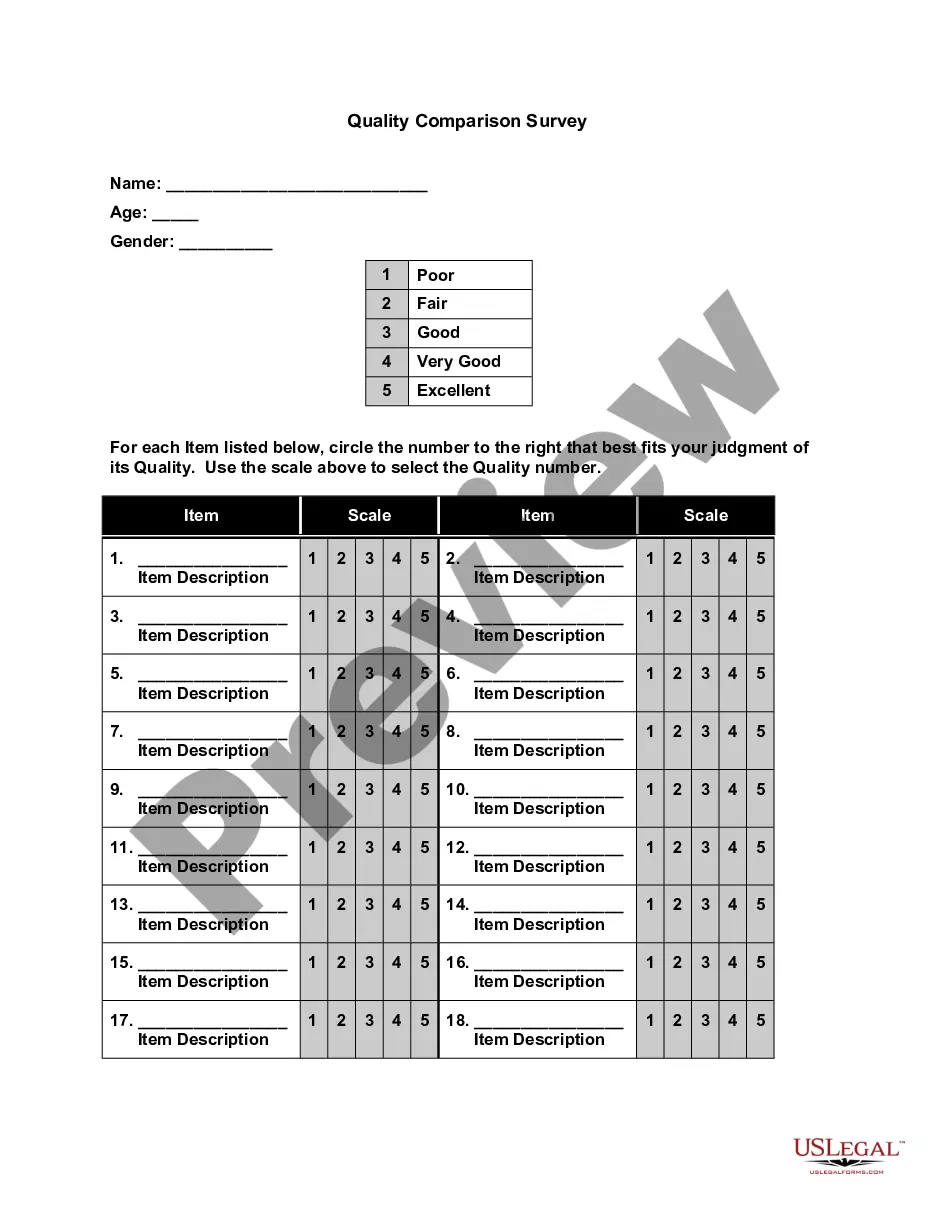
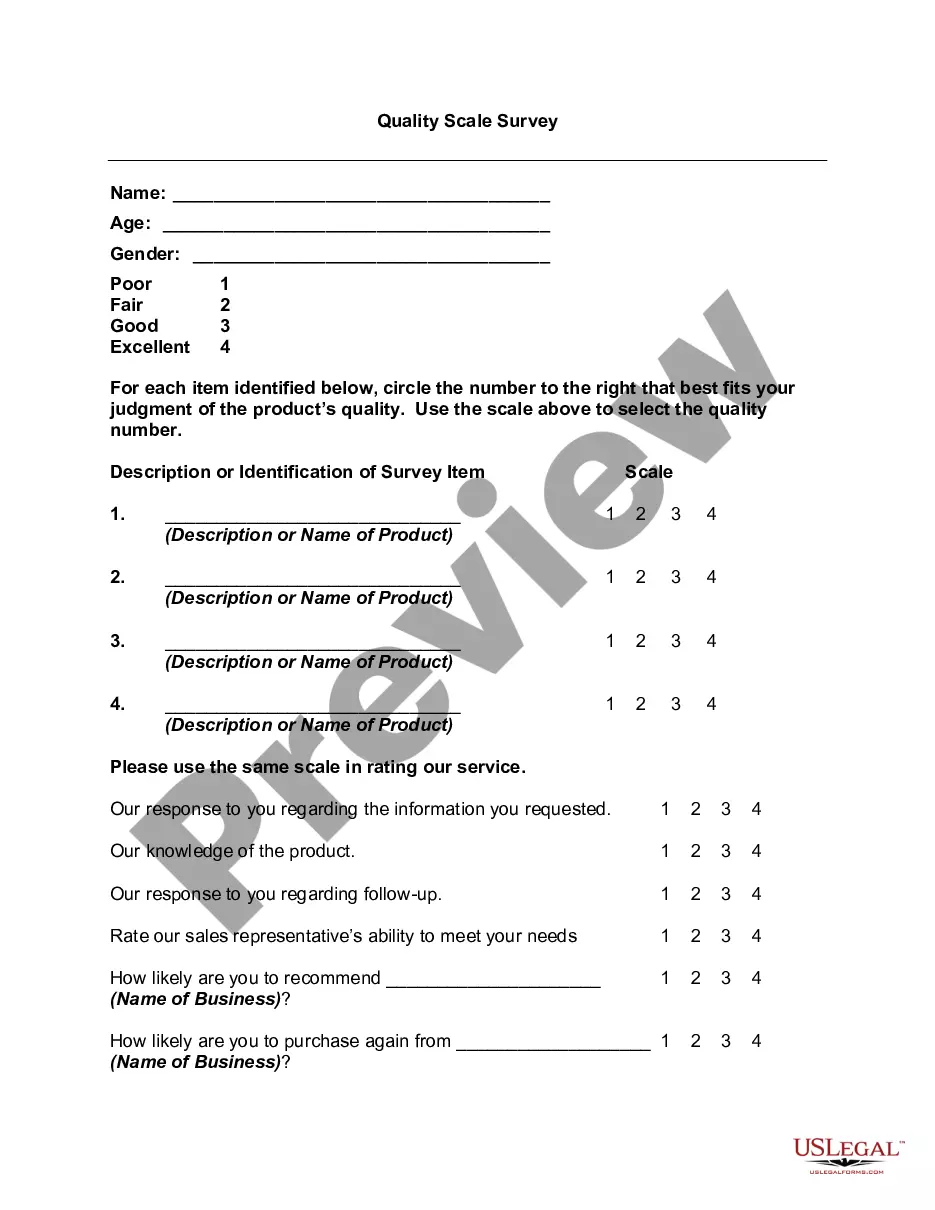
The Quality Comparison Survey is a legal template designed to assist in gathering feedback about the quality of a product or service. This form allows users to quantify their evaluations using a standard rating scale, enabling businesses to compare different items effectively. Unlike similar forms, the Quality Comparison Survey focuses specifically on structured comparisons, making it an essential tool for reviews and feedback collection.
Key parts of this document
- Personal information fields: Name, age, and gender
- Rating scale: Options ranging from Poor to Excellent (1 to 5)
- Item descriptions: Space to list multiple items for comparison
- Individual rating sections for each item
Common use cases
This survey form is useful in various scenarios, such as collecting customer feedback on products after purchase, evaluating services in a focus group setting, or assessing overall quality for performance reviews. Organizations can also utilize this form during product launches, service evaluations, or market research to gather quantifiable data on customer satisfaction.
Who needs this form
- Businesses seeking customer feedback on their products or services
- Market researchers conducting surveys for comparative analysis
- Service providers aiming to understand client satisfaction levels
- Organizations that need structured feedback for evaluations or improvements
Instructions for completing this form
- Fill in your name, age, and gender at the top of the form.
- Review the rating scale provided (from Poor to Excellent).
- List the items you wish to evaluate in the designated space.
- Circle the number that corresponds to your judgment of each item's quality.
- Ensure all items are rated before submitting the survey.
Is notarization required?
This form does not typically require notarization unless specified by local law. Always confirm local requirements to ensure compliance.
Get your form ready online
Our built-in tools help you complete, sign, share, and store your documents in one place.
Make edits, fill in missing information, and update formatting in US Legal Forms—just like you would in MS Word.
Download a copy, print it, send it by email, or mail it via USPS—whatever works best for your next step.
Sign and collect signatures with our SignNow integration. Send to multiple recipients, set reminders, and more. Go Premium to unlock E-Sign.
If this form requires notarization, complete it online through a secure video call—no need to meet a notary in person or wait for an appointment.
We protect your documents and personal data by following strict security and privacy standards.

Make edits, fill in missing information, and update formatting in US Legal Forms—just like you would in MS Word.

Download a copy, print it, send it by email, or mail it via USPS—whatever works best for your next step.

Sign and collect signatures with our SignNow integration. Send to multiple recipients, set reminders, and more. Go Premium to unlock E-Sign.

If this form requires notarization, complete it online through a secure video call—no need to meet a notary in person or wait for an appointment.

We protect your documents and personal data by following strict security and privacy standards.
Common mistakes
- Forgetting to rate all items listed.
- Leaving personal information incomplete.
- Misunderstanding the rating scale, which may lead to inaccurate feedback.
Why use this form online
- Convenient access: Download and fill out the form anytime.
- High-quality templates crafted by licensed attorneys to ensure compliance.
- Editable format allows for customized item descriptions and ratings.
- The survey results can be used for improving products and customer service.
- Feedback collected is generally anonymous unless personal information is required.
- Using a standardized scale facilitates comparison across different items or services.
Quick recap
- The Quality Comparison Survey helps collect structured feedback on products and services.
- It is crucial for businesses to gauge customer satisfaction and make informed improvements.
- This form is usable across various jurisdictions with no specific notarization requirements.
Looking for another form?




Form popularity
FAQ
Use Simple, Direct Language. Be Specific. Break Down Big Ideas into Multiple Questions. Avoid Leading Questions. Ask One Thing per Question. Use More Interval Questions.
Once someone knows that you like to receive feedback, it gets easier, she says. She also makes it a practice to ask specific questions like: How effective would you rate my leadership style? or How do you think I could have handled situation X better? she says. It usually results in more constructive feedback.
Did we meet your expectations? How would you rate your interaction with our employees? Was it easy to find what you were looking for? Was it easy to purchase your item or service? How likely are you to repeat your business with us?
Online surveys: One of the most popular types is an online survey. Paper surveys: As the name suggests, this survey uses the traditional paper and pencil approach. Telephonic Surveys: Researchers conduct these over telephones. One-to-One interviews:
The quality of a survey is of prime importance for accurate, reliable and valid results.Establishment of effective and efficient strategies towards improvement of the quality of a survey will help achieve the timely collection of high-quality data and the validity of the results.
Most research can be divided into three different categories: exploratory, descriptive and causal. Each serves a different end purpose and can only be used in certain ways.
Quality of life survey questions are defined as a set of survey questions that are asked to a survey respondent to collect feedback about the general well-being and happiness or unhappiness quotient about life.These surveys are generally used by government bodies, NGO's, schools or other governing authorities.
CSAT stands for customer satisfaction and is a score that indicates how satisfied a customer is with a specific product, transaction, or interaction with a company. The term CSAT is most often used in the context of a CSAT score, which describes a numerical measure of customer satisfaction.
How do you use our product/service? What would persuade you to use our product more often? What's the one thing our product is missing?